Flashback Friday: The Physick Book of Deliverance Dane

ffbutton2Flashback Friday is a weekly tradition started here at Bookshelf Fantasies, focusing on showing some love for the older books in our lives and on our shelves. If you’d like to join in, just pick a book published at least five years ago, post your Flashback Friday pick on your blog, and let us all know about that special book from your reading past and why it matters to you. Don’t forget to link up!

My Flashback Friday pick this week:

The Physick Book of Deliverance Dane

The Physick Book of Deliverance Dane by Katherine Howe
(published 2009)

This week’s book just barely makes the 5-year requirement for Flashback Friday!

Synopsis (Goodreads):

Harvard graduate student Connie Goodwin needs to spend her summer doing research for her doctoral dissertation. But when her mother asks her to handle the sale of Connie’s grandmother’s abandoned home near Salem, she can’t refuse. As she is drawn deeper into the mysteries of the family house, Connie discovers an ancient key within a seventeenth-century Bible. The key contains a yellowing fragment of parchment with a name written upon it: Deliverance Dane. This discovery launches Connie on a quest–to find out who this woman was and to unearth a rare artifact of singular power: a physick book, its pages a secret repository for lost knowledge.

As the pieces of Deliverance’s harrowing story begin to fall into place, Connie is haunted by visions of the long-ago witch trials, and she begins to fear that she is more tied to Salem’s dark past then she could have ever imagined.

Written with astonishing conviction and grace, The Physick Book of Deliverance Dane travels seamlessly between the witch trials of the 1690s and a modern woman’s story of mystery, intrigue, and revelation.

Katherine Howe’s first novel, The Physick Book of Deliverance Dane, delivers in so many ways! In part, it’s the story of an intelligent woman pursuing an intellectual puzzle as she attempts to move her academic career forward. It’s also the story of this woman’s search for hidden truths about her family’s past. As Connie uncovers clue after clue, we see family history unfold in one generation of remarkable women after another — until the past finally collides with the present in shocking and unexpected ways.

I really enjoyed the balance of the historical and modern elements of the story, and the academic setting works well in combination with an exploration of mysterious forces and powers. Readers who were captivated by Deborah Harkness’s A Discovery of Witches may want to check out Deliverance Dane as well!

What flashback book is on your mind this week?

Note from your friendly Bookshelf Fantasies host: To join in the Flashback Friday fun:

  • Grab the Flashback Friday button
  • Post your own Flashback Friday entry on your blog (and mention Bookshelf Fantasies as the host of the meme, if you please!)
  • Leave your link in the comments below
  • Check out other FF posts… and discover some terrific hidden gems to add to your TBR piles!

♥♥♥♥♥♥♥♥

Do you host a book blog meme? Do you participate in a meme that you really, really love? I’m building a Book Blog Meme Directory, and need your help! If you know of a great meme to include — or if you host one yourself — please drop me a note on my Contact page and I’ll be sure to add your info!

Book Review: Ghost Train to New Orleans by Mur Lafferty

Book Review: Ghost Train to New Orleans by Mur Lafferty

The Ghost Train to New Orleans (The Shambling Guides, #2)Ghost Train to New Orleans is the second book in the Shambling Guides series — and if you enjoyed the first book, you’ll want to read this one as well.

The series, which starts with The Shambling Guide to New York (reviewed here), tells the story of Zoe Norris, a nice ordinary travel writer who takes a job working for a publisher that specializes in travel guides for the non-human set. Be warned: The proper term for these folks is “coterie” — definitely do not refer to them as monsters! Among Zoe’s colleagues are vampires, zombies, incubi and succubi, goddesses and dragons… and it seems that every time Zoe turns a corner, she discovers some new type of coterie, much to her amazement.

In Ghost Train to New Orleans, Zoe and her team head off to the Big Easy (via the titular Ghost Train — which is in fact quite literally a ghost train). Their mission is to write their next travel book — but first, they need to survive. Among the big revelations here is the fact that Zoe is no mere human: She’s a rare human coterie known as a citytalker — and again, take that term literally. Zoe has the ability to form a psychic (or spiritual) bond with a city, so that the city can speak to her. The problem is, Zoe has has no training on how to use her gift, and could badly use a mentor before she gets into her usual heaps of trouble.

The tongue-in-cheek narration that provides a lot of the series’ charm is back in book 2:

She liked her coworkers, mostly, but was always acutely aware that many saw her as a meal they weren’t allowed to touch.

Also back is the vast array of scary creatures who might possibly want to help Zoe, but who are just as likely to put her in mortal danger. Added to that, Zoe’s boyfriend is on the verge of zombiehood, her closest ally, a water sprite, is missing, and her previous mentor has formed a seemingly permanent melding with the city of New York, and it’s clear to see that Zoe needs to stay on her toes.

In Ghost Train to New Orleans, the mythology of the series is further developed, with new and different supernatural beings, a lot of historical backstory for citytalkers like Zoe, and some new rules regarding ghosts, possessions, demons, and more. New Orleans itself adds a nice flavor, and it’s quite fun to see city landmarks woven into the fabric of the coterie world. Likewise, the author quite inventively works Hurricane Katrina into the supernatural narrative in a way that feels organic to the story, so that the damage to New Orleans is integral to the ability of the city to communicate with Zoe — and factors into just how the city treats Zoe once they’ve connected.

The narrative zooms along from one action sequence to another, and Zoe’s perspective is as wry and snarky as always. Even when lives are at stake, the tone is zippy and energetic, and never veers too long into serious or weighty territory without a well-placed smart-ass comment or two to steer things back into the quirky groove.

I did notice quite a few instances of awkward phrasings and wording errors (for example, the use of “ascent” in a place where only “descent” actually makes sense), and had to wonder whether it was the writing or the editing that was problematic — was there a rush to publication that resulted in these types of seemingly careless errors? I normally wouldn’t make too much of this sort of thing, but it happens enough in Ghost Train to actually be distracting, and therefore is worth noting.

Putting that aside, Ghost Train to New Orleans is a good follow-up installment, and succeeds at maintaining the through-story while introducing new elements and laying the groundwork for future adventures. Some answers are provided, but even more new dilemmas and mysteries are introduced, and that’s just the right mix for a 2nd book in what appears to be an open-ended, ongoing series. I’m intrigued enough — and having enough fun — that I’ll be back for more. I didn’t see anything on the author’s website confirming a 3rd book, but based on the wrap-up of Ghost Train, it’s clear that there are more travels in store for Zoe and her team… and I’d guess lots more trouble (and scary new coterie) as well.

_________________________________________

The details:

Title: Ghost Train to New Orleans
Author: Mur Lafferty
Publisher: Orbit
Publication date: March 4, 2014
Length: 352 pages
Genre: Urban fantasy
Source: Library


Thursday Quotables: The Serpent of Venice

quotation-marks4

Welcome back to Thursday Quotables! This weekly feature is the place to highlight a great quote, line, or passage discovered during your reading each week.  Whether it’s something funny, startling, gut-wrenching, or just really beautifully written, Thursday Quotables is where my favorite lines of the week will be, and you’re invited to join in!

The Serpent of Venice

The Serpent of Venice by Christopher Moore
(to be released April 22, 2014)

Dying in his cellar and being eaten by rats was not enough punishment for Brabantio. For the first time I hoped that there was an afterlife, and he could look up through the sulfurous clouds of Hell to watch me unwind his plots, drain his power, and extinguish the light of his legacy.

Intense, right? On a lighter note:

“Cry havoc, and let slip the trousers of most outrageous bonkilation!” said the queen, throwing off the sash of her gown and stepping out of it. “Off with your kit, fool!”

What lines made you laugh, cry, or gasp this week? Do tell!

If you’d like to participate in Thursday Quotables, it’s really simple:

  • Write a Thursday Quotables post on your blog. Try to pick something from whatever you’re reading now. And please be sure to include a link back to Bookshelf Fantasies in your post (http://www.bookshelffantasies.com), if you’d be so kind!
  • Leave your link in the comments — or, if you have a quote to share but not a blog post, you can leave your quote in the comments too!
  • Visit other linked blogs to view their Thursday Quotables, and have fun!

Wishing & Waiting on Wednesday: Conversion

There’s nothing like a Wednesday for thinking about the books we want to read! My Wishing & Waiting on Wednesday post is linking up with two fabulous book memes, Wishlist Wednesday (hosted by Pen to Paper) and Waiting on Wednesday (hosted by Breaking the Spine).

My most wished-for book this week is:

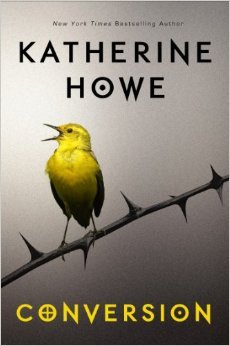
Conversion

Conversion by Katherine Howe
(Release date: July 1, 2014)

Synopsis via NetGalley:

It’s senior year at St. Joan’s Academy, and school is a pressure cooker. College applications, the battle for valedictorian, deciphering boys’ texts: Through it all, Colleen Rowley and her friends are expected to keep it together. Until they can’t.

First it’s the school’s queen bee, Clara Rutherford, who suddenly falls into uncontrollable tics in the middle of class. Her mystery illness quickly spreads to her closest clique of friends, then more students and symptoms follow: seizures, hair loss, violent coughing fits. St. Joan’s buzzes with rumor; rumor blossoms into full-blown panic.

Soon the media descends on Danvers, Massachusetts, as everyone scrambles to find something, or someone, to blame. Pollution? Stress? Or are the girls faking? Only Colleen—who’s been reading The Crucible for extra credit—comes to realize what nobody else has: Danvers was once Salem Village, where another group of girls suffered from a similarly bizarre epidemic three centuries ago . . .

Inspired by true events—from seventeenth-century colonial life to the halls of a modern-day high school—Conversion casts a spell. With her signature wit and passion, New York Times bestselling author Katherine Howe delivers an exciting and suspenseful novel, a chilling mystery that raises the question, what’s really happening to the girls at St. Joan’s?

Katherine Howe’s first novel, The Physick Book of Deliverance Dane, is one of my go-to books when it comes to both academic settings and modern-day connections to witchcraft. Conversion is this author’s first young adult novel, and I think it sounds pretty terrific. The book blurbs describe it as Prep meets The Crucible” — and that’s enough right there to make me want to read it!

What are you wishing for this Wednesday?

Looking for some bookish fun on Thursdays and Fridays? Come join me for my regular weekly features, Thursday Quotables and Flashback Friday! You can find out more here — come share the book love!

♥♥♥♥♥♥♥♥

Do you host a book blog meme? Do you participate in a meme that you really, really love? I’m building a Book Blog Meme Directory, and need your help! If you know of a great meme to include — or if you host one yourself — please drop me a note on my Contact page and I’ll be sure to add your info!

Top Ten Tuesday: Top Ten Most Unique Books I’ve Read… in 5 words or less*

fireworks2

Top Ten Tuesday is a meme hosted by The Broke and the Bookish, featuring a different top 10 theme each week. This week’s topic focuses on books that we consider unique. I had a hard time narrowing it down to a manageable list, until I decided on a guiding principle: To make the list, I had to be able to come up with a “tagline” of 3 – 5 words that captures the spirit of what makes the book unique.

Without further ado, my list of unique books… in 5 words or less!

1) The Sparrow by Mary Doria Russell: Jesuits in Space!

the sparrow

2) Lamb: The Gospel According to Biff, Christ’s Childhood Pal by Christopher Moore: Jesus’s Wacky Sidekick!

lamb

3) Room by Emma Donoghue: Five-Year-Old Narrator!

room

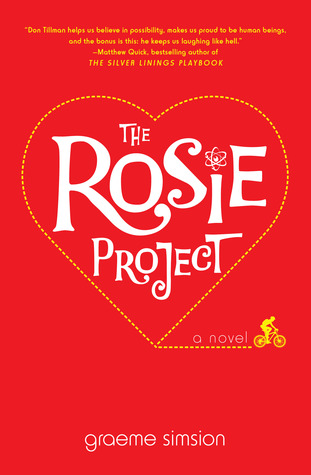
4) The Rosie Project by Graeme Simsion: Love, Quirks, and Lobster!

rosie

5) The Time Traveler’s Wife by Audrey Niffenegger: Disappearing Husbands Are A Pain!

TTW

6) Grasshopper Jungle by Andrew Smith: Apocalypse By Praying Mantis!

grasshopper jungle

7) The Golem and the Jinni by Helene Wecker: Mythical Creatures Take New York!

golem

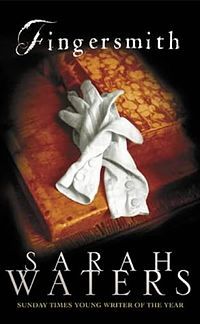
8) Fingersmith by Sara Waters: Con Artists Need Love Too!

fingersmith

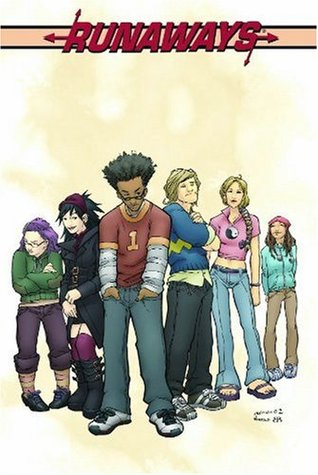
9) Runaways by Brian K. Vaughan: Evil Parents Suck! Teens Rule!

runaways

10) Every Day by David Levithan: Different Day, Different Body! (Whoa…)

every day

What are the most unique books that you’ve read? Share your links, and I’ll come check out your top 10!

*Yeah, yeah, I know… but “5 words or fewer” just doesn’t have the same ring to it, does it?

If you enjoyed this post, please consider following Bookshelf Fantasies! And don’t forget to check out our regular weekly features, Thursday Quotables and Flashback Friday. Happy reading!

♥♥♥♥♥♥♥♥

Do you host a book blog meme? Do you participate in a meme that you really, really love? I’m building a Book Blog Meme Directory, and need your help! If you know of a great meme to include — or if you host one yourself — please drop me a note on my Contact page and I’ll be sure to add your info!


The Monday Agenda 4/7/2014

MondayAgendaNot a lofty, ambitious to-be-read list consisting of 100+ book titles. Just a simple plan for the upcoming week — what I’m reading now, what I plan to read next, and what I’m hoping to squeeze in among the nooks and crannies.

How did I do with last week’s agenda?

The No. 1 Ladies' Detective Agency  (No. 1 Ladies' Detective Agency #1)The Mapmaker's DaughterThe Ghost Train to New Orleans (The Shambling Guides, #2)

The No. 1 Ladies’ Detective Agency by Alexander McCall Smith: Done! My review is here.

The Mapmaker’s Daughter by Laurel Corona: Done! My review is here.

The Ghost Train to New Orleans by Mur Lafferty: I’ve read about half of this very entertaining urban fantasy novel (sequel to The Shambling Guide to New York City, reviewed here), and it’s a ton of fun so far.

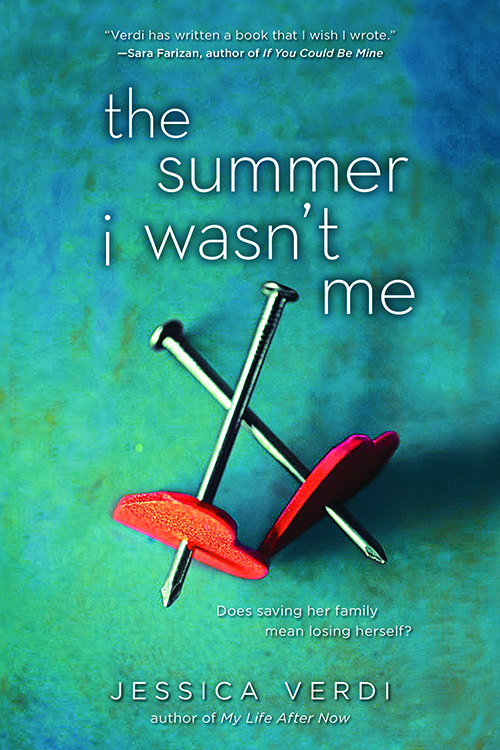
summeriwasn'tI posted my review and blog tour feature for The Summer I Wasn’t Me by Jessica Verdi. The author was kind enough to participate in a Q&A, even answering my dorkier questions! Check the post out here, and be sure to enter the giveaway for this terrific book!


Fresh Catch:

A few new ARCs came my way this week that look pretty awesome:

What’s on my reading agenda for the coming week?

The Serpent of VeniceLove Letters to the DeadFar From You

Once I finish The Ghost Train to New Orleans by Mur Lafferty, I have big plans!

I’m looking forward to starting The Serpent of Venice, Christopher Moore’s upcoming new release (and sequel to his hilarious Fool).

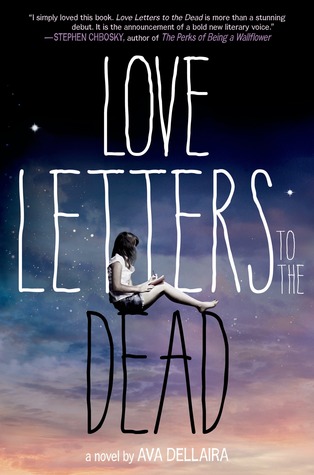
If I can squeeze in a couple more this week, then I’ll devote some time to catching up on review books, starting with Love Letters to the Dead by Ava Dellaira and then Far From You by Tess Sharpe.

Random pop culture goodness:

It’s the return of Game of Thrones!

And a very sad good-bye to Being Human.

Being Human Apr3

I’m going to miss these crazy kids.


But at least this week’s Grimm finally answered a question viewers have been asking for three years: How do Wesen spot a Grimm? Inquiring minds want to know.

[Update: Oops! Looks like the video clip that used to live right here is gone from YouTube. Alas…}

Oh, TV, you give and you take…

And also in the works:

echoThe Outlander Book Club’s re-read of An Echo in the Bone by Diana Gabaldon continues! Coming up this week: Chapters 59 – 63. Want to join in? Contact me and I’ll provide all the details!

So many book, so little time…

That’s my agenda. What’s yours? Add your comments to share your bookish agenda for the week.

boy1

Book Review: The Mapmaker’s Daughter by Laurel Corona

Book Review: The Mapmaker’s Daughter by Laurel Corona

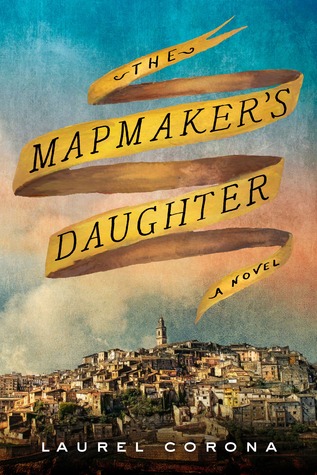
The Mapmaker's DaughterIn Sevilla, Spain in 1432, Amalia Cresques is the young daughter of a famous cartographer, whose own father was renowned for his cartography skills as well. But the family has a secret: Amalia, her sisters, and her parents conceal their Jewish heritage by living as conversos — Jews who have converted to Catholicism for the sake of survival, but who secretly practice their own religion in hiding. Amalia makes sure to be seen with dirty hands as the Jewish Sabbath approaches on Friday afternoons and buys pork and ham at the butcher shop, so that no prying neighbors can accuse the family of “Judaizing”, a crime that carries harsh punishments if caught.

In The Mapmaker’s Daughter, we follow Amalia from 1432, when she is a little girl of six, through 1492 when, as an old woman, she and her remaining family must leave the land they love as part of the Jewish expulsion from Spain ordered by King Ferdinand and Queen Isabella. Along the way, we view the life of this one woman as well as the shared experiences of the Jews of Spain and Portugal — experiences including forced conversions, hidden identities, persecution, scapegoating, ghettos, and finally banishment.

Amalia is raised from an early age to cherish her heritage, but at the same time to keep it as her most closely guarded secret. Once she and her father move to Portugal in order to accept a court appointment, Amalia begins to explore what it might mean to be more open about her religion, and ultimately finds refuge with an openly Jewish family, the Abravanels, who are esteemed by the Jewish community and who have a great influence at court. With the Abravanels, Amalia is able to embrace the rhythms and rituals of Jewish life, as well as to find a place as an adopted daughter and cherished family member.

And yet, danger is never far away. The fear of persecution is ever-present, and the risks become even greater as Torquemada’s Inquisition grows in power, threatening everyone and everything dear to Amalia.

The Mapmaker’s Daughter covers a period of history that’s both fascinating and frightening. Already familiar with the general history of the time, I still found much to learn from this book. As with all good historical fiction, The Mapmaker’s Daughter makes real events tangible by introducing us to them through the eyes of a character we care about a great deal, which only serves to heighten the impact of the great and awful circumstances that Amalia encounters.

Amalia herself is an interesting character, strong in her convictions, aching for love and connection, never giving up on her inner truths even when they put her at great risk. Desperate for passion and belonging, Amalia’s love life is not easy, but does lead to some remarkable adventures and experiences. Amalia serves as her father’s right hand during her youth, and becomes a skilled polyglot and translator, later an adept poet and tutor, and refuses to take the easier paths available to women at that time. Above all, Amalia believes in her own personal family heritage as well as the heritage of the Jewish people, and holds on to her family’s great atlas, created by her father and grandfather, as a symbol of where she came from and her family’s roots in Spain.

The story as a whole is quite interesting and moving, and yet I found it hard at times to feel emotionally connected. Perhaps this is because the earliest parts of the book are told through the eyes of Amalia as a very young girl, starting at age six, and her narrative voice doesn’t feel entirely true for her age. The pacing of the novel is somewhat problematic: We spend quite a lot of time on Amalia’s childhood, youth, and 20s, then rush through the remainder of her life in the last quarter of the book. This ending section is crammed full of relatives and descendants, children’s children, marriages and pursuits, and it just feels like a lot.

The Mapmaker’s Daughter is filled with historical figures — not just the nobility who are a more well-known part of the historical record, but also the characters who people Amalia’s life. The Cresques were in fact a well-known family of cartographers, and their masterwork, the Catalan Atlas, is considered one of the most important sets of maps of the period. Likewise, the Abravanels were a real family of Jewish scholars, philosophers, and royal advisers, and played a key role in the fate of the Jews of Spain and Portugal during this period. I only wish that I had had this information prior to reading the novel, rather than finding out via the extras at the end of the book. I think knowing which characters are in fact real people would have helped make the impact of the story even stronger.

Overall, I enjoyed reading The Mapmaker’s Daughter very much. The author brings to life a chapter of history that may not be well known today, but which is certainly powerful and frightening. Using such an unusual and admirable woman as a main character helps make the plight of the Jews feel real in a much more visceral way, perhaps, than just reading a straightforward history. Despite my reservations about the book’s structure and certain issues around the narrative flow, I’m very glad to have read The Mapmaker’s Daughter, and recommend it for fans of historical fiction, particularly those who enjoy reading about time periods less heavily represented in popular literature and learning about the struggles of real people.

________________________________________

The details:

Title: The Mapmaker’s Daughter
Author: Laurel Corona
Publisher: Sourcebooks Landmark
Publication date: March 1, 2014
Length: 360 pages
Genre: Historical fiction
Source: Review copy courtesy of Sourcebooks Landmark via Netgalley

Blog Tour, Author Q&A, & Giveaway: The Summer I Wasn’t Me by Jessica Verdi

Thank you, Sourcebooks Fire, for inviting me to be a part of the blog tour celebrating the release of The Summer I Wasn’t Me!

(And psssst — don’t miss the link for the giveaway at the bottom of the page!)
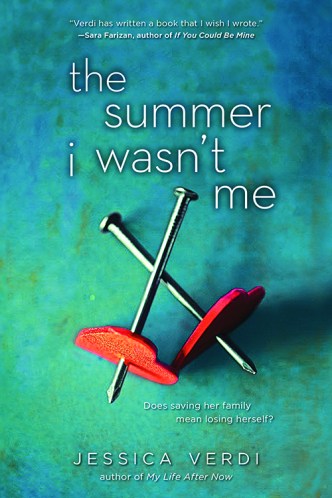
summeriwasn't

The Summer I Wasn’t Me
By Jessica Verdi
Sourcebooks Fire
Release date: April 1, 2014

Lexi has a secret…

Ever since her mom found out she was in love with a girl, seventeen-year-old Lexi’s afraid that what’s left of her family is going to fall apart for good.

You are on the road to truth. Help is on the way.

The road signs leading to New Horizons summer camp promise a new life for Lexi—she swears she can change. She can learn to like boys. But denying her feelings is harder than she thinks. And when she falls heads over heels for one of her fellow campers, Lexi will have to risk her mother’s approval for the one person who might love her no matter what.

I’m thrilled to be participating in the blog tour for this terrific young adult novel! Author Jessica Verdi was kind enough to answer my rambling questions for a Q&A:

What inspired you to write this particular story?

When I was toying with ideas for the topic of my second novel, this story really called out to me. I’ve always been fascinated by these so-called conversion camps, places where religious leaders claim they can turn gay kids straight. There is no doubt in my mind that they’re claiming to do the impossible, and that telling LGBTQ kids there’s something wrong with them is nothing short of abuse, but the root behind these camps actually, in a twisted way, stems from a good place. The parents who send their kids to these programs truly believe their children are on the wrong path in life and that they will go to hell if they don’t make a change. These parents are desperate to “save” their kids, in their own misguided way. This is something that has long intrigued me, and a world I knew I wanted to explore in the book.

But it all came together for me when, funnily enough, I was listening to Lady Gaga’s song “Hair.” The chorus of that song goes, “I just want to be myself and I want you to love me for who I am.” And I started thinking about all the kids who aren’t loved for who they are, and that made me so sad. And I knew I had to tell Lexi’s story.

How did you come up with the concept for New Horizons?

Sadly, New Horizons isn’t a concept I came up with on my own. These camps do exist, and have for quite some time. Every single “exercise” or “technique” they use in the book (the role playing, the Father Wound discussions, the gender teachings…) is a real method that came from my research. California and New Jersey have recently outlawed the use of reparative therapy on youths, but there are still 48 states (in our own country alone) to go.

What message would you hope your readers would take from this story?

On a very basic level, I hope Lexi’s story will help readers to know that they are perfect the way they are. And if someone is telling you otherwise (whether they’re criticizing your sexuality, your appearance, your disability, your hobbies and interests, or anything else) they’re the ones who have to take a long, hard look at themselves, and maybe start to make some new choices, not you.

A few about writing:

When did you first realize you wanted to be a writer?

It actually took me a little while before I knew I wanted to be a writer. When I was 27 (5 years ago) I got the idea for a novel. I was pursuing an acting career in New York at the time, and once I started putting the story in my head down on paper, it all clicked for me—this was the way I was really meant to be using my creativity. There’s something so personal and free about writing that you don’t get in acting. When you’re an actor, you have to audition for roles, you have to wait for someone to cast you in something in order for you to even get permission to start. But when you’re writing, you can still be creative, a storyteller, an entertainer, but you get to do it on your own terms.

How did you get started?

After I finished that first novel, I knew it wasn’t quite good enough and I needed to learn more, so I applied for graduate school. In 2010 I started the MFA program in Writing for Children at The New School, and by graduation in 2012 I had an agent and a book deal!

What advice would you give teens who are interested in writing?

Just do it. I think we all get better with each book we write, and the only way to really develop your skills is to just keep writing and writing. I was also once given a great piece of advice that I’ll pass on here: Finish what you start. You often don’t know what a story really is until you get to the end of the first draft and can step away from it, look at it, and see the pieces fall together. Then you go back and revise, and it almost always ends up working better (and usually much differently) than you could have imagined when you started. But you won’t really know until you get to the end, so keep going! If it’s a project you’re really interested in and excited about, don’t give up at page 40 when it gets hard. You might be giving up on something amazing.

And on a lighter note:

What book(s) influenced you the most as a teen?

I’ll never forget the first time I read Wicked by Gregory Maguire. I was in high school, and thought it was a masterpiece (I still do). The writing is stunning, the story is dark and political and raw, and I was so inspired by how Maguire was able to take something so concretely ingrained in the collective consciousness and turn it into something new, making us all question what we thought we knew about Oz all along. I think everyone should read this book—and no, seeing the musical won’t suffice. Sure, the songs are great, but the story has been so drastically altered it barely resembles the book.

Which part of the New Horizons dress code would you have the most trouble with?

Hahaha great question! Um, all of it? 🙂 I’m not a huge fan of pink, and nightgowns are just the worst. But most of all, I’d hate someone telling me what I have to wear. Uniforms, dress codes, black tie events… those things have never exactly gelled well with me. Like Lexi, I like having freedom in how I present myself to the world.

What’s your Monopoly strategy?

Play eagerly for ten minutes and then get super bored and wish someone would just win already so the game can end. Hahaha

Thank you, Jessica, for taking the time to answer my questions!

♦♦♦♦♦♦♦♦♦♦

My thoughts:

The Summer I Wasn’t Me takes a surprisingly nuanced approach to a topic that could easily have been handled in a judgmental or even scornful way.

After all, who here thinks a “degayifying” camp is a good idea? The thought of sending a bunch of teens to spend a summer “learning” to be straight, learning how to deny their own feelings and sublimate everything they want into a bizarrely old-fashioned view of “normal” is really abhorrent (well, certainly to me it is).

And yet, in The Summer I Wasn’t Me, it’s not that simple.

Main character Lexi has a very good reason for wanting to attend New Horizons. For her, it’s a last-ditch chance to reconnect with her mother and salvage what’s left of her family. After her father’s death, Lexi watched and suffered as her mother drowned in grief, and discovering that Lexi is gay has sent her over the edge. Misguided or not, Lexi firmly believes that if she can turn herself into the daughter her mother needs, they can be close again and rebuild their relationship.

But as we progress up the mountain, hints that this place is not quite as natural as it first seemed begin to emerge. The tree branches above us have been pruned back from the road. The narrow strip of grass that buffers the road from the tree line has been cropped. Flowers sprout in patterns too perfect to be accidental.

Someone has gone to a lot of trouble to manipulate the raw landscape into some preconceived idea of what nature should look like. Goosebumps trickle across the back of my neck as I realize that’s exactly what they’re going to do to me too.

Others have their own reasons for being at New Horizons as well. Carolyn came out to her family a while ago, and her parents are totally supportive — but after getting her heart not just broken but positively mauled by the girl she loved, Carolyn is convinced that if she allows herself to become involved only with boys, she’ll never risk getting hurt that way ever again. For Matthew, who is happily involved in a great relationship with a boy and completely comfortable in his own skin, attending New Horizons is part of an ultimatum from his father: Complete the program, or don’t bother coming home.

The camp program itself is awful, with its emphasis on traditional gender roles so over the top that girls are required to dress in pink and boys in blue. A camper’s gayness is attributed to the fact that her mother dresses in a “mannish” style and her father didn’t assert himself enough as the head of the household, resulting in the girl’s “confusion” about what men and women are supposed to be.

But as author Jessica Verdi shows, it’s too simplistic to laugh at the teens who come to New Horizons, either hoping to change their lives or being forced into going through the program. They all have wounds to heal, they all have something at stake, and they’re all trying to make the best of a bad situation.

I loved the view into Lexi’s psyche, as we see her struggles and come to understand why this girl from a small Southern town would feel the need to at least try to be straight — even while knowing deep-down that she’ll be lying to herself and everyone around her if she succeeds. Lexi is smart and caring, yearning for love yet also desperate to do whatever it takes to help her mother, even if it means completely denying herself.

The further we get into the book, the more we come to understand the characters, their needs, and how they ended up in this place. Even for those we might feel are misguided, it’s hard not to empathize and to feel indignant on their behalf.

The only discordant note for me in The Summer I Wasn’t Me is the introduction of a plot thread concerning corruption and sexual coercion among the camp administration. In my opinion, this just muddies the waters. While an interesting twist, it felt a bit tangential to the main point of the story. The emphasis of the book is on the teens participating in the program and what they get out of it — which may not have anything to do with what the program is designed to do. I felt that the point about the futility of the program and the needless humiliations it imposes is made strongly just by means of seeing how the summer is managed and the types of activities that the campers are required to engage in; it’s not necessary to have a sexual predator involved in order to show that the camp is a bad idea and does not have a chance of achieving its goals.

But that’s a minor quibble in a book that overall is spot-on in its message and absolutely full of heart.

I found The Summer I Wasn’t Me to be moving, well-constructed and nicely paced, with fully fleshed-out characters facing unique and varied challenges. I came to care for them all a great deal, and the subject matter is dealt with honestly and compassionately. I certainly recommend this book highly, for adult and teen readers, and hope that it will have great success in inspiring conversations and sensitivity amongst its readers. Most of all, I hope this fine book lands in the hands of a teen who really needs it, to see that life is full of options and that love and acceptance starts with loving and accepting oneself.


Giveaway time!

To enter the giveaway for a copy of The Summer I Wasn’t Me, click on the link below:

a Rafflecopter giveaway

____________________________________________

About the Author:

jessica verdiJessica Verdi lives in Brooklyn, NY, and received her MFA in Writing for Children from The New School. She loves seltzer, Tabasco sauce, TV, vegetarian soup, flip-flops, tattoos, and her dog. Jessica is also the author of My Life After Now.

Flashback Friday: Persuasion

ffbutton2Flashback Friday is a weekly tradition started here at Bookshelf Fantasies, focusing on showing some love for the older books in our lives and on our shelves. If you’d like to join in, just pick a book published at least five years ago, post your Flashback Friday pick on your blog, and let us all know about that special book from your reading past and why it matters to you. Don’t forget to link up!

My Flashback Friday pick this week:

Persuasion

Persuasion by Jane Austen
(published 1817)

Going way, way back for this week’s Flashback Friday!

Synopsis (Goodreads):

Twenty-seven-year old Anne Elliot is Austen’s most adult heroine. Eight years before the story proper begins, she is happily betrothed to a naval officer, Frederick Wentworth, but she precipitously breaks off the engagement when persuaded by her friend Lady Russell that such a match is unworthy. The breakup produces in Anne a deep and long-lasting regret. When later Wentworth returns from sea a rich and successful captain, he finds Anne’s family on the brink of financial ruin and his own sister a tenant in Kellynch Hall, the Elliot estate. All the tension of the novel revolves around one question: Will Anne and Wentworth be reunited in their love?

When I talk to people who proclaim themselves Austen-ites, Persuasion is one of the books most likely to be mentioned in the same breath as “oh, I always meant to get around to that one!” I’m not sure why more people haven’t read Persuasion, but I’ve always loved it.

Anne Elliot is a lovely main character. She’s flawed and full of regrets, but also deeply thoughtful and with an underlying passion that years of sadness haven’t quite erased. She’s often the sole reasonable person amidst a sea of social-minded snobs, and the Bath society seen here is extremely silly by today’s standards.

Persuasion is not a flashy book, but has a strength and dignity  — plus a really terrific love story! — that just very much appeal to me. And I’m due for a re-read, I’m now convinced!

What flashback book is on your mind this week?

Note from your friendly Bookshelf Fantasies host: To join in the Flashback Friday fun:

  • Grab the Flashback Friday button
  • Post your own Flashback Friday entry on your blog (and mention Bookshelf Fantasies as the host of the meme, if you please!)
  • Leave your link in the comments below
  • Check out other FF posts… and discover some terrific hidden gems to add to your TBR piles!

♥♥♥♥♥♥♥♥

Do you host a book blog meme? Do you participate in a meme that you really, really love? I’m building a Book Blog Meme Directory, and need your help! If you know of a great meme to include — or if you host one yourself — please drop me a note on my Contact page and I’ll be sure to add your info!

Thursday Quotables: The No. 1 Ladies Detective Agency

quotation-marks4

Welcome back to Thursday Quotables! This weekly feature is the place to highlight a great quote, line, or passage discovered during your reading each week.  Whether it’s something funny, startling, gut-wrenching, or just really beautifully written, Thursday Quotables is where my favorite lines of the week will be, and you’re invited to join in!

The No. 1 Ladies' Detective Agency  (No. 1 Ladies' Detective Agency #1)

The No. 1 Ladies Detective Agency by Andrew McCall Smith

We don’t forget, thought Mma Ramotswe. Our heads may be small, but they are as full of memories as the sky may sometimes be full of swarming bees, thousands and thousands of memories, of smells, of places, of little things that happened to us and which come back, unexpectedly, to remind us who we are.

What lines made you laugh, cry, or gasp this week? Do tell!

If you’d like to participate in Thursday Quotables, it’s really simple:

  • Write a Thursday Quotables post on your blog. Try to pick something from whatever you’re reading now. And please be sure to include a link back to Bookshelf Fantasies in your post (http://www.bookshelffantasies.com), if you’d be so kind!
  • Leave your link in the comments — or, if you have a quote to share but not a blog post, you can leave your quote in the comments too!
  • Visit other linked blogs to view their Thursday Quotables, and have fun!