The Monday agenda 3/18/2013

MondayAgendaNot a lofty, ambitious to-be-read list consisting of 100+ book titles. Just a simple plan for the upcoming week — what I’m reading now, what I plan to read next, and what I’m hoping to squeeze in among the nooks and crannies.

How did I do with last week’s agenda?

The Best of All Possible Worlds, by Karen Lord: Done! My review is here. (Amazing book. √ it out!)

Revenge of the Girl With the Great Personality by Elizabeth Eulberg: Finished reading on Sunday – review to follow. Lots of fun!

And in the category of unbelievable accomplishments:

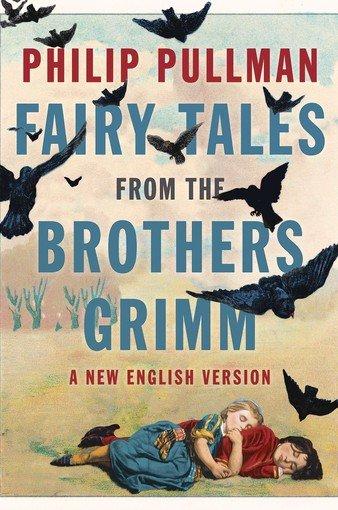
Fairy Tales from the Brothers Grimm by Philip Pullman: At long last, done! It may have been a struggle at times, but I’m glad I stuck with it. My review is here.

New Monday Agenda feature: Fresh Catch!

In addition to looking at my reading plans from the last week and setting goals for the coming week, I thought it might be fun to provide an update each week on all the new acquisitions that make their way into my home and onto my shelves. So, Fresh Catch for the past seven days:

From the library, I checked out four different urban fantasy anthologies for one specific purpose: To read the short story by Patricia Briggs in each collection! After reading the newly published Frost Burned (Mercy Thompson series, book #7) last week, I felt like a starving woman grasping at crumbs — please, give me more! The Patricia Briggs stories in these collections are not about Mercy herself, but do take place in her world:

book cover of Strange Brew byP N Elrod

Other new books purchased or received:

A Tale For The Time Being by Ruth Ozeki

That Time I Joined The Circus by J. J. Howard

Eleanor & Park by Rainbow Rowell

What’s on my reading agenda for the coming week?

I’m in pre-vacation mode, heading out of town for a week starting next weekend, and that puts me into serious book decision-making panic. What to bring? What to read on the plane? What do I bring as back-up? See what I mean? Decisions, decisions, decisions.

To start the week, I want to read the review copy I received of That Time I Joined The Circus, a YA novel which sounds like a lot of fun.

I should try to read Eleanor and Park before I leave, so I can return it to the library and into the hands of whoever is eagerly awaiting it. (I understand there’s a rather long waiting list right now).

For “serious” vacation reading, I’m planning to bring with me Dreamers of the Day by Mary Doria Russell and The Uninvited Guests by Sadie  Jones. And if I get through those, maybe I’ll finally read one of the 40 or so titles on my Kindle that I still haven’t gotten to!

My son seems to have bailed on our co-read of Down the Mysterly River by Bill Willingham, although he hasn’t yet declared himself officially out. I want to know what happens! If the kiddo decides not to keep going, then I’m definitely going to gobble this one up on my own. It’s quite wonderful so far!

So many book, so little time…

That’s my agenda. What’s yours? Add your comments to share your bookish agenda for the week.

Book Review: The Best of All Possible Worlds by Karen Lord

Book Review: The Best of All Possible Worlds by Karen Lord

The Best of All Possible WorldsThe Best of All Possible Worlds opens with catastrophe. The planet of Sadira has been destroyed by a poison gas attack that leaves the planet uninhabitable and exterminates most of the Sadiri people. The only survivors are those who were off planet at the time of the attack. This near-genocide will result in the extinction of the Sadiri people, unless those who survive establish new settlements and find a way to perpetuate their genetic line.

With that as the background, The Best of All Possible Worlds takes off into a study of culture clashes and cooperation. The Sadiri are a people known for their unparalleled mastery of the “mental disciplines” — telepathy, the ability to control emotions, the ability to travel with their minds, and more. When a contingent of Sadiri diplomats and scientists arrive on Cynus Beta, their goals are twofold: One, establish homesteads and rebuild a community, and two, seek out taSadiri communities — people descended from long-ago emigrants from Sadira, who share physical and possibly mental traits with the dwindling Sadiri population, in hopes of establishing marriages resulting in a resurgence of the Sadiri people. Initially viewing the Sadiri representatives as objects of pity, the Cygnians are eager to assist, and assign a team of cultural and scientific experts to set out with the Sadiri contingent on a mission to travel their world and explore the far-flung communities who may bear taSadiri genetic markers.

Key members of this mission are our two main characters: Grace Delarua is a Cygnian biotechnician who is smart, tough, wise-cracking, prone to laughter and chatter, and with unexplored empathic talents.  Dllenahkh is the Sadiri Councillor heading up the mission, who is stoic, in complete control of his emotions, and a master of the mental disciplines. These two opposites seem to fit, despite their differences, and over the course of the book, we see their partnership deepen into a connection that explores both the Sadiri mental abilities and Grace’s tendency toward emotionalism and expression. Opposites attract, although these two are a long time in realizing what’s obvious to everyone else.

Not to say that The Best of All Possible Worlds is a love story (although it is). The book presents a deep and thoughtful look at cross-cultural misunderstandings, the imperative to survive, the many ways that friendship and respect can grow and develop, and the varieties of love and relationships that are possible. Along the way, the details of the different communities encountered during the mission are fascinating, each representing a branch on the Sadiri family tree. In these far-flung communities, each has chosen its own path toward adaptation and evolution, emphasizing different traits and values. In some communities, the mental disciplines allow all members to communicate telepathically throughout the settlement. In others, the inhabitants are sharply Sadiri in appearance but generations past have abandoned all study of the mental disciplines. In each, Dllenahkh and his team must recommend whether to encourage the community to send members to the new Sadiri homestead — in essence, determining whether they’d make good breeding stock for the continuation of the Sadiri race.

Let me get this part out of the way: I loved this book. The writing is at once zippy, clever, and achingly sad, depending on the perspective and the circumstances. Grace is a wonderful heroine. She’s not flawless — she can be insecure, she has demons from her past to overcome, and she does tend to babble a bit, but at the same time, she cares deeply about her friends and family, she’s willing to put herself at risk and even sacrifice her career to right wrongs, and she’s open to the wonders and joys of exploring new worlds, new thoughts, and new possibilities. Dllenahkh is seemingly unreachable at first, masked by his tight control and walled off by his people’s tragedy, yet he too manages to reach out and explore, and demonstrates his ability to feel even when making emotional declarations in completely non-emotional, rational terms. A favorite interaction of mine shows just how different, yet how well-suited, Grace and Dllenahkh are:

“I have identified you as the most appropriate mate, probably through an unconscious assessment of pheromones, mental capacity, and, of course, social compatibility.”

“So, you’re saying you like how I smell, you like how I think, and you like to hang out with me?”

I read The Best of All Possible Worlds on my Kindle, for which I found a new appreciation as I started highlighting lines and paragraphs that I found especially moving, entertaining, or generally noteworthy. By the end of the book, my highlights were everywhere. This book is rich in detail, and I was consistently impressed with the author’s ability to capture and portray the distinct voices of so many different characters, representing so many different cultures.

Curiously, one of the dominant populations on Cygnus Beta is the Terran community, which seems to consist of descendants of our Earth. There are references to watching old holovids of classic Terran movies such as Indiana Jones, E.T., and Casablanca. Various origin myths exist, among them that a mysterious group called The Caretakers brought representatives from different planets to Cygnus Beta in order to give them the best chance of survival. Are The Caretakers gods? Scientists? Simply a myth? Did the Caretakers bring the Terrans of Cygnus Beta from our Earth before the Terran planet became unreachable? There are no answers, and fortunately the story doesn’t bog down in exploring this mystery, but simply presents it as one key to understanding the world as it exists on Cygnus Beta and its universe.

I did have one “WTF” moment in reading The Best of All Possible Worlds, when there suddenly appeared a chapter called “The Faerie Queen”, in which the mission arrives at a community ruled by, yes, a Faerie Queen. The people consider themselves the Seelie Court, and live in a treetop world almost identical to the forests of Lothlorien in Lord of the Rings. Coincidence? Hardly, given the popularity of Terran classic movies. Right when I was exclaiming, “Wait! This is supposed to be science fiction! Why are there faeries??”, we get what I thought was an ingenious answer: In this community’s earlier history, two separate tribes were battling over whose traditions should dominate. Peace was achieved when the people decided to instead follow a new, created path that both tribes could embrace as a new beginning, and so they chose to consider their mental gifts as faerie traits and to model their faerie kingdom on cultural myths and legends that they could adapt to their lives.

The Best of All Possible Worlds has a very episodic rhythm to its narrative. Each chapter is a new stage in the progress of the mission, and while the events build one upon the other, each does have a feel of sitting down with a master storyteller to hear a new bit of the yarn. The writing is fresh and funny, and Grace is an engaging and honest narrator. At the same time, the author, via Grace’s descriptions, does not shy away from confronting the harshness and cruelty witnessed by the mission team in various new settlements or the painful family secrets both Grace and Dllenahkh confront over the course of the novel.

Simply put, I was swept away by the world created by Karen Lord in this masterful, moving story. The characters are unforgettable, and some are immensely lovable as well. The world of Cygnus Beta and beyond is a fascinating study of developing cultures, the impact of contact on isolated populations, and the role of creativity and compromise in a people’s drive to survive. On top of all this, the “mental disciplines” and other aspects of Cygnian science and technology are quite fun to imagine, but never to the extent that they distract from the human focus of this excellent story.

I highly recommend The Best of All Possible Worlds. Not just for science fiction fans, this book should appeal to any reader who appreciates good storytelling, strong characters, deeply-felt emotions, and moments of laughter as well.

Review copy courtesy of Random House Publishing Group – Del Rey Spectra via NetGalley.
Flashback Friday: It’s an All-Clone Two-fer!

Flashback Friday is my own little weekly tradition, in which I pick a book from my reading past to highlight. If you’d like to join in, here are the Flashback Friday book selection guidelines:

  1. Has to be something you’ve read yourself
  2. Has to still be available, preferably still in print
  3. Must have been originally published 5 or more years ago

Other than that, the sky’s the limit! Join me, please, and let us all know: what are the books you’ve read that you always rave about? What books from your past do you wish EVERYONE would read? Pick something from five years ago, or go all the way back to the Canterbury Tales if you want. It’s Flashback Friday time!

My picks for this week’s Flashback Friday:


The Boys From Brazil by Ira Levin (published 1976)

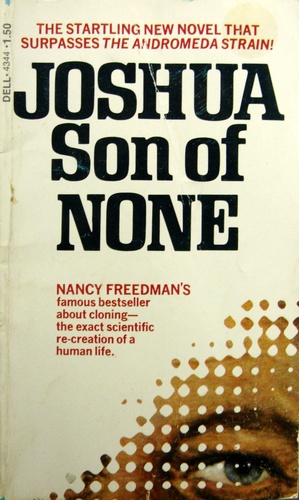
Joshua Son of None by Nancy Freedman (published 1973)

It’s a cloning two-fer! What was going on in the American psyche in the 1970s that made the topic of cloning both so fascinating and so frightening?

The Boys From Brazil is a very scary story about a secret plot to clone Hitler. Joshua Son of None is a not-quite-as-scary story about efforts to clone a Kennedy-esque US President. Both present cloning at a time when it was a new and hypothetical possibility, something out of science fiction dreams that only recently contained the first inklings of real, feasible scientific accomplishment. Both books address the role of upbringing and environment in human development: Is it enough to carry a certain genetic code in order to achieve the desired results, or does the cloned person’s entire life need to be recreated in order to give the genetic inheritance a chance to come to fruition?

When these two books were written, of course all of this was far-distant and purely speculative. Now, given our 21st century advances in genetic engineering and reproductive technologies, the science, at least, is possible, although the nature versus nurture debate remains. I would imagine that both books, while startling for their time, might seem a little less so now, although the central question remains: If we have the science to clone a great man, should we? And if the science exists to clone a monster, what could anyone do to stop it?

I remember being quite fascinated by both of these books when I first encountered them. I’d love to know how they’d strike a new reader today — scary or silly? If you’ve read these books and have any thoughts about them, share a comment!

So, what’s your favorite blast from the past? Leave a tip for your fellow booklovers!

Note from your friendly Bookshelf Fantasies host: To join the Flashback Friday fun, write a blog post about a book you love and share your link below. Don’t have a blog post to share? Then share your favorite oldie-but-goodie in the comments section. Jump in!


Book Review: Fairy Tales From The Brothers Grimm by Philip Pullman

Book Review: Fairy Tales From The Brothers Grimm by Philip Pullman

First of all, for those of you who have been following my struggles: I did it! I actually finished a book of short stories! I’ve mentioned a few times now that I have a big problem with story collections, and generally avoid them like the plague. I made an exception, however, for Fairy Tales From The Brothers Grimm by Philip Pullman, because a) fairy tales! and b) Philip Pullman!

And now that that’s out of the way… what can I tell you about this collection? We all — or at least, those of us above a certain age — grew up with the color-themed fairy books, right? I was a bit obsessed with these as a child, and read whichever volumes were available on my library’s shelves at any given book-bingeing visit. It’s been years since I’ve revisited fairy tales in the written form, as opposed to all the Disnified versions that I’ve watched countless times with my kids.

In Fairy Tales From The Brothers Grimm (let’s just call if FTFTBG for now, okay?), Philip Pullman presents fifty Grimm tales which he’s rewritten in modern, simple English. The language is straightforward and pure, without archaisms that abound in more “traditional” Grimm collections. At the conclusion of each story, the author includes source information as well as his own comments on the story itself and any changes he may have made from the original narratives. He is quite faithful to Grimm, identifying which edition of the Grimm stories he’s pulled from, and only deviates from the source material when he feels that the story is missing a connection or a conclusion.

Pullman’s comments vary from factual — stating source and context — to highly opinionated, and it’s these latter types of comments that are the most entertaining. When the author has something to say, he really says it. Here’s one of my favorites:

However, the tale itself is disgusting. The most repellent aspect is the cowardice of the miller, which goes quite unpunished. The tone of never-shaken piety is nauseating, and the restoration of the poor woman’s hands simply preposterous… Instead of being struck by wonder, here we laugh. It’s ridiculous. This tale and others like it must have spoken very deeply to many audiences, though, for it to spread so widely, or perhaps a great many people like stories of maiming, cruelty and sentimental piety. (Comments on story #21, “The Girl With No Hands”)

The introduction to FTFTBG is wonderful, outlining the history of the Brothers Grimm and their efforts to record and retell folk tales. Philip Pullman gives a very useful overview of common characteristics of fairy tales, among them the immediacy of the characters and narrative: The characters tend to have no backstory, and often lack names other than “the miller”, “the tailor”, “the youngest son”, etc. The stories are tales of actions and consequences, with little to no time spent on descriptions of settings or the natural world, character motivations, or personal growth or development:

There is no psychology in a fairy tale. The characters have little interior life; their motives are clear and obvious. If people are good, they are good, and if bad, they’re bad… The tremors and mysteries of human awareness, the whispers of memory, the promptings of half-understood regret or doubt or desire that are so much part of the subject matter of the modern novel are absent entirely.

I am not an academic; I have no fancy degrees in folklore, ethnography, or comparative literature. I can’t compare Philip Pullman’s retellings to other versions, reinterpretations, or new translations. What I can assess is how this particular collection of stories worked for me as a reader — and the answer is, it worked very well indeed!

I truly enjoyed this collection, which includes both familiar tales (“Cinderella”, “Rapunzel”, “Snow White”, “Little Red Riding Hood”) as well as tales (with wonderful titles!) that I’d never heard of, such as “Hans-my-Hedgehog”, “The Mouse, the Bird and the Sausage”, and “The Singing, Springing Lark”. Even for the most familiar tales, I was surprised to realize how far my own memory of the stories had strayed from the Grimm version into the land of Disney princesses and happily-ever-afters. There’s something oddly appealing — at least to me, with my appreciation for the dark and off-beat — in realizing that even a story that ends with kisses and marriage (such as “Cinderella”) also includes self-mutilation, horrific cruelty, and shoes filled with blood. In real Grimm stories, fairy tales are definitely not soothing stories to lull children into peaceful dreams!

Some of the stories which were new to me were quirky and funny, such as “The Boy Who Left Home to Find Out About The Shivers” and “Lazy Heinz”. Then again, there are plenty of truly disturbing stories. “Thousandfurs”, for me, is the most disturbing in the collection, not specifically because of Pullman’s retelling, but because “Thousandfurs”  is one of the origin stories for the brilliant yet wildly upsetting novel Deerskin by Robin McKinley.

And perhaps that’s the point and the beauty of reading such a well-written and thoughtful collection of traditional fairy tales: We’ve all encountered these stories in so many ways, with so many different interpretations. In reading them anew, we’re instantly reminded of all the associations we’ve developed with these stories, from reinterpretations in modern novels to our grandparents’ versions of fairy tales as bed-time stories to cautionary tales about greed and duplicity. What’s most interesting to me is that the stories resonate so deeply and so widely; your Rapunzel and my Rapunzel may be very different, but the bottom line is that fairy tales like these give us a common language and cultural points of reference. On my bookshelf, I have a wonderful collection of short fiction by women writers entitled We Are The Stories We Tell. Given the depth of experiences we all share thanks to fairy tales such as those in FTFTBG, I’d say that we are also the stories we read.

Wishlist Wednesday

Welcome to Wishlist Wednesday!

The concept is to post about one book from our wish lists that we can’t wait to read. Want to play? Here’s how:

  • Follow Pen to Paper as host of the meme.
  • Do a post about one book from your wishlist and why you want to read it.
  • Add your blog to the linky at the bottom of the post at Pen to Paper.
  • Put a link back to Pen to Paper somewhere in your post.
  • Visit the other blogs and enjoy!

My Wishlist Wednesday book is:

 The Love Song of Jonny Valentine

The Love Song of Jonny Valentine by Teddy Wayne

From Goodreads:

Megastar Jonny Valentine, eleven-year-old icon of bubblegum pop, knows that the fans don’t love him for who he is. The talented singer’s image, voice, and even hairdo have been relentlessly packaged—by his L.A. label and his hard-partying manager-mother, Jane—into bite-size pabulum. But within the marketing machine, somewhere, Jonny is still a vulnerable little boy, perplexed by his budding sexuality and his heartthrob status, dependent on Jane, and endlessly searching for his absent father in Internet fan sites, lonely emails, and the crowds of faceless fans.

Why do I want to read this?

This new release has been getting a lot of attention (inevitable, given its instant association with Justin Bieber and other teen pop stars), as well as some excellent reviews. The topic is probably a little outside of my normal reading interests, but I’ll give it a whirl! Has anyone read it yet? Any thoughts?

Quick note to Wishlist Wednesday bloggers: Come on back to Bookshelf Fantasies for Flashback Friday! Join me in celebrating the older gems hidden away on our bookshelves. See the introductory post for more details, and come back this Friday to add your flashback favorites!

Top Ten Tuesday: Top Ten Books On My Spring 2013 TBR List

Top 10 Tuesday newTop Ten Tuesday is a meme hosted by The Broke and the Bookish, featuring a different top 10 theme each week. This week’s topic is:

Top Ten Books On My Spring 2013 TBR List

Easy-peasy! My TBR (to-be-read) list grows by leaps and bounds. The challenge is not to come up with ten — it’s deciding which ten out of the hundreds of unread books in my house will actually make the list.

Without further ado:

Let’s start with a few books already pre-ordered, which will bump up to the top of my reading pile as soon as they arrive:

1) The Ocean At The End Of The Lane by Neil Gaiman. From Goodreads: “THE OCEAN AT THE END OF THE LANE is a fable that reshapes modern fantasy: moving, terrifying and elegiac – as pure as a dream, as delicate as a butterfly’s wing, as dangerous as a knife in the dark, from storytelling genius Neil Gaiman.” Okay, it’s Neil Gaiman. I’m in.

2) NOS4A2 by Joe Hill. Joe Hill writes some of the scariest horror I’ve ever read. The new book sounds terrifyingly terrific.

3) Tempest Reborn by Nicole Peeler. The 6th and final book in the amazing Jane True urban fantasy series. Jane is a totally kick-butt heroine with a soft spot for good books, yummy food, and hot guys. I’ve love watching Jane’s development of the course of the series from sad, downtrodden town pariah to fully empowered action hero with heart. Go, Jane!

A few books that have been on my shelves for longer than I care to admit:

4) Dreamers of the Day by Mary Doria Russell. The only book by this author that I haven’t read yet — and given the fact that I’ve adored everything else she’s written, I’m really looking forward to finally sitting down with this one.

5) The Eyre Affair by Jasper Fforde. I’ve been wanting to get to this silly-sounding series for years! This spring, I’m going to make it happen.

6) The Shadowy Horses by Susanna Kearsley. I’ve read three of Susanna Kearsley’s atmospheric, romance-drenched time-slip novels, and want to read this one ASAP, as I understand a character from The Shadowy Horses features in her new upcoming book, The Firebird.

And a few newer acquisitions, which I really, really, really intend to read!

7) Me Before You by Jojo Moyes. I’ve read nothing but good reviews for this new release, and it’s been a while since I’ve read a book that made me cry. (I’ve been warned)

8) The Child’s Child by Barbara Vine. I’m not usually a mystery buff, but this story about family secrets and a book-within-a-book sounds too good to miss.

9) Billy Lynn’s Long Halftime Walk by Ben Fountain. So much buzz about this book! Must check it out, see if it lives up to the hype.

10) The Uninvited Guests by Sadie Jones. My city’s public library system is featuring this book as its current “One City, One Book” selection. Coming off the most recent season of Downton Abbey, this tale of an English manor house and the entanglements of its inhabitants sounds very appealing to me.

Whew! That’s ten! If I don’t get distracted by some other ten or twenty books, I hope to make a serious dent in this list over the next few months. Have you read any of these? Any thoughts or recommendations? And what are you planning to read this spring?

Save

The Monday agenda 3/11/2013

MondayAgendaNot a lofty, ambitious to-be-read list consisting of 100+ book titles. Just a simple plan for the upcoming week — what I’m reading now, what I plan to read next, and what I’m hoping to squeeze in among the nooks and crannies.

How did I do with last week’s agenda?

Spellbinding by Maya Gold: Done! My review is here.

Frost Burned (Mercy Thompson, book 7) by Patricia Briggs: Done! My review is here. (Short version: Loved it! I want to live in Mercy’s world.)

New Monday Agenda feature: Fresh Catch!

In addition to looking at my reading plans from the last week and setting goals for the coming week, I thought it might be fun to provide an update each week on all the new acquisitions that make their way into my home and onto my shelves. So, Fresh Catch for the past seven days:

From the library, I picked up copies of A Natural History of Dragons by by Marie Brennan; The Painted Girls by Cathy Marie Buchanan; and The Uninvited Guests by Sadie Jones.

Front Cover

Other new books purchased or received:

Frost Burned by Patricia Briggs (of course!); Where She Went by Gayle Forman; and for my son, Stranded by Jeff Probst. (Yes, the Survivor host has written the first in a middle-grade trilogy about a bunch of kids stranded on an island. Hey, write what you know, Jeff!)

What’s on my reading agenda for the coming week?

I received an e-ARC of a new science fiction book, The Best of All Possible Worlds, by Karen Lord. I’ve only read the first few pages, but I’m intrigued. I hope to make a big dent in this one in the next few days.

Next up, I’m expecting a copy of Ruth Ozeki’s new release, A Tale for the Time Being. I loved this author’s My Year of Meats, and I’m really looking forward to starting her newest book.

And if I finish both of these books and still have time, I need to dig into some of the books that have been patiently waiting for me. Dreamers of the Day by Mary Doria Russell is inching its way to the top of the pile. Our destinies may finally intertwine by the end of this week.

In the world of reading with my kiddo, we’re still enjoying — and puzzling over — Down The Mysterly River by Bill Willingham, although the kiddo has now discovered the joys of reading books on my IPad, and has ditched our mom/kid reading sessions for individual reading for a few days now. He is totally hooked on Dan Gutman’s hilarious Funny Boy books. Could it be that my boy is finally reading without being pressured to do so? I’m not holding my breath just yet, but perhaps we’re having a breakthrough!

And yes, I’m still reading Philip Pullman’s collection of Grimm fairy tales, a few stories each week. Slow and steady, but I’m getting there. Boy, there are some really gross and disturbing fairy tales in the mix!

So many book, so little time…

That’s my agenda. What’s yours? Add your comments to share your bookish agenda for the week.

Book Review: Frost Burned by Patricia Briggs

Book Review: Frost Burned by Patricia Briggs

Frost Burned (Mercy Thompson, #7)

Mercy is back! Mercy is back! Mercy is back!

Clearly, my babbling inner fangirl is dominant at the moment, as I get practically giddy over the return of my favorite urban fantasy heroine and her pack of strong, conflicted, devoted werewolves.

Frost Burned is book #7 in the outstanding Mercy Thompson series by Patricia Briggs. Fingers crossed — here’s hoping there are many more stories set in Mercy’s world yet to come. Brief spoiler alert: While I won’t give away too much from Frost Burned, from this point forward you may encounter spoilers for some of the earlier books. You have been warned!

For the uninitiated, Mercy Thompson is a talented VW mechanic living in the Tri-Cities region of Washington, who also happens to be a shapeshifter. Thanks to her Native American lineage, Mercy can shift at will into coyote form and has certain other magical predispositions as well. At the outset of the series, Mercy lived in a trailer adjacent to the property of werewolf pack Alpha Adam Hauptmann, which gave Mercy all sorts of childish pleasure as she found new and creative ways to annoy the bejeesus out of Adam.

Flash forward to book #7, and Mercy and Adam are happily married, completely in love, and enjoying life surrounded by their pack and their friends. When Adam and the pack are attacked and kidnapped, Mercy has to use all the power at her disposal and call in some significant favors in order to find the wolves and rescue them before disaster strikes.

That’s the two-second version of the plot, and I won’t go further. If you’re a Mercy fan, you’ll want to read this book at the first possible second. And if you’re not already a Mercy fan — what are you waiting for? Go get book #1 (Moon Called) immediately, and don’t stop reading until you get through Frost Burned!

I don’t often gush so enthusiastically, but I have to say that these books are really special. The characters are unique and unforgettable. By this point in the series, I’m in love with at least half of the pack, and would want the rest at my side in any dark alley imaginable.

What I really love about these books is the wonderful world that Patricia Briggs has built, especially when it comes to creating a fully-formed werewolf social structure. The pack dynamics echo those of wolf packs in the wild. Dominance is a key theme, and each werewolf in Adam’s pack knows exactly where he stands in the pack rankings. There’s a magic involved as well — Adam can call on the strength of the pack when he needs an extra boost, or he can send his power to a wolf who’s in trouble. Likewise, the mate bond between Adam and Mercy isn’t just about love. They have a connection that they can use to reach one another, to strengthen one another, and rather surprisingly, to physically save one another when in danger.

The author’s depictions of dominance struggles among the wolves is fascinating. Even in human form, the pack members know better than to look the Alpha in the eye. When in a crowded or unfamiliar location, it’s difficult for the dominant wolves to relax, as their instinctive need to control their surroundings and protect those packmembers who are weaker can push them toward a violence that always lurks below the surface. As we learn in Frost Burned, even a simple card game used to pass the time can end in bloodshed when two dominant wolves are involved, and it’s a bad idea to get too close to a wounded werewolf, when his aversion to showing vulnerability might just trigger an attack.

Mercy herself is a wonderful hero. She’s physically strong and capable, and even stronger willed. She’s driven to protect her loved ones, even when doing so puts her own life on the line. Mercy dives in and takes action. She never waits to be rescued; she’s the rescuer. Of course, she suffers for it, too — over the course of the series, very bad things have happened to Mercy, and they do leave scars, both emotional and physical. Unlike some lead females in ongoing paranormal series, Mercy doesn’t get bogged down in her beauty routines or other silliness. She works hard, she takes care of her family, she pays attention to her pack… and she pretty much never has a dull moment.

I suppose you could complain that the books are so action-packed that the characters never have a quiet moment to breathe. Well, that’s true, but that’s not necessarily a bad thing. The plots in the Mercy Thompson books are hyper-fueled by danger, threats, conspiracies, and various and sundry super-scary bad guys. While there are tender, domestic moments built in, I suppose we just have to imagine that in the months that go by in Mercy’s life in between the books in the series, she and Adam and their wolfy gang are able to catch up on their sleep, enjoy their families, go out on runs, and play intense rounds of video games.

By now, I’m sure that it’s clear that I adore the Mercy Thompson series, and I’m wild about the spin-off Alpha & Omega series as well. My chief unhappiness at the moment? Having read the book the absolute second I got my hands on it, I have no more Mercy adventures to read! I understand that at least nine Mercy books are planned, and that #8 is due out in 2014. I don’t want to wait!

Seriously, read these books. You can thank me later.

Flashback Friday: The Mind-Body Problem

Flashback Friday is my own little weekly tradition, in which I pick a book from my reading past to highlight. If you’d like to join in, here are the Flashback Friday book selection guidelines:

  1. Has to be something you’ve read yourself
  2. Has to still be available, preferably still in print
  3. Must have been originally published 5 or more years ago

Other than that, the sky’s the limit! Join me, please, and let us all know: what are the books you’ve read that you always rave about? What books from your past do you wish EVERYONE would read? Pick something from five years ago, or go all the way back to the Canterbury Tales if you want. It’s Flashback Friday time!

My pick for this week’s Flashback Friday:

 The Mind-Body Problem

The Mind-Body Problem by Rebecca Goldstein

(published 1983)

From Goodreads:

When Renee Feuer goes to college, one of the first lessons she tries to learn is how to liberate herself from the restrictions of her orthodox Jewish background. As she discovers the pleasures of the body, Renee also learns about the excitements of the mind.

She enrolls as a philosophy graduate student, then marries Noam Himmel, the world-renowned mathematician. But Renee discovers that being married to a genius is a less elevating experience than expected.

The story of her quest for a solution to the mind-body problem involves the prickly contemporary dilemmas of sex and love, of doubt and belief.

I read The Mind-Body Problem ages ago, but can still more or less quote one of the lines from this book which I found marvelous:

I am beautiful for a brainy woman, brainy for a beautiful woman, but objectively speaking, neither beautiful nor brainy.

That, in essence, is the heart of main character Renee’s struggle. She’s always considered herself an intellectual, but when she marries a bona fide genius, has to face some hard truths about herself, what it means to be smart, and what it means to love and be loved. Renee’s exploration of identity, success, love, and desire is both philosophical and physical, and always fascinating.

So, what’s your favorite blast from the past? Leave a tip for your fellow booklovers!

Note from your friendly Bookshelf Fantasies host: To join the Flashback Friday fun, write a blog post about a book you love and share your link below. Don’t have a blog post to share? Then share your favorite oldie-but-goodie in the comments section. Jump in!

Wishlist Wednesday

Welcome to Wishlist Wednesday!

The concept is to post about one book from our wish lists that we can’t wait to read. Want to play? Here’s how:

  • Follow Pen to Paper as host of the meme.
  • Do a post about one book from your wishlist and why you want to read it.
  • Add your blog to the linky at the bottom of the post at Pen to Paper.
  • Put a link back to Pen to Paper somewhere in your post.
  • Visit the other blogs and enjoy!

My Wishlist Wednesday book is:

 A Small Death in the Great Glen

A Small Death in the Great Glen by A. D. Scott

From Amazon:

In the Highlands of 1950s Scotland, a boy is found dead in a canal lock. Two young girls tell such a fanciful story of his disappearance that no one believes them. The local newspaper staff—including Joanne Ross, the part-time typist embroiled in an abusive marriage, and her boss, a seasoned journalist determined to revamp the paper—set out to uncover and investigate the crime. Suspicion falls on several townspeople, all of whom profess their innocence. Alongside these characters are the people of the town and neighboring glens; a refugee Polish sailor; an Italian family whose café boasts the first known cappuccino machine in the north of Scotland; and a corrupt town clerk subverting the planning laws to line his own pocket.

Together, these very different Scots harbor deep and troubling secrets underneath their polished and respectable veneers—revelations that may prevent the crime from being solved and may keep the town firmly in the clutches of its shadowy past.

Why do I want to read this?

I’ll be honest — they had me at Scottish Highlands. I’m a sucker for this setting, although most of my Highlands fiction tends to take place centuries in the past, with an emphasis on dashing men in kilts. I’ve yet to read a book set in Scotland within a more contemporary time frame — as soon as I spotted this one in a bookstore, I knew it was for me. The story itself sounds intriguing — local drama and deception, a tragic and suspicious death, a melting pot of townspeople and immigrants. Great ingredients for what I hope will be a terrific mystery!

Quick note to Wishlist Wednesday bloggers: Come on back to Bookshelf Fantasies for Flashback Friday! Join me in celebrating the older gems hidden away on our bookshelves. See the introductory post for more details, and come back this Friday to add your flashback favorites!