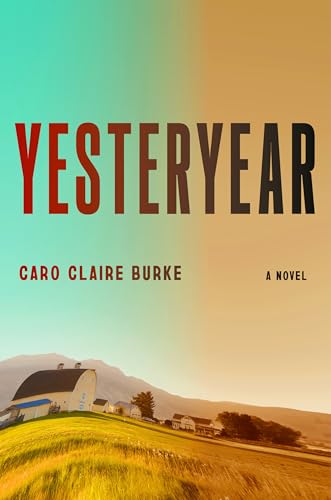
Title: Yesteryear
Author: Caro Claire Burke
Publisher: Knopf
Publication date: April 7, 2026
Length: 400 pages
Genre: Contemporary fiction
Source: Library
Rating:
My name was Natalie Heller Mills, and I was perfect at being alive.
Natalie lives a traditional lifestyle. Her charming farmhouse is rustic, her husband a handsome cowboy, her six children each more delightful than the last. So what if there are nannies and producers behind the scenes, her kitchen hiding industrial-grade fridges and ovens, her husband the heir to a political dynasty? What Natalie’s followers—all 8 million of them—don’t know won’t hurt them. And The Angry Women? The privileged, Ivy League, coastal elite haters who call her an antifeminist iconoclast? They’re sick with jealousy. Because Natalie isn’t simply living the good life, she’s living the ideal—and just so happens to be building an empire from it.
Until one morning she wakes up in a life that isn’t hers. Her home, her husband, her children—they’re all familiar, but something’s off. Her kitchen is warmed by a sputtering fire rather than electricity, her children are dirty and strange, and her soft-handed husband is suddenly a competent farmer. Just yesterday Natalie was curating photos of homemade jam for her Instagram, and now she’s expected to haul firewood and handwash clothes until her fingers bleed. Has she become the unwitting star of a ruthless reality show? Could it really be time travel? Is she being tested by God? By Satan? When Natalie suffers a brutal injury in the woods, she realizes two things: This is not her beautiful life, and she must escape by any means possible.
A gripping, electrifying novel that is as darkly funny as it is frightening, Yesteryear is a gimlet-eyed look at tradition, fame, faith, and the grand performance of womanhood.
The premise sounds like a perfect reality TV show, in a way: Take a tradwife influencer and make her actually live on a homestead. No running water, no appliances, no fresh veggies except what she can grow herself. Make bread for the family every day… without an electric stove or perfect kitchen tools or curated ingredients. And do it all again, day in, day out. How many would last more than a day? A week?
In Yesteryear, this is exactly the set-up… sort of. Natalie is a perfect wife and perfect mother, raising her adorable brood of adorable children with good old-fashioned family values, with a devoted husband to protect them all and care for the farm while she prepares wholesome food and homeschools her little ones. She’s devout, she’s pretty, she’s hard-working… and she’s an influencer with millions of followers. So yes, she makes a small fortune from the products her fans buy, and she’s adored and hated probably in equal measure — but loved or hated, that’s attention, and that means money and fame.
Until it doesn’t. Because one day, Natalie wakes up cold, under a rough quilt rather than the high quality linens she’s used to, and the children in her kitchen aren’t really her children. Instead of a rustic-looking but actually highly polished home, her house is truly rustic, with gaps in the boards, heat from a wood-burning hearth, and no modern conveniences whatsoever. Is this a trick? Is she being secretly filmed? Has she teleported back in time? All Natalie knows is that something is very, very wrong, and she’s powerless to change it or to escape.
As Yesteryear moves forward, we follow several timelines. We seeing Natalie’s history from childhood to college, where she disdained her classmates and dropped out to marry a seemingly perfect man, to their complicated early years of marriage, and finally, to their life at Yesteryear Ranch and her growing internet fame. We also see Natalie’s panic when, pregnant with her sixth child and experiencing huge success, her carefully constructed world starts to crumble around her. And mixed in with all this, we see Natalie’s awakening in the ranch of 1855, experiencing displacement, confusion, and sheer panic as she tries to figure out what’s been done to her and how she can get back to her real life.
Lest you have the impression that Natalie is a hero or a good person, let me assure you: She is not. In every age and stage, Natalie — who professes to be a good, Christian, God-fearing woman — is full of spite, scorn, and even hatred for the people around her. She judges everyone and finds them lacking, and sees herself as the epitome of everything a woman should be.
And who was I? A flawless Christian woman. The manic pixie American dream girl of this nation’s deepest, darkest fantasies. The mother every woman wanted to be, and the wife every man wanted to come home to. Like a nun in a porno, it didn’t make sense, but also, by God: it worked. My name is Natalie Heller Mills, and I was perfect at being alive.
As Natalie’s world unravels, readers may struggle to feel any sympathy for her at all. The world she’s built is so blatantly false, existing only while the cameras roll. Modern conveniences, nannies, farmhands — all are hidden behind false fronts, so that her perfect prairie life appears on screens as a shining example of virtuous, healthy, wholesome family living. It’s all a bit sickening… but even Natalie is aware that she exists as both Online Natalie and Offline Natalie, and it’s only when the two converge that things really go south.
Yesteryear is a strange book in so many ways. It’s truly dismal for much of it. I have no idea why the synopsis calls this book darkly funny; I couldn’t find anything to laugh at. Well, okay, that’s not entirely true: Natalie’s self-serving statements and prayers really did make me stifle a snort at times:
Thank you for watching over the farm animals, Lord, and thank you for helping us pass five million on Instagram this week.
And yet, Natalie is just so awful that there isn’t truly much in the way of enjoyment in reading about her rise and fall and the startling transposition to a 19th century farmhouse. She’s certainly not sympathetic in any way. There’s a weird fascination to it all, as readers are forced to piece together the truth of what’s going on from hints and clues. It takes a very long time for any of it to make sense. I will say that the author manages to pull it all together in an ending that answers all the questions posed along the way, although I didn’t necessarily think the actual events and explanations were believable.
I picked up Yesteryear after seeing the book start gaining buzz once it was selected as the April pick for Good Morning America’s book club, and after winning two hardcover copies for my Little Free Library (which got snapped up in the blink of an eye). Luckily, I was able to get a copy from the library to read myself without too long a wait.
I’m not sorry that I read Yesteryear — but I also didn’t find it as compelling or deep as the buzz might have us believe. Until close to the end, I probably would have given this book less than a 3-star rating… but I did admire the author’s sleight of hand in coming up with an ending that (more or less) works, so long as you can apply a hefty dose of suspending disbelief.
I’d be curious to hear other people’s thoughts on Yesteryear: Timely story about today’s society, influencer culture, the rot beneath the family values/tradwife hype, a rant against anti-feminism? Or a muddled book that seems to want to be saying more than it actually is?

Purchase links: Amazon – Audible audiobook – Bookshop.org – Libro.fm
Disclaimer: When you make a purchase through one of these affiliate links, I may earn a small commission, at no additional cost to you.

