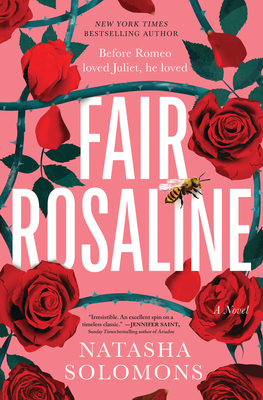
Book Review: Fair Rosaline by Natasha Solomons

Title: Fair Rosaline
Author: Natasha Solomons
Publisher: Sourcebooks Landmark
Publication date: August 3, 2023
Length: 336 pages
Genre: Historical fiction
Source: Review copy courtesy of the publisher via NetGalley
Rating:

Rating: 4.5 out of 5.

Was the greatest ever love story a lie?

The first time Romeo Montague sees young Rosaline Capulet he falls instantly in love.

Rosaline, headstrong and independent, is unsure of Romeo’s attentions but with her father determined that she join a convent, this handsome and charming stranger offers her the chance of a different life.

Soon though, Rosaline begins to doubt all that Romeo has told her. She breaks off the match, only for Romeo’s gaze to turn towards her cousin, thirteen-year-old Juliet. Gradually Rosaline realises that it is not only Juliet’s reputation at stake, but her life.

With only hours remaining before she will be banished behind the nunnery walls, will Rosaline save Juliet from her Romeo? Or can this story only ever end one way?

A subversive, powerful untelling of Shakespeare’s best-known tale, narrated by a fierce, forgotten voice: this is Rosaline’s story.

Fair Rosaline is a powerful retelling of Romeo and Juliet, faithful to the major plot beats of Shakespeare’s tragedy, but with a shift in perspective that changes everything. It’s fascinating, fast-moving, and now that I’ve finished, hard to stop thinking about.

In the traditional version, Romeo is first introduced as lovestruck over “fair Rosaline” — until he attends a Capulet party and suddenly falls completely in love with Rosaline’s cousin Juliet. Rosaline is forgotten, and we all know how things turn out for Juliet.

Here in Fair Rosaline, we see life in Verona through Rosaline’s eyes, and it isn’t pretty. With her mother a recent plague victim, Rosaline mourns her loss mostly alone, as her father is consumed by his own grief and has little patience for his 15-year-old daughter. After passing the required period of being locked up to make sure they don’t spread the plague further, Rosaline’s father shares devastating news: It was her mother’s wish that she be sent to the nunnery, and he intends to carry out this plan immediately.

There are no good choices here for Rosaline. Marriage or the convent are the only options, and as her brother is already married and has children, there’s no need to worry about further heirs. Rosaline’s dowry will go instead to the convent, and she’ll be locked behind its walls forever. Her wishes don’t matter. Desperate to prolong her freedom, Rosaline bargains with her father, and in the end, gets a concession — he’ll give her twelve days more at home, but then she must go.

Into Rosaline’s sad life, Romeo bursts like a ray of light. She sneaks away to attend the forbidden Montague ball, wanting a taste of life before she’s locked away, and there meets the handsome, smooth-talking Romeo, who seems instantly enamored by beautiful young Rosaline. Where Fair Rosaline differs sharply from the story we think we all know is that Romeo is clearly older — late twenties or early thirties, at least. As the author’s notes tell us, it’s just custom that Romeo is usually portrayed as a teen: Shakespeare specifies that Juliet is thirteen, but Romeo’s age is never stated.

What becomes clear in Fair Rosaline is that Romeo is a predator. His beautiful words are creepy here, as he uses his sleek, skillful speeches as tools of seduction, preying on much younger, innocent girls, whose sheltered lives leave them susceptible to his grooming. He doesn’t use physical violence to get his way — instead, he seduces with poetic pronouncements and over-the-top romantic gestures, promises of immediate marriage, and depictions of a future life together that’s always just out of reach.

Love with him was carnal and delicious and all consuming; he wasn’t just a hunter but a thief, stealing from girls their very selves.

When Rosaline finally faces the cruel reality of Romeo’s true nature and confronts him, he turns his attentions to her younger cousin Juliet, another easy victim for his manipulation. Rosaline and her beloved cousin Tybalt are desperate to save Juliet, who is too swept up by Romeo’s suave charm to hear their warnings.

Fair Rosaline sweeps us up into Rosaline’s misery as well as her moments of joy. This is clearly a young woman hungry for life, literature, and music, yearning for freedom that can never be hers. Between mourning her mother and dreading her incarceration behind convent walls, it’s no wonder that she’s an easy target for an experienced man who seems to offer her everything she could want.

Life in Verona at this time is presented at a tangible, visceral level, full of dirt, disease, and smells. The upper class lives of Rosaline’s world are adjacent to the terrible poverty and filth of the poorer quarters, and disease isn’t the only threat, as we see example after example of women dying in childbirth or losing children.

Even Juliet, pampered and protected, isn’t truly safe — even before she meets Romeo. After all, to the wealthy and powerful, a pretty thirteen-year-old girl is considered a candidate for marriage. Juliet’s parents plan her marriage to Paris despite her youth.

It was because of Lauretta and Nurse and Old Capulet and the good honest hypocrites of Verona that Juliet believed it was well and good for her to wed a man when she was still a child. While trying to break her in for Paris or his like, her family had seen to it that she was nicely softened for Romeo. Her arms had already been open and ready for him.

The crypts and graveyards themselves loom menacingly throughout the story. They’re not austere, holy sites to remember loved ones, but reeking pits where the dead rot and stink. Juliet’s pretend death and placement in the family crypt is horrifying: This isn’t a beautiful tableau of a young woman in eternal sleep, but a horror of a scene in which a young girl is entombed among rotting corpses.

I won’t say how the author ends her version of the story, but it’s quite powerful and masterfully told. The author weaves in phrases and moments from Shakespeare, but has them feel like natural parts of the story. Events and people fall in line with the origin story, but only on the surface. There’s more going on, and while the major set-pieces still happen, there are different elements, emotions, and motives at play as well. It’s utterly fascinating to see these pieces come together.

Rosaline is a sympathetic character. It’s easy to understand how she’d be vulnerable to someone like Romeo, and while we know she’s making bad decisions, given her lack of experience and dire circumstances, it’s impossible to fault her in any way. She’s a young girl who’s being preyed upon, and we can only admire her for wanting to take action and protect Juliet once she realizes the truth.

Fair Rosaline is a compelling read, upsetting and moving and thought-provoking. I’ll never think of Romeo and Juliet in quite the same way again.
Book Review: The Hundred Loves of Juliet by Evelyn Skye

Title: The Hundred Loves of Juliet
Authors: Evelyn Skye
Publisher: Del Rey
Publication date: August 1, 2023
Length: 337 pages
Genre: Contemporary fiction / fantasy
Source: Review copy courtesy of the publisher via NetGalley

Rating: 3.5 out of 5.

A woman discovers that she is part of a legendary love story that spans lives, years, and continents in this modern-day reimagining of Romeo and Juliet.

I may go by Sebastien now, but my name was originally Romeo. And hers was Juliet.

It’s a frosty fairytale of an evening in small-town Alaska when Helene and Sebastien meet for the first time. Except it isn’t the first time. You already know that story, though it didn’t happen quite as Shakespeare told it.

To Helene, Sebastien is the flesh-and-blood hero of the love stories she’s spent her life writing. But Sebastien knows better—Helene is his Juliet, and their story has always been the same. He is doomed to find brief happiness with her over and over, before she dies, and he is left to mourn.

Albrecht and Brigitta. Matteo and Amélie. Jack and Rachel. Marius and Cosmina. By any name, no matter where and when in time, the two of them are drawn together, and it always ends in tragedy.

This time, Helene is determined that things will be different. But can these star-cross’d lovers forge a new ending to the greatest love story of all time?

The Hundred Loves of Juliet takes the classic tragedy of Romeo and Juliet as inspiration for a modern-day love story that spans centuries.

After leaving her awful — manipulative, cheating, gaslighting — husband, Helene Janssen decides to create a new life for herself, and relocates to a small town in Alaska to recover her equilibrium and work on her novel. A professional journalist, Helene is eager to see if she can turn the snippets of stories she’s written all her life into an actual book.

Since middle school, Helene has had a vividly detailed imaginary hero at the center of her stories and daydreams. Whether as a nobleman at Versailles, a Swiss clockmaker, or trekking across the Sahara, the same man repeatedly appears in all her scenarios, and she knows everything about him — his appearance, his voice, even his quirky habits and gestures.

Imagine Helene’s shock when, on her first night in Alaska, the man from her stories shows up in the restaurant where she’s having dinner. He’s not just similar to her character — every detail matches up exactly. But when Helene approaches Sebastien, who’s clearly much beloved by the town and seems like kindness itself — he rudely rebuffs her and makes it clear that he doesn’t want to know her.

We soon learn more from Sebastien’s point-of-view, and what a story he has to tell! Sebastien is only his latest identity. Originally, he was Romeo Montague. Yes, that Romeo. And he lets us know just what Shakespeare got wrong. Juliet did die, shockingly and tragically, just a few short days after their secret marriage — but Romeo survived. Since then, he’s been cursed with immortality, and doomed to meet, fall in love with, and then lose reincarnations of Juliet, over and over again across the long centuries.

Each time he meets a new version of Juliet, he hopes things will be different, but each time, she dies — sometimes within days, sometimes after they begin a life together, but no Juliet has lasted more than two years after they meet. This time, he’s determined to save Helene — whom he immediately recognizes as Juliet — by staying out of her life. If he needs to run away from his life in Alaska in order to avoid her, he will… but when Helene is stranded near his home during a blizzard, he has no choice but to offer her shelter, and his carefully constructed walls can’t last once they begin to spend time together.

In many ways, The Hundred Lives of Juliet is highly enjoyable. Thanks to the alternating POV sections, we see the past vignettes as well as the current storyline unfold from both Helene’s and Sebastien’s perspectives, which helps us understand why they behave as they do. The rules of their curse aren’t clear-cut or consistent, and even Romeo/Sebastien isn’t entirely sure why things happen the way they do. Were they cursed by Mercutio’s dying words:

A plague o’ both your houses

Or is there some other reasons why Sebastien seems to live forever, while Juliet lives through sequential lives, always destined to die tragically at a young age?

There’s an undeniable tension that builds as the story progresses. Once Helene and Sebastien give in to the inevitability of their love, we can feel the clock ticking on their happiness. We know that all Juliets die, so there’s a sense of held breath — what will go wrong? This tension pulled me in and kept me reading, to the point where I just couldn’t stop until I reached the end.

At the same time, not everything here works well. We read Helene’s story vignettes scattered throughout the book, and there isn’t a particularly kind way to say that they feel pretty clichéd and stale. Not to mention, yes, Romeo has lived for about 700 years, but it still feels unlikely that his adventures would take him to quite that many new lives around the world.

On top of this, Helene’s novel-writing project is centered on turning her vignettes into a cohesive whole — but since it turns out that all of these stories are actually depictions of past lives she’s lived with Sebastien, how is that actually creative writing, and isn’t this all supposed to be a secret? (Also, I was amused that one of Helene’s first errands in Alaska is a trip to the local bookstore to buy a book about how to write a novel — is that really all it takes? A good how-to book?)

There’s a suspense element toward the end of the book involving a looming threat to Sebastien and Helene, as his secret is on the verge of being revealed (and they fear that if the truth gets out, he’ll be locked away in a government research facility forever — again, this feels very clichéd to me). However, the danger is dealt with pretty quickly in a way that is almost a deus ex machina solution, and I didn’t love anything about this part of the story.

Not to be overly nitpicky, but one scene in the first half of the book made me consider walking away from it all. Sebastien warns Helene not to go wandering around his house at night, she compares the warning to Belle being barred from the west wing in Beauty & the Beast, and he responds by calling her “childlike”. Okay, agreed, that’s rude… but she responds to the “childlike” comment by slapping him. SLAPPING him!?! Who does that? To a stranger who’s giving you shelter from a dangerous storm, and who may not be as polite as we’d like, but who has a right to set limits on where a guest goes in his home? Wow, I did not like this scene at all, and it made me think less of Helene as a person.

I’ve gone into greater details on what I didn’t like about the book, but the fact remains that I read the whole thing in about 24 hours, so clearly there was plenty that I did like! Helene and Sebastien’s struggles to make sense of their connection and to understand the past were very compelling, and the key concepts of the story are unique. I had a hard time suspending my disbelief, but ultimately decided to just go with it (immortality! reincarnation!) and not worry about whether every last bit made sense.

Overall, The Hundred Loves of Juliet is a compelling read despite its flaws, and I appreciated the momentum that builds over the course of the novel. It’s definitely more than a bit melodramatic, but considering this is a retelling/reimagining of Romeo and Juliet, I suppose melodrama is allowed!

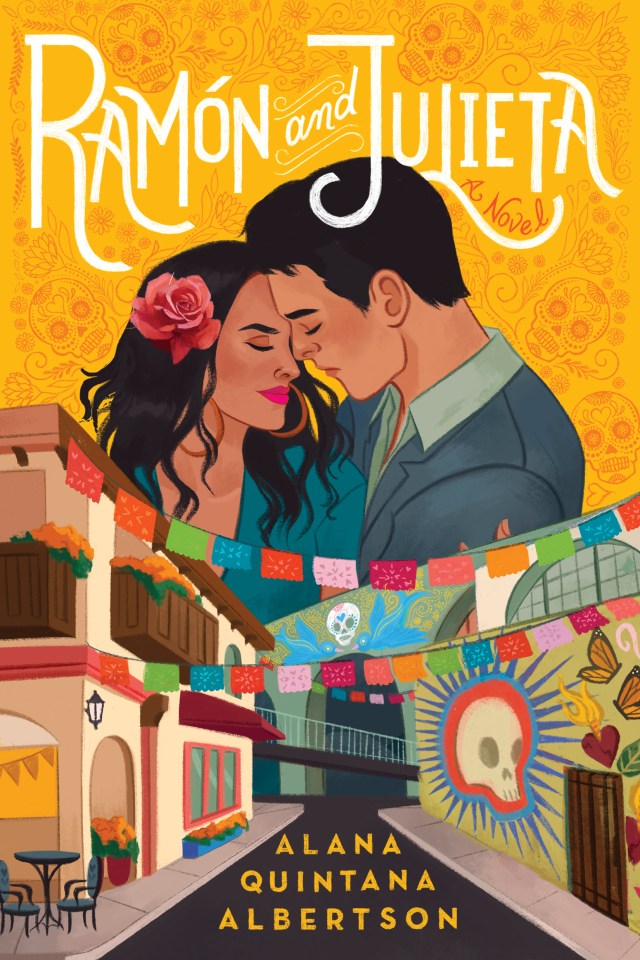
Audiobook Review: Ramón and Julieta by Alana Quintana Albertson

Title: Ramón and Julieta
Author: Alana Quintana Albertson
Narrators:  Alexander Amado, Vanessa Vasquez
Publisher: Berkley
Publication date: February 1, 2022
Print length: 304 pages
Audio length: 8 hours, 25 minute
Genre: Contemporary romance
Source: Library
Rating:

Rating: 3 out of 5.

When fate and tacos bring Ramón and Julieta together on the Day of the Dead, the star-crossed pair must make a choice: accept the bitter food rivalry that drives them apart or surrender to a love that consumes them.

Ramón Montez always achieves his goals. Whether that means collecting Ivy League degrees or growing his father’s fast-food empire, nothing sets Ramón off course. So when the sexy señorita who kissed him on the Day of the Dead runs off into the night with his heart, he determines to do whatever it takes to find her again.

Celebrity chef Julieta Campos has sacrificed everything to save her sea-to-table taqueria from closing. To her horror, she discovers that her new landlord is none other than the magnetic mariachi she hooked up with on Dia de los Muertos. Even worse, it was his father who stole her mother’s taco recipe decades ago. Julieta has no choice but to work with Ramón, the man who destroyed her life’s work–and the one man who tempts and inspires her.

As San Diego’s outraged community protests against the Taco King take-over and the divide between their families grows, Ramón and Julieta struggle to balance the rising tensions. But Ramón knows that true love is priceless and despite all of his successes, this is the one battle he refuses to lose. 

The vibrancy of Mexican culture in a San Diego neighborhood is threatened by gentrification — and in this contemporary romance version of Romeo and Juliet (spoiler alert — with a much happier ending!), a Day of the Dead meet-cute throws together members of rival families with a long, bitter history.

from the author’s website

Dia de los Muertos is a very big deal in Old Town, San Diego. Besides attracting tourists, for the Mexican community, it’s a day of beautiful traditions honoring their loved ones who’ve passed away. Julieta, chef at a popular, authentic local restaurant in Barrio Logan, plans to sell her specialty tacos at a pop-up stand at the festival, and Ramón, CEO of the multi-million-dollar family business that owns a hugely successful chain of Taco King fast food joints, is planning to schmooze up the local politicians and gain a little last-minute publicity before sealing the deal to buy an entire block of Barrio Logan.

Dressed in full Dia de los Muertos costumes and face paint, when Ramón and Julieta have a chance encounter in a garden near the festival, there’s instant attraction and a deeper connection as well — but they don’t exchange real names and can’t see one another’s faces. Tired of her responsiblities and lack of pleasure in her life, Julieta makes the impulsive decision to go home with Ramón, but once back in his La Jolla mansion, about to remove her face paint, she realizes who he really is — he’s the enemy.

Decades earlier, as Julieta’s been told countless times, her mother was a young woman selling home-made fish tacos at a stand in Mexico, when a Mexican-American student on a surfing trip during spring break fell in love with her and her tacos. He never returned as promised, but he stole her family’s secret recipe and turned it into the key to Taco King’s success. When Julieta realizes that Ramón is the son of her family’s nemesis, who profited off of her family’s recipe all these years without ever acknowledging or compensating them, she’s livid and appalled.

Things become even worse the following day when Ramon’s offer on the block in Barrio Logan is accepted. Ramón’s father plans to raise all the rents, force the existing businesses out, and replace Julieta’s lovely restaurant with a flagship location for a new Taco King. This is war! But also, this is love… because despite their stance on opposing sides of this gentrification battle, Ramón and Julieta can’t deny their feeling or their attraction for one another.

from the author’s website

I enjoyed the depiction of the close-knit community of Barrio Logan, the sense of tradition and pride in the Mexican culture of the residents, and the absolutely amazing-sounding descriptions of spices and flavors and foods. But, these great elements are in many ways background to the romance, and that’s where the book didn’t particularly work for me.

First of all, the characters: Not only is Ramón CEO of the family empire, he’s also Stanford and Harvard educated. Not only is Julieta an amazing chef, but she’s been trained at Michelin-starred restaurants. [Side note: Why does every romance novel about foodies throw around Michelin stars? Why does everyone in business need a Harvard MBA?] They’re both gorgeous and have amazing bodies, of course. They’re not just reasonably nice people who meet and connect — they’re both stellar in every way. It’s too much.

Second, I just couldn’t help cringing over their dialogue and their inner thoughts. Within seconds of meeting, Julieta is admiring how good Ramón looks in his costume, including “that huge bulge in his pants”. But don’t worry, the ogling is two-sided, as Ramón notes about Julieta: “That ass was the kind that songs were written about”.

The supposedly romantic moments are super corny, and the sexy/steamy scenes are unnecessarily specific and graphic. Then again, I recognize that preferences about graphic vs implied sex vary widely among romance readers, so while this aspect didn’t work for me, it may not be a deal-breaker for other readers.

The audiobook features different narrators for chapters from Ramón and Julieta’s perspectives, although they each still have to depict the other character whenever there are scenes together, which means there are two different voices each for Ramón and Julieta — a little weird at times, since they sound so different. It’s a light listen, and overall, the audiobook presentation is well done and entertaining.

I gave Ramón and Julieta 3 stars: I really liked the creative use of Shakespearean inspiration in telling a modern tale and the way the story honors and depicts elements of Mexican heritage and the strong sense of community. It doesn’t rise above 3 stars for me, though, because of the hokiness of the love story — which, in a romance, should be its strongest element.

Ramón and Julieta is enjoyable, despite the cringe-factor. Apparently, it’s the first in a planned series called Love and Tacos. The pieces that didn’t work for me are enough to make me doubt whether I’d want to come back for more.