Book Review: Light from Uncommon Stars by Ryka Aoka

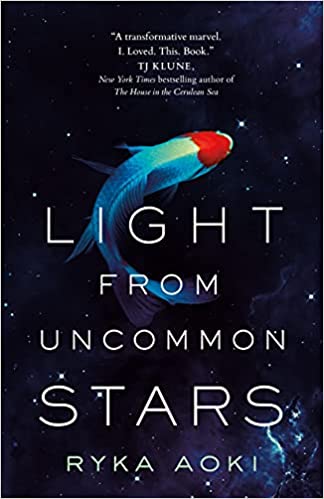
Title: Light from Uncommon Stars
Author: Ryka Aoki
Publisher: Tor
Publication date: September 28, 2021
Length: 384 pages
Genre: Science fiction / fantasy
Source: Purchased
Rating:

Rating: 3 out of 5.

A defiantly joyful adventure set in California’s San Gabriel Valley, with cursed violins, Faustian bargains, and queer alien courtship over fresh-made donuts.

Shizuka Satomi made a deal with the devil: to escape damnation, she must entice seven other violin prodigies to trade their souls for success. She has already delivered six. When Katrina Nguyen, a young transgender runaway, catches Shizuka’s ear with her wild talent, Shizuka can almost feel the curse lifting. She’s found her final candidate. But in a donut shop off a bustling highway in the San Gabriel Valley, Shizuka meets Lan Tran, retired starship captain, interstellar refugee, and mother of four. Shizuka doesn’t have time for crushes or coffee dates, what with her very soul on the line, but Lan’s kind smile and eyes like stars might just redefine a soul’s worth. And maybe something as small as a warm donut is powerful enough to break a curse as vast as the California coastline.

As the lives of these three women become entangled by chance and fate, a story of magic, identity, curses, and hope begins, and a family worth crossing the universe for is found.

Light from Uncommon Stars has been on my to-read shelf for a few years now, and even though I picked up a Kindle edition a while back, it’s taken me until now to finally read it. And while I sped through it and enjoyed the reading experience, my overall reaction is… mixed.

There is a lot going on in Light from Uncommon Stars. The three main characters are a transgender teen runaway, a violin teacher who made a deal with the devil many years earlier, and an alien starship captain hiding from intergalactic war in a donut shop. The characters come together in strange, quirky, and even touching circumstances, while also having individual challenges to overcome.

Katrina, the young runaway, is the most affecting of the characters. Escaping a cruel, abusive family and a world that judges and mistreats her, she has only her battered violin for comfort.

Yet, this student, this human being, had been forsaken not for ambition, nor revenge, nor even love, but for merely existing?

Who needs the Devil when people can create a hell like this themselves?

When Shizuka meets her in a park, she recognizes that Katrina may be the final protégé needed to fulfill her bargain — she needs to deliver one more soul to Hell in order to redeem her own soul. But as Shizuka starts to teach Katrina and provide her with a home, the protectiveness she feels for her student may prevent her from living up to the deal she’s made.

Meanwhile, Shizuka also meets Lan, the space-captain-turned-donut-shop-owner, and feels an unexpected connection — but Lan has her own family to protect and worry about as well, and can’t quite get why music is all that important to Shizuka.

There’s also a woman carrying out her family’s legacy of repairing violins, a nasty toad-like demon, Shizuka’s lovely housekeeper/confidante, and many, many more characters.

Light from Uncommon Stars has some important messages about belonging, kindness, fitting in, and treasuring one another. It recognizes that cruelty abounds in the world, yet beauty can still be found by those who are open to it.

The characters, especially Katrina, are quite special, and each of them is interesting in their own right, as well as in connection to one another. Again, Katrina’s journey is especially compelling, as she finally recognizes her own beauty in a world that tells her she doesn’t deserve it.

Her tonality had been honed by a lifetime of being concerned with her voice. Her fingerings were liquid, born of years of not wanting her hands to make ugly motions. And her ability to play to a crowd, project emotion, follow physical cues? Katrina had trained in that most of all.

The focus on music is where the book loses me along the way — there’s just so much about the composition and structure of violins, how they work, different pieces of music, composers, what the music means… honestly, it just doesn’t interest me that much, which meant that for big chunks of the book, I felt like an outsider looking in.

As I mentioned, there’s a LOT going on in this book… and for me, it was too much. Deals with the devil and extraterrestrials, cursed bows and spaceships? Plus, violin lessons and competitions and secrets of the violin-building trade? It’s all a bit messy, and doesn’t ever quite fully click into one coherent whole.

I do need to mention that the descriptions of the wide variety of food — Vietnamese, Mexican, Chinese — junk food and donuts and breads, and much, much more — is all mouth-watering and adds a richness to the characters’ experience that brings the Southern California setting to vivid life.

I expected to love this book — it’s gotten so much hype, and is blurbed by a bunch of authors I love, including T. J. Klune and John Scalzi, among others. I read the book quickly and felt absorbed enough to want to see how it would all work out… but taken as a whole, Light from Uncommon Stars was not the glorious reading experience I expected. Perhaps this just wasn’t the book for me. In any case, I’m glad to have read it, but couldn’t help feeling a bit let down.

Book Review: The Mercy of Gods (The Captive’s War, #1) by James S. A. Corey

Title: The Mercy of Gods
Series: The Captive’s War, #1
Author: James S. A. Corey
Publisher: Orbit
Publication date: August 6, 2024
Length: 433 pages
Genre: Science fiction
Source: Review copy courtesy of the publisher via NetGalley
Rating:

Rating: 5 out of 5.

How humanity came to the planet called Anjiin is lost in the fog of history, but that history is about to end.

The Carryx—part empire, part hive—have waged wars of conquest for centuries, destroying or enslaving species across the galaxy. Now, they are facing a great and deathless enemy. The key to their survival may rest with the humans of Anjiin.

Caught up in academic intrigue and affairs of the heart, Dafyd Alkhor is pleased just to be an assistant to a brilliant scientist and his celebrated research team. Then the Carryx ships descend, decimating the human population and taking the best and brightest of Anjiin society away to serve on the Carryx homeworld, and Dafyd is swept along with them.

They are dropped in the middle of a struggle they barely understand, set in a competition against the other captive species with extinction as the price of failure. Only Dafyd and a handful of his companions see past the Darwinian contest to the deeper game that they must play to survive: learning to understand—and manipulate—the Carryx themselves.

With a noble but suicidal human rebellion on one hand and strange and murderous enemies on the other, the team pays a terrible price to become the trusted servants of their new rulers.

Dafyd Alkhor is a simple man swept up in events that are beyond his control and more vast than his imagination. He will become the champion of humanity and its betrayer, the most hated man in history and the guardian of his people.

This is where his story begins.

I’m not sure how an author (or in this case, an author duo) manages to start something new after completing what could easily be considered their magnum opus. Fortunately for readers, James S. A. Corey has done just that, and have published their first novel since the conclusion of The Expanse series. And it’s a doozy.

The Mercy of Gods opens by introducing us to humans on their home world, Anjiin. No one quite knows how humans ended up on this planet**, whose native flora and fauna are not compatible with human biology — but there they are, and have been for thousands of years. As the story opens, another year of scientific achievement is wrapping up with a celebration, and no one is more lauded than rockstar scientist Tonner Freis and his team of researchers.

**I’m sure this is just me going off on a wild goose chase, but could these humans on Anjiin have originally passed through the gate in the Expanse series to a new world? Perhaps this is all happening several thousand years later… just a thought.

Trouble looms when lowly research assistant Dafyd Alkhor catches wind that their team may be acquired and split up by rival labs. That devastating news is quickly overshadowed by a world-changing cataclysm, as Anjiin is attacked and quickly defeated by the invading forces of the Carryx — proving for the first time that humans are not alone in the universe.

The Carryx are vastly superior in technology and firepower, and humans don’t stand a chance. The research team and countless others are rounded up, taken aboard a Carryx ship, and transported back to their world, where the nature of their new lives soon becomes apparent. The Carryx evaluate humans and all other captive species by one metric — how useful are they? If Dafyd and the others want to survive, they have to demonstrate their utility. Species that can’t or won’t live up to this standard are eliminated. There’s no mercy, there’s no kindness — and hope seems pointless. Humans are chattel; Carryx see them as animals, just the same as the many other species they’re penned up with.

As the first in a series, The Mercy of Gods has a lot of heavy lifting to do in terms of world building, and this is literally the case as life on Anjiin is established, as is the new world the human captives find themselves in after being captured. It’s a lot to take in, and requires a great deal of concentration, but it’s well worth the effort.

The plot of The Mercy of Gods is complicated, and the authors throw a lot at readers right from the start, with terminology and structures and societal norms introduced without explanation. We can figure it out, eventually, but at least for me, it was a struggle for the first third or so of the book to find a rhythm. (Oddly, once the alien invasion begins, I found the plot and writing easier to follow, and ended up completely immersed.)

Does The Mercy of Gods live up to The Expanse? Well, it’s probably not fair to compare the first book in a series to a series that’s already complete. Still, I have opinions! While I found the plot, the conflicts, and the concepts in The Mercy of Gods fascinating, I didn’t feel the same sort of connection to the characters themselves as I did with the characters of The Expanse. Yes, the characters of The Mercy of Gods are interesting, some more so than others, and the relationships, needs, and motivations of the characters make for compelling conflicts and circumstances. Still, I didn’t feel an emotional connection to these people — but perhaps that will come with the rest of the books in the series, as the story continues to build and deepen.

The synopsis, as well as some asides early in the book, all make clear that Dafyd will be a driving force in whatever is yet to come. He’s referred to as “champion of humanity and its betrayer, the most hated man in history and the guardian of his people” — and I haven’t seen that yet, or at least, not more than just the earliest steps toward what’s to come. I’m frustrated to not know more… but also appreciate how well the suspense is built up by the end of The Mercy of Gods. I need the next book!

All in all, The Mercy of Gods is a fantastic read. While initially a bit challenging to get into, it quickly becomes an absorbing, frightening, high stakes story that’s impossible to put down.

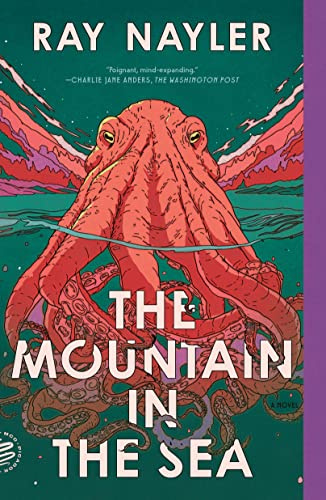
Book Review: The Mountain in the Sea by Ray Nayler

Title: The Mountain in the Sea
Author: Ray Nayler
Publisher: Picador
Publication date: October 4, 2022
Length: 464 pages
Genre: Science fiction
Source: Purchased
Rating:

Rating: 4 out of 5.

Humankind discovers intelligent life in an octopus species with its own language and culture, and sets off a high-stakes global competition to dominate the future.

Rumors begin to spread of a species of hyperintelligent, dangerous octopus that may have developed its own language and culture. Marine biologist Dr. Ha Nguyen, who has spent her life researching cephalopod intelligence, will do anything for the chance to study them.

The transnational tech corporation DIANIMA has sealed the remote Con Dao Archipelago, where the octopuses were discovered, off from the world. Dr. Nguyen joins DIANIMA’s team on the islands: a battle-scarred security agent and the world’s first android.

The octopuses hold the key to unprecedented breakthroughs in extrahuman intelligence. The stakes are high: there are vast fortunes to be made by whoever can take advantage of the octopuses’ advancements, and as Dr. Nguyen struggles to communicate with the newly discovered species, forces larger than DIANIMA close in to seize the octopuses for themselves.

But no one has yet asked the octopuses what they think. And what they might do about it.

A near-future thriller about the nature of consciousness, Ray Nayler’s The Mountain in the Sea is a dazzling literary debut and a mind-blowing dive into the treasure and wreckage of humankind’s legacy.

The Mountain in the Sea had been on my radar for a while, so I was happy to have my book group discussion as motivation to finally pick it up and read it! The Mountain in the Sea is a first-contact story, but also a deep-dive (sorry, hard to avoid ocean-related punning!) into the meaning of consciousness, communication, and perception.

The main plotline of this complicated book centers on researcher Dr. Ha Nguyen, whose focus is on communication across species and whether such a thing is truly possible. She arrives, via high-tech security, on the island of Con Dao, part of an archipelago purchased by the DIANIMA corporation and sealed off from the outside world via the heavy weaponry used to defend its perimeters.

But Con Dao is not just a nature preserve, shielding marine biology from a world that plunders the remaining global supply of sea life in a quest for protein for a world on the brink of starvation. It also hides a discovery that could upend human understanding of consciousness and perception.

Before the population of Con Dao was relocated by DIANIMA, rumors abounded about a sea monster, a scary and possibly supernatural being that stalked the shores and left death in its wake. But as Ha discovers, the truth is less supernatural and far more wondrous — a species of octopus that has developed symbolic communication, enabling the sharing of knowledge across generations. The octopus community that the researchers discover does not welcome intrusion, and issues clear warning that the humans should stay away… or else.

Meanwhile, the book also introduces various shady figures who seek access to the most heavily guarded of AI systems, and who will kill to keep their secrets. Some fascinating concepts are introduced, including what’s known as a “point-five” — a virtual companion who communicates and interacts with a person in such a realistic way that they’re indistinguishable from a real human, but custom-made to suit as a partner.

There’s also a plot thread about an AI-driven illegal fishing vessel trawling the seas, crewed by people kidnapped and enslaved and a team of human guards — but the ship’s functions and actions are entirely controlled by its AI core, and all of the people are dispensable. It’s scary and horrifying, but entirely believable.

“The great and terrible thing about humankind is simply this: we will always do what we are capable of.”

Some of the science discussion probably went over my head, and there’s a lot — almost too much — talk about the meaning of consciousness and what defines being a human — but overall, the storylines are fascinating.

I wished that the aspects showing Ha’s deciphering of the octopus symbols and her attempts at communication were a bigger part of the overall story. This is the piece that interested me the most, but it’s just one part of the whole, and I wanted more, especially to see where it goes from where the story ends.

Also, I could have done with less of the corporate espionage plotlines — they build out the world of the book, but are far removed from the central element — spending time learning about the octopus consciousness.

Reading The Mountain in the Sea brough to mind the non-fiction book An Immense World, which I read last year. If you’re interested in understanding how animal senses shape the way they perceive the world, I recommend checking it out.

I was also vastly entertained by the number of words I had to look up while reading! This tends to be the case with any book with a science or technology focus, but it amused me to see just how many there were in The Mountain in the Sea. Some new-to-me words included:

  • senescent
  • icosahedral
  • qualia
  • benthic
  • exapted
  • sfumato
  • peristyle
  • arcature
  • manuport

The Moutain in the Sea is a deeply engrossing book with themes concerning humanity, connection, and communication, and it explores the risks and barriers inherent in a first contact situation — in this case, not between humans and aliens, as we so often see in science fiction, but between two vastly different species inhabiting the same planet.

Despite the book’s length, it’s a fast read, largely because it’s impossible to put the book down. The Mountain in the Sea is not a light read, but it’s worth the effort to experience this thought-provoking, startling story.

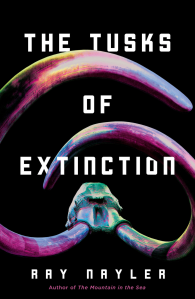
Novella review: The Tusks of Extinction by Ray Nayler

 Title: The Tusks of Extinction
Author: Ray Nayler
Publisher: Tor Books
Publication date: January 16, 2024
Length: 192 pages
Genre: Science fiction
Source: Review copy courtesy of the publisher via NetGalley
Rating:

Rating: 4 out of 5.

When you bring back a long-extinct species, there’s more to success than the DNA.

Moscow has resurrected the mammoth, but someone must teach them how to be mammoths, or they are doomed to die out, again.

The late Dr. Damira Khismatullina, the world’s foremost expert in elephant behavior, is called in to help. While she was murdered a year ago, her digitized consciousness is uploaded into the brain of a mammoth.

Can she help the magnificent creatures fend off poachers long enough for their species to take hold?

And will she ever discover the real reason they were brought back?

A tense eco-thriller from a new master of the genre.

The synopsis kind of says it all, yet doesn’t do justice to the weirdness and wonder of The Tusks of Extinction.

The main plot points are as described: A scientist who devoted herself to studying elephants, and lost her life in the doomed fight against poachers, is returned one hundred years after her murder to a new life thanks to the digital brain mapping made before her death.

Damira’s driving passion was to save the elephants — a passion that failed. Elephants are now extinct in the wild, with only a few specimens still living on in captivity. But a team of scientists has reconstructed mammoths through the wonders of genetic technology, and new herds wander the Siberian steppes. The problem, though, is that the mammoths were gestated and raised by captive elephants. They have no social structures with species memory, and lack the skills needed to survive and thrive in the wild.

Damira’s conciousness, transferred into the brain of a mammoth matriarch, has the ability to change all that. She understands elephant dynamics better than anyone, living or dead. With Damira leading the herd, the mammoths finally have a chance to reclaim their place in the world, and perhaps reclaim space for other resurrected species as well. But poachers are still as ruthless as ever, and the black market value of mammoth tusks can make people unimaginably wealthy. It may not be enough for Damira to simply teach the mammoths the ways of elephants — she may also have to teach them to fight back.

Giants may walk the earth again, but for how long? The problem you are trying to solve — how to bring animals back from extinction — it’s the wrong problem. Extinction has only one cause, and that cause is older, even, than the wheel. That cause is human greed.

As I said, this is a weird concept and a weird story, and yet, I really loved it. We learn about Damira through flashbacks and scenes of her present life, and the author presents mammoth thought processes in a fascinating way. At the same time, we follow poachers and hunters with varying motivations, learn about what their purposes are, and follow them to their fates.

Power was the ability to destroy without needing to. To do it not out of necessity, but as an act of pure excess. To do something to someone else simply because you could. And this was perhaps the greatest power of all: to kill something that no one else could kill.

To have a miracle resurrected — and then destroy it.

The writing is beautiful, with harsh truths about humanity’s future and the future of life on the planet. Through Damira, we’re shown reflections on the role of our pasts and how they shape our present. Damira’s thoughts flow across time, weaving together the disparate threads of her life to see the patterns that brought her to her new existence:

Whoever can remember is real. A being that remembers is alive, and authentic. I am here. That is enough.

The Tusks of Extinction is sad and awe-inspiring and thought-provoking. It’s definitely unlike anything else I’ve read. I’m looking forward to reading this author’s debut novel. The Mountain in the Sea, with my book group later this year.

Audiobook Review: Starter Villain by John Scalzi

Title: Starter Villain
Author: John Scalzi
Narrator: Wil Wheaton
Publisher: Tor
Publication date: September 29, 2023
Print length: 264 pages
Audio length: 8 hours 5 minutes
Genre: Science fiction
Source: Purchased
Rating:

Rating: 4.5 out of 5.

Inheriting your uncle’s supervillain business is more complicated than you might think. Particularly when you discover who’s running the place.

Charlie’s life is going nowhere fast. A divorced substitute teacher living with his cat in a house his siblings want to sell, all he wants is to open a pub downtown, if only the bank will approve his loan.

Then his long-lost uncle Jake dies and leaves his supervillain business (complete with island volcano lair) to Charlie.

But becoming a supervillain isn’t all giant laser death rays and lava pits. Jake had enemies, and now they’re coming after Charlie. His uncle might have been a stand-up, old-fashioned kind of villain, but these are the real thing: rich, soulless predators backed by multinational corporations and venture capital.

It’s up to Charlie to win the war his uncle started against a league of supervillains. But with unionized dolphins, hyperintelligent talking spy cats, and a terrifying henchperson at his side, going bad is starting to look pretty good.

In a dog-eat-dog world…be a cat.

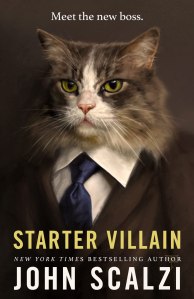
First things first: Don’t be fooled by the cover. There are no cats wearing suits in this novel.

However, there are cats, and they are important, and they are amazing. Also, the author dedicates the novel to his own cats… so there you have it: Starter Villain is decidedly pro-cat. And it’s awesome.

In Starter Villain, Charlie Fitzer has been laid off from his journalism job, works as a substitute teacher, lives in a house he co-owns with his half-siblings (who all want to sell it), and hangs out with his cat Hera. He dreams of buying the local pub and making a go of it, but considering his lack of money or collateral, the chances of securing a small business loan are nil.

When Charlie’s long-estranged uncle Jake dies, it’s newsworthy, in that Jake was a multimillionaire who made his fortune in the exciting world of parking garage ownership. But it’s merely a blip for Charlie, who hasn’t seen his uncle since he was five years old.

Charlie’s life takes a turn for the weird and interesting when he’s left a bequest from Jake, conditional on Charlie standing up to represent the family at Jake’s funeral. As Jake’s only living relative, and with a potential reward to look forward to, Charlie agrees. And then the funeral is filled up by thugs and flower arrangements with very angry and/or obscene messages attached, and Charlie starts to realize that his uncle’s life might have entailed a bit more than just those parking garages.

So yes, as the synopsis explains, it turns out that Uncle Jake was a supervillain, and as his heir, Charlie is now expected to fill his villainous shoes. (And yes, there is a volcano lair, which Charlie is super excited about).

With high stakes technology, evil overlords, and dolphins seeking fair representation, it’s an understatement to say that Starter Villain goes in unexpected directions. It’s fast, silly, and full of surprises (not to mention lots of cats), and is totally fun from start to finish.

“… I’m here on an island in the Caribbean, being told I need to talk to the dolphins in the middle of a labor action about some whales that might have torpedoes, armed by a secret society of villains who want access to a storeroom full of objects probably looted from the victims of the friggin’ Nazis and who are maybe willing to blow up my volcano lair to get it.”

I always love Scalzi’s books, and it’s clear the author himself is having a great time. Starter Villain does not take itself seriously for even a moment, and the result is peak sci-fi entertainment.

“Request delivery of the second target package on my mark.” Gratas looked at me and smiled. “Here it comes, Charlie,” he said.

“Request confirmed and denied,” the voice on the other end of the line said.

“Excuse me?” Gratas looked confused.

“Request confirmed and denied,” the voice repeated.

“You’re denying my request.”

“Confirm, we’re denying it.”

“You can’t deny it.”

“Your denial of our denial is confirmed and denied,” the voice said.

The audiobook is narrated by Wil Wheaton — he does such an amazing job with Scalzi’s books that even when I read them in print, I hear Wheaton’s voice in my head. He’s expressive and hilarious — and you have to admire a narrator who can pull off assassins, tech bros, and foul-mouthed dolphins quite so well.

Starter Villain was one of the books I was most looking forward to this year, and I’m happy to say that it absolutely lived up to expectations. This audiobook was a much-needed ray of sunshine this week. I loved it!


SOLVED! Re: Calling on the hive mind! Help me find a story I only sort of remember…

Photo by Pixabay on Pexels.com

Earlier this week, I asked the bookish community to help me identify a book I only kinda, sorta remembered from my college days.

Lo and behold, the answer came not from another book blogger, but from my sister, who only occasionally checks out what I post about, but happened to see this particular post this week!

What can I say? Sisters rock.

Thank you to everyone who offered either suggestions or resources for further digging. I appreciate the input!

And now, for the big reveal…

The original query was for a book or story with the following elements:

  • It’s sci-fi / speculative fiction
  • No idea if it’s a short story or if we read an excerpt from a full-length book
  • The plot revolves around a society consisting only of women
  • I think (maybe) men are allowed to live somewhere nearby, and there’s contact between the groups for reproductive purposes (note: I was wrong about the reproduction part — must have been thinking of something else!)
  • The women have telepathic/empathic abilities
  • There’s something about a woman sitting up in a tree, using her telepathy to expand her consciouness outward in order to stand watch over the community
  • Someone who uses her telepathy to invade another person’s thoughts is punished — maybe exiled?
  • This would have been written no later than the early 1980s.

Based on my sister’s input, which I’m pretty certain is the right answer, the book I’ve been thinking of is:

The Wanderground by Sally Miller Gearhart
Originally published 1978

Synopsis (Goodreads):

In a world where girls can no longer wear pants, only skirts and hose; women’s Sunday softball is discontinued; shorter rest periods on the job exist so that women can’t socialize; and a ten o’clock curfew is created for increasing the protection for women – an exodus begins. This monumental move separates men and women, such that many women flee to the hills for freedom, while men remain in the cities.

Leading us through the women’s shared stories of survival, remembrance, and self-discovery, Wanderground brings us years later to a future, present with spiritual awakening. Here, the hill women have gained telepathic abilities, unique flying and healing techniques, and go on tours of duty to assist women in the cities still struggling for enlightenment.

According to Wikipedia, The Wanderground “is Gearhart’s first and most famous novel, and continues to be used in women’s studies classes as a characteristic example of the separatist feminism movement from the 1970s.” Bingo! Based on the Wikipedia details, I feel 99% sure that this is the book I was thinking of, although I still don’t know if I read the whole thing way back when or (more likely) an excerpt as part of a class syllabus.

This is so exciting! Trying to figure out this half-remembered book has been like an itch in my brain for a long time now. My library has a single copy available to request, and I’m looking forward to checking it out!

Thanks, once again, to the people who offered ideas, and a big THANK YOU (todah rabah!) to my sister!

Calling on the hive mind! Help me find a story I only sort of remember…

Photo by Pixabay on Pexels.com

Calling on all you wonderful book lovers and avid readers!

I’ve had a memory of a story in my mind for a while now, and it’s driving me bonkers. I need your help figuring out what this could be!

I read a story for women’s studies class back in college, and here’s all I can piece together about it:

  • It’s sci-fi / speculative fiction
  • No idea if it’s a short story or if we read an excerpt from a full-length book
  • The plot revolves around a society consisting only of women
  • I think (maybe) men are allowed to live somewhere nearby, and there’s contact between the groups for reproductive purposes
  • The women have telepathic/empathic abilities
  • There’s something about a woman sitting up in a tree, using her telepathy to expand her consciouness outward in order to stand watch over the community
  • Someone who uses her telepathy to invade another person’s thoughts is punished — maybe exiled?
  • This would have been written no later than the early 1980s.

(I wondered if what I remembered might be connected to Herland by Charlotte Perkins Gilman, but now that I’ve read Herland, I know it’s not.)

That’s about all I remember.

Any ideas?

Novella two-fer: The Expert System’s Brother and The Expert System’s Champion by Adrian Tchaikovsky

I recently read a science fiction duology from the gifted mind of Adrian Tchaikovsky, and I’m here to share some thoughts!


The Expert System’s Brother
Length: 167 pages
Published: 2018
Rating:

Rating: 4.5 out of 5.

After an unfortunate accident, Handry is forced to wander a world he doesn’t understand, searching for meaning. He soon discovers that the life he thought he knew is far stranger than he could even possibly imagine.

Can an unlikely saviour provide the answers to the questions he barely comprehends?

In the first book, we meet Handry, a young man who lives in the village of Aro, where people work together, live in harmony, and follow the guidance of the Lawgiver. But those who don’t act as expected and who blow their chances to make amends are cast out through a process called Severance — and once severed, they don’t typically survive long.

When Handry is accidentally partially Severed, he’s forced out into the wilderness, where he learns startling truths about the origins of his world’s scattered villages.

This powerful story demonstrates how history becomes myth after enough time goes by, and how technology itself can take on the role of gods and ghosts for those who have no other context for its wonders.

Fascinating, start to finish!

The Expert System’s Champion
Length: 194 pages
Published: 2021
Rating:

Rating: 4 out of 5.

It’s been ten years since Handry was wrenched away from his family and friends, forced to wander a world he no longer understood. But with the help of the Ancients, he has cobbled together a life, of sorts, for himself and his fellow outcasts.

Wandering from village to village, welcoming the folk that the townships abandon, fighting the monsters the villagers cannot—or dare not—his ever-growing band of misfits has become the stuff of legend, a story told by parents to keep unruly children in line.

But there is something new and dangerous in the world, and the beasts of the land are acting against their nature, destroying the towns they once left in peace.

And for the first time in memory, the Ancients have no wisdom to offer…

In this second novella, we’re taken back in history in interludes that provide a different view on the origins of humanity on this hostile planet. Meanwhile, Handry is now the leader of a group of outcasts, and what they encounter tests them physically and mentally.

The System Expert’s Champion introduces new elements to the setting introduced in the first novella, and adds in certain developments that verge on horror (pretty icky!). It’s all fascinating, though, and expands our understanding of both the past and future of human life on this planet.

Read together, these two novellas make an utterly immersive and compelling experience! The world is complex, alien, and dangerous, and while it takes a while to understand what’s happened to the people there and why their lives are the way they are, the answers that do emerge add up to an amazing payoff.

I’m trying to avoid saying too much about the plot or the reasons behind what happens — this is all best experienced fresh and without much information in advance.

What I can say is that Adrian Tchaikovsky is a gifted, creative writer and creator of worlds, and these two novellas are absolutely worth checking out.

Book Review: Citizen of the Galaxy by Robert A. Heinlein

Title: Citizen of the Galaxy
Author: Robert A. Heinlein
Publication date: 1957
Length: 282 pages
Genre: Science fiction
Source: Purchased

Rating: 4 out of 5.

In a distant galaxy, the atrocity of slavery was alive and well, and young Thorby was just another orphaned boy sold at auction. But his new owner, Baslim, is not the disabled beggar he appears to be: adopting Thorby as his son, he fights relentlessly as an abolitionist spy. When the authorities close in on Baslim, Thorby must ride with the Free Traders — a league of merchant princes — throughout the many worlds of a hostile galaxy, finding the courage to live by his wits and fight his way from society’s lowest rung. But Thorby’s destiny will be forever changed when he discovers the truth about his own identity…

What a treat to “discover” a classic sci-fi that I might have missed if not for my book group. This was an unusual choice for us, but we do like to mix things up on occasion, and I’m so glad Citizen of the Galaxy made this year’s list!

Citizen of the Galaxy is the story of Thorby, a boy captured and enslaved at such a young age that he has no memory of anything else. Alone, mistreated, and hopeless, he’s sold at auction to a beggar named Baslim the Cripple, who is not at all what he seems. Baslim raises Thorby with love, morality, and an education. Upon Baslim’s death, teenaged Thorby must escape from the repressive planet they lived on and find his own way, assisted by subliminal messages implanted in his mind by Baslim. From there, Thorby’s adventures take him to a family of Free Traders, a military ship, and finally back to Terra, where he discovers his true origins once and for all.

This is a fast-paced book, and Thorby is a sympathetic, likable main character. His adventures take us into unusually structured societies which are fascinating to read about. Ultimately, as he reclaims his heritage on Terra and assumes adult responsibilities, he realizes that freedom isn’t about running off to follow his heart’s desire, but taking on the job he knows he needs to do in order to fix at least some of his family’s wrong-doings.

I had a great time reading Citizen of the Galaxy, although the final sections bog down a bit in untangling corporate schemes and dealing with the legal system. Still, this is a top-notch science fiction from an earlier era of sci-fi writing, and I appreciate the messages and themes tucked in amidst the fun and action.

It’s been ages since I’ve read any Heinlein, and Citizen of the Galaxy has sparked my interest in reading more.

Are you a Heinlein fan? Any favorites to recommend?

Book Review: In the Lives of Puppets by TJ Klune

Title: In the Lives of Puppets
Author: TJ Klune
Publisher: Tor Books
Publication date: April 25, 2023
Length: 432 pages
Genre: Science fiction
Source: Review copy courtesy of the publisher via NetGalley
Rating:

Rating: 3 out of 5.

In a strange little home built into the branches of a grove of trees, live three robots–fatherly inventor android Giovanni Lawson, a pleasantly sadistic nurse machine, and a small vacuum desperate for love and attention. Victor Lawson, a human, lives there too. They’re a family, hidden and safe.

The day Vic salvages and repairs an unfamiliar android labelled “HAP,” he learns of a shared dark past between Hap and Gio-a past spent hunting humans.

When Hap unwittingly alerts robots from Gio’s former life to their whereabouts, the family is no longer hidden and safe. Gio is captured and taken back to his old laboratory in the City of Electric Dreams. So together, the rest of Vic’s assembled family must journey across an unforgiving and otherworldly country to rescue Gio from decommission, or worse, reprogramming.

Along the way to save Gio, amid conflicted feelings of betrayal and affection for Hap, Vic must decide for himself: Can he accept love with strings attached?

Author TJ Klune invites you deep into the heart of a peculiar forest and on the extraordinary journey of a family assembled from spare parts.

It absolutely pains me to give a TJ Klune book anything less than 5 stars… but alas, In the Lives of Puppets just didn’t hit the mark for me. This makes me sad! I’ve loved so many of the author’s books, but this tale of robots and found family — which is also a Pinocchio retelling — left me oddly uninvested.

In the Lives of Puppets is the story of a family of oddball robots and machines, living in an isolated forest grove, raising a human child named Victor. As the story gets underway, Victor is now 21, and spends his days in the company of his two best friends, a Roomba-type vacuum robot named Rambo and a medical care robot named Nurse Ratched, who seems to delight in heartless provision of medical treatments (except when she engages her Empathy Protocols and offers a soothing “there, there” to her potential patient).

The trio also live with Gio (Giovanni), an older android who loves inventing, creating, listening to jazz music, and enjoying peaceful family time. Everything changes when Victor discovers a broken down android in the Scrap Yards that seems to still have a little power left in it. Once Victor repairs Hap, hidden secrets come to life, and soon the family’s entire existence is in peril.

In the Lives of Puppets is part exploration of love, family, and what it means to be a “real” human, and part road trip/adventure/quest. By the midpoint of the book, Victor and friends are off on a journey to the City of Electric Dreams to rescue Gio and, hopefully, restore him to his true self.

The writing can be very funny, especially Rambo and Nurse Ratched’s lines. These are probably my favorite parts of the book.

“Are we lost?” Rambo asked nervously.

“Of course not,” Nurse Ratched said. “I know exactly where we are.”

“Oh. Where are we?”

“In the forest.”

“Whew,” Rambo said. “I was worried for a moment that we were lost. Since we’re not, I will instead focus on the fact that we’re in the middle of the woods at night by ourselves. Do big animals like to eat vacuums?”

“I am sure they do,” Nurse Ratched said.

“Oh no,” Rambo whispered. “But I’m a vacuum.”

As the for story threads about emotions and connection and humanity… I was left largely unmoved, and the quest elements mostly failed to hold my interest.

I have to admit, overall this book was a letdown. As I mentioned, I usually adore this author’s work, and can’t really understand why In the Lives of Puppets just did not click for me. In any case, I’ll still be tuning in for whatever he writes next, and meanwhile will look to read some of his backlist titles too.