Thursday Quotables: Archetype

quotation-marks4

Welcome back to Thursday Quotables! This weekly feature is the place to highlight a great quote, line, or passage discovered during your reading each week.  Whether it’s something funny, startling, gut-wrenching, or just really beautifully written, Thursday Quotables is where my favorite lines of the week will be, and you’re invited to join in!

Archetype

Archetype by M. D. Waters
Release date: February 6, 2014

His lips part to say something, but I cannot wait any longer. I kiss him. He does not stop it, but his hands hover over my cheeks as if debating it. Finally — finally — his hands tighten on either side of my head and his return kiss is desperate. This kiss feels as if it is my first breath after a lifetime of being forced to hold it. I want to cry and laugh and scream and claw and crawl inside him. I do not care that I do not understand what has happened, because nothing matters more than being with him in this moment. Holding him. Feeling him. Tasting him.

Wow. Steamy, right?

Happy book birthday to Archetype! Be sure to check out my review of this smart, sexy, and altogether mesmerizing new science fiction novel!

What lines made you laugh, cry, or gasp this week? Do tell!

If you’d like to participate in Thursday Quotables, it’s really simple:

  • Write a Thursday Quotables post on your blog. Try to pick something from whatever you’re reading now. And please be sure to include a link back to Bookshelf Fantasies in your post (http://www.bookshelffantasies.com), if you’d be so kind!
  • Leave your link in the comments — or, if you have a quote to share but not a blog post, you can leave your quote in the comments too!
  • Visit other linked blogs to view their Thursday Quotables, and have fun!

Book Review: Archetype by M. D. Waters

Book Review: Archetype by M. D. Waters

ArchetypeSay you wake up in a hospital room with no memories. You’re told you’ve been in a terrible accident. There’s an incredibly handsome man sitting by your bedside, pledging his love and saying he’ll see you through your recovery. He’s your husband, after all. And he’s going to get you the very best of care, because he loves you with all his heart.

Be afraid. Be very afraid.

Well, that’s my take-away, in any case, after reading this scary, suspenseful, and altogther un-put-downable first novel by the very talented M. D. Waters. In this science fiction thriller, main character Emma wakes up in a high-tech hospital with no memories, surrounded by an elite medical team and with a very sexy man by her side, who only wants her to get better so they can continue their perfect lives together.

Problems? Well, there are the nightmares, for a start. Emma wakes in horrible trauma each night after dreaming of being trapped in a tank of water, unable to communicate, and watching a strange man who seems to be consumed by anger and grief. And that’s not all. On the nights without nightmares, there are other dreams: dreams of a beautiful beach, the arms of an unseen lover, and words of undying passion and commitment. And still more: dreams of battle, explosions, weapons, and danger. Are these delusions? Simple nightmares? Products of a damaged brain? Or is Emma starting to remember something — something that her husband wants to keep hidden?

Far be it from me to give anything away — but suffice it to say that all is not as it seems. Archetype takes place a couple of hundred years in the future, in a world quite similar to ours… but with much more pervasive technology, a United States that has divided into two separate countries following a civil war, a fertility crisis resulting in some very paternalistic laws around reproduction, and young women kept in restrictive Women’s Training Centers until age 18, when they are either bought and paid for by wealthy men who want families or assigned to a more menial role of support and subservience.

And yet, Emma’s husband Declan seems to really love her, and lavishes her with affection, patience, gifts, a lovely mountain home, and an art studio in which to pursue her newly awakened compulsion to paint landscapes. Declan is one hot guy, and just happens to be incredibly rich and powerful as well. Emma can’t help but be drawn to him, and there’s a connection between the two that just steams up the pages.

There’s more, lots more, but I absolutely want you all to experience Archetype for yourselves! I gobbled this book up within the space of 24 hours, because I just could not look away. And when I stopped for little things like eating or sleeping, I swear I kept turning over all the puzzles of the plot in my brain. There are so many clues, and so much to tease apart. What really happened to Emma? What do those dreams represent? Can Declan be trusted? Who is the mystery lover that Emma may or may not remember? There’s danger, there’s mystery, there’s passion, and there’s enough new and bizarre medical technology to make a sci-fi geek purr with contentment.

I loved the scientific and medical twists and turns, the strange new world of this alternate America, and of course, I loved Emma herself. She may be confused, but she’s not weak or a pushover, and it’s just thrilling to see her take control and try to outsmart everyone, stay ten steps ahead, and figure out how to survive — all without knowing whether anything she believes about herself or her life is actually true.

Normally, this is where you’d hear me complain about a book with a “to-be-continued” ending. Well, not this time. Yes, Archetype ends with a shocker of a cliffhanger, and yes, I’m dying to know more. But — thank you, thank you, thank you — the sequel, Prototype, will be out in July 2014! Now that’s some smart publishing! Anyone who reads Archetype will be practically salivating over the prospect of  a speedy sequel.

Archetype is one crazy roller coaster ride of a thrill, and plenty smart too. Read this book! But be prepared to lose sleep until you get to the very end.

_________________________________________

The details:

Title: Archetype
Author: M. D. Waters
Publisher: Dutton
Publication date: February 6, 2014
Length: 384 pages
Genre: Science fiction (adult)
Source: Review copy courtesy of Dutton

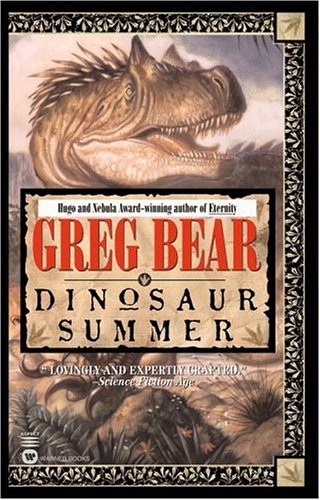
A book with the kiddo: Dinosaur Summer by Greg Bear

Book Review: Dinosaur  Summer by Greg Bear

dinosaur summerDinosaur Summer takes the 1912 novel The Lost World (by Sir Arthur Conan Doyle) as its starting point, imagining a world in which The Lost World is not fiction, but rather a history of a real discovery of dinosaurs living in an isolated world on a South American plateau.

It is 1947 when Dinosaur Summer opens, and the world has pretty much lost interest in the marvels of Conan Doyle’s discoveries. Dinosaurs had become so commonplace in the years since 1912 that all circuses had to have them — but in the post-war years, there just isn’t enough public demand to keep the dinosaur circuses running, and finally, the very last one is about to close for good.

15-year-old Peter Belzoni lives with his father Anthony, who is wild, impetuous, and prone to drinking too much. Anthony decides to bring Peter on the adventure of a lifetime by securing gigs for both of them with National Geographic, to photograph and write about an epic undertaking: the return of the last circus dinosaurs to their original homes on the El Grande plateau. Accompanying the expedition are filmmakers, trainers, and various local guides and authorities — and as the team sets sail and then journeys through the jungles and rivers of South America, the trip becomes more and more dangerous.

I read this book with my 11-year-old son, based on the recommendation of an old friend who is a terrifically well-read sci-fi connoisseur. But note: Dinosaur Summer is not a kids’ book! As far as I can tell, this is adult science fiction — but with an angle that definitely appealed to my kiddo.

We enjoyed the action, the drama, the danger, and the humorous dialogue. In Dinosaur Summer, the lost world of El Grande has evolved on its own, in isolation from the rest of the world. Consequently, the animal species are unique (and fictional, for the most part). The author helpfully includes a “What’s Real, and What’s Not” afterword, and the kiddo and I had a good time looking  up illustrations of similar dinosaur, reptile, and mammalian species. Most memorable (and life-threatening) are the death eagles (yikes), and weirdest are communisaurs, mole-like dinosaurs who live in hives serving a queen.

Dinosaur Summer has drawings throughout by illustrator Tony DiTerlizzi. You can see a few from the book on his website.

A few minor quibbles: The story occasionally bogs down in details about political conflicts between the Venezuelan government, the army, the indigenous tribes, and the oil companies. Likewise, much of the catalyst for the expedition has to do with Hollywood interest, and there are a lot of characters introduced connected to the movie studios, to the point that the action drags a bit as we are introduced to producers, cameramen, studio heads, and more. Frankly, the names become overwhelming at times — although it was amusing to see some real-life Hollywood folks included here as characters in the story. (Most notably, special effects pioneer and movie great Ray Harryhausen is featured prominently as both a member of the expedition and a mentor to Peter, and I can only imagine how much he must have enjoyed the tribute when the book was published.)

Of course, it’s entirely possible that the draggy bits mentioned above wouldn’t have been an issue if I’d just sat and read this book on my own. It’s just that in reading it aloud, the passages and chapters that were so crammed with Hollywood names and political drama just didn’t flow. I will say, however, that this didn’t seem to bother my kiddo in the slightest — I think he just ignored the parts that he didn’t get, and focused on the action… of which there is plenty!

Some of the scenes toward the end are on the gory side for a bed-time story, not that my son seemed to mind. Still, I felt a teeny bit like a bad mother reading to him about dinosaurs chomping and eviscerating right before tucking in his blankets and turning off the light!

All in all, both my son and I were fascinated by Dinosaur Summer, which nicely blends high-stakes adventure with a surprisingly touching story of a boy growing up, figuring out who he is, and developing a more adult relationship with his difficult father. I recommend this book for adults looking for an old-school adventure, as well as for middle school to teen readers who don’t mind having to work a bit for a good story.

_________________________________________

The details:

Title: Dinosaur Summer
Author: Greg Bear
Publisher: Warner Books
Publication date: 1998
Genre: Science fiction
Source: Purchased

Recently Read: The Incrementalists by Steven Brust and Skyler White

The Incrementalists by Steven Brust and Skyler White

The Incrementalists

The Incrementalists—a secret society of two hundred people with an unbroken lineage reaching back forty thousand years. They cheat death, share lives and memories, and communicate with one another across nations, races, and time. They have an epic history, an almost magical memory, and a very modest mission: to make the world better, just a little bit at a time. Their ongoing argument about how to do this is older than most of their individual memories.

Phil, whose personality has stayed stable through more incarnations than anyone else’s, has loved Celeste—and argued with her—for most of the last four hundred years. But now Celeste, recently dead, embittered, and very unstable, has changed the rules—not incrementally, and not for the better. Now the heart of the group must gather in Las Vegas to save the Incrementalists, and maybe the world.

My reaction:

I’ve been fascinated by the concept behind The Incrementalists since I first stumbled across a “coming soon” mention of it several months ago. In fact, back in July, this was one of my Wishlist Wednesday selections, and I was really excited to finally get my hands on a copy.

So did it live up to my expectations?

Yes and no.

I’m reminded of the line from Julius Caesar (oh, shush, stop rolling your eyes at me just because I’m quoting Shakespeare!): “The fault, dear Brutus, is not in our stars but in ourselves…”

In the case of The Incrementalists, I think the fact that this book didn’t entirely work for me is less about the book itself than about me.

Me, me, me… and now I sound incredibly self-centered. It’s all about me!

But seriously… I think I expected much more of a paranormal thriller of some sort. Secret societies! Shared memories! Cheating death! But that’s not really what The Incrementalists is.

Instead, it’s a smart, intellectual science fiction brain-teaser centered almost entirely around something called The Garden, an “exo-brain” or virtual world that all Incrementalists can access mentally. It’s a non-material space in which Incrementalists can store (or “seed”) their memories, then invite other members of the group to “graze” their “seeds”. When an Incrementalist’s body dies, the others choose a new “Second” to receive the deceased’s “stub” — his or her essence, which will then basically fight the recipient’s personality for dominance until the weaker personality is integrated into the stronger. In this way, the personalities live on in an unbroken chain for hundreds or even thousands of years, being “spiked” into new bodies whenever needed.

The terminology of the Incrementalists includes terms like “switches”, “pivots”, and “sugar spoons”, and just boggled my mind after a while. While the plot is fast-paced and included some really clever and unusual characters, I often felt that I was missing something.

More about me — I consider myself a fairly smart reader and it’s not often that I feel that I can’t keep up. The Incrementalists made me feel like a cave-dweller at times. As the virtual worlds — and virtual chase scenes — became more and more complex, I increasingly felt like I was losing the plot thread and didn’t understand what was going on.

Which was frustrating. Because I like The Incrementalists quite a bit, and especially liked main characters Phil and Ren. Their story and their growing relationship was marvelous and tricky and intellectual and challenging. And yet, I finished the book feeling like I’d only understood a portion of the details, and while I got the big picture, I couldn’t tell you exactly why it had worked out the way it did, or even what specifically had transpired.

To sum it all up: For someone who enjoys virtual worlds, artificial intelligence and constructs, symbols and multiple realities, this would probably be a great choice. It’s certainly not your run-of-the-mill thriller, and it definitely will send your brain into overdrive. I do think The Incrementalists is quite a good book. I just think that perhaps I wasn’t the right reader for it.

__________________________________________

The details:

Title: The Incrementalists
Author: Steven Brust and Skyler White
Publisher: Tor/Forge
Publication date: 2013
Genre: Science Fiction
Source: Review copy courtesy of Tor/Forge via NetGalley

Wishlist Wednesday

Welcome to Wishlist Wednesday!

The concept is to post about one book from our wish lists that we can’t wait to read. Want to play? Here’s how:

  • Follow Pen to Paper as host of the meme.
  • Do a post about one book from your wishlist and why you want to read it.
  • Add your blog to the linky at the bottom of the post at Pen to Paper.
  • Put a link back to Pen to Paper somewhere in your post.
  • Visit the other blogs and enjoy!

My wishlist book this week is:

The Incrementalists

The Incrementalists by Steven Brust and Skyler White

From Goodreads:

The Incrementalists—a secret society of two hundred people with an unbroken lineage reaching back forty thousand years. They cheat death, share lives and memories, and communicate with one another across nations, races, and time. They have an epic history, an almost magical memory, and a very modest mission: to make the world better, just a little bit at a time. Their ongoing argument about how to do this is older than most of their individual memories.
Phil, whose personality has stayed stable through more incarnations than anyone else’s, has loved Celeste—and argued with her—for most of the last four hundred years. But now Celeste, recently dead, embittered, and very unstable, has changed the rules—not incrementally, and not for the better. Now the heart of the group must gather in Las Vegas to save the Incrementalists, and maybe the world.

Why do I want to read this?

Why wouldn’t I? It sounds like a blast. People who can trace their heritage back 40,000 years — plus, a love story! This book sounds odd and quirky and wonderful, all at the same time. The Incrementalists will be published by Tor Books in September.

I think this blurb by sci-fi writer John Scalzi (author of the hilarious Redshirts) sums it up better than I ever could:

Secret societies, immortality, murder mysteries and Las Vegas all in one book? Shut up and take my money.

What’s on your wishlist this week?

So what are you doing on Thursdays and Fridays? Come join me for my regular weekly features, Thursday Quotables and Flashback Friday! You can find out more here — come share the book love!

And don’t miss out on my blogoversary giveaway — open for a few more days…

Book Review: The Best of All Possible Worlds by Karen Lord

Book Review: The Best of All Possible Worlds by Karen Lord

The Best of All Possible WorldsThe Best of All Possible Worlds opens with catastrophe. The planet of Sadira has been destroyed by a poison gas attack that leaves the planet uninhabitable and exterminates most of the Sadiri people. The only survivors are those who were off planet at the time of the attack. This near-genocide will result in the extinction of the Sadiri people, unless those who survive establish new settlements and find a way to perpetuate their genetic line.

With that as the background, The Best of All Possible Worlds takes off into a study of culture clashes and cooperation. The Sadiri are a people known for their unparalleled mastery of the “mental disciplines” — telepathy, the ability to control emotions, the ability to travel with their minds, and more. When a contingent of Sadiri diplomats and scientists arrive on Cynus Beta, their goals are twofold: One, establish homesteads and rebuild a community, and two, seek out taSadiri communities — people descended from long-ago emigrants from Sadira, who share physical and possibly mental traits with the dwindling Sadiri population, in hopes of establishing marriages resulting in a resurgence of the Sadiri people. Initially viewing the Sadiri representatives as objects of pity, the Cygnians are eager to assist, and assign a team of cultural and scientific experts to set out with the Sadiri contingent on a mission to travel their world and explore the far-flung communities who may bear taSadiri genetic markers.

Key members of this mission are our two main characters: Grace Delarua is a Cygnian biotechnician who is smart, tough, wise-cracking, prone to laughter and chatter, and with unexplored empathic talents.  Dllenahkh is the Sadiri Councillor heading up the mission, who is stoic, in complete control of his emotions, and a master of the mental disciplines. These two opposites seem to fit, despite their differences, and over the course of the book, we see their partnership deepen into a connection that explores both the Sadiri mental abilities and Grace’s tendency toward emotionalism and expression. Opposites attract, although these two are a long time in realizing what’s obvious to everyone else.

Not to say that The Best of All Possible Worlds is a love story (although it is). The book presents a deep and thoughtful look at cross-cultural misunderstandings, the imperative to survive, the many ways that friendship and respect can grow and develop, and the varieties of love and relationships that are possible. Along the way, the details of the different communities encountered during the mission are fascinating, each representing a branch on the Sadiri family tree. In these far-flung communities, each has chosen its own path toward adaptation and evolution, emphasizing different traits and values. In some communities, the mental disciplines allow all members to communicate telepathically throughout the settlement. In others, the inhabitants are sharply Sadiri in appearance but generations past have abandoned all study of the mental disciplines. In each, Dllenahkh and his team must recommend whether to encourage the community to send members to the new Sadiri homestead — in essence, determining whether they’d make good breeding stock for the continuation of the Sadiri race.

Let me get this part out of the way: I loved this book. The writing is at once zippy, clever, and achingly sad, depending on the perspective and the circumstances. Grace is a wonderful heroine. She’s not flawless — she can be insecure, she has demons from her past to overcome, and she does tend to babble a bit, but at the same time, she cares deeply about her friends and family, she’s willing to put herself at risk and even sacrifice her career to right wrongs, and she’s open to the wonders and joys of exploring new worlds, new thoughts, and new possibilities. Dllenahkh is seemingly unreachable at first, masked by his tight control and walled off by his people’s tragedy, yet he too manages to reach out and explore, and demonstrates his ability to feel even when making emotional declarations in completely non-emotional, rational terms. A favorite interaction of mine shows just how different, yet how well-suited, Grace and Dllenahkh are:

“I have identified you as the most appropriate mate, probably through an unconscious assessment of pheromones, mental capacity, and, of course, social compatibility.”

“So, you’re saying you like how I smell, you like how I think, and you like to hang out with me?”

I read The Best of All Possible Worlds on my Kindle, for which I found a new appreciation as I started highlighting lines and paragraphs that I found especially moving, entertaining, or generally noteworthy. By the end of the book, my highlights were everywhere. This book is rich in detail, and I was consistently impressed with the author’s ability to capture and portray the distinct voices of so many different characters, representing so many different cultures.

Curiously, one of the dominant populations on Cygnus Beta is the Terran community, which seems to consist of descendants of our Earth. There are references to watching old holovids of classic Terran movies such as Indiana Jones, E.T., and Casablanca. Various origin myths exist, among them that a mysterious group called The Caretakers brought representatives from different planets to Cygnus Beta in order to give them the best chance of survival. Are The Caretakers gods? Scientists? Simply a myth? Did the Caretakers bring the Terrans of Cygnus Beta from our Earth before the Terran planet became unreachable? There are no answers, and fortunately the story doesn’t bog down in exploring this mystery, but simply presents it as one key to understanding the world as it exists on Cygnus Beta and its universe.

I did have one “WTF” moment in reading The Best of All Possible Worlds, when there suddenly appeared a chapter called “The Faerie Queen”, in which the mission arrives at a community ruled by, yes, a Faerie Queen. The people consider themselves the Seelie Court, and live in a treetop world almost identical to the forests of Lothlorien in Lord of the Rings. Coincidence? Hardly, given the popularity of Terran classic movies. Right when I was exclaiming, “Wait! This is supposed to be science fiction! Why are there faeries??”, we get what I thought was an ingenious answer: In this community’s earlier history, two separate tribes were battling over whose traditions should dominate. Peace was achieved when the people decided to instead follow a new, created path that both tribes could embrace as a new beginning, and so they chose to consider their mental gifts as faerie traits and to model their faerie kingdom on cultural myths and legends that they could adapt to their lives.

The Best of All Possible Worlds has a very episodic rhythm to its narrative. Each chapter is a new stage in the progress of the mission, and while the events build one upon the other, each does have a feel of sitting down with a master storyteller to hear a new bit of the yarn. The writing is fresh and funny, and Grace is an engaging and honest narrator. At the same time, the author, via Grace’s descriptions, does not shy away from confronting the harshness and cruelty witnessed by the mission team in various new settlements or the painful family secrets both Grace and Dllenahkh confront over the course of the novel.

Simply put, I was swept away by the world created by Karen Lord in this masterful, moving story. The characters are unforgettable, and some are immensely lovable as well. The world of Cygnus Beta and beyond is a fascinating study of developing cultures, the impact of contact on isolated populations, and the role of creativity and compromise in a people’s drive to survive. On top of all this, the “mental disciplines” and other aspects of Cygnian science and technology are quite fun to imagine, but never to the extent that they distract from the human focus of this excellent story.

I highly recommend The Best of All Possible Worlds. Not just for science fiction fans, this book should appeal to any reader who appreciates good storytelling, strong characters, deeply-felt emotions, and moments of laughter as well.

Review copy courtesy of Random House Publishing Group – Del Rey Spectra via NetGalley.
Book Review: Redshirts by John Scalzi

Book Review: Redshirts by John Scalzi

If this book doesn’t bring out your inner nerd, then you clearly lack the nerd gene, end of story. Reading Redshirts, I couldn’t help but wish that I’d watched more Star Trek episodes in my youth — despite clearly recalling that I never did enjoy the original Star Trek all that much.

Redshirts is funny and surprisingly touching, and certainly the most original writing I’ve read all year. (Yes, I know it’s only January 6th; I still mean it as a compliment).

It’s the year 2456, and being a crew member of the Universal Union’s flagship Intrepid is not a career move with a whole lot of job security. Junior crew members seem to die on a regular basis, particularly whenever they accompany senior officers on away missions. Their deaths are gruesome, horrible, bloody, and sadly unavoidable. In fact, the crew have taken to hiding whenever the senior officers are about, in order to avoid encounters that may lead to death, or they rely on unproven ideas such as that only one crew member ever dies in the company of a certain officer — so if one person has already met their death on a given mission, the rest will be safe if only they manage to stick with the officer. Life kind of sucks, and death seems to be lurking right around the corner.

When Ensign Andrew Dahl is assigned to the Intrepid, it seems like a plum assignment — until he and his friends, also new to the ship, notice just how weird thing onboard truly are. People die in ridiculous ways (Borgovian Land Worms! Ice Sharks! Killer robots with harpoons!). At key times, pieces of previously unknown information just seem to appear in their minds. Everyone freaks out about away teams. An elaborate tracking system warns certain crew members when a senior officer is en route, at which point those in the know take convenient coffee breaks. When a scientific problem seems impossible, a mysterious machine called The Box is ready to spit out a solution within the designated time frame, usually only minutes before cataclysmic disaster is sure to strike.

Dahl and his four colleagues are doing their best to avoid away missions, but it’s only a matter of time before they get caught in one of the death-inducing assignments… and really, they’d rather not get blown up or eaten. As they start putting clues together, they encounter Jenkins, a former science team member now hiding out in the ship’s cargo tunnels. Jenkins has a crazy theory — but given events on the Intrepid, his craziness might just be the only explanation that fits.

Jenkins’s theory? The reality of the Intrepid is being warped by events occurring during episodes of a sci-fi television series from the early 21st century. He gives an ominous warning: “Avoid the Narrative.” As Dahl and friends dig deeper, they come up with a desperate plan to rewrite their own reality by changing the TV series they seem to be living. Will it work? I won’t ruin the fun by revealing anything further, but suffice it to say that this wacky space odyssey takes on all the tropes of space opera TV serials and does them up to the nth degree.

John Scalzi’s writing is smart, funny, and full of insider jokes and references sure to warm the hearts of fanboys and fangirls everywhere. As the characters try to make sense of the rudimentary technology and information systems available in 2012, we’re treated to gems such as this:

Kerensky grabbed the phone and read the article sullenly. “This doesn’t prove anything,” he said. “We don’t know how accurate any of this information is. For all we know, this” — he scrolled up on the phone screen to find a label — “this Wikipedia information database here is complied by complete idiots.”

Little moments throughout the book led to irrepressible giggling on my part. The plot itself is so clever and mind-bending that I could only stop and admire how crazily convoluted it had all become, and yet with its own internal logic that literally defies the laws of physics as the heroes figure out a solution to their reality-challenged existence.

Redshirts ends with three codas, and they are a nice touch indeed, adding a human element to the story’s wrap-up that is sweet, sentimental, and completely fitting.

If you enjoy science fiction, have a basement full of Star Trek memorabilia, or ever became hooked on a TV show that features warp speed and space battles, you simply must read Redshirts. I haven’t had this much fun since finishing my Big Bang Theory viewing marathon. Geek heaven!

This book is my first encounter with John Scalzi’s writing, but I’d love to read more. Have you read other books by John Scalzi? Which book do you recommend as a starting place?

Flashback Friday: Parable of the Sower by Octavia E. Butler

It’s time, once again, for Flashback Friday…

Flashback Friday is a chance to dig deep in the darkest nooks of our bookshelves and pull out the good stuff from way back. As a reader, a blogger, and a consumer, I tend to focus on new, new, new… but what about the old favorites, the hidden gems? On Flashback Fridays, I want to hit the pause button for a moment and concentrate on older books that are deserving of attention.

If you’d like to join in, here are the Flashback Friday book selection guidelines:

  1. Has to be something you’ve read yourself
  2. Has to still be available, preferably still in print
  3. Must have been originally published 5 or more years ago

Other than that, the sky’s the limit! Join me, please, and let us all know: what are the books you’ve read that you always rave about? What books from your past do you wish EVERYONE would read? Pick something from five years ago, or go all the way back to the Canterbury Tales if you want. It’s Flashback Friday time!

My pick for this week’s Flashback Friday:

Parable of the Sower by Octavia Butler

(published 1993)

When a friend with exquisite taste in books first recommended this book to me, I delayed and dawdled. It just didn’t sound like something I’d want to read — too Biblical, perhaps? Not at all, she assured me. Just give it a try, she cajoled. When I finally read it, I could have kicked myself. Why, oh why did I wait to read this book? This masterpiece by Octavia Butler scared the heck out of me, kept me up nights, and simply enthralled me.

From Publishers Weekly:

Hugo and Nebula Award-winner Butler’s first novel since 1989’s Imago offers an uncommonly sensitive rendering of a very common SF scenario: by 2025, global warming, pollution, racial and ethnic tensions and other ills have precipitated a worldwide decline. In the Los Angeles area, small beleaguered communities of the still-employed hide behind makeshift walls from hordes of desperate homeless scavengers and violent pyromaniac addicts known as “paints” who, with water and work growing scarcer, have become increasingly aggressive. Lauren Olamina, a young black woman, flees when the paints overrun her community, heading north with thousands of other refugees seeking a better life. Lauren suffers from ‘hyperempathy,” a genetic condition that causes her to experience the pain of others as viscerally as her own–a heavy liability in this future world of cruelty and hunger. But she dreams of a better world, and with her philosophy/religion, Earthseed, she hopes to found an enclave which will weather the tough times and which may one day help carry humans to the stars. Butler tells her story with unusual warmth, sensitivity, honesty and grace; though science fiction readers will recognize this future Earth, Lauren Olamina and her vision make this novel stand out like a tree amid saplings.

Parable of the Sower sets the bar high for dystopian fiction. In a world that is scarily recognizable, as the planet warms and resources become scarce, one young woman finds the strength to lead a makeshift family north toward a better life, guided by her vision of a new faith and a new future. The novel takes place only a little over a decade from now, and it’s all too easy to see that Octavia Butler’s fictional world isn’t that far from reality. Lauren Olamina is an unforgettable heroine, and while her story has more than its share of awful inhumanity and depravity, it has moments of loveliness, inspiration, and connection as well.

Whether or not you typically read science fiction, don’t miss out on Parable of the Sower and its powerful sequel, Parable of the Talents.

So, what’s your favorite blast from the past? Leave a tip for your fellow booklovers, and share the wealth. It’s time to dust off our old favorites and get them back into circulation! 

Note from your friendly Bookshelf Fantasies host: To join in the Flashback Friday bloghop, post about a book you love on your blog, and share your link below. Don’t have a blog post to share? Then share your favorite oldie-but-goodie in the comments section. Jump in!