
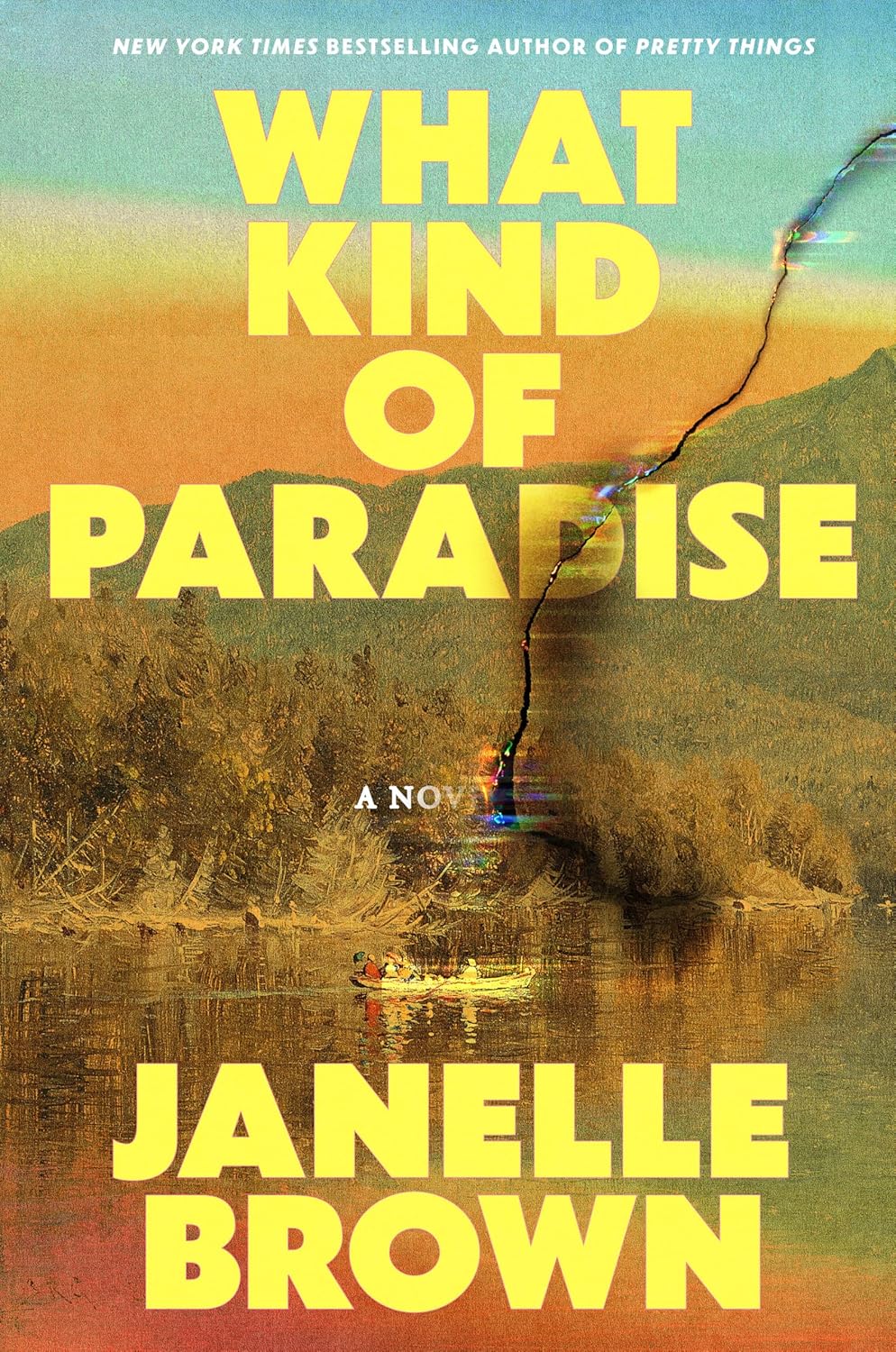
Title: What Kind of Paradise
Author: Janelle Brown
Publisher: Random House
Publication date: June 3, 2025
Length: 368 pages
Genre: Thriller/historical fiction
Source: Review copy courtesy of the publisher via NetGalley
Rating:
A teenage girl breaks free from her father’s world of isolation in this exhilarating novel of family, identity, and the power we have to shape our own destinies—from the New York Times bestselling author of Pretty Things and Watch Me Disappear
The first thing you have to understand is that my father was my entire world.
Growing up in an isolated cabin in Montana in the mid-1990s, Jane knows only the world that she and her father live in: the woodstove that heats their home, the vegetable garden where they try to eke out a subsistence existence, the books of nineteenth-century philosophy that her father gives her to read in lieu of going to school. Her father is elusive about their pasts, giving Jane little beyond the facts that they once lived in the Bay Area and that her mother died in a car accident, the crash propelling him to move Jane off the grid to raise her in a Thoreau-like utopia.
As Jane becomes a teenager she starts pushing against the boundaries of her restricted world. She begs to accompany her father on his occasional trips away from the cabin. But when Jane realizes that her devotion to her father has made her an accomplice to a horrific crime, she flees Montana to the only place she knows to look for answers about her mysterious past, and her mother’s death: San Francisco. It is a city in the midst of a seismic change, where her quest to understand herself will force her to reckon with both the possibilities and the perils of the fledgling Internet, and where she will come to question everything she values.
In this sweeping, suspenseful novel from bestselling author Janelle Brown, we see a young woman on a quest to understand how we come to know ourselves. It is a bold and unforgettable story about parents and children; nature and technology; innocence and knowledge; the losses of our past and our dreams for the future.
TL;DR: What if the Unabomber had a daughter?
In this thriller by Janelle Brown, set during the early days of the Silicon Valley internet boom, an increasingly unhinged father steals his young daughter away to live in an isolated cabin in Montana. There, he drills her on philosophy, teaches her to hunt and farm, and conducts evacuation practices through secret tunnels. Above all, he raises her to embrace his own world view:
“Companionship is a crutch. Learning to be alone is the most critical life skill of all — haven’t I taught you that? Because when you rely on other people, for emotional support or intellectual engagement or entertainment or just survival, you are weak. You are vulnerable. Because it means that you will suffer when it’s taken away — and it inevitably will be. You should never rely on anyone.”
From the age of four, Jane’s life is contained within the walls of the cabin and the surrounding forests, and centers on her father. He’s her teacher and protector, and as she grows, he trains her to follow in his footsteps, indoctrinating her on his anti-technology theories, and eventually, involving her in creating his manifesto and in his quest to rid the world of advanced tech, which he sees as dooming the human race.
Jane believes whole-heartedly in her father — for a while. But as she grows up, she has the opportunity to access a TV, and later, the internet (after her father brings her a how-to guide for HTML and instructs her to create a website for his manifesto). As she gains access to the outside world, she begins to wonder whether her faith in her father is flawed, whether his teachings are correct, and whether she’s actually more of a prisoner than someone being protected.
After her father involves her in an act of violence, she flees — but the world outside her cabin is dangerous and baffling, and Jane is forced into difficult situations and hard decisions. Meanwhile, through Jane’s experiences, we see the rise of tech in its glory days, filled with hope and inspiration as well as dire warnings about the destruction of humanity.
What Kind of Paradise is fascinating on both the personal and global levels. Jane herself is an immediately sympathetic character. When she parrots her father’s teachings, we know it’s because that’s all she knows and has been taught. When she takes ill-advised actions, we know that she has no idea what the consequences might be. Due to her extremely sheltered upbringing, she doesn’t see red flags where most others might, and misses essential clues and warnings that could potentially save her from disasters.
The book offers an insightful look into the competing mindsets during the early days of the internet boom. On the one hand, tech gurus speak rapturously about the upcoming changes:
An economic boom due to new technological breakthroughs will enable everyone to join the middle class, so that there are no more working poor. The proliferation of new media will allow truth to disseminate in new ways through new voices bringing an end to widespread ignorance. A rise of liberalism due to a connected global citizenry will usher in the New Enlightenment and the end of fascism and authoritarianism.
On the other hand, we have the doomsday prophecies of Jane’s father, warning that human reliance on machines and computers will spell the end of civilization as we know it:
The world today has lost its mind, and it can all be traced back to the rise of technology. The consequence of the ever-forward march of “progress” has been a society whose citizens are greatly suffering and aren’t even aware of it. The more we continue to replace a life of value with “virtual” life, the less satisfaction we derive from our existence, resulting in a world in which citizens are anesthetized by pharmaceuticals and entertainment living entirely in their heads rather in in a tangible, physical world.
Beyond the philosophical considerations, What Kind of Paradise is a tightly constructed thriller that keeps character-driven perspectives at the heart of the narrative. Yes, a crime is being unraveled, but it’s really Jane’s journey that drives the story and pulls the reader in.
Drawing from the real-life terror of the Unabomber and the ensuing manhunt, What Kind of Paradise has a ripped-from-the-headlines feel, while also expanding the actual story in a compelling direction. What if the bomber didn’t live a life of complete isolation? What if there was a child involved? How would the child of such a person develop and learn? The action and character-driven elements of this story combine to provide a compelling, thoughtful, and high-adrenaline read.

Purchase links: Amazon – Bookshop.org
Disclaimer: When you make a purchase through one of these affiliate links, I may earn a small commission, at no additional cost to you.

 Bookshelf Fantasies