Book Review: The Girls at the Kingfisher Club by Genevieve Valentine

Book Review: The Girls at the Kingfisher Club by Genevieve Valentine

The Girls at the Kingfisher Club: A NovelIn this fairy tale retelling, author Genevieve Valentine takes the classic story of the Twelve Dancing Princesses and transplants it to Jazz Age Manhattan, with a result that is equal parts captivating and frustrating.

The Twelve Dancing Princesses was always one of my favorite fairy tales. In a nutshell: A king with twelve daughters locks the princesses into their chamber each night, but each morning finds that their shoes are worn completely through. He offers the pick of the princesses to any suitor who can find out for him how the girls wear out their shoes — but anyone who tries and does not succeed must die. Prince after prince fails to figure out the secret, until finally one man comes who manages to outwit the princesses and follows them to a secret castle where they dance all night until their shoes are worn through. Ta da! He wins the hand of a princess and the kingdom besides. The end.

In The Girls at the Kingfisher Club, the father is no king, but a wealthy, grasping businessman trying to break into high society. His wife produces daughter after daughter, much to his dissatisfaction, so he keeps her pregnant, time and again, until after twelve failed attempts at a son and heir, his frail wife finally gives up the ghost.

And the girls? Each girl is sent upstairs to be raised among her sisters, with a tiny allowance for clothing, a meager library to learn the basics, and strict requirements that they be neither seen nor heard. The girls are hidden away from the world, kept indoors and educated first by tutors, then later by the older sisters, with no hope and no way out. The oldest sister, Josephine (Jo), serves as liaison, summoned a few times a year into her father’s presence to give reports, receive any orders, and then sent back to enforce her father’s rules.

But as the girls age, their frustration grows, and Jo knows it’s only a matter of time until her sisters run away or act rashly enough to bring disaster down on all of them — and so she figures out a release for them all. Jo learns to dance by sneaking off to see movies, then teaches her sisters, and eventually starts sneaking the girls out of the house at midnight to dance the night away at Manhattan’s hidden speaky-easys and dance halls.

Jo is known amongst her sisters as the General — the one in charge, demanding instant obedience, running their days and nights. Jo determines which nights they go out. Jo gets the cabs, Jo sets the rules: Flirt, but don’t give a man your name. Have fun, but don’t get romantically involved. Above all else, always be ready to run, and know where the exits are. The dance halls are glitzy and glamorous, and the beautiful, exotic girls with no names — affectionately nicknamed “the Princesses”  — are the talk of the town, but there’s a constant risk of police raids, or even worse, having their father find out what they’re up to.

When their father finally decides to assert his control in new and awful ways once his daughters are of marriageable age, the sisters have to figure out how to survive — and Jo has to both let go and start to live for herself, rather than putting her own needs after those of her sisters.
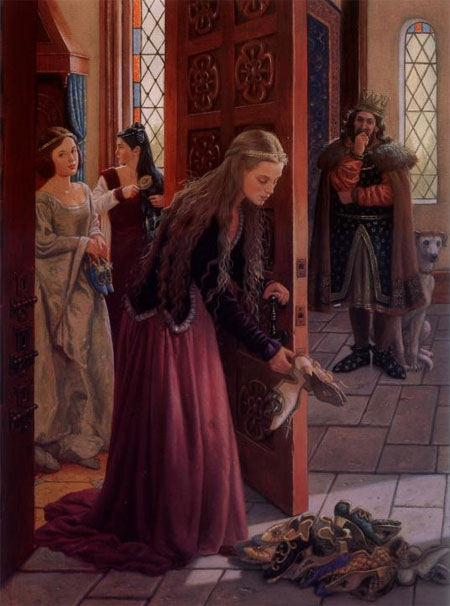
Here's the version I remember, from The Twelve Dancing Princesses by Ruth Sanderson

Here’s the version I remember, from The Twelve Dancing Princesses by Ruth Sanderson

There’s a lot to like about The Girls at the Kingfisher Club. In this mostly successful retelling, the fairy tale works well in its new setting. There’s a terrible logic to the father’s cruelty and tyranny, and the girls’ lives are uniformly dull and drab except for their nightly escapes. The dance halls are described in all their decadent 1920s glory — no wonder the sisters come to life on the dance floor, dancing the Charleston with enchanted admirers, always the belles of the ball, living fully in the moment. The era is a smart choice for this story, a time when women started emerging into something like independence, yet often chained to their fathers or husbands by complete financial dependence and a society that viewed strong women as depraved, or worse, mentally unstable.

Where the novel is less successful is in creating twelve distinct characters for the reader to care about. Jo is the point of view for the story, and we come to know her sisters through her eyes, but it’s difficult to differentiate one from another, particularly those we only see in passing. Certain sisters have more distinctive roles to play, but others seem to come and go with only a few lines or scenes, and it’s hard to remember who’s who or what’s special about each one.

The narrative style is somewhat choppy, so that while some passages and chapters keep the feeling of  a fairy tale in their descriptions — telling the story in broad strokes that seem like an outsider’s perspective on an enchanted world — other chapters bog down and feel sluggish. The book suffers a bit from a lack of intimacy. Perhaps because there are so many girls to keep track of, none seem very knowable, and I didn’t end up feeling connected emotionally to any of the characters, thus making the stakes of the story less compelling than they should have been.

Did I enjoy The Girls at the Kingfisher Club? Yes, quite a bit. Still, something was lacking, and the story always felt as thought it was unfolding at a distance. I wanted to know what happened, but I wasn’t invested in any one of the sisters enough — even main character Jo – to make the story feel the urgency it should have by the end.

Still, if you enjoy reading about the roaring 20s and relish the thought of a flapper-era fairy tale, check out The Girls at the Kingfisher Club. For those who always wanted to be one of the royal, glamorous sisters who dance the night away, this book offers a fresh spin on an old tale — and if nothing else, will make you want to dust off your copy of the Brothers Grimm.

_________________________________________

The details:

Title: The Girls at the Kingfisher Club
Author: Genevieve Valentine
Publisher: Atria Books
Publication date: June 3, 2014
Length: 288 pages
Genre: Adult fiction/historical fiction
Source: Review copy courtesy of Atria Books via NetGalley

Book Review: The Impossible Lives of Greta Wells by Andrew Sean Greer

Book Review: The Impossible Lives of Greta Wells by Andrew Sean Greer

The Impossible Lives of Greta Wells

The impossible happens once to each of us.

From the very first line, author Andrew Sean Greer sets the stage for a magical, impossible, emotional journey as we follow one woman through three different lives in three very different times.

Who among us hasn’t at one time or another sighed, “I was born in the wrong era” or some similar sentiment?

In The Impossible Lives of Greta Wells, we meet a woman who gets a strange and miraculous chance to experience her life not just in her current world of the mid 1980s, but also in 1918 and 1941. After being treated for severe depression with electro-convulsive therapy, Greta slips into alternative versions of her life, where the familiar and the strange collide. It’s not time travel, but rather a shift in reality, a journey to an alternate universe in which Greta and the people in her life are the same people, but facing very different choices and circumstances.

Greta is a twin, and her brother Felix is the center of her universe. It is Felix’s death in 1985 during the “plague years” of the AIDS epidemic that pushes Greta first into depression and then on her impossible journey into two other versions of herself. In 1985, Greta’s long-term lover Nathan has just left her after she pushed him away during Felix’s illness. In 1918, Greta is a young wife to Nathan, an army doctor away in the trenches of WWI, but she faces her own set of disappointments and fears. And in 1941, with America on the brink of war, Greta and Nathan are married with a child, but Greta has suffered the loss of her beloved aunt Ruth and is beset by worries over Felix’s own unhappiness.

As Greta moves between lives, she leaves a footprint. She becomes convinced that her purpose is to perfect the alternate lives she inhabits — but she’s not the only one. 1918 Greta and 1941 Greta are on this journey as well, so that “our” Greta finds her own world changed by the imprints left by the others as they circle through one another’s lives.

Confused yet? It is a lot to track, and at times (many times) I found myself flipping back to double-check just which version of Greta’s life I was in now, and just where we’d left off that time around.

It’s fascinating to visit New York of 1918 and 1941, to see the roles available to women — housewives, mothers, lovers — and how those changed over time. Equally fascinating, and quite touching as well, is the view into life for a gay man in those times. In 1985, Greta is destroyed by Felix’s loss . She finds him alive and well in 1918 and 1941, but living lives defined by hiding, pretending, and sublimating. Part of Greta’s quest is to help Felix be happy in the worlds left to him; in his “real” life, Felix was an exuberantly joyful man, and although he (like so many others) died too soon, he was able to live his brief life to the fullest, surrounded by friends and loved by a good man. As 1985 Greta meets Felix again and again, she pushes him to find a way to live in his world and at the same time to seek love and truth in whatever way he can.

The writing in The Impossible Lives of Greta Wells is lyrical and lovely, full of moments of quiet emotion and heart-breaking truths. In Greta’s first visit to 1918, she is literally stopped in her tracks by seeing a familiar young man on the street — a man who in her own world of 1985 was but one of the many young men struck down by AIDS:

Laughing again, turning, looking around at me: familiar young men appearing in this unfamiliar world. Men who had died months or years before from the plague miraculously revived! There, in an army uniform, was the boy who made jewelry from papier-mâché beads; he died in the spring. And that one soldier, the stark blond Swede jumping from the streetcar, once sold magazines; he’d died two years before, one of the first: the cave’s canary. Who know how many more were off to war? Alive, each one, alive and more than alive — shouting, laughing, running down the street!

Of course, in the joy of seeing these young men alive once more, Greta is overlooking the fact that other perils await. There’s a war on, and although armistice is around the corner, some of these bright young men, “miraculously revived”, will not make it through the war. It was interesting to see the parallels drawn by the author between the great calamities each age: In 1918 and 1941, it was world war that took the lives of so many as such a young age; in 1985, it was the AIDS plague that seemed to wipe out a generation, so that by the time Greta attends the most recent in a string of funerals, there’s almost no one left to be mourners, all of the deceased’s friends having been taken already.

I couldn’t stop reading, once I’d started, and I probably made a mistake in gobbling it up quite so fast. The Impossible Lives of Greta Wells has an engrossing plot, but in my rush to see what happens next, I didn’t take as much time as I should have to savor the rich characters and the extraordinary use of language. This is not a long book, but it felt jam-packed — with the jumps through time, with vivid period details, with sights and smells that take you immediately into the worlds of 1918, 1941, and 1985 — so that by the time I reached the end, I felt like I’d experienced something much more than 289 pages of a fictional tale.

The simplest way for me to sum up? I was swept away by the magical possibilities of living three versions of a life, and was enchanted by Greta’s journey. Filled with fully-realized characters and given life by a unique premise, The Impossible Lives of Greta Wells is a reading experience to enjoy in the moment, and then to ponder for hours afterward.

__________________________________________

The details:

Title: The Impossible Lives of Greta Wells
Author: Andrew Sean Greer
Publisher: HarperCollins
Publication date: 2013
Genre: Adult Fiction
Source: Purchased

Wishlist Wednesday

Welcome to Wishlist Wednesday!

The concept is to post about one book from our wish lists that we can’t wait to read. Want to play? Here’s how:

  • Follow Pen to Paper as host of the meme.
  • Please consider adding the blog hop button to your blog somewhere, so others can find it easily and join in too! Help spread the word! The code will be at the bottom of the post under the linky.
  • Pick a book from your wishlist that you are dying to get to put on your shelves.
  • Do a post telling your readers about the book and why it’s on your wishlist.
  • Add your blog to the linky at the bottom of the post at Pen to Paper.
  • Put a link back to Pen to Paper somewhere in your post.
  • Visit the other blogs and enjoy!

My Wishlist Wednesday book is:

The Chaperone by Laura Moriarty

From Amazon:

The Chaperone is a captivating novel about the woman who chaperoned an irreverent Louise Brooks to New York City in 1922 and the summer that would change them both.

Only a few years before becoming a famous silent-film star and an icon of her generation, a fifteen-year-old Louise Brooks leaves Wichita, Kansas, to study with the prestigious Denishawn School of Dancing in New York. Much to her annoyance, she is accompanied by a thirty-six-year-old chaperone, who is neither mother nor friend. Cora Carlisle, a complicated but traditional woman with her own reasons for making the trip, has no idea what she’s in for. Young Louise, already stunningly beautiful and sporting her famous black bob with blunt bangs, is known for her arrogance and her lack of respect for convention. Ultimately, the five weeks they spend together will transform their lives forever.

For Cora, the city holds the promise of discovery that might answer the question at the core of her being, and even as she does her best to watch over Louise in this strange and bustling place she embarks on a mission of her own. And while what she finds isn’t what she anticipated, she is liberated in a way she could not have imagined. Over the course of Cora’s relationship with Louise, her eyes are opened to the promise of the twentieth century and a new understanding of the possibilities for being fully alive.

Drawing on the rich history of the 1920s,’30s, and beyond—from the orphan trains to Prohibition, flappers,  and the onset of the Great Depression to the burgeoning movement for equal rights and new opportunities for women—Laura Moriarty’s The Chaperone illustrates how rapidly everything, from fashion and hemlines to values and attitudes, was changing at this time and what a vast difference it all made for Louise Brooks, Cora Carlisle, and others like them.

Why do I want to read this?

I seem to be drawn to historical fiction lately, and I do love the 1920s/New York setting. I adored The Diviners by Libba Bray, which was a supernatural-tinged YA novel set in the same era. The Chaperone, with its hint of glamour and promise of empowerment for the lead female characters, sounds like both a great story about personal change and an exciting trip back to the roaring ’20s.

Have you read The Chaperone? What did you think? And what are you wishing for this week?

Quick note to Wishlist Wednesday bloggers: Come on back to Bookshelf Fantasies for Flashback Friday! Join me in celebrating the older gems hidden away on our bookshelves. See the introductory post for more details, and come back this Friday to add your flashback favorites!

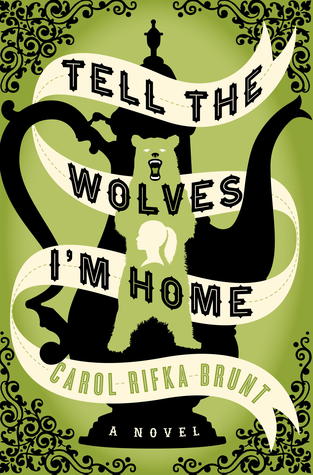
Book Review: Tell The Wolves I’m Home by Carol Rifka Brunt

Book Review: Tell The Wolves I’m Home by Carol Rifka Brunt

Tell The Wolves I’m Home, a first novel by Carol Rifka Brunt, defeated my best efforts to remain stoically dry-eyed while reading. What I expected to be a not-so-extraordinary family drama surprised me with its honest, emotional look at love and loss… and yes, there were tears.

Set in Manhattan and Westchester, New York in the mid-1980s, Tell The Wolves I’m Home is a look at one eventful spring in the life of 14-year-old June Elbus. As the book opens, June’s beloved uncle Finn has just died, an early casualty of the AIDS epidemic. Finn was not just June’s uncle, however; he was her godfather, her inspiration, and her first true love. Finn, a gifted artist, introduced June to everything she considers beautiful in her life — Mozart’s Requiem, visits to the Cloisters, an appreciation for the fine details all around her. June believes that the bonds between her and Finn are all-encompassing, but in the weeks following Finn’s death, June begins to realize that Finn had an entire life that she knew nothing about, and is forced to reexamine her relationship with Finn and its central role in her life.

As June reels through previously unimagined depths of loss, she is contacted by a stranger, Toby, who reveals himself to have had a key role in Finn’s life. Finn, before his death, left secret messages asking June to take care of Toby and Toby to take care of June, and as they try to honor Finn’s wishes, they find themselves connecting through shared bonds of loss, love and jealousy. June is shattered to realize how much she didn’t know about her uncle, as Toby struggles to let her in and to give dignity to June’s adolescent broken heart. As June mourns Finn and all she thinks she has lost, her older sister Greta acts out in her own brand of grief and loneliness in a desperate attempt to be understood and to reforge a connection before it’s too late.

The author does a wonderful job of capturing a particular time and place: New York, in the first throes of fear and ignorance about AIDS. Glancing references are made to Finn’s “special friend”, whom June’s parents consider a murderer — blaming him for Finn’s illness and death — and who is ostracized and banned from the funeral. June worries about catching AIDS from a kiss under the mistletoe; June’s sister is yelled at by their mother for using Finn’s chapstick. Other small details of life in the 80s bring the time to life: June wears her Gunne Sax dress in a desperate effort to isolate herself from the real world, as she hides out alone in the woods behind the school and pretends to live in the Middle Ages she so adores. Finn gives June cassette tapes of favorite music; June’s parents listen only to Greatest Hits albums (“it was like the thought of getting even one bum track was too much for them to handle”), and June has a fondness for “99 Luftballons” (the German version — much cooler sounding). June wears Bonne Belle lip gloss, and Greta has half of a “best friends” necklace, the other half of which some erstwhile best friend has long since discarded. It’s these small details and more which lend this book such a sense of nostalgic poignancy. At the same time, this coming-of-age story feels like it could be the story of any girl — or rather, every girl — growing up, seeing the human flaws in her parents, realizing that long-held truths may be illusions, finding and losing love, and coming to terms with a picture of one’s inner self which isn’t always so pretty.

Tell The Wolves I’m Home is a quiet, lovely book, a look backward that feels current and relevant, and a sad, sweet story of love and friendship. I’m so glad to have read it, and recommend it highly.