Book Review: Miss Lattimore’s Letter by Suzanne Allain

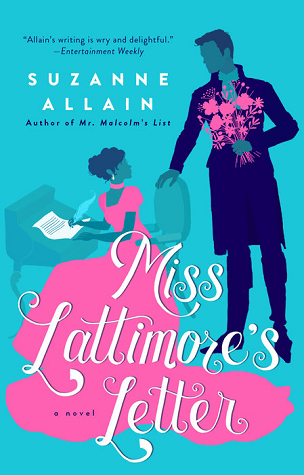
Title: Miss Lattimore’s Letter
Author: Suzanne Allain
Publisher: Berkley
Publication date: August 10, 2021
Length: 256 pages
Genre: Historical fiction
Source: Library
Rating:

Rating: 4 out of 5.

The woman who never made a match of her own is making matches for everyone else in this hilarious comedy of manners from the author of Mr. Malcolm’s List.

Sophronia Lattimore had her romantic dreams destroyed years ago and is resigned to her role as chaperone for her cousin. Still, she cannot sit idly by when she becomes aware that a gentleman is about to propose to the wrong woman. She sends him an anonymous letter that is soon the talk of the town, particularly when her advice proves to be correct. Her identity is discovered and Sophie, formerly a wallflower, becomes sought after for her “expert” matchmaking skills.

One person who seeks her out is the eligible and attractive Sir Edmund Winslow. As Sophie assists Sir Edmund in his pursuit of a wife, she wishes she could recommend herself as his bride. However, she vows to remain professional and uninvolved while aiding him in his search (especially since the gentleman surely does not return her affections).

Three unexpected arrivals soon show up at Sophie’s door—the man who once broke her heart, a newlywed who is dissatisfied with the match Sophie made for her, and the man madly in love with Sophie’s cousin—all wanting her attention. But when her onetime beau and Sir Edmund both appear to be interested in her, Sophie can’t figure out if she’s headed for another broken heart­­ or for the altar. How can she be expected to help other people sort out their romantic lives when her own is such a disaster?

After thoroughly enjoying The Ladies Rewrite the Rules, released earlier in 2024, I was eager to read more by author Suzanne Allain. I was glad to find Miss Lattimore’s Letter at the library — this 2021 novel is yet another gem of a Regency romance, with an empowered woman steering her own course rather than sitting back and letting life pass her by.

When we meet Sophie — Sophronia — she’s a 28-year-old spinster chaperoning her younger cousin Cecilia through the social season. Sophie once had a chance at marriage, but that fell through — and now she’s fated to sit with the older ladies, wear dull dresses, and watch the pretty young women enjoy their shining moments.

All this changes when Sophie accidentally overhears a private conversation, from which she learns that two impending engagements are between couples who each secretly wish to be with someone else. Sophie thinks that someone should set these people straight before it’s too late… and then decides that that “someone” might as well be her. She writes an anonymous letter, and it works: The couples realign, and the people involved end up with the ones they truly love.

Sophie’s anonymity doesn’t last long, and she’s soon being hailed as a genius matchmaker… even though she didn’t actually do anything but write a letter. Still, she finds herself once again a person generating interest in society, being asked to dance, and suddenly thought of as more than an over-the-hill spinster. When she catches the eye of a kind and witty gentleman, she’s more than a little interested, but the reappearance of the man who broke her heart so many years earlier brings unexpected complications.

Miss Lattimore’s Letter is an utterly engaging read. Yes, making matches and pursuing romances are quite central, but much of the fun is in seeing the friendships and alliances formed between Sophie and the various people in her orbit. It’s delightful to see Sophie take control of her own life, offer advice to women who feel pressured to choose money and titles over true connection, and remain true to herself even while finding a way to allow love back into her life.

The writing is clever and warm-hearted, and there are nods both to Jane Austen and to the joys of being a bookworm, which absolutely appealed to my book-loving little soul.

By the end of the morning, a morning spent in traversing the room back and forth in earnest conversation, the two young ladies were quite pleased at having made the acquaintance of someone who seemed destined to become a friend. They even had that most important characteristic of all in common: they counted the same books among their favorites.

While romance is always at the forefront of the story, I loved that the friendships between the women are treated as relationships that matter, and it’s lovely to see the trust that developments once the women open up to one another and speak honestly.

Sophie’s love triangle is perhaps a bit annoying — clearly, we know who she’s meant to be with, and which of the two men is basically a cad. Still, it’s fun watching it all play out… and we know Sophie is smart enough to make the right choice.

Sophie found it quite astonishing that she had gone eight-and-twenty years without being kissed by even one gentleman and had now been kissed by two different ones in the span of as many days. 

Miss Lattimore’s Letter is a joyful book with a memorable lead character and very clever storytelling. It made me laugh and kept me interested enough to read it straight through in one day. For Regency romance fans, this book is a treat. Don’t miss it!

Book Review: The Matchmaker’s Gift by Lynda Cohen Loigman

Title: The Matchmaker’s Gift
Author: Lynda Cohen Loigman
Publisher: St. Martin’s Press
Publication date: September 20, 2022
Length: 320 pages
Genre: Contemporary/historical fiction
Source: Review copy courtesy of the publisher via NetGalley

Rating: 4.5 out of 5.

From Lynda Cohen Loigman, the bestselling author of The Two-Family House and The Wartime Sisters, comes a heartwarming story of two extraordinary women from two different eras who defy expectations to utilize their unique gift of seeing soulmates in the most unexpected places in The Matchmaker’s Gift.

Is finding true love a calling or a curse?

Even as a child in 1910, Sara Glikman knows her gift: she is a maker of matches and a seeker of soulmates. But among the pushcart-crowded streets of New York’s Lower East Side, Sara’s vocation is dominated by devout older men—men who see a talented female matchmaker as a dangerous threat to their traditions and livelihood. After making matches in secret for more than a decade, Sara must fight to take her rightful place among her peers, and to demand the recognition she deserves.

Two generations later, Sara’s granddaughter, Abby, is a successful Manhattan divorce attorney, representing the city’s wealthiest clients. When her beloved Grandma Sara dies, Abby inherits her collection of handwritten journals recording the details of Sara’s matches. But among the faded volumes, Abby finds more questions than answers. Why did Abby’s grandmother leave this library to her and what did she hope Abby would discover within its pages? Why does the work Abby once found so compelling suddenly feel inconsequential and flawed? Is Abby willing to sacrifice the career she’s worked so hard for in order to keep her grandmother’s mysterious promise to a stranger? And is there really such a thing as love at first sight?

I’m not always a fan of dual timelines in historical fiction, but in the case of The Matchmaker’s Gift, this approach absolutely works.

In one timeline, we follow the story of Sara Glickman, a woman who emigrates to the United States in 1910 with her family, settling on New York’s Lower East Side. Sara realizes at age 10 that she has an unusual gift — she can “see” when two people are a match. First, she helps her sister find her bashert (soulmate, destined true love, the one that’s meant to be), and soon after, realizes she can see these connections for others as well.

The shadchanim (matchmakers) of the New York Jewish community are outraged — a young, unmarried girl has no business meddling in their business and potentially stealing their customers and their income. Sara swears to her father that she’ll give up matchmaking, but she’s unable to entirely ignore her calling and the good that she brings about.

In the other timeline (in the 1990s), we meet Sara’s granddaughter Abby, an associate in a prestigious divorce law firm who grew up scarred by her own parents’ divorce and is determined to make sure other women have the support her own mother lacked. When Abby learns of her beloved grandmother’s death, she’s grief-stricken — but she’s also inspired by Sara’s journals, which provide meticulous records of all the matches Sara made over the years. She’s also a little freaked out, though, when she starts seeing the same sort of connections that her grandmother once saw.

There’s so much to love about The Matchmaker’s Gift. In Sara’s part of the story, not only do we get to know what a strong and dedicated person she is, but we also get a beautifully written depiction of life in the Jewish community of the Lower East Side in the early 20th century. The characters, the environment, the traditions — all are brought lovingly to life.

Abby’s storyline, while more modern and perhaps less picturesque, still vibrates with a sense of New York in that time period. Abby interacts with characters from various walks of life through her work and through unexpected connections that come about after her grandmother’s passing, and it’s fascinating to see all the various ways that these people intersect and overlap.

I was particularly moved when Abby discovers that Sara came back to her matchmaking vocation in the postwar years of the late 1940s, when rabbis came to her to ask her help with making sure the Jewish people could survive after the devastation of the Holocaust. Sara saw it as her mission to bring together refugees and survivors, and it’s so powerful to read about. In fact, I wish this section of the story was explored in more detail — it’s not central to the plot, more something that’s filled in as a piece of Sara’s history, but it’s really beautiful.

Also very powerful is the information that later on in her life, Sara’s gift occasionally led her to see damaged connections, allowing her recognize an abusive marriage and help the woman escape and start over. Again, I might have liked to see more of this element of Sara’s gift, but the fact that’s it’s included at all made a big impression.

On a funny note, reading this book made me think of the Netflix series Jewish Matchmaking, and in the author’s notes, she mentions having consulted with Aleeza Ben Shalom — who is the host of the Netflix series!

Overall, I found The Matchmaker’s Gift to be very readable, engaging, and touching. Highly recommended!

Audiobook Review: Mr. Perfect on Paper by Jean Meltzer

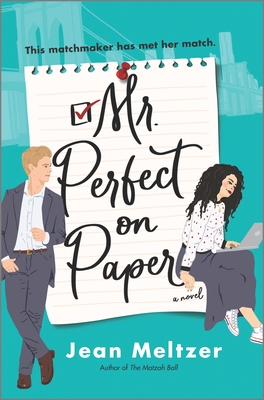
Title: Mr. Perfect on Paper
Author: Jean Meltzer
Narrator: Dara Rosenberg
Publisher: Mira
Publication date: August 9, 2022
Print length: 387 pages
Audio length: 10 hours 27 minutes
Genre: Contemporary romance
Source: Library
Rating:

Rating: 3 out of 5.

From the author of The Matzah Ball comes a pitch-perfect romcom following a third-generation Jewish matchmaker who unwittingly finds her own search for love thrust into the spotlight…

The perfect Jewish husband should be:
* A doctor or lawyer (preferably a doctor)
* Baggage-free (no previous marriages, no children)
* And of course—he must be Jewish

As the creator and CEO of the popular Jewish dating app J-Mate, matchmaker Dara Rabinowitz knows the formula for lasting love—at least, for everyone else. When it comes to her own love life, she’s been idling indefinitely. Until her beloved bubbe shares Dara’s checklist for “The Perfect Jewish Husband” on national television and charming news anchor Chris Steadfast proposes they turn Dara’s search into must-see TV.

As a non-Jewish single dad, Chris doesn’t check any of Dara’s boxes. But her hunt for Mr. Perfect is the ratings boost his show desperately needs. If only Chris could ignore his own pesky attraction to Dara—a task much easier said than done when Dara starts questioning if “perfect on paper” can compete with how hard she’s falling for Chris…

Jean Meltzer, author of 2021’s The Matzah Ball, is back with another Jewish-themed romance, this one depicting a young Jewish matchmaker’s search for her own true love.

Dara Rabinowitz is the powerhouse CEO of J-Mate, the super successful Jewish dating app she created inspired by her mother and grandmother’s careers as matchmakers. Knowing what makes a good match, as well as being a hugely talented coder, is the secret to Dara’s rise to corporate stardom. Dara lives with generalized anxiety disorder, which she’s quite open about, and manages her high-pressure life through coping and calming strategies as well as medication.

Dara is devoted to her darling grandmother, bubbe Miriam, whom she considers her best friend — but Miriam wants to see Dara happily married and exploring life. When Miriam goes off-script on a TV appearance and shares a private list of Dara’s requirements for her perfect husband (written one night while drinking with her sister), Dara is utterly humiliated… until the video clip goes viral, the show’s rating skyrocket, and suddenly everyone wants more of Dara.

The show’s host, Chris (handsome, non-Jewish, and a widowed father of a tween girl) is enchanted by Dara, and sees her as a potential key to saving his floundering show. Reluctantly, Dara agrees to his proposal: He’ll use her app and algorithms to find her nice Jewish men who are “Mr. Perfect on Paper” — checking all the boxes on her list — and she’ll allow the show to follow her on her dates.

What could go wrong?

Obviously, plenty. Dara encounters one dating disaster after another… and meanwhile, even once she meets a man who might really be her perfect match, she can’t quite shake her attraction and feelings for Chris himself. Chris, too, feels drawn to Dara, but he knows he’s not what she wants. But what if????

Dara and Chris are both sensitively portrayed and well developed. I really felt like I got to know each of them, with attention paid to their family backgrounds and the tragedies and struggles they’ve each endured. Chris’s story is particularly sad, and his dedication to being the best dad he can be, while navigating the tricky world of dealing with a pre-teen girl, is quite moving.

Dara and Chris have good chemistry, and I appreciated how genuine their care and concern for one another is. While denying to themselves that they could ever be romantically involved, they do both consider themselves friends, and they’re truly there for one another in the way that real friends should be.

Some elements of the book just didn’t work as well for me, however. Based on this book as well as her previous one, it seems that this author’s approach to conveying humor is to create slapstick moments where everything goes wrong. Maybe some readers will find these moments funny (such as Dara ending up dunking her head into a barrel of water in the middle of a date in order to get away from a pesky bumblebee), but honestly, I tend to find them too silly and embarrassing and over the top.

I had to question some of the Jewish elements too. Dara is devoted to her religion and her people, which is nice to see, but some of her choices in regard to the TV show seem questionable — for example, allowing the camera crew to come to synagogue on Yom Kippur and follow the date that arranged for her at the break fast. I doubt any synagogue would actually allow a camera crew to set up and film on the holiday, and the idea of having a blind date at a break fast after a day of fasting seems like a set-up for disaster (which is exactly how it ends up).

The audiobook was mostly enjoyable, but the narrator seemed to struggle with some of the Jewish/Hebrew/Yiddish terms and names, and that was very distracting to me. Still, when the characters are in more natural or relaxed setting, the narration flows well, and I liked the scenes with Chris and his daughter very much.

Overall, Mr. Perfect on Paper is light entertainment with a sweet story to tell. The characters are bright spots, very engaging and sympathic, but on the downside, the predictable nature of the plot and the occasional cringe-worthy pratfalls and dating disasters keep this book from being totally successful. It’s fun, but I had to overlook a lot of my quibbles in order to appreciate the good stuff.

Take A Peek Book Review: An Unorthodox Match by Naomi Ragen

“Take a Peek” book reviews are short and (possibly) sweet, keeping the commentary brief and providing a little peek at what the book’s about and what I thought.

Synopsis:

(via Goodreads)

California girl Lola has her life all set up: business degree, handsome fiancé, fast track career, when suddenly, without warning, everything tragically implodes. After years fruitlessly searching for love, marriage, and children, she decides to take the radical step of seeking spirituality and meaning far outside the parameters of modern life in the insular, ultraorthodox enclave of Boro Park, Brooklyn. There, fate brings her to the dysfunctional home of newly-widowed Jacob, a devout Torah scholar, whose life is also in turmoil, and whose small children are aching for the kindness of a womanly touch.

While her mother direly predicts she is ruining her life, enslaving herself to a community that is a misogynistic religious cult, Lola’s heart tells her something far more complicated. But it is the shocking and unexpected messages of her new community itself which will finally force her into a deeper understanding of the real choices she now faces and which will ultimately decide her fate.

An Unorthodox March is a powerful and moving novel of faith, love, and acceptance, from Naomi Ragen, the international bestselling author of The Devil in Jerusalem.

My Thoughts:

An Unorthodox Match is set in the ultra-orthodox community of Boro Park, Brooklyn, and is told through the points of view of several characters. Leah (Lola) is Jewish by birth, but was raised by a mother who wants nothing to do with the religion of her own upbringing. Leah only discovers faith and deeper meaning as a college student, and eventually pursues religious studies in her path back to observant, orthodox Judaism. Yaakov, a widower with five children mourning for his late wife, is a prize sought after by a slew of matchmakers, all looking to make a marriage involving his prestigious family. Yaakov’s mother-in-law Fruma Esther wants what’s best for Yaakov and his children, but not at the risk of their family’s reputation. And getting involved with someone newly returned to religion is a sure way to get gossip flowing, possibly endangering the future standing of the next generation.

This book is a deep dive into the community and its social constructs, and does a good job of explaining why a modern, educated woman might turn to a world that outsiders view as repressive and misogynistic. Leah is an interesting character, and the author does a good job at letting us see why Leah might find a fresh meaning and purpose through religion, faith, and tradition.

I’d tried everything the secular world had to offer and still felt empty. I wanted something else, something that would give meaning to my life. In your world, I found so many of the things I’d longed for all my life: safety, order, rules, limitations, real community, deep values. But I have to be absolutely honest with you… I’ve also discovered some things I wasn’t prepared for.

The family dynamics are well-drawn and touching, and I felt quite sorry for Yakov, his late wife (whose postnatal depression is only revealed late in the book, although there are certainly plenty of hints), and the children whose lives fall apart, until Leah steps in to provide love and order in their home once more.

Of course, as a 21st century feminist, I have a huge problem with religious rules that force women into “modest” clothing, declare them unclean when they have their periods, and require the rabbi’s okay for a woman to stop having babies when she’s clearly suffering and in severe distress. Through Leah’s perspective, the dress requirements are freeing, keeping her body private and preventing men from seeing her as a sexual object — but that only goes so far. Leah (or the author) seems to be a bit fixated on weight, and we keep hearing about how Leah has gained weight since giving up running (which she can’t do as a religious woman, since the clothing and/or activity would be immodest). The issues around body image and looks got in my way quite a bit, as did some of the characters’ attitudes around race and difference.

That’s not to say that An Unorthodox Match isn’t a good read — it is. I was caught up in the story and invested in the characters… but I definitely was challenged by needing to put my own opinions aside in order to accept Leah’s values and hopes. [Side note: For contrast, check out the memoir Unorthodox, which tells the story of a woman’s struggle to leave the Orthodox Jewish community she grew up in.]

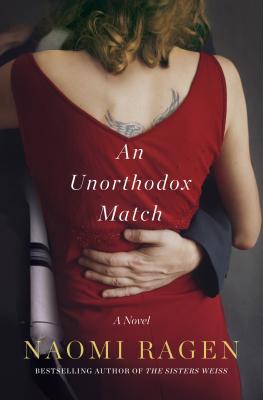
A word on the cover: It’s a striking cover image for sure, but totally misleading. At no point in the story does Leah wear a skimpy little red dress, nor do she and Yaakov ever embrace or touch each other. And she does not have a back tattoo. (Okay, she has a small tattoo on her wrist, which is quite the scandal until it miraculously (?) goes away after she spills scalding water on her hands.)

_________________________________________

The details:

Title: An Unorthodox Match
Author: Naomi Ragen
Publisher: St. Martin’s Press
Publication date: September 24, 2019
Length: 336 pages
Genre: Contemporary fiction
Source: Review copy courtesy of the publisher via NetGalley

**Save

Save

Save

Save

Save

Save

Save