
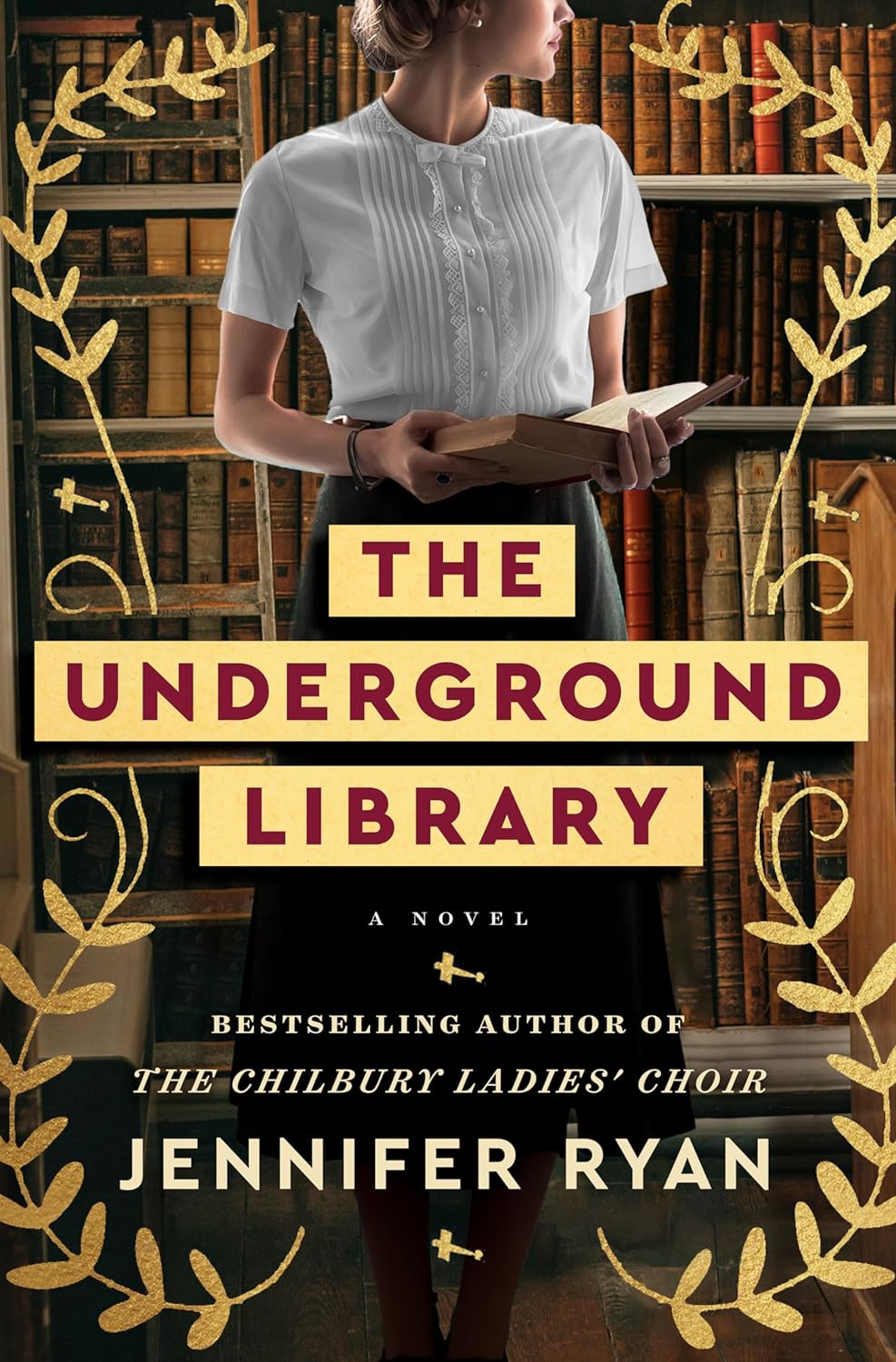
Book Review: The Underground Library by Jennifer Ryan

Title: The Underground Library
Author: Jennifer Ryan
Publisher: Ballantine Books
Publication date: March 12, 2024
Print length: 368 pages
Genre: Historical fiction
Source: Review copy courtesy of the publisher via NetGalley
Rating:

Rating: 4 out of 5.

When the Blitz imperils the heart of a London neighborhood, three young women must use their fighting spirit to save the community’s beloved library in this heartwarming novel from the author of The Chilbury Ladies’ Choir

When new deputy librarian, Juliet Lansdown, finds that Bethnal Green Library isn’t the bustling hub she’s expecting, she becomes determined to breathe life back into it. But can she show the men in charge that a woman is up to the task of running it, especially when a confrontation with her past threatens to derail her?

Katie Upwood is thrilled to be working at the library, although she’s only there until she heads off to university in the fall. But after the death of her beau on the front line and amid tumultuous family strife, she finds herself harboring a life-changing secret with no one to turn to for help.

Sofie Baumann, a young Jewish refugee, came to London on a domestic service visa only to find herself working as a maid for a man who treats her abominably. She escapes to the library every chance she can, finding friendship in the literary community and aid in finding her sister, who is still trying to flee occupied Europe.

When a slew of bombs destroy the library, Juliet relocates the stacks to the local Underground station where the city’s residents shelter nightly, determined to lend out stories that will keep spirits up. But tragedy after tragedy threatens to unmoor the women and sever the ties of their community. Will Juliet, Kate, and Sofie be able to overcome their own troubles to save the library? Or will the beating heart of their neighborhood be lost forever?

The Underground Library is the newest book by talented historical fiction author Jennifer Ryan, showing the strengths and struggles of women on the homefront during World War II.

Three main characters are our points of focus, each with a memorable story of her own. Through these characters and their friends and connections, a sense of a strong, resilient community is beautifully presented.

The lead characters, Juliet, Katie, and Sofie, each end up at the Bethnal Green library in London by different paths. Juliet leaves her small town, where she lives with uncaring parents, after her fiancé disappears during battle and is believed to be a deserter. Juliet needs both a fresh start and a chance to make something of herself, and is delighted to land a role as deputy librarian — a role available to a woman only because qualified men are scarce during wartime.

Katie, a Bethnal Green local, works at the library temporarily as she prepares to leave for university, eager to pursue her education and escape the pressures of her social-climbing father and a mother who only cares about reputation and what the neighbors think. When Katie receives word that her boyfriend is missing and presume dead, her world falls apart in more ways than one.

Sofie is a Jewish resident of Berlin whose family urges her to leave while she still can, and secures her a British visa conditional on domestic employment — something Sofie has never done before, having been raised in a well-off family with domestic help of their own. She’s reluctant to leave her family, but is finally convinced of the necessity of doing so. After a hair-raising and dangerous trip, she arrives in London. There, she finds safety from the Nazi terrors of Germany, but at a price: Her employer is cruel, demanding, and abusive, and she lives in constant fear for the family she left behind. When she happens to stop by the library while on an errand for her employer, a new world opens to her, as she’s welcomed and encouraged to keep coming back.

As the women meet and come together, new opportunities for community emerge. The head librarian is stuffy and bound by tradition, wanting to keep the library a quiet, dignified space for the privileged, but Juliet is determined to infuse new life into it, planning book discussions and activities during the hours when her boss is away.

When air raids begin, the people of Bethnal Green eventually begin using the underground station as a shelter, and it becomes a place of refuge, where night after night, people sleep, share stories, seek medical care, and find a place of relative safety while bombs are dropped overhead. When the library itself is hit in an air raid, the head librarian wants to shut it down, but Juliet has another idea: With the help of her trusted group of friends and the women who form the inner circle of her reading groups, she relocates as many books and resources as possible down into the shelter, and the underground library is born.

The Underground Library is a wonderful portrayal of women’s strength and the glory of friendship, as well as the absolutely awesome power of books to bring people together, provide an escape from the harsh realities of daily life, and offer inspiration and hope. It’s also a realistic depiction of life during wartime, showing the struggles of people on the homefront to feed and clothe their families, find medical care, and find safety from nightly dangers — all while worrying about loved ones serving on the front and mourning terrible losses.

Juliet, Katie, and Sofie each have their own struggles and heartbreaks, and each is given ample space to grow as characters and face their challenges. Each of their storylines is well developed and affecting. In some books with multiple main characters, there’s often one who outshines the others, but here, all three are interesting and provoke sympathy and emotional connection.

In addition to the main characters, it’s fascinating to see how their friends and associates find their own paths forward and take on new and different roles through their involvement with the Underground Library. By the end of the book — which includes plenty of tears but is ultimately uplifting — we see how friends can become family, how families can rebuild, and how people who’ve suffered loss can find reasons to keep going.

The Underground Library has a gentle tone, even when frightening events are happening around the characters. The focus is on the people — this is less a story about war and more a story about how people impacted by war find hope and strength in unexpected ways. I came to care deeply about the characters and their lives, and felt thoroughly immersed in the book as a whole. In fact, my only complaint is that there are some secondary characters I wish we’d gotten to see more of — I felt like there were even more stories to be told about the people who made up the Bethnal Green community.

The Underground Library is Jennifer Ryan’s 5th novel, and I’ve enjoyed each and every one. She has a talent for showing the ordinary people affected by historical events, and especially, the importance of community during times of great struggles.

Book Review: The Invisible Hour by Alice Hoffman

Title: The Invisible Hour
Author: Alice Hoffman
Publisher: Atria
Publication date: August 15, 2023
Length: 272 pages
Genre: Contemporary/historical fiction
Source: Review copy courtesy of the publisher via NetGalley
Rating:

Rating: 3 out of 5.

From the beloved New York Times bestselling author of The Marriage of Opposites and the Practical Magic series comes an enchanting novel about love, heartbreak, self-discovery, and the enduring magic of books.

One brilliant June day when Mia Jacob can no longer see a way to survive, the power of words saves her. The Scarlet Letter was written almost two hundred years earlier, but it seems to tell the story of Mia’s mother, Ivy, and their life inside the Community—an oppressive cult in western Massachusetts where contact with the outside world is forbidden, and books are considered evil. But how could this be? How could Nathaniel Hawthorne have so perfectly captured the pain and loss that Mia carries inside her?

Through a journey of heartbreak, love, and time, Mia must abandon the rules she was raised with at the Community. As she does, she realizes that reading can transport you to other worlds or bring them to you, and that readers and writers affect one another in mysterious ways. She learns that time is more fluid than she can imagine, and that love is stronger than any chains that bind you.

As a girl Mia fell in love with a book. Now as a young woman she falls in love with a brilliant writer as she makes her way back in time. But what if Nathaniel Hawthorne never wrote The Scarlet Letter ? And what if Mia Jacob never found it on the day she planned to die?

Nathaniel Hawthorne “A single dream is more powerful than a thousand realities.”

This is the story of one woman’s dream. For a little while it came true.

When teenaged Ivy becomes pregnant, her wealthy Boston family treats her with scorn and decides — without her consent — that she’ll give birth and then give the baby away. In desperation, Ivy runs away, and a chance encounter with a stranger leads her to the Community, a farm outside the western Massachusetts town of Blackwell, led by a charismatic man named Joel Davis. At first, the Community seems like a haven. Ivy is welcomed, given a home, and captures the attention of Joel, who eventually marries her.

But the Community is not merely a peaceful communal farm — it’s a structure, highly regulated, isolated world completely controlled by Joel and his dictates. Women must dress simply, vanity is not allowed, children belong to the Community at large and not to their biological parents, and books of any kind are forbidden. Punishments are harsh — from lettered signs hung around necks for initial or minor offenses to having letters branded on the offenders’ arms for more serious infractions. But by the time Ivy realizes the truth of the Community, she’s stuck — she’s given birth to her daughter Mia, and Joel has made it clear that if she ever leaves, she’ll never see Mia again.

As Mia grows, Ivy and Mia maintain a secret bond despite its forbidden nature, and Ivy shares the stories and fairy tales she remembers from her own youth during their secret meetings in the woods. As Mia grows up, Ivy encourages her to sneak away to the Blackwell public library while working at the Community’s farmstand in town, and soon Mia’s life revolves around the books she hides in the barn.

Mia now understood that Joel was well aware that once a girl walked into a library she could never be controlled again.

After tragic events, Mia is more trapped than ever. In despair, Mia takes a random book from the library shelves and then heads to the river, where she intends to load her pockets with stones and drown herself, the only escape she can envision. But when she opens the books and begins to read, she’s awed to find that this particular book speaks directly to her, and offers her a new way to think about her life and her future.

The book is The Scarlet Letter by Nathaniel Hawthorne, and it literally changes Mia’s life. Without going too much further into the plot points, I’ll just say that Mia finds a way to escape and start over, thanks to the help of a kind librarian (librarians rock!), and her love for Nathaniel Hawthorne eventually leads to a timeslip element that takes her into his world.

It’s hard to summarize my feelings about The Invisible Hour. As with all of Alice Hoffman’s books, the writing here is beautiful, with some passages and ideas that just take my breath away. And while some of the author’s books are among my very favorites, there are also many where I love the writing and feel disconnected from or let down by the plot. Sadly, The Invisible Hour mostly fits into the second category.

I was deeply engrossed in the first half of the book, where Mia’s childhood and youth at the Community are the focus, as well as her escape and her discovery of a future filled with books, autonomy, loving found family, and the ability to set her own path. When the timeslip elements come into play in the second half of the book, that’s where it loses me to a great extent.

It’s not that I have a problem with time travel or timeslip novels, not by a long shot! Somehow, the introduction of the time element in The Invisible Hour felt jarring and not at all believable to me. Perhaps it was the introduction of Nathaniel Hawthorne as a character that broke the spell for me. In any case, despite the seeming intention to show this as a magical element brought about by a special book, I just couldn’t buy it, and felt dissatisfied for much of the rest of the book.

On the other hand, I do love how beautifully the power of books and reading is shown throughout The Invisible Hour. Books literally save and then change Mia’s life

… he believed it was possible to see inside a person’s soul once you knew which books mattered to them.

I wish I had loved The Invisible Hour. As I’ve already said, the writing is gorgeous and evocative, and makes this book well worth reading. I just wish I’d felt as strongly about the plot itself as I do about the way it’s written. Mia’s story is sad yet ultimately lovely and full of hope, but the timeslip elements fell flat for me and detracted from the impact of the whole.

Side note: I don’t have particularly good memories of reading The Scarlet Letter way back in high school, but after reading The Invisible Hour, I’m very tempted to give it another try.

Book Review: The Library Book by Susan Orlean

On the morning of April 28, 1986, a fire alarm sounded in the Los Angeles Public Library. As the moments passed, the patrons and staff who had been cleared out of the building realized this was not the usual fire alarm. As one fireman recounted, “Once that first stack got going, it was ‘Goodbye, Charlie.’” The fire was disastrous: it reached 2000 degrees and burned for more than seven hours. By the time it was extinguished, it had consumed four hundred thousand books and damaged seven hundred thousand more. Investigators descended on the scene, but more than thirty years later, the mystery remains: Did someone purposefully set fire to the library—and if so, who?

Weaving her lifelong love of books and reading into an investigation of the fire, award-winning New Yorker reporter and New York Times bestselling author Susan Orlean delivers a mesmerizing and uniquely compelling book that manages to tell the broader story of libraries and librarians in a way that has never been done before.

In The Library Book, Orlean chronicles the LAPL fire and its aftermath to showcase the larger, crucial role that libraries play in our lives; delves into the evolution of libraries across the country and around the world, from their humble beginnings as a metropolitan charitable initiative to their current status as a cornerstone of national identity; brings each department of the library to vivid life through on-the-ground reporting; studies arson and attempts to burn a copy of a book herself; reflects on her own experiences in libraries; and reexamines the case of Harry Peak, the blond-haired actor long suspected of setting fire to the LAPL more than thirty years ago.

Along the way, Orlean introduces us to an unforgettable cast of characters from libraries past and present—from Mary Foy, who in 1880 at eighteen years old was named the head of the Los Angeles Public Library at a time when men still dominated the role, to Dr. C.J.K. Jones, a pastor, citrus farmer, and polymath known as “The Human Encyclopedia” who roamed the library dispensing information; from Charles Lummis, a wildly eccentric journalist and adventurer who was determined to make the L.A. library one of the best in the world, to the current staff, who do heroic work every day to ensure that their institution remains a vital part of the city it serves.

Brimming with her signature wit, insight, compassion, and talent for deep research, The Library Book is Susan Orlean’s thrilling journey through the stacks that reveals how these beloved institutions provide much more than just books—and why they remain an essential part of the heart, mind, and soul of our country. It is also a master journalist’s reminder that, perhaps especially in the digital era, they are more necessary than ever.

After that lengthy synopsis, I’m not sure what else there is to say, other than to talk about my experience reading this book.

The short version is — I loved it.

Susan Orlean is a brilliant writer, new to me, although I’ve been hearing about The Orchid Thief for years and always meant to get to it (and after finishing The Library Book, finally bought myself a copy). The story here is fascinating and multi-layered. The framing device of the book is the 1986 Los Angeles library fire, which is devastating and horrifying to read about, as the author takes us practically minute by minute through the fire’s path and shows us the awful damage done during those terrible hours.

Interspersed with the story of the fire is a history of the role of libraries in society, focusing mainly (but not exclusively) on the history of the library in Los Angeles, showing the library as a reflection of the society it serves, its challenges and its triumphs. We see how public libraries have evolved over time, and how those who work in libraries are devoted both to serving the public and to keeping public libraries vital and vibrant, even as society and technology constantly change and provide fresh challenges to the concept of what a library actually is.

We also meet amazing people, past and present, who played a part in the Los Angeles library, from head librarians to architects to security guards. It’s amazing to see the incredible talent and intelligence and humor of the people who helped build the library system and who continue to keep it relevant and important.

The story of Harry Peak is the most puzzling piece of the book — an unsuccessful actor who was suspected of the arson, but whose constantly shifting stories and alibis made any sort of case against him questionable at best. He’s an odd person, and so much is uncertain — but it’s interesting to see how his strange life intersected with such a major civic disaster.

Susan Orlean’s writing is gorgeous. Like the best non-fiction, it flows and captivates, and I never for a moment felt bored or like I was reading a dusty, dry history book.

On visiting a boarded-up, abandoned branch library:

This building made the permanence of libraries feel forsaken. This was a shrine to being forgotten; to memories sprinkled like salt; ideas vaporized as if they never had been formed; stories evaporated as if they had no substance and no weight keeping them bound to the earth and to each of us, and most of all, to the yet-unfolded future.

Other memorable (or just entertaining) lines and passages:

In times of trouble, libraries are sanctuaries.

In the year leading up to Prohibition, when the ban on alcohol seemed inevitable, every book about how to make liquor at home was checked out, and most were never returned.

[Althea] Warren was probably the most avid reader who ever ran the library. She believed librarians’ single greatest responsibility was to read voraciously. Perhaps she advocated this in order to be sure librarians knew their books, but for Warren, this directive was based in emotion and philosophy: She wanted librarians to simply adore the act of reading for its own sake, and perhaps, as a collateral benefit, they could inspire their patrons to read with a similarly insatiable appetite. As she said in a speech to a library association in 1935, librarians should “read as a drunkard drinks or as a bird sings or a cat sleeps or a dog responds to an invitation to go walking, not from conscience or training, but because they’d rather do it than anything else in the world.”

The library is a whispering post. You don’t need to take a book off a shelf to know there is a voice inside that is waiting to speak to you, and behind that was someone who truly believed that if he or she spoke, someone would listen.

The Library Book is simply a delicious read, perfect for anyone who appreciates finely detailed research, expressive writing, and a passion for books and libraries. I loved this book, and can’t wait to give copies to a whole bunch of book-obsessed friends.

_________________________________________

The details:

Title: The Library Book
Author: Susan Orlean
Publisher: Simon & Schuster
Publication date: October 16, 2018
Length: 317 pages
Genre: Non-fiction
Source: Gift (yay!)

Save

Save

Save

Save

Save

Giving thanks, part 2

In my rush to finish the previous blog post and hit the kitchen to peel sweet potatoes, I neglected to include an important part of what I’d been planning to say, so here’s the addendum:

I AM THANKFUL for all the organizations working so hard to bring education, books, and literacy programs to the people and communities who need these resources so desperately.

Goodreads has a terrific list of non-profits working in these areas, and I urge everyone who cares about these causes to check it out and find a way to pitch in.

My daughter referred me to JWI (Jewish Women’s Initiative), whose good works include establishing children’s libraries in homeless shelters and shelters for victims of domestic violence and abuse. They’ve also set up a fund for rebuilding shelter libraries in the wake of Hurricane Sandy. You can find more information here.

Locally, I know that the Friends of the San Francisco Public Library not only raises funds to support our library branches, but also sponsors a Book Buddies program in which volunteers read to hospitalized children. Check out your local library organizations — you may be amazed at what they do!

I’ll add to this list as I come up with more, but couldn’t leave for Thanksgiving dinner without giving at least a brief shout-out to the organizations that make such a difference in people’s lives.

Do you know of others? Please add information and links in the comments.

Happy Thanksgiving!