
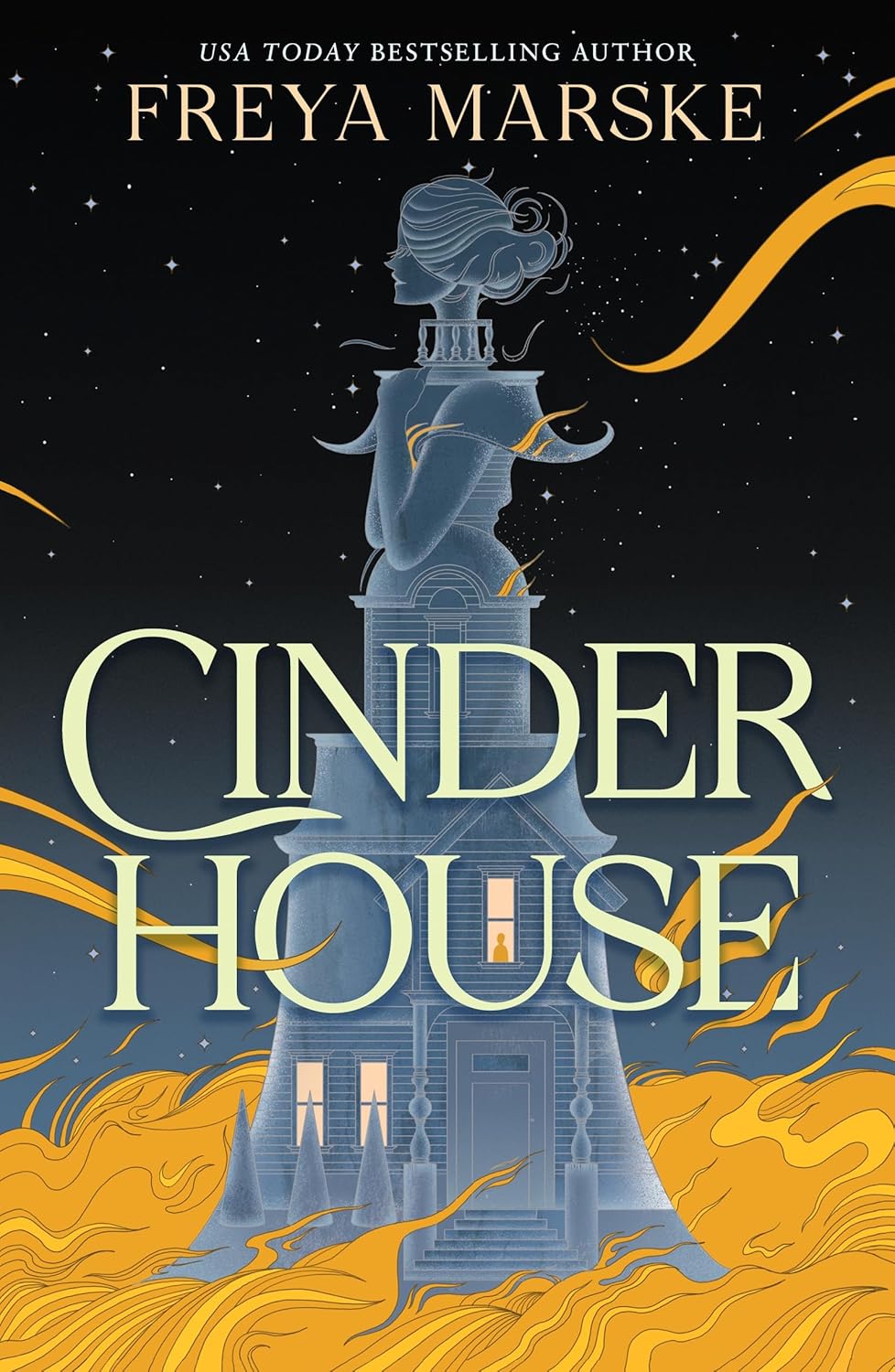
Novella review: Cinder House by Freya Marske

Title: Cinder House
Author: Freya Marske
Publisher: Tor
Publication date: October 7, 2025
Length: 144 pages
Genre: Fantasy
Source: Library
Rating:

Rating: 4.5 out of 5.

Sparks fly and lovers dance in this gorgeous, yearning Cinderella retelling from bestselling author Freya Marske—a queer Gothic romance perfect for fans of Naomi Novik and T. Kingfisher.

Ella is a haunting.

Murdered at sixteen, her ghost is furiously trapped in her father’s house, invisible to everyone except her stepmother and stepsisters.

Even when she discovers how to untether herself from her prison, there are limits. She cannot be seen or heard by the living people who surround her. Her family must never learn she is able to leave. And at the stroke of every midnight, she finds herself back on the staircase where she died.

Until she forges a wary friendship with a fairy charm-seller, and makes a bargain for three nights of almost-living freedom. Freedom that means she can finally be seen. Danced with. Touched.

You think you know Ella’s story: the ball, the magical shoes, the handsome prince.

You’re halfway right, and all-the-way wrong.

Rediscover a classic fairy tale in this debut novella from “the queen of romantic fantasy” (Polygon).

Cinder House by Freya Marske is a magical, memorable novella-length retelling of Cinderella, and it includes a haunting unlike any I’ve read before.

Cinder House starts by killing the main character:

Ella’s father died of the poison in their tea. Ella drank less and so might have lived, and not turned ghost at all, if the house hadn’t shrieked for its master’s murder in the moment she stood, dizzied and weak, at the top of the stairs.

Ella is dead… but that’s not the end of her story. As she comes back to consciousness, she finds herself tethered to her home, visible to those who live there — her stepmother Patrice, and her two stepsisters, Danica and Greta. None of them care about Ella in the slightest, but they do come to realize that she’s convenient.

Ella is not just an airy, incorporeal ghost floating around a particular place. Instead, she truly becomes the spirit of the house — she feels the house, as if it’s an extension of her own body.

How does a house, lacking flesh, feel fury? With the fire in its hearth and in the wide black stove.

She’s aware of the mice in the walls, the water in the pipes, the heat in the stove… but she’s also aware of anything wrong or out of place, and she can interact physically with anything that belongs to the house. She has an obsessive need to clean anything messy, to mend anything broken. For Ella’s stepfamily, it’s handy to have a ghost around to do their bidding, and it’s even economical! They’re able to dismiss the servants, and have Ella at their beck and call. Worst of all for Ella, when her sadistic youngest stepsister realizes that Ella feels what the house feels, she’s able to use pain — like sawing away pieces of woodworking or breaking windows — to coerce Ella into obedience.

Ella is trapped, until she discovers a trick for leaving the house — but no matter how far she wanders, she snaps right back to the staircase where she died at the stroke of midnight. Years pass, until finally, events in the world outside the house affect Ella and her family.

The Prince invites all the young unmarried women of the kingdom to a ball, during which he’ll choose a bride. Of course, most people suspect that there’s already a betrothal being arranged for political purposes, but that doesn’t stop the eligible women of the kingdom from dressing up and hoping for attention — including Ella’s stepsisters.

As the story progresses, we see Ella find a magical means for attending the ball too, thanks to her friendship with a fairy she meets in the marketplace. There are conditions, of course, and nothing goes quite according to plan — but she does meet the prince, and discovers that he’s dealing with magical complications of his own… and that the two of them may be able to help one another in ways that no one else can.

Cinder House is such an inventive retelling! I loved the details around what Ella feels and goes through as a house ghost, and the encounters with the prince, and the details of his curse, are fascinating too. The plot is tightly woven, yet never feels rushed, and the overall tone is full of magical, fantastical elements that create an atmosphere of surprise and delight.

The ending does get surprisingly… well… kinky, in a certain way, but it’s not terribly explicit (and definitely is not your typical fairy tale ending!)

Overall, I thought Cinder House was great! I’m so glad I saw so many positive reviews and decided to check it out for myself. Cinder House is a terrific example of what a novella can be: It tells a full story, provides characters to care about, and wraps up a compelling plot with just enough storytelling.

I’d never read anything by Freya Marske before, but now I’m eager to explore more of her books. I know people love the Last Binding series — adding to my TBR!

Purchase linksAmazon – Audible audiobook – Bookshop.org – Libro.fm
Disclaimer: When you make a purchase through one of these affiliate links, I may earn a small commission, at no additional cost to you.
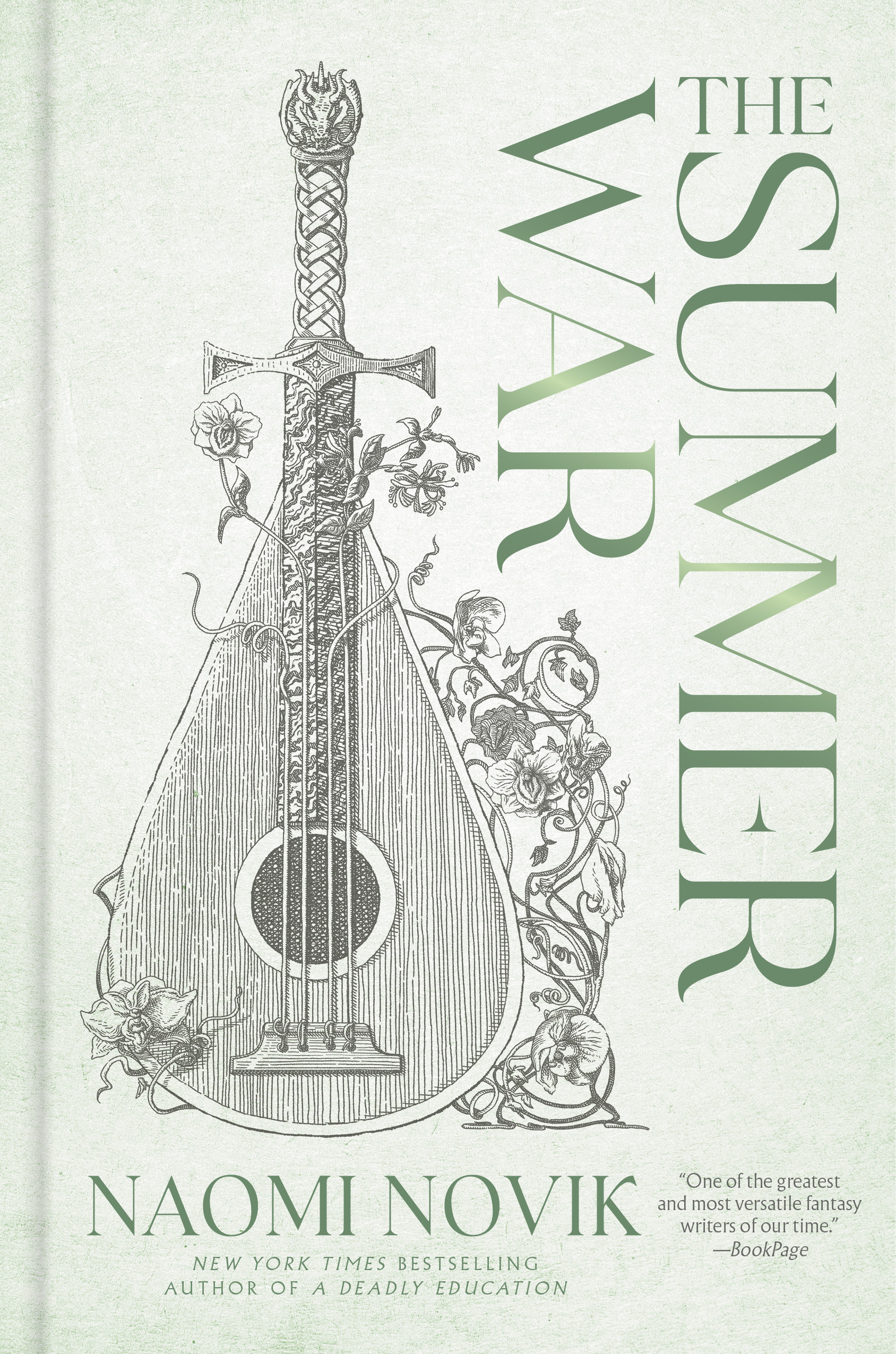
Novella review: The Summer War by Naomi Novik

Title: The Summer War
Author: Naomi Novik
Publisher: Del Rey
Publication date: September 16, 2025
Length: 131 pages
Genre: Fantasy
Source: Library
Rating:

Rating: 3.5 out of 5.

In this poignant, heartfelt novella from the New York Times bestselling author of Spinning Silver and the Scholomance Trilogy, a young witch who has inadvertently cursed her brother to live a life without love must find a way to undo her spell.

Celia discovered her talent for magic on the day her beloved oldest brother Argent left home. Furious at him for abandoning her in a war-torn land, she lashed out, not realizing her childish, angry words would suddenly become imbued with the power of prophecy, dooming him to a life without love.

While Argent wanders the world, forced to seek only fame and glory instead of the love and belonging he truly desires, Celia attempts to undo the curse she placed on him. Yet even as she grows from a girl to a woman, she cannot find the solution—until she learns the truth about the centuries-old war between her own people and the summerlings, the immortal beings who hold a relentless grudge against their mortal neighbors.

Now, with the aid of her unwanted middle brother, Celia may be able to both undo her eldest brother’s curse and heal the lands so long torn apart by the Summer War.

In this fairy tale novella, a younger sister’s hurt feelings lead her to cast a terrible curse. At age twelve, Celia’s beloved oldest brother informs the family that’s he’s leaving for good. In her fury, she wishes upon him a life without love… and realizes too late that her sorceress powers have awakened, turning her childish wish into a spell with power.

As she grows up, Celia becomes a pawn in her father’s schemes within their kingdom, threatening the hard-won peace that ended the hundred-year Summer War between the mortals and the summerlings. When a betrayal leaves her in the hands of the kingdom’s enemy, the love between Celia and her brothers may be the only thing that can save her and her people.

The Summer War is at its best when we see the world around Celia, her experiences within her family, and the ways in which love and expectations can have lasting consequences. The writing can be truly lovely, casting a magical spell of sorts as we follow the story of revenge and magical consequences and betrayals.

I especially liked learning about the dynamics between Celia and her brothers, but felt less interested in the history of the Summer War. When the plot takes us into the Summer Lands, there’s an added edge of enchantment and danger, and the stakes become very high for Celia and everyone she cares about — and her actions can determine whether the peace between the kingdoms will be shattered once again.

The ending didn’t feel especially clear to me. The dramatic events are compelling, yet I didn’t quite see how the curse was broken, and we don’t really get to see Celia’s sorcery in action. The resolution seems muddled, but perhaps this is due to the novella length. The Summer War feels like a story that could have used a bit more breathing space. Maybe a fuller-length novel could have expanded the action and helped it make better sense. As a novella, it all seems a bit too condensed.

Overall, I enjoyed The Summer War and I’m glad I read it, even though I was left feeling like a bit more storytelling was needed to tie all the pieces together.

Purchase linksAmazon – Audible audiobook – Bookshop.org – Libro.fm
Disclaimer: When you make a purchase through one of these affiliate links, I may earn a small commission, at no additional cost to you.

Book Review: Thornhedge by T. Kingfisher

Title: Thornhedge
Author: T. Kingfisher
Publisher: Tor Books
Publication date: August 16, 2023
Length: 128 pages
Genre: Fantasy
Source: Review copy courtesy of the publisher via NetGalley
Rating:

Rating: 4.5 out of 5.

There’s a princess trapped in a tower. This isn’t her story.

Meet Toadling. On the day of her birth, she was stolen from her family by the fairies, but she grew up safe and loved in the warm waters of faerieland. Once an adult though, the fae ask a favor of Toadling, to return to the human world and offer a blessing of protection to a newborn child. Simple, right?

But nothing with fairies is ever simple.

Centuries later, a knight approaches a towering wall of brambles, where the thorns are as thick as your arm and as sharp as swords. He’s heard there’s a curse here that needs breaking, but it’s a curse Toadling will do anything to uphold…

This slim novella is a fabulous fairy tale retelling… and at this point, the fact that T. Kingfisher has written yet another amazing story should come as no surprise to any of her fans.

In Thornhedge, we get the Sleeping Beauty story, but turned inside out and sideways. The main character is Toadling, a kind-of human (or is she a fairy?) who can shapeshift into a toad. She’s described as:

… the greenish-tan color of mushroom stems and her skin bruised blue-black, like mushroom flesh. She had a broad, frog-like face and waterweed hair. She was neither beautiful nor made of malice, as many of the Fair Folk are said to be.

Mostly she was fretful and often tired.

Toadling is a character who waits, always remaining near the thorn and bramble-covered castle as generations of people come and go across the barren lands nearby.

But Toadling was originally a human child who was stolen off to the world of faeries and replaced by a changeling baby. Toadling was raised with loved by a family of scary sea monsters, but eventually she’s called back to deal with the changeling who replaced her.

Years later, a kind knight stumbles across Toadling and the abandoned keep, and wants to solve the mystery of the girl in the tower — but once Toadling shares her story, it’s clear that waking the princess may not lead to the fairy tale ending everyone expects.

This is such a creative spin on the Sleeping Beauty story, and I loved it! At novella length, Thornhedge makes use of every word and chapter to let us know Toadling, her worries, her struggles, and her sorrows, as well as her memories of a loving childhood and her desire for a different future.

There are scary beings and horrific moments too, but overall, this is a lovely story about a highly unusual fairy tale heroine.

I loved it!

Book Review: Nettle & Bone by T. Kingfisher

Title: Nettle & Bone
Author: T. Kingfisher
Publisher: Tor Books
Publication date: April 26, 2022
Length: 256 pages
Genre: Fantasy
Source: Review copy courtesy of the publisher via NetGalley
Rating:

Rating: 4 out of 5.

After years of seeing her sisters suffer at the hands of an abusive prince, Marra—the shy, convent-raised, third-born daughter—has finally realized that no one is coming to their rescue. No one, except for Marra herself.

Seeking help from a powerful gravewitch, Marra is offered the tools to kill a prince—if she can complete three impossible tasks. But, as is the way in tales of princes, witches, and daughters, the impossible is only the beginning.

On her quest, Marra is joined by the gravewitch, a reluctant fairy godmother, a strapping former knight, and a chicken possessed by a demon. Together, the five of them intend to be the hand that closes around the throat of the prince and frees Marra’s family and their kingdom from its tyrannous ruler at last.

This is my 4th book by T. Kingfisher, and I’ve never once been disappointed! Nettle & Bone is another terrific tale from this gifted author.

I’m not sure why I expected horror (well, it was probably a misinterpretation of the cover), but this isn’t that! Nettle & Bone is a fairy tale about curses and kingdoms and doomed princesses — but forget all the traditional stories about dashing princes riding to the rescue. Here, the rescuer is none other than one of the princesses, the overlooked third daughter of a king and queen whose tiny kingdom is constantly threatened by the larger kingdoms along its borders.

To save their kingdom, the royal couple marry off their oldest daughter Damia to Prince Vorling of the Northern Kingdom, but soon after their marriage, the princess dies. The Northern Kingdom still has its eyes on the smaller kingdom’s ideally located ports, and to keep their land safe, the king and queen send their second daughter Kania to be the prince’s new bride. The prince longs for the day when he and his heirs are the sole rulers of both kingdoms, and to that end, he insists that the third daughter, Marra, remain unmarried, so that there will be no competing heirs to the thrown.

Marra is perfectly content with this arrangement, and spends the next years of her life as an “almost” nun at a convent that’s much more about female empowerment than strict rules or deprivations. Over time, however, Marra becomes aware that something is seriously wrong with Kania’s marriage. Fearing for her sister’s life, Marra sets out to save her, enlisting the aid of a dustwife (a woman with the ability to speak to the dead), a godmother, and a disgraced knight whom she frees from enslavement to the fae.

With her strange band of allies, Marra sets off to the Northern Kingdom, determined to rescue her sister, break an ancient curse, and protect her own kingdom… and hopefully, not get killed along the way.

Nettle & Bone is often funny, and the author has a light touch with humor and clever dialogue. At the same time, Kania’s situation is disturbing and serious, and the book manages to balance the adventurous tone with the heavier themes related to Marra’s quest and its dire nature.

The situations the band of allies encounter are often absurd, but quite entertaining, and I loved how the fairy tale tropes used here receive fresh, new twists.

T. Kingfisher excels at depicting creepy scenes too, as is evident from the book’s opening lines:

The trees were full of crows and the woods were full of madmen. The pit was full of bones and her hands were full of wires.

From this opening, I expected a much more sinister feel overall to the book, and was happily surprised to find many lighter-spirited moments and even downright silliness amidst the high stakes perils and quests.

All in all, Nettle & Bone is a terrific read. The author has another new book coming out this summer, and meanwhile, I have a few of her backlist books yet to read on my Kindle!

Book Review: Princess Floralinda and the Forty-Flight Tower by Tamsyn Muir

Title: Princess Floralinda and the Forty-Flight Tower
Author: Tamsyn Muir
Publisher: Subterranean Press
Publication date: November 30, 2020
Length: 216 pages
Genre: Fantasy
Source: Purchased
Rating:

Rating: 4 out of 5.

When the witch built the forty-flight tower, she made very sure to do the whole thing properly. Each flight contains a dreadful monster, ranging from a diamond-scaled dragon to a pack of slavering goblins. Should a prince battle his way to the top, he will be rewarded with a golden sword—and the lovely Princess Floralinda.

But no prince has managed to conquer the first flight yet, let alone get to the fortieth.

In fact, the supply of fresh princes seems to have quite dried up.

And winter is closing in on Floralinda… 

The idea of the princess rescuing herself isn’t exactly new anymore, thanks to the (incredibly welcome) surge in grrl-power fairy tale retellings. Still, in the hands of Tamsyn Muir, this princess story feels fresh and so, so entertaining.

Princess Floralinda and the Forty-Flight Tower is a slim book (with a wonderful cover!), but it’s jam-packed with humor and adventure (and all sorts of guts and gore, but in a FUNNY gross way).

A witch has imprisoned the beautiful princess at the top of a tower. It’s a classic concept — princes will come, battle their way to the top, and win the lovely princess (and a rocking golden sword). The problem is, the very first flight is guarded by a fearsome diamond-coated dragon, and for the first several days, all Floralinda can hear from way up in her tower is the crunch-crunch-crunch of prince bones. Eventually, the princes stop coming, and Floralinda’s tower prison starts to feel dismal.

Joined by a wayward fairy named Cobweb, Floralinda is spurred into action. If the two of them don’t do something about it, she’ll be stuck in the tower forever — and the magically regenerating bread and oranges that felt like a treat at first are just not enough to sustain a princess forever.

Floralinda and Cobweb begin to battle their way down the flights of the tower, crafting weapons and poisons, using their wits and their muscles (Cobweb assigns Floralinda a workout regimen) to defeat sirens, goblins, giant rats, and sorts of other ghastly, deadly adversaries.

I love how Floralinda sheds her princessy exterior, becoming grimier and tougher, turning her silk gown into bandages and her curtain rods into spears, turning into a warrior without ever really meaning to. The relationship beween her and Cobweb is funny and sweet, even though Cobweb spends most of her time hating on Floralinda (even while making sure she’s got the weapons and training needed to kill all the monsters that stand between them and freedom).

Princess Floralinda and the Forty-Flight Tower is a funny delight, and I’m so glad I treated myself to a copy. I think I’m the last person on the planet who hasn’t read Gideon the Ninth yet, but now that I’ve read this short treat by Tamsyn Muir, I definitely want to read her full-length works too.