
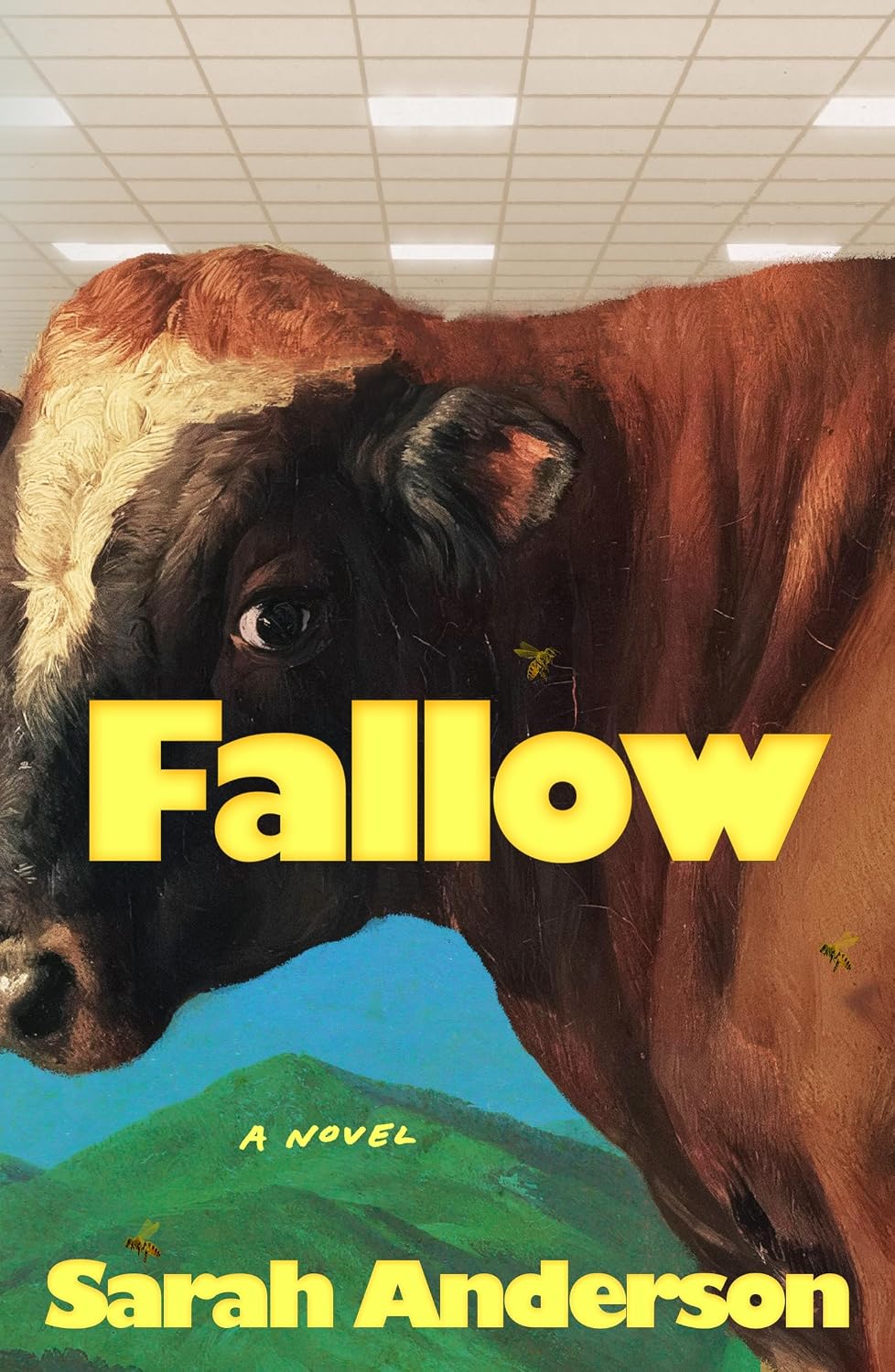
Title: Fallow
Author: Sarah Anderson
Publisher: Farrar, Straus and Giroux
Publication date: September 15, 2026
Length: 336 pages
Genre: Contemporary fiction
Source: Library
Rating:
Slyly funny and disarmingly tender, Fallow is the story of a young woman who signs up to be the world’s first in-house corporate surrogate, then finds herself caught up in a social experiment of another kind.
Natalie knows one truth: there is no such thing as a good job.
As the clock ticks away at the call center where she logs complaints of workplace harassment, she tries to ignore the increasing pain in her jaw. She has no dental insurance. She has no skills or ambitions. She has student loans. And, minute by minute, she hears the many ways workers are not just not getting by, but actually getting hustled.
Then, at the blood bank where she sells her plasma, a mysterious flyer leads her to The Company. Natalie turns out to be the perfect candidate for their pilot program, pitched as an opportunity to help women access greater gender equity. She will be their in-house surrogate, delivering seven babies in ten years and enabling their executives to have motherhood without maternity leave. Finally, she will be adequately—generously—compensated.
For years, her every need is met: stacks of healthy meals in the refrigerator of a luxury condo, fitness coaches and nutritionists, around-the-clock health care. Between deliveries, she takes time off— a fallow period, with no obligations or expectations. For the first time in her life, she is good at her job; for the first time, she feels free.
But just as she’s about to fulfill the terms of her contract, a staffing decision upends everything. Natalie is pulled into an entirely different kind of social experiment, one that raises new questions about her future, her freedom, her purpose, what she can expect from the world, and what she can offer to it.
Woundingly funny and genuinely moving, Sarah Anderson’s Fallow is a tender, alarmingly real vision of a woman balancing on the knife-edge of capitalism as she comes to realize who she wants to be.
From the opening lines of this strange yet utterly absorbing book, it’s clear what Natalie doesn’t want: Work.
When we were little, my sisters’ stuffed animals became astronauts and firefighters and chefs. Mine took vacations and naps and watched TV.
Sure, she’s done her time in afterschool jobs during high school, got a college degree (and all the debt that comes with it), and works full-time at a call center processing workplace harassment complaints. But none of it means anything, and none of it pays the bills. Or comes with dental insurance. A dental emergency that she can’t afford leads her to plasma donation, and at the blood center, she finds a flyer for a job with the Company — which we’re told is one of the most ubiquitous tech companies in the world. (I’m thinking Google, Microsoft, Apple… ) The job posting is vague, but promises to pay well… and yes, there’s dental!
After passing in-depth, intrusive screenings and signing intense NDAs (without reading the fine print), Natalie finally learns what she’s been selected for. She’ll be the Company’s first in-house gestational carrier. No longer will top professional women have to step away from their careers for maternity leave! By providing them with a company-paid surrogate, they can truly have it all — the baby they’ve always wanted, without the career disruption that comes with it. Gender equality at last! Sigh.
And so begins Natalie’s strange new life. Her contract is for seven pregnancies within ten years, with bonuses at various milestones and after each birth, a huge completion bonus at the end of the contract, a very nice salary, luxury accommodations provided by the Company, and all medical and health needs provided. It’s quite the sweet deal for someone who hates work.
I knew that being pregnant meant being tired all the time. But it also meant reason to rest. Being pregnant meant people offering to do things for you. Being pregnant was the perfect excuse, in fact, to not do anything at all.
Yes, there’s quite a bit of monitoring (if her biofeedback ring reports a less-than-ideal night’s sleep, she gets an immediate call from her doctor), tons of rules (playing language lessons in two selected languages to her belly everyday, strict dietary and exercise requirements, no artificial anything), and even performance reviews after each pregnancy.
Natalie also gets a “fallow” period after each delivery — a period of months where she’s free (or freer) of the intense rules, before beginning the preparation for the next pregnancy. She interprets her fallow time as time to cut loose — wild nights out, indulging in junk food, alcohol, random sex, and all the things she must deny herself otherwise. It’s an odd life, but it’s hers, and for once, she doesn’t have to worry about money, or much of anything at all.
But midway through the book, things change in a way that Natalie couldn’t have foreseen, and her cozy life of pampered pregnancies and fallow periods is knocked off course. From here, events occur (no spoilers!) that take Fallow out of the realm of corporate culture into something else entirely. It’s quite a transition, and requires a sharp adjustment for readers right alongside Natalie.
In some ways, Fallow reads as a satire of corporate culture. Breaking down barriers, enabling true workplace equality… by eliminating the need for maternity leave, a workplace protection that took years to enshrine into employment rights. The idea of Natalie writing a self-evaluation after each delivery is absurd, yet fits within the skewering of corporate life and the ladder to success.
At the same time, Fallow is an exploration of finding one’s path amidst the untenable reality of mounting bills, housing and health insecurity, and lack of safety nets. Natalie takes the Company job not just for the life of ease it promises, but also because she really has nothing else on the horizon and can’t imagine any job or career that offers a realistic option for her. She’s quite clear that she doesn’t want to work — but would that change if she actually found meaning or joy in any of the work she might be able to find?
The back half of the book goes in a very different direction, as Natalie finds herself in a situation she didn’t expect. Without going into detail, I’ll just say that it’s weird and jarring, but ends up being a fantastic contrast to the first half of the book, and finally gives Natalie the space to think about what she actually wants. I did wish for a bit more resolution at the end. We get a good idea of what Natalie’s life might look like going forward, but I would have liked an epilogue or at least something a bit more concrete to tie it all together. That’s a minor quibble — overall, I was satisfied with the plot and character development, and my attention never flagged.
I read Fallow in about two days — it’s fast-paced, totally engaging, a lot of fun, and hard to put down. The premise sounds off the wall, but the execution is so good that we readers have no choice but to buy into it and go along for the ride.

Purchase links: Amazon – Bookshop.org – Libro.fm
Disclaimer: When you make a purchase through one of these affiliate links, I may earn a small commission, at no additional cost to you.

