At A Glance: Thirteenth Child by Patricia C. Wrede

Book Review: Thirteenth Child by Patricia C. Wrede

Thirteenth Child (Frontier Magic, #1)

Synopsis (via Goodreads):

Eff was born a thirteenth child. Her twin brother, Lan, is the seventh son of a seventh son. This means he’s supposed to possess amazing talent — and she’s supposed to bring only bad things to her family and her town. Undeterred, her family moves to the frontier, where her father will be a professor of magic at a school perilously close to the magical divide that separates settlers from the beasts of the wild.

I recently finished reading Thirteenth Child with my son, and while we both enjoyed it, I hesitate to declare this book an unmitigated success.

First, the good: In the world of Thirteenth Child, the American frontier is redefined as a place in which magic is the only thing standing between people and all sorts of deadly beasts. In the country of Columbia, the Mammoth River marks the barrier between civilization and the wild, and as settlers venture west, they rely on magicians to provide the protective spells needed to keep out the wild. The world-building here is quite imaginative — a world in which magic is commonplace, used on a basic level to manage household chores and day-to-day tasks, and on a more complex level, to provide the means of human survival.

Main character Eff is a girl whose powers are just beginning to emerge by the end of this book. Brought up believing herself to harbor some inner evil, thanks to being a thirteenth child, Eff is hesitant and uncomfortable when it comes to using magic, until a gifted teacher introduces her to non-Avrupan (read non-European) approaches to magic. Eff’s worldview is expanded, and she starts to tap into non-traditional approaches to magic, realizing that her talents may be positive after all.

The not-quite-as-good: Thirteenth Child is the first book in the Frontier Magic trilogy, and as such, has to cover a lot of ground in terms of exposition and explanation. Likewise, quite a lot of time is covered, as we follow Eff from age five to age eighteen. Because of the length of time covered in a relatively short book, many of the chapters feel more like summaries than actual events — basically, well, that year, not much happened except Eff’s brother went away to school, or, that year, Eff was sick for a while, missed a lot of classes, and ended up having to repeat a grade.

The author is building a world system from scratch, and at times the jargon threatens to overwhelm the plot. We have Avrupan magic, Hijero-Cathayan magic, and Aphrikan magic, as well as Rationalists, the North Plains Territory Homestead Claim and Settlement Office, and circuit magicians.

The climax of this volume involves a plague of grubs that threaten the western settlements, and Eff’s role in fighting the bug invasion. The solution to the problem comes across like convoluted mumbo-jumbo, not that it’s not exciting to read.

Finally, on the negative side, I’d be remiss in not mentioning the to-do over this book from when it first came out concerning the lack of a Native American population. The only people in the book are the (presumably) white settlers, with a couple of people of color mixed in among the townsfolk and school magicians. There isn’t a native culture, at least not one that’s mentioned at all in this book. Apparently, there was quite a bit of criticism over this when the book came out. As a work of fantasy fiction, I suppose it’s the author’s right to create whatever world she sees fit… but I leave it to potential readers to decide whether or not this is a deal-breaker for them.

Bottom line: My son and I enjoyed Thirteenth Child enough to continue with the series. Despite uneven pacing, the story itself is fresh and intriguing — so that the duller parts are easily outweighed by chapters and sequences that are suspenseful and highly engaging.

_________________________________________

The details:

Title: Thirteenth Child
Author: Patricia C. Wrede
Publisher: Scholastic
Publication date: 2009
Length: 344 pages
Genre: Children’s fantasy fiction
Source: Purchased

Flashback Friday: Half Magic

ffbutton2Flashback Friday is a weekly tradition started here at Bookshelf Fantasies, focusing on showing some love for the older books in our lives and on our shelves. If you’d like to join in, just pick a book published at least five years ago, post your Flashback Friday pick on your blog, and let us all know about that special book from your reading past and why it matters to you. Don’t forget to link up!

It’s a childhood favorite for this week’s Flashback Friday!

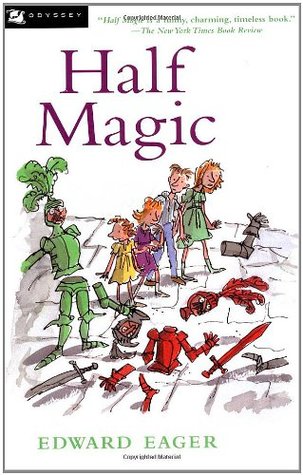
Half Magic (Tales of Magic, #1)

Half Magic by Edward Eager
(published 1954)


Synopsis (Amazon):

Edward Eager has been delighting young readers for more than 40 years with stories that mix magic and reality. Half Magic, the most popular of his tales about four children who encounter magical coins, time-travel herb gardens, and other unlikely devices, is a warm, funny, original adventure. The “Half Magic” of the title refers to a coin that the children find. Through a comical series of coincidences, they discover that the coin is magic. Well, it’s not totally magic–it’s only (you guessed it) half magic. That means there’s a certain logic to the wishes one must make to generate a desired outcome. Imagine the results emerging from inaccurate efforts: “half” invisible, “half” rescued, “half” everything!

If this book doesn’t delight you, then you, my friend, have no appreciation for magic!

Too judgmental? Sorry…

Half Magic is an enchanting book, and one that stands the test of time pretty well too. I remembered it vaguely from eons ago (a.k.a, my childhood), then read it again with my daughter and then again with my son — and each time, the magic just shone through. Despite some old-fashioned word usage, the overall themes and ideas are crystal clear and utterly entertaining: Four children, having a rather boring summer, find a magical coin that grants wishes — except it only grants half wishes. When someone wishes they were home, they find themselves suddenly on the side of the road, halfway there. Wish not to be somewhere… and you may find yourself halfway invisible with people shrieking about seeing a ghost. On and on the adventure goes, as the kids figure out the trick: Wish for double of whatever you want, and when it’s divided in half, you’ll end up with what you really want… which is a lot harder and takes a lot more cleverness than you might think.

Edward Eager wrote seven books in his magic series, some more directly linked than others. I remember Knight’s Castle as being one of the most amazing reads of my childhood (and have only recently come up with a copy, so I’ll need to reread it pronto), and have read Magic By The Lake with my son (not as great as Half Magic, but still a really good time).

Have you read any Edward Eager books? Which were your favorites? And if you had a coin that granted half wishes, what would you wish for? (My wish? To have the time to read every book I own — twice!)

What flashback book is on your mind this week?

Note from your friendly Bookshelf Fantasies host: To join in the Flashback Friday fun:

  • Grab the Flashback Friday button
  • Post your own Flashback Friday entry on your blog (and mention Bookshelf Fantasies as the host of the meme, if you please!)
  • Leave your link in the comments below
  • Check out other FF posts… and discover some terrific hidden gems to add to your TBR piles!

♥♥♥♥♥♥♥♥

Do you host a book blog meme? Do you participate in a meme that you really, really love? I’m building a Book Blog Meme Directory, and need your help! If you know of a great meme to include — or if you host one yourself — please drop me a note on my Contact page and I’ll be sure to add your info!

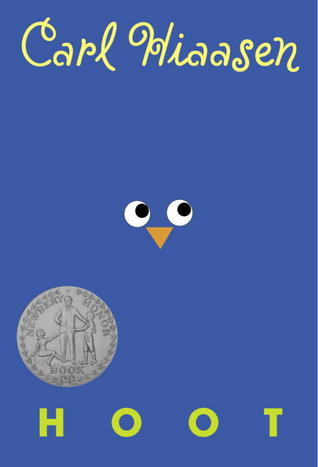
Hoot by Carl Hiaasen: A book & a movie with the kiddo

Book Review: Hoot by Carl Hiaasen

Hoot

Perhaps you’re familiar with Carl Hiaasen’s smart-ass, Florida-centric books for grown-ups — all 22 of them! — that include bestsellers such as Strip Tease, Nature Girl, Star Island, and Skinny Dip. But the way this author found his way into my heart was through his books for kids, now totaling four — and here’s hoping there are many more to come!

Hoot was Carl Hiaasen’s first book for kids, aimed at the middle school crowd and featuring some fun, fearless, and memorable characters with just enough gross-outs and goof-ball mischief to appeal to 10 to 13-year-olds. Hoot certainly appealed to my 11-year-old, who isn’t the easiest kid to please when it comes to books. (Video games are a different matter, but I digress.)

In his younger days — oh, say at age 10 — my kiddo would help me out on my blog from time to time with “Q&A with the Kiddo” posts, where I’d write about books that we’d read together, ask him questions, and then share some thoughts from each of us. Alas, now that he’s reached the ripe old age of 11, he’s no longer willing to indulge me. Luckily, though, he still enjoys a good book, and has not yet decided that he’s too old for a read-aloud at bed time. So for as long as he’ll let me, I continue reading him a chapter or two once he’s tucked in (knowing that our days of reading together are probably numbered, although I’ve told him more than once than I’ll come to college with him if he wants).

Hoot is our most recent reading adventure, and it was a big success. We’d thoroughly enjoyed the author’s most recent kids’ book, Chomp, last year (my review is here), and reading Hoot was actually the kiddo’s idea — he’d seen part of the movie at his after school program recently, and wanted to know the rest of the story.

hoot owlSo what’s it about? In a nutshell: Roy Eberhardt moves to Florida from Montana when his dad gets reassigned for work, and boy, is Roy unhappy about being the new kid all over again. After getting bullied by the meanest kid in school, he encounters a mysterious barefoot boy running down the street, and quickly becomes fascinated by figuring out who the kid is and why he’s running. Meanwhile, Mother Paula’s Pancake House is about to open a new franchise location in Roy’s small town… but someone keeps playing pranks and causing mischief at the construction site, and the Mother Paula’s people are not happy about it. The storylines come together as Roy and his new friends Beatrice Leep and Mullet Fingers try to find a way to save the rare burrowing owls who live at the construction site before the bulldozers start to roll. Hoot is filled with a host of amusing supporting characters, from the well-intentioned but bumbling Officer Delinko to construction manager Curly to the oozily nasty corporate tool Chuck E. Muckle. As the various plotlines and people converge, Carl Hiaasen doesn’t skimp on humor, pranks, or bizarre human behavior.

In both Hoot and Chomp, a dominant theme is the natural wonders of Florida and how greedy humans are encroaching on natural habitats. In both books, the author’s love for nature shines through, and the kids who are heroes are the ones who stand up and fight against the careless, thoughtless, or just plain mean grown-ups who value money over beauty. While the main characters in both books come from homes with supportive and loving parents, the author doesn’t shy away from showcasing kids who come from troubled homes or less wholesome environments. One of the things he does best is dig beneath the surface and show why a kid might be weird, or dressed funny, or be reluctant to trust or share secrets. At the same time, no mercy is shown to the bullies, whether kids or adults: The characters who mistreat others, who are mean and nasty, who like to hurt people for their own glory, or who just don’t care — well, they do tend to get what’s coming to them, and then some.

After reading the book, kiddo and I decided to watch the movie as well — and while I almost never, ever, ever sayhoot this, in this case I’ll admit to liking the movie just a smidge more than the book. The book was great, don’t get me wrong — but the movie just did a better job of showing the natural beauty of the Florida coastlines and waterways, as well as the vulnerability of the little owls (awwwww… baby owls!) being threatened by the big construction machinery. This is one instance where a picture really is worth a thousand words, because the one thing I really didn’t get from the book was enough description of the construction site and the landscape, and that made it harder to visualize the nature of the threat. The movie is mostly faithful to the book, up until the ending — where again, I have to admit that I found the movie ending a bit more exciting and dramatic than the final confrontation and big finale in the book.

The cast was very good, with a young Logan Lerman in the role of Roy, and a nice cameo by Jimmy Buffett as well. Plus, the geek in me and my kiddo (call us Mama Geek and Geek Junior, I suppose) did a little happy dance when Clark Gregg (Agent Coulson!) appeared in the sleazy role of corporate bad guy Chuck Muckle.

Should you read the book or watch the movie?

Yes to both! Why choose?

Meanwhile, I have no hesitation about recommending this author’s books for kids. Carl Hiaasen’s writing is funny and fast-paced, with strong messages about family connections, loyalty, and respect for the environment. I can pretty much guarantee that kids will love these books, and their parents will too.

_________________________________________

The details:

Title: Hoot
Author: Carl Hiaasen
Publisher: Alfred A. Knopf
Publication date: 2002
Genre: Middle grade
Source: Purchased

Flashback Friday: A Hanukkah Favorite!

Flashback Friday is my own little weekly tradition, in which I pick a book from my reading past to highlight — and you’re invited to join in!

Here are the Flashback Friday book selection guidelines:

  1. Has to be something you’ve read yourself
  2. Has to still be available, preferably still in print
  3. Must have been originally published 5 or more years ago

Other than that, the sky’s the limit! Join me, please, and let us all know: what are the books you’ve read that you always rave about? What books from your past do you wish EVERYONE would read? Pick something from five years ago, or go all the way back to the Canterbury Tales if you want. It’s Flashback Friday time!

Happy Hanukkah! Your turkey may be nothing but leftovers by now, but you’ve still got six more days to chow down on latkes! In honor of the (very early!) festival of lights, I thought I’d highlight a family favorite for this week’s Flashback Friday post:

Hershel and the Hanukkah Goblins

Hershel and the Hanukkah Goblins
by Eric Kimmel
Illustrated by Trina Schart Hyman
(published 1994)

Synopsis (Amazon):

What are the poor villagers to do? The holiday-hating, hill-dwelling hobgoblins are bound and determined to ruin yet another Hanukkah for them. Every year the beasties snuff out the menorah candles, destroy the dreidels, and pitch the potato latkes on the floor. But these wicked wet blankets never counted on someone as clever as Hershel of Ostropol showing up. Using his wits and a few props–pickles, eggs, and a dreidel (a square-shaped top with Hebrew letters on each side)–Hershel manages to outwit all the creepy critters and break the spell. This fabulously creative adaptation of the ancient Hanukkah story in which the Syrians forbade the Jews to worship as they wanted, keeps the spirit of the original while adding a spine-tingling twist. Warmth and humor prevail, even in the midst of hopeless-looking circumstances. Award-winning illustrator Trina Schart Hyman creates lively and witty pictures that pair perfectly with Eric Kimmel’s words to create this Caldecott Honor Book. (Ages 4 to 8)

I have never seen a more rapt group of 6-year-olds than on the day that my son’s teacher asked me to read a Hanukkah story to the class. Once I began the story of Hershel and the icky, creepy, mean creatures who were trying to destroy Hanukkah, they were hooked. Even today, my 11-year-old pulls this one off the shelf for a Hanukkah read-along (although he’d probably be thoroughly embarrassed that I said so). Hershel and the Hanukkah Goblins has it all — scary creatures, an ordinary guy who outsmarts the baddies, and really funny (and a little bit frightening) illustrations as well.

Sure, there are plenty of Hanukkah books to choose from, but how many have goblins? We’ve always loved this book at my house, and I’m glad none of us are too old to enjoy it once again this year!

Happy Friday! I hope you’re enjoying the company of a terrific book… and avoiding the shopping madness!

♥♥♥♥♥♥♥♥

Do you host a book blog meme? Do you participate in a meme that you really, really love? I’m building a Book Blog Meme Directory, and need your help! If you know of a great meme to include — or if you host one yourself — please drop me a note on my Contact page and I’ll be sure to add your info!

Book Review: The Expeditioners and the Treasure of Drowned Man’s Canyon by S. S. Taylor

Book Review: The Expeditioners and the Treasure of Drowned Man’s Canyon by S. S. Taylor

The Expeditioners and the Treasure of Drowned Man's CanyonIf you love adventurous kids, mysterious maps, hidden canyons, and steam-powered everything, you won’t want to miss The Expeditioners, the first installment in what promises to be a very exciting middle grade series.

The West kids — Zander, Kit, and MK — are the orphaned children of famous explorer Alexander West, who rose to fame and fortune exploring new lands, then died under mysterious circumstances, leaving the three kids to fend for themselves. And when I say new lands, I really mean New Lands: Several decades earlier, after computers and electricity were proven unreliable and were discarded, explorers discovered New Lands hidden amidst the lands already known. Apparently, all those earlier maps were wrong, and the globes we all rely upon are really just quaint relics. The current world includes places such as the New North Polar Sea, Fazia, and Deloia, and exploring and cartography are among the most esteemed and  sought-after vocations.

Unfortunately, the BNDL (Bureau of Newly Discovered Lands) is in control and is awfully shady. Current policy seems to be to discover resource-rich new worlds and then plunder them for all they’re worth. It’s becoming clear to the West kids that perhaps their dad wasn’t entirely pleased with BNDL’s approach — and it’s starting to seem that the feeling was mutual. The kids are being watched, and when our narrator, Kit, receives a package from a stranger in the market, it sets off a chain of events that will lead the kids into danger as well as excitement.

As The Expeditioners moves forward, Kit and his siblings, along with their new friend Sukey, daughter of a famous explorer herself, set out to solve a puzzle left behind by Alexander. Hidden maps and secret codes lead the gang to a daring escape from BNDL agents and on a mad cross-country dash toward a legendary treasure lost centuries earlier in the canyons of Arizona. The government wants the treasure too, and it’s a race to see who will find it first — if it exists at all.

I read this book with my 11-year-old (who still likes me to read to him at bedtime — hurray!). Let me just cut to the chase here — we both loved The Expeditioners.

The world-building is terrific, as we are introduced to a steampunky society in which the ability to build, tinker, and create is of utmost importance, as are big heaps of courage and a willingness to leap into the unknown. The author takes our own world and technology and spins it into something at once familiar yet completely new. There are no cars, but that’s okay: People travel by steam trains, dirigibles, even steam-powered bicycles and IronSteeds, steam-powered mechanical horses.

The West kids are all talented and honorable. Zander, the oldest at 14, is brave and protective; Kit is a budding cartographer like his dad, and little sister MK can fix anything. Along with their pilot friend Sukey, they demonstrate courage and conviction over and over again, relying on their smarts to get in and out of tight scrapes, with an absolute devotion to one another and to their mission.

A hint of preachiness creeps in when the kids begin to understand the unscrupulous dealings of BNDL and realize how poorly the indigenous populations of the new worlds are being treated. Of course, the PC-lecture tone didn’t faze my son, but I found it a bit heavy-handed.

The storyline is tightly woven and packed with action. After the initial chapters, which seemed about to bog down in exposition, the pace picks up, and we get to truly know the West kids through their adventure, seeing their initiative and daring, as well as their commitment to their father’s memory and to their family as a whole.

Black and white illustrations by Katherine Roy add to the hip feel of the book, bringing the kids to life and adding in details such as gears, clockwork, and goggles that really enhance the story.

The ending makes clear that there is more to come, as the children complete their treasure-seeking adventure and are given a fresh opportunity for new experiences in a new setting. (I’m being intentionally vague here — you won’t get spoilers out of me!) My kiddo and I are both looking forward to seeing how Zander, Kit, and MK fare along their new path, and we really can’t wait for the next Expeditioners book!

Summing it all up: The Expeditioners seems like a perfect choice for middle grade readers, and it’s smart, savvy, and hip enough that parents will enjoy it too. A decidedly different adventure story that’s full of intellectual challenges too, with brave, independent characters of both genders and a range of ages, set in a steampunky American Southwest — this book is one I could see appealing to a wide audience for years to come.

__________________________________________

The details:

Title: The Expeditioners and the Treasure of Drowned Man’s Canyon
Author: S. S. Taylor; illustrated by Katherine Roy
Publisher: McSweeney’s McMullens
Publication date: 2012
Genre: Middle grade fiction
Source: Library

Flashback Friday: The All-of-a-Kind Family series

Flashback Friday is my own little weekly tradition, in which I pick a book from my reading past to highlight — and you’re invited to join in!

Here are the Flashback Friday book selection guidelines:

  1. Has to be something you’ve read yourself
  2. Has to still be available, preferably still in print
  3. Must have been originally published 5 or more years ago

Other than that, the sky’s the limit! Join me, please, and let us all know: what are the books you’ve read that you always rave about? What books from your past do you wish EVERYONE would read? Pick something from five years ago, or go all the way back to the Canterbury Tales if you want. It’s Flashback Friday time!

My pick for this week’s Flashback Friday:

All-of-a-Kind Family (All-of-a-Kind Family, #1)

All-of-A-Kind Family by Sydney Taylor

(published 1951)

Synopsis:

There’s something to be said for a book that makes you wish you’d been part of a poor immigrant family living in New York’s lower east side on the eve of World War I. Sydney Taylor’s time-honored classic does just that. Life is rich for the five mischievous girls in the family. They find adventure in visiting the library, going to market with Mama, even dusting the front room. Young readers who have never shared a bedroom with four siblings, with no television in sight, will vicariously experience the simple, old-fashioned pleasures of talk, make-believe, and pilfered penny candy. The family’s Jewish faith strengthens their ties to each other, while providing still more excitement and opportunity for mischief. Readers unfamiliar with Judaism will learn with the girls during each beautifully depicted holiday. This lively family, subject of four more “all-of-a- kind” books, is full of unique characters, all deftly illustrated by Helen John. Taylor based the stories on her own childhood family, and the true-life quality of her writing gives this classic its page-turning appeal.

There are five books in Sydney Taylor’s lovely, heart-warming, classic series:

  • All-of-a-Kind Family (1951)
  • More All-of-a-Kind Family (1954)
  • All-of-a-Kind Family Uptown (1958)
  • All-of-a-Kind Family Downtown (1972)
  • Ella of All-of-a-Kind Family (1978)

Through these books, we meet the five sisters and their parents, and get a sweet and savory view of life on the Lower East Side of New York in the early 1900s. The girls live in close quarters, bicker and play, make up stories and get into trouble, and learn important (but not overly preachy) lessons along the way.  The very first chapter in the first book is about the hugely important weekly trip to the library — and between the lovely library lady and the emphasis on having great books to read, it’s a great way to start! Another chapter is about dusting (!!) — and it really is the stuff of legends, for kids who grew up with these books. In order keep dusting fun (I can’t believe I’m writing this…), the girls’ mother hides buttons that they can only find by cleaning super-carefully.

And now I’m praising a book that has us thinking housework is delightful. So not me. But I digress.

library aoakf

The library scene from All-of-a-Kind Family, illustrated by Helen John

The All-of-a-Kind Family books are memorable for the wonderful and distinctive characters, the upbeat look at life in a relatively poor immigrant neighborhood, the non-sentimental view of some of the era’s hardships, and the positive portrayal of life in an American Jewish family. With penny candy stores, Coney Island, pickles, Fourth of July celebrations, and later, very circumspect parties and dating rituals, the books are at once of historical interest and human interest. I think, as a kid reading these books, I didn’t think about the history too much — I was too busy siding with the different girls in their squabbles and plans, worrying about them getting caught when they got into mischief, and wishing I lived in a house full of girls.

So talk about a flashback! The All-of-a-Kind Family series was a huge part of my childhood. My sister and I pored over these books as kids, reenacting key scenes (the button search was a special favorite!) and in general maintaining a fascination with the five sisters. (Ella, we agreed, was glamorous; Henny, on the other hand, was a big trouble-maker — although looking back from the adult perspective, she also probably had the most gumption of the lot!)

Later on, I found myself returning to these books. As a summer camp counselor, I would read a chapter a night to my girls, who despite being almost too cool during the day, really craved the connection these stories offered at bedtime. And still later, the All-of-a-Kind Family books were read-aloud favorites for my daughter and me.

In a way, these books are like a Jewish parallel to the Little House books by Laura Ingalls Wilder. In each, we see a family’s challenges over the course of many years and many books, set in a particular point in America’s history — but written in such a way that kids today won’t feel like they’re being taught, as they’ll be too busy being entertained by the characters’ antics and adventures. In both series as well, the fictional characters are directly based on the authors’ own lives, and perhaps that ring of authenticity is what helps bring these books, with their detailed descriptions of daily life and routines, into such rich and resounding life.

Did you read the All-of-a-Kind Family books as a kid?

And have you ever, for even a second, believed that dusting is fun?

Happy Friday, and enjoy your flashbacks!

♥♥♥♥♥♥♥♥

Do you host a book blog meme? Do you participate in a meme that you really, really love? I’m building a Book Blog Meme Directory, and need your help! If you know of a great meme to include — or if you host one yourself — please drop me a note on my Contact page and I’ll be sure to add your info!

Book Review: Will in Scarlet by Matthew Cody

Book Review: Will in Scarlet by Matthew Cody

Will in ScarletIn this exciting middle grade adventure story, Robin Hood takes a backseat to young Will Scarlet, born the son of a nobleman, now a refugee on the run from the evil lord who has captured his father’s castle and betrayed the king. When we first meet Will, he is the 13-year-old son of the estate, born to privilege and prone to mischief. Now on the verge of manhood, it’s time for him to grow up and start acting like a lord — but when his family is betrayed, Will escapes to Sherwood Forest, where he meets up with a band of thieves and outlaws. Will the Merry Men kill Will, ransom him, or make him one of their own? Will is forced to finally figure out who he is and what he stands for — and whether he going to allow his thirst for vengeance to take over his life.

In the forest, Will meets Much the Miller’s Son (who is really a girl in disguise), John Little, a big, strong but fair fighting man, and the drunken, smelly man whose tent Will shares — the prickly and rather repulsive Rob. But once Rob sobers up on a key mission, Will starts to realize what a natural-born leader this man is — as well as an expert hand with a longbow.

It’s terrific fun to read this version of the Robin Hood story. Will In Scarlet serves very much as an origin story. Instead of focusing on Robin Hood himself, we see the band of outlaws through Will’s eyes, and as Will comes to appreciate their bravery and honor, so do we. The story is told mostly from Will’s perspective, although Much gets her fair share of the action as well, and she’s… well… awesome, for lack of a better word! Much is clever, skilled with a knife or a lock-pick, fierce and determined — and bloody well certain that she does NOT want anyone to know she’s a girl.

As Will and Much discover each other’s secrets, they also form a strong bond based on trust, respect — and something more as well. They’re both such delightful characters, and it’s wonderful to get to know them and see how they grow and change during the course of the story.

The plot of Will in Scarlet zips along with never a dull moment. There are battles, sword fights, ambushes, trickery, and daring escapes. There are also moments of great kindness, and we see how Will changes from spoiled little rich kid to young man with a conscience. In this version of the Robin Hood legend, it’s Will who is responsible for the “rob from the rich and give to the poor” ethos of the Merry Men, and this turning point for Will and the gang is given a meaningful and powerful context within the story.

There are serious moments and moments of pain and suffering as well, but overall Will in Scarlet is an upbeat adventure story with terrific characters, some cleverly concealed and revealed secrets, and a storyline that bounces right along. With Will and Much as the two lead characters, I can see this story appealing to boys and girls alike, and highly recommend it for kids in the middle grade zone.

While I couldn’t find anything to confirm this, Will in Scarlet certainly seems like it should be the first in a series. Nothing is left hanging at the end, and the wrap-up is well-earned and satisfying — but in Will in Scarlet, we’re seeing the early days of Robin Hood as the leader of his band of Merry Men. I really and truly hope that author Matthew Cody will give us more! I’d love to see what happens next for Will, Much, Rob and the rest of the gang!


__________________________________________

The details:

Title: Will in Scarlet
Author: Matthew Cody
Publisher: Random House Children’s Books
Publication date: 2013
Genre: Middle grade fiction/adventure/historical fiction
Source: Review copy courtesy of Random House Children’s Books via NetGalley


Book Review: Mister Max: The Book of Lost Things by Cynthia Voigt

Book Review: Mister Max: The Book of Lost Things by Cynthia Voigt

The Book of Lost Things (Mister Max #1)There’s a lot to love in this middle-grade novel about a very smart boy looking for solutions. Max, age 12, is the son of two successful, larger-than-life parents who run their own theater company and bring their characters to life day after day. Max enjoys the show but likes his place on the sidelines — until a mysterious letter arrives offering Max’s parent a too-good-to-be-true opportunity for fame and fortune, which they immediately accept. Max and his parents are due to set sail from their unnamed town on a luxurious ocean-liner headed for India, but on the day of departure, Max shows up at the docks at the appointed time only to discover that his parents have gone already — and that the ship they were meant to board does not actually exist.

Left behind, Max determines that his best course is independence, so even though his grandmother (Grammie) wants to take him in and care for him in his parents’ absence, Max decides to live under his own roof and support himself by any means possible. (His house is right next door to Grammie’s, so it’s not that dramatic a separation, after all). But how can a 12-year-old survive on his own — and what happened to his parents? Max stumbles onto a good thing, realizing that by enacting the parts he’s seen his father play so many times, he can assume any persona he needs: town official, humble laborer, stuffy bureaucrat, ardent detective. Max is a chameleon, and as he slips into his different characters, he begins to solve problems for the townspeople he encounters, earning enough along the way to retain his independence and managing to help the people he cares for in different ways as well.

Mister Max is a charming book, with a main character who is good-hearted, caring, and endlessly inventive. Max does not have magical resources or superpowers; instead, he uses his wits and logic to find solutions and set things right, figuring out not only facts but reasons and motivations, and helping others to figure out what it is that they truly want and need.

My main quibble with Mister Max is that it lacks a certain urgency. Although Max’s parents’ disappearance is the catalyst for the book’s story line, this mystery mostly sits on the back burner for much of the book. It’s a problem for Max and a worry, but he spends much more of his time solving other people’s problems and worries. True, there isn’t much he can do and there aren’t many clues — but Max seems to mostly take a shrug-your-shoulders, get-on-with-it sort of approach to his current situation. It’s all very pragmatic, but I’m afraid at times the plot concerning the mystery of Max’s parents seems to get buried in all the other busy moments of Max’s independent life.

Still, it’s an entertaining and clever read, and refreshing in an old-fashioned sort of way. The specific time and place of the book’s setting isn’t revealed, but it appears to take place sometime in the early 1900s. Travel is by steamship, communication is conducted via letters and telegrams, and Max weaves his way through the streets of Old Town and New Town on his trusty bicycle. There’s a simplicity to the problems that Max is hired to solve, and his solutions are smart and simple — perhaps needing a 12-year-old’s eyes to see the clues and patterns that closed-minded adults might miss.

I do wonder how well this book will work for the intended audience, children ages 8 – 12. At 400 pages, this is a rather hefty book, and the pace is somewhat slow, particularly for kids more used to reading books about fantasy worlds or high-speed adventures. Still, the writing is engaging and the characterizations are funny, straight-forward, and evocative, so that within a few well-written lines, we clearly see into the heart of each new character we meet and understand what makes them all tick. Author Cynthia Voigt is adept at talking to children without talking down, and it’s obvious that she credits her reading audience with a great deal of intelligence. It’s whether young readers will have the patience to commit to such a lengthy, character driven book that I’m not so sure about.

I read this book after receiving a review copy, and needless to say, I can’t help but apply an adult perspective to the action and the plot. I’d like to try this one out on my 11-year-old and see what he thinks. I have a feeling that Mister Max is a more subtle read than he’s used to, but that doesn’t mean that he won’t enjoy it, if he gives it a fair chance… and I’d imagine this may be true for other kids his age as well. Mister Max feels like the kind of story that might have been more popular a generation ago, but I do believe kids today will enjoy it, if they can just stick with it long enough to get into the flow and rhythm of a different sort of storytelling.

Mister Max: The Book of Lost Things is apparently first in a series, and ends without resolving the central question: What happened to Max’s parents? I’ll be interested in seeing where the series goes and what happens next for Max.

__________________________________________

The details:

Title: Mister Max: The Book of Lost Things
Author: Cynthia Voight
Publisher: Knopf Books for Young Readers
Publication date: 2013
Genre: Middle Grade fiction
Source: Review copy courtesy of Knopf via NetGalley

Q&A with the kiddo: A kid’s-eye view of the books of Narnia

The Lion, the Witch and the Wardrobe (The Chronicles of Narnia, #1)Prince Caspian (The Chronicles of Narnia, #2)The Horse and His Boy (The Chronicles of Narnia, #5)

Proudly presenting Q&A with the kiddo, courtesy of my 10-year-old son, in which I ask my kiddo to describe a book he’s enjoyed recently and he gives his opinions, more or less unfiltered by mom.

Kiddo and I are in the midst of our Narnia read. Neither of us had read these books previously. In fact, I consider my childhood somewhat deficient due to its lack of both Narnia and Anne of Green Gables books. It’s never too late, I say! I read The Lion, The Witch and The Wardrobe for the first time about ten years ago, but it’s a whole different ballgame reading it as part of a greater body of work. So far, we two have read The Magician’s Nephew (discussed earlier, here) and have now finished TLTW&TW, Prince Caspian, and most recently, The Horse and His Boy.

Let’s see what the kiddo has to say. Without further ado:

Q: Of the four Narnia books we’ve read so far, which was your favorite?

A: My favorite was The Horse and His Boy. I like Shasta, the main character, and I like the ending. In the end, everything turned out good. Aslan actually saved them, and Shasta turned out to be Prince Cor. I like how Rabadash (the bad guy) was punished in the end and got turned into a donkey. I like how they (the main characters) traveled through all the places and how Aravis got scratched by the lion to punish her for causing her servant to get whipped. Bree and Hwin (the talking horses) were cool. They should have gotten married, but at least they’re still best friends. I liked Prince Corin because he always knocked people down and later became a champion boxer. I liked King Lune too. The battle scenes were cool. I wish they’d make a movie from this book.

Q: What did you think about the other books? What parts or characters did you like the most?

A:  I liked King Peter, King Edmund, Queen Susan, and Queen Lucy. They brought light into the story. They were the most important in The Lion, The Witch and The Wardrobe and were also important in Prince Caspian. I liked them better in TLTW&TW because they were more active in the fighting and in controlling what happened. In Prince Caspian, Prince Caspian was the most important, and Peter, Edmund, Susan, and Lucy were just there to support him.

Q: What did you think of Prince Caspian?

A: He’s okay. I liked the book. I especially liked all the talking animals and the fight (battle) scenes. I liked how they (the Pevensies) got called back to Narnia by Susan’s horn. Reepicheep (the warrior mouse) was cool with his uncut tail.

Q: Any final thoughts?

A: It’s a good series. I definitely want to continue with the other books. I want to see the movies.

Mom’s two cents:

Well, we’ve managed to mess up the order of the books, but it’s actually all turning out fine anyway. From what I understand, you can either read them in order of publication (starting with The Lion, The Witch and the Wardrobe) or in what is supposed to be C. S. Lewis’s preferred reading order, going by the chronology of the story itself. [Note: In trying to figure out which way is “right”, all I could find was reference to a single letter by the author in which he states that it would work to read the stories chronologically rather than by publication date. It didn’t sound like he was terribly insistent upon it though, which made me think that C. S. Lewis  might not really have had a preference after all. But I digress.]

In any case, we started out going by the story chronology, then inadvertently switched a couple of books, but it doesn’t seem to matter in the slightest in terms of following the story. So far, we’ve read The Magician’s Nephew, then The Lion, The Witch and the Wardrobe, Prince Caspian, and finally The Horse and His Boy.

I’ll agree with my son on this one, and say that we both thought that The Horse and His Boy was the most fun of the lot. Perhaps it’s because it reads like a great adventure story — all about a boy who doesn’t fit in, who runs off with a stolen war horse rather than be sold as a slave, and in seeking his freedom, discovers his own bravery and encounters courage, kindness, treachery, and danger along the way. There are hidden and mistaken identities, twins separated at birth, chases across the desert, royal viziers and high princes, a siege, a great battle, and a variety of odd and interesting creatures, including talking horses and other beasts of Narnia, giants, and the great and noble Lion Aslan.

Not to say that we didn’t enjoy TLTW&TW and Prince Caspian quite a bit as well. We love High King Peter and his brother and sisters, King Edmund, Queen Lucy, and Queen Susan. It was a bit disconcerting at the start of Prince Caspian to see them back in their old lives as English schoolchildren, but quite fascinating once they return to Narnia and realize that centuries have gone by since the time of their reign, despite it only being one year later in their world. The story of Prince Caspian and his rise to power, overthrowing his evil uncle in order to restore the magic and wonder of the kingdom of Narnia, is exciting and action-packed, and introduces us to many memorable magical creatures. There’s quite a bit of humor as well, so the moments of suspense and danger are nicely balanced by laughter and light-heartedness.

All in all, we’re having a great time reading the Narnia books together. The pacing of the story makes for a good read-aloud, and the chapters are just the right length for reading one each night before bed without a) me losing my voice (like I did with Harry Potter) or b) being too short to be satisfying.

At this point, we’re in. We’re definitely planning to read the three remaining books this summer, picking back up with The Voyage of the Dawn Treader as soon as the kiddo gets home from sleepaway camp.

As Bree the horse frequently exclaimed, “Narnia and the North!” Onward we go.

Book Review: Doll Bones by Holly Black

Book Review: Doll Bones by Holly Black

Doll Bones

Doll Bones is a middle-grade book about friendship and growing up, about imagination and adventures — and it’s also a ghost story involving a pretty creepy doll, a mystery, and a quest.

Zach, Poppy, and Alice have been friends since they were little, but now, at age 12, they’re beginning to realize that childhood doesn’t last forever and that no matter what they want, their lives are all changing. The three friends live in the same neighborhood, go to school together, and for years now have been playing “the game” — a sweet flight of imagination involving their assorted action figures and dolls, in which they take on different characters in an ongoing story of pirates, adventures on the high seas, secret quests and a mysterious queen who rules over all.

But Zach is all too aware that his playtime isn’t so cool anymore, now that he’s in middle school and a star of the basketball team. They’re all growing up, physically and emotionally, and change is in the air. How long can they hold onto their childhood pleasures? At what point do they give into the pressure to put aside their toys and focus on sports, flirting, and other more “age-appropriate” pursuits?

Two events act as catalysts to the main action in Doll Bones: Zach’s father, newly reunited with the family after a three-year separation, grows frustrated with his son’s childish games and tries to force him into manhood by throwing away his action figures. At the same time, Poppy swears that the off-limits old doll in her mother’s china cabinet — dubbed the Great Queen by the three kids —  has come to her in a dream, demanding that the children deliver her to her proper resting place or risk being haunted forever.

All three children have doubts and fears to overcome. Zach knows that the time for such things is coming to an end. And yet, Alice and Poppy are his best friends. To keep his friends, should he indulge them one more time and agree to the crazy quest Poppy proposes? Alice, who lives with a strict and over-protective grandmother, has a lot on the line as well, but can’t quite walk away. And is Poppy telling the truth about the haunting? Or is this a last-ditch desperate attempt to keep her friends with her in their world of imagination, rather than allowing them all to move forward into their more grown-up lives as almost-teens?

At heart, Doll Bones is a sweet but sad exploration of the end of childhood. There are choices involved — whether to hang onto the fantasy worlds of their game for as long as possible, or to face the inevitable and say good-bye to make-believe. Zach is fully aware that Poppy’s quest is a defining moment for him, and ultimately, by choosing to go, he’s asserting to himself and to his friends that he wants to be someone who still believes:

But Zach wanted [ghosts] to be real, wanted that desperately.

If they were real, then maybe the world was big enough to have magic in it. And if there was magic– even bad magic, and Zach knew it was more likely that there was bad magic than any good kind — then  maybe not everyone had to have a story like his father’s , a story like the kind all the adults he knew told, one about giving up and growing bitter. He might have been embarrassed to wish for magic back home, but there in the woods, it seemed possible. He looked over at the cruel, glassy eyes of the doll, so close that she could have touched his face.

Anything was better than no magic at all.

The trio’s quest — to bring the doll to the grave of the girl she’s connected to and give her a proper burial — involves a road trip, camping, piracy, and breaking and entering. Along the way, they learn truths about themselves and each other, confront their fears, and start to figure out what they will leave behind and what they will keep as they move forward from childhood to adolescence.

Doll Bones works on multiple levels. Children may read it as a straight-forward adventure story, with secret missions, dangers and risks, and a ghostly mystery to unravel. I think adults will more likely be moved by the book’s exploration of the transition from childhood to adulthood, and the questions it poses: Does the end of childhood mean the end of dreaming and imagination? Do we have to give up magic and wonder in order to grow up?

The writing in Doll Bones is lovely and accessible. There’s just enough of eerie winds, strange sensations on the back of one’s neck, and seeing things that may not be there to give a reader a few chills and goose bumps along the way. It’s not terribly scary, but the middle grade target audience may find themselves a bit spooked by certain scenes and images. The reading level seems appropriate for middle school and above, although it might be a bit much for kids on the younger end of the middle-grade-reader spectrum. As for adults… well, I read it and thought it was wonderful. It’s a terrific book to read and and discuss with a kid, but there’s no reason not to read it for your own pleasure too. For an adult, there’s a certain sweet nostalgia for the days when one could indulge freely in imagination and make-believe, for the time before reality becomes more important than play.

In Doll Bones, Holly Black has created memorable, complex characters, a spooky ghost story, and a beautiful ode to childhood and the imagination. It’s sweet, it’s sad, and it’s delicious. Don’t miss it!