Wishlist Wednesday

And now, for this week’s Wishlist Wednesday…

The concept is to post about one book from our wish lists that we can’t wait to read. Want to play? Here’s how:

  • Follow Pen to Paper as host of the meme.
  • Please consider adding the blog hop button to your blog somewhere, so others can find it easily and join in too! Help spread the word! The code will be at the bottom of the post under the linky.
  • Pick a book from your wishlist that you are dying to get to put on your shelves.
  • Do a post telling your readers about the book and why it’s on your wishlist.
  • Add your blog to the linky at the bottom of the post at Pen to Paper.
  • Put a link back to pen to paper (http://vogue-pentopaper.blogspot.com) somewhere in your post.
  • Visit the other blogs and enjoy!

My Wishlist Wednesday book is:

The Brides of Rollrock Island by Margo Lanagan
(published September 2012)

From Amazon:

On remote Rollrock Island, men go to sea to make their livings—and to catch their wives.

The witch Misskaella knows the way of drawing a girl from the heart of a seal, of luring the beauty out of the beast. And for a price a man may buy himself a lovely sea-wife. He may have and hold and keep her. And he will tell himself that he is her master. But from his first look into those wide, questioning, liquid eyes, he will be just as transformed as she. He will be equally ensnared. And the witch will have her true payment.

Margo Lanagan weaves an extraordinary tale of desire, despair, and transformation. With devastatingly beautiful prose, she reveals characters capable of unspeakable cruelty, but also unspoken love.


Why do I want to read this?

Well, just look at that description! Selkies, witches, love… windswept, sea-battered islands… sounds like the perfect mixture of mythology and otherworldly romance, with a very dark undercurrent.

I read Margo Lanagan’s story collection Black Juice a couple of years ago, and — unusual for me with my bad attitude toward short stories — I just couldn’t look away until I’d read the whole thing. “Singing My Sister Down” immediately became one of my favorite short stories ever — it’s crisp, creepy, tragic, and unforgettable.

Since I’m trying to curtail my hardcover book buying, I haven’t given into temptation yet on The Brides of Rollrock Island… but if my local library doesn’t get it PRETTY DARN QUICK, I have a feeling this will be my next purchase.

Quick note to Wishlist Wednesday bloggers: Come on back to Bookshelf Fantasies for Flashback Friday! Join me in celebrating the older gems hidden away on our bookshelves. See last week’s introductory post for more details, and come back this Friday to add your flashback favorites!

The Monday agenda

Not a lofty, ambitious to-be-read list consisting of 100+ book titles. Just a simple plan for the upcoming week — what I’m reading now, what I plan to read next, and what I’m hoping to squeeze in among the nooks and crannies.

Another Monday morning, another workweek underway… another opportunity to make grandiose, pie-in-the-sky plans to read everything I can get my paws on. Here’s the latest:

From last week:

Hmm, how’d I do?

Frozen by Mary Casanova: Done! My review is here. Short version: Okay, some nice elements, but not a must-read.

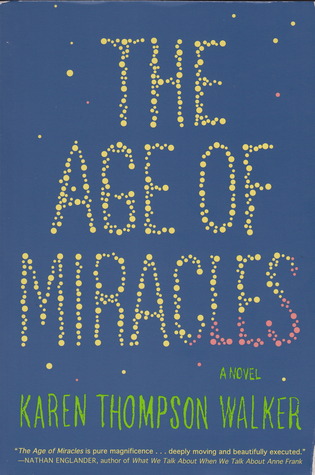
The Age of Miracles by Karen Thompson Walker: Done! Here’s my review. Overall, I’d say nicely written but flawed. Still, I’m glad to have read it.

The Unbecoming of Mara Dyer by Michelle Hodkin: Finished late last night, review to follow. Highly readable and hard to put down.

In graphic novels, I finished up the Jack of Fables series. A fun additional to the world of Fables, but not essential reading.

Drums of Autumn by Diana Gabaldon (group re-read): Need I keep saying it? Terrific book, terrific chapter discussions!

And this week’s new agenda:

I may veer off the fiction path (shocking, for me) and delve into a few books I’ve been wanting to try:

A Stolen Life by Jaycee Dugard. Just picked this one up at the library. As a parent, I approach reading this with some trepidation, but I do so admire this young woman’s courage and want to see how she portrays her own experiences.

I really should read one of the Mary Roach books that were my Wishlist Wednesday selections last week, either Stiff or Spook.

In sci-fi/fantasy, I have Jane by Robin Maxwell all queued up on my e-reader. That’s Jane, as in “me, Tarzan”. Sounds like fun!

Drums of Autumn by Diana Gabaldon (group re-read): Chapters 46 and 47 on deck for this week. We’re getting up to some parts that are emotionally difficult. It’s hard when bad things happen to characters you’re so invested in!

So many book, so little time…

That’s my agenda. What’s yours? Add your comments to share your bookish agenda for the week.

Book Review: The Age of Miracles by Karen Thompson Walker

Book Review: The Age of Miracles by Karen Thompson Walker

ageofmiracles

It’s a little daunting to sit down to write a book review when the book’s jacket is covered with high praise from authors such as Nathan Englander, Aimee Bender, Karen Russell, and Amy Bloom. I have to wonder — did they see something in The Age of Miracles that I missed?

The Age of Miracles is a tale of global catastrophe. For reasons unknown, the earth’s rotation has slowed. The slowing, as people call it, starts as a small thing, as scientists announce that a full rotation of the earth is now 56 minutes longer than it should be. Days lengthen, with the rate of slowing increasing inexorably. The sun sets later and later; longer periods of daylight are followed by longer periods of night. People panic, adapt, panic, adapt some more. And life goes on.

Narrator Julia is 11 years old as these events unfold, but is narrating the story from some time later. The Age of Miracles often reads like a nostalgia piece, in many ways a typical coming of age story, where the young person at its center has her eyes opened to some of the harsh truths of life. Best friends don’t necessarily stay BFFs. Grown-ups aren’t always reliable or honest. Parents disappoint their children and fail to be enough to shelter their children from life’s dangers.

The author makes use of the 2nd person plural throughout, so that Julia is telling not only her own story, but the story of the end of civilization as it was.

In the hours that followed, we would worry and wait. We would guess and wonder and speculate. We would learn new words and new ways from the scientists and officials who paraded in and out of our living room through the television screen and the Internet. We would stalk the sun across our sky as we never had before.

Each new day, each further bit of slowing, brings new changes and challenges. World governments announce a commitment to staying on “clock-time”, continuing to structure human lives around a 24-hour cycle. Soon everyone has black-out curtains so they can sleep while the sun is shining, and school children line up for the bus as the first stars are still appearing in the night sky. A rift in the community forms as some people decide to live in “real-time”, waking and sleeping by the rising and setting of the sun. Real-timers are viewed as anarchists, hippies, throw-backs to a wild past, and are shunned or worse. Suicide cults blossom. People hoard perishables… and then they wait.

To an extent, although The Age of Miracles takes place over the course of a year, we never do see the full impact of the disaster. The effects become more and more dramatic as time passes, but life is still manageable, at least in Julia’s little world. Her mother comes down with slowing syndrome, a common condition caused by changes in gravity, with symptoms such as fainting, dizziness, and nausea. Coastal homes are evacuated and within weeks, are completely flooded, as the slowing causes worldwide changes in currents and tides. There is a massive bird die-out, as the gravitational changes wreak havoc with birds’ internal systems. All agriculture must eventually move into indoor, artificially lit environments, as nothing can grow with the extreme periods of heat and sun followed by long hours of darkness and cold.

And yet, Julia goes to school every day, worries about being friendless and not fitting in, crushes on a cute boy, and tries to figure out what really matters to her. She worries about puberty and growing up, worries about appearing childish next to her make-up and high heel-wearing classmates, and frets about the strain in her parents’ marriage. She begins to see her parents’ flaws, and reflects often on their physical signs of aging — her former-model mother has gray roots, her physician father, always perfectly put together, has wrinkles around his eyes.

The writing is often lovely and lyrical. The author has a keen eye for description of the every day, and evokes a particular time and place with many small details that add up to a complete portrait of life in a small southern California town on the brink of permanent change.

I didn’t quite buy Julia’s voice or perspective in The Age of Miracles. Julia’s experiences, at age 11, seemed out of place. The issues with boys, social status, and cliques, as written, would have felt more authentic to me if the children involved were at least two or three years older. It’s a neat trick to have Julia tell her own story as a 20-something-year-old looking back, but I couldn’t believe many of the observations attributed to 11-year-old Julia as truly coming from a girl that age.

The other flaw with this narrative choice is the diminution of the drama — we know that Julia survives, because she makes it clear that she’s telling us about events from her past. Much has changed, and things look pretty grim, but as a point of fact, Julia’s life has gone on, and so has much of the world’s. Nothing ever feels that immediate or urgent, as it’s all presented as a memory.

This is one of several global disaster/end of the world books that I’ve read lately. In The Age of Miracles, the disaster is almost background, as the main story is about Julia saying good-bye to her childhood and moving forward into a brand new world. An interesting choice, but not entirely convincing or satisying for me.

I would recommend The Age of Miracles, but can’t say that I loved it.

For another take, check out the io9 review here, which questions whether The Age of Miracles works as a science fiction novel.

Flashback Friday: The Sparrow by Mary Doria Russell

Et voila! A new weekly event here at Bookshelf Fantasies!

Flashback Fridays will be a chance to dig deep in the darkest nooks of our bookshelves and pull out the good stuff from way back. As a reader, a blogger, and a consumer, I tend to focus on new, new, new… but what about the old favorites, the hidden gems? On Flashback Fridays, I want to hit the pause button for a moment and concentrate on older books that are deserving of attention.

My rules — since I’m making this up:

  1. Has to be something I’ve read myself
  2. Has to still be available, preferably still in print
  3. Must have been originally published 5 or more years ago

Other than that, the sky’s the limit! As soon as I figure out how**, I’ll open this up to others, so put your thinking caps on: What are the books you’ve read that you always rave about? What books from your past do you wish EVERYONE would read? Pick something from five years ago, or go all the way back to the Canterbury Tales if you want. It’s Flashback Friday time!

**I think I’ve got it! Add your link below — join in for Flashback Friday!

And without further ado, here’s my inaugural pick for Flashback Friday:

The Sparrow by Mary Doria Russell

(published 1996)

From Amazon:

In 2019, humanity finally finds proof of extraterrestrial life when a listening post in Puerto Rico picks up exquisite singing from a planet which will come to be known as Rakhat. While United Nations diplomats endlessly debate a possible first contact mission, the Society of Jesus quietly organizes an eight-person scientific expedition of its own. What the Jesuits find is a world so beyond comprehension that it will lead them to question the meaning of being “human.” When the lone survivor of the expedition, Emilio Sandoz, returns to Earth in 2059, he will try to explain what went wrong… Words like “provocative” and “compelling” will come to mind as you read this shocking novel about first contact with a race that creates music akin to both poetry and prayer.

I can’t overstate just how very much I love this book. It has it all: compelling characters, a science fiction slant, discovery of new worlds, fascinating interpersonal dynamics, and a confounding mystery at its core.

Lead character Emilio is so magnetic, so fascinating, and so wounded that I wanted to jump into the story to protect and defend him. Author Mary Doria Russell, an anthropologist by training, creates a world unto itself, with culture, mores, and languages that are unique and yet fully formed.

Whenever I’m asked to name my favorite books, The Sparrow is right there in the top 5. Over the years, I’ve given copies to friends and family members, and I’ve recommended it to dozens more. If you’ve never read The Sparrow, give it a try! You’ll thank me for it — I promise.

So, what’s your favorite blast for the past? Leave a tip for your fellow booklovers, and share the wealth. Time to dust off our old favorites and get them back into circulation.

Note from your friendly Bookshelf Fantasies host: This is my first attempt at a blog hop! Join in, post a Friday Flashback on your blog, and share your link below. Let’s get this party started!


Sunday morning musings

Sunday mornings are a special time, a weekly reprieve from plans and commitments, the one time each week when everyone at my house seems to just go with the flow and acknowledge that we have a tiny window of down-time. I’m typically the last to rise, which is only fair, since I’m up and at ’em before everyone else each day during the school and work week.

We float on our own paths toward the kitchen. My son ensconces himself on the couch with the TV on. My husband makes a yummy hot breakfast for the kiddo (today’s feast included french toast and turkey bacon). Husband brews himself a small pot of decaf; I show up afterward and make a big pot of the fully charged stuff.

And then we divvy up the paper. We’re modern creatures and enjoy our technology like good consumers, but we’ve stubbornly clung to our morning delivery of the local newspaper, hot off the press and printed on actual paper (which we diligently recycle after reading). There’s nothing like a cup of coffee and a big fat newspaper on a Sunday morning.

No conflicts in our house — we each grab our favorite sections of the paper, no need to fight or compete. The kid takes the comics, of course, not realizing that he’s lucky that his older siblings no longer live in our house, thereby avoiding the comics wars that used to plague us when we had a house full of kids. Hubby takes the front page — he’s a serious follower of politics and world news — and then moves on to sports, which is the green section in our paper.

Me? No surprise there. Straight to the book review section. I’m happiest when it’s full of fiction reviews, but I tend to read it all. I even take notes occasionally — books to read immediately, books to remember a year or so from now when they’re released in paperback, books to recommend to my daughter. This morning, my smartphone happened to be sitting right next to me, so without delay I navigated to the public library website and put in a request for a title that caught my eye. (I’m request #77 of 77, as it turns out — we’ll see if I still have any interest by the time it becomes available).

I love to read the “Grabbers” feature –“a selection of first sentences from new books” — you never know what will be there, but they’re always fun. I check out the literary guide to see which authors will be speaking locally this week.

And on the last page, I pore through the bestsellers list. I can’t help feeling a little glimmer of civic pride, product of my previously confessed book snobbery, when I compare the lists. Each week, the paper includes both local bestsellers, based on data collected from sales from local independent booksellers, and national bestsellers, based on “computer-processed reports from bookstores and wholesalers throughout the United States”. Here’s what I learned this week:

Both locally and national, Gone Girl by Gillian Flynn is #1 (and I’m request #300-something at the library — it’ll be a looooong wait for this one). From there, the lists diverge. Locally, bestsellers include A Hologram For The King by Dave Eggers, Where’d You Go, Bernadette by Maria Semple, Beautiful Ruins by Jess Walter, and The Dog Stars by Peter Heller. There’s not a title listed that makes you think “supermarket shelf” or “airport rack”. (I told you already, I am a book snob.) Looking at the national list, I see Debby Macomber, Emily Giffin, Dean Koontz, Daniel Silva, Brad Thor, and Danielle Steel. Clearly, lots of people enjoy these authors, but mass-market bestsellers do not equate with works of literature.

My to-read list now a few titles longer, I’m ready to move on to the news sections, business, travel, the arts, and yes, the comics. Sunday morning ritual completed once more, it’s time to face the day, plan our plans, and get out of the house. Maybe we’ll even manage to find sunshine within driving distance of home.

Enjoy your Sunday, everyone, wherever it may take you. And read some good stuff along the way.

My top 5 favorite timey-wimey books

It’s September 1st, and you know what that means, right? It’s the return of the Doctor! (And if you’re asking, “Doctor who?”, the answer is — yes!). The BBC’s Doctor Who returns for a much-anticipated 7th season tonight, and Whovians everywhere are dusting off their bowties and sonic screwdrivers in preparation for another fantastic journey through time and space.

“People assume that time is a strict progression of cause to effect, but actually from a non-linear, non-subjective viewpoint – it’s more like a big ball of wibbly wobbly… timey wimey… stuff” – The Doctor

Inspired by the Doctor, step inside my TARDIS (that’s Time and Relative Dimension in Space, for the uninitiated) for a tour of my favorite timey-wimey books — books that deal with time travel, time slips, or just plain old time-related weirdness.

1) The Time Traveler’s Wife by Audrey Niffenegger

I was just swept away by this mind-bending journey through a relationship between a woman who is fixed in time and a man who is not. Claire meets Henry when she is six years old; Henry meets Claire when she is 21. Early on, they discuss their temporal relationship in comparison to a Mobius strip, and it’s an apt metaphor. Older Henry visits child Claire; young Henry visits older Claire. In the midst of all the comings and goings, they find true love. At once tragic and beautiful, this book will make your head spin as you try to puzzle out whether the words “before” and “after” have any meaning whatsoever. This was one of the very few books that I began reading a second time immediately upon reaching the end the first time through, just to see how the pieces fit together knowing what was still to come.

2) Kindred by Octavia Butler

As Kindred opens in the mid-1970s, Dana is an African American woman in her 20s, happily married to a white man and living a contented life. She is yanked back through time to the ante-bellum South, where time and again she must intervene to save the life of her ancestor Rufus, son of a slave-owner. Dana’s experiences are shocking, raw, and brutal, and the effect upon her and her marriage is indelible. Kindred is less about time travel than about slavery, power, and freedom. It is a shocking book, and packs a powerful punch. Not to be missed.

3) Replay by Ken Grimwood

Replay is not about time travel, but the timey-wimey weirdness is here just the same. At age 43, unfulfilled and bored, Jeff Winston has a heart attack and dies… but wakes up again in his 18-year-old body, with his whole life ahead of him again, and with all the memories of his previous life. Is this a chance to right old wrongs? to set a new path for himself? to make an impact on the world? Jeff relives his life, but with alterations along the way, all the way through to age 43, when he dies again… and so on, and so on, and so on. Each time around, Jeff comes back to himself just a bit later, and each time around he thinks he’s found the way to get it right — but of course, life isn’t something you can plan for or make turn out just the way you want. Replay is hard to explain, but marvelous to read.

4) Somewhere in Time by Richard Matheson

Until a couple of years ago, I actually had no idea this was a book. I fell in love with the lush romance of the Christopher Reeve/Jane Seymour movies years ago, and was astonished to find the book at a used book sale. And by Richard Matheson, no less — someone who really knows how to tell a story. Richard is a modern man who falls in love with a woman in a photo from decades earlier, and using the power of his mind, finds a way to travel back in time to be with her. Passionate and intense, this is yet another interesting spin on a journey through time. (For more details, you can see my Goodreads review here).

5) 11/22/63 by Stephen King

I love Stephen King, am fascinated by the Kennedy assassination and all the associated conspiracy theories, and adore reading about time travel. Clearly, this massive novel was right up my alley! Given the opportunity to travel back through time and avert a national tragedy, would you? Should you? 11/22/63 is a combination of time travel, historical fiction, and romance, and it works. As I say in my review, I recommend this book wholeheartedly.

I’m leaving out some other great ones, not because I don’t love them — I do! I really do! — but because time’s a-wasting, and I must move on. So I’ll wrap this up with a list of a few other favorite books full of timey-wimey goodness. Let me know what time-related books you’ve enjoyed!

More time-travel, time-slip, and time oddities:

Outlander (and sequels) by Diana Gabaldon (which I didn’t include in my top 5 despite my mad love for them, just because I’m always raving about these books to the point of sounding like a broken record. Read these books! There, ’nuff said.)

Harry Potter and the Prisoner of Azkaban by J. K. Rowling — the book that introduced my children to the brain-twisting concept of time travel!

Miss Peregrine’s Home For Peculiar Children by Ransom Riggs
The Revisionists by Thomas Mullen
The Future of Us by Jay Asher
The Rose Garden by Susanna Kearsley
Lightning by Dean Koontz
The Sound of Thunder (short story) by Ray Bradbury

It’s Friday! It’s Friday!

Upon waking up this morning and feeling very giddy about the fact that Friday has finally arrived after an excruciatingly long workweek, my first thoughts naturally turned to books. I wondered — have I ever read a book with the word Friday in its title?

I couldn’t come up with any off the top of my head, but a quick perusal of my Goodreads shelves reveals that I have, indeed, read exactly one Friday book, entitled… wait for it… Friday. Herewith, a salute to Friday books:

Friday by Robert A. Heinlein (1982)

My one and only Friday book, read so long ago, in the dark days of the 1980s, that I can barely remember the plot — although I do recall enjoying it quite a bit. I was on a mini-Heinlein bender in those days, and read this one right after discovering I Will Fear No Evil and Stranger In A Strange Land.

The description on Amazon is lamentably brief and not terribly helpful:

Engineered from the finest genes, and trained to be a secret courier in a future world, Friday operates over a near-future Earth, where chaos reigns. Working at Boss’s whimsical behest she travels from far north to deep south, finding quick, expeditious solutions as one calamity after another threatens to explode in her face….

Still, I seem to remember that it was quite fun to read, brimming with typical Heinlein wit and humor. Maybe not his finest, but I think fans of ’80s sci-fi will have a good time with Friday.

A quick search reveals a few other promising Friday titles:

The Friday Night Knitting Club by Kate Jacobs (2007)

From Booklist:

Georgia Walker’s entire life is wrapped up in running her knitting store, Walker and Daughter, and caring for her 12-year-old daughter, Dakota. With the help of Anita, a lively widow in her seventies, Georgia starts the Friday Night Knitting Club, which draws loyal customers and a few oddballs. Darwin Chiu, a feminist grad student, believes knitting is downright old-fashioned, but she’s drawn to the club as her young marriage threatens to unravel. Lucie, 42, a television producer, is about to become a mother for the first time–without a man in her life. Brash book editor KC finds her career has stalled unexpectedly, while brilliant Peri works at Walker and Daughter by day and designs handbags at night. Georgia gets her own taste of upheaval when Dakota’s father reappears, hoping for a second chance. The yarn picks up steam as it draws to a conclusion, and an unexpected tragedy makes it impossible to put down. Jacobs’ winning first novel is bound to have appeal among book clubs.

Oh, and it’s a series. A series about knitting. Okaaaaaay…

Moving on, a non-fiction title that I know has a lot of fans and followers:

Friday Night Lights: A Town, A Team, And A Dream by H. G. Bissinger (1990)

I didn’t read the book; I didn’t watch the TV series. I understand both were great.

From Amazon:

Secular religions are fascinating in the devotion and zealousness they breed, and in Texas, high school football has its own rabid hold over the faithful. H.G. Bissinger, a Pulitzer Prize-winning journalist, enters into the spirit of one of its most fervent shrines: Odessa, a city in decline in the desert of West Texas, where the Permian High School Panthers have managed to compile the winningest record in state annals. Indeed, as this breathtaking examination of the town, the team, its coaches, and its young players chronicles, the team, for better and for worse, is the town; the communal health and self-image of the latter is directly linked to the on-field success of the former. The 1988 season, the one Friday Night Lights recounts, was not one of the Panthers’ best. The game’s effect on the community–and the players–was explosive. Written with great style and passion, Friday Night Lights offers an American snapshot in deep focus; the picture is not always pretty, but the image is hard to forget.

After reading The Blind Side by Michael Lewis (before it was a movie, thank you very much!), I got a lot of mileage out of shocking the people who know me well by announcing that I actually read a football book. I really should read Friday Night Lights, although I’m afraid my friends will start to worry if I read two sports book in my lifetime.

Friday’s Child by Georgette Heyer (1944)

From Amazon:

When the incomparable Miss Milbourne spurns the impetuous Lord Sherington’s marriage proposal (she laughs at him—laughs!) he vows to marry the next female he encounters, who happens to be the young, penniless Miss Hero Wantage, who has adored him all her life. Whisking her off to London, Sherry discovers there is no end to the scrapes his young, green bride can get into, and she discovers the excitement and glamorous social scene of the ton. Not until a deep misunderstanding erupts and Sherry almost loses his bride, does he plumb the depths of his own heart, and surprises himself with the love he finds there.

I’ve never read anything by Georgette Heyer, but I know she has legions of adoring fans. For me personally, I think this would go on the “some day when I really have nothing else to read” pile, but I know there are a lot of avid readers who’d want to gobble this one up right away.

Black Friday by James Patterson (1986)

From Publishers Weekly:

While Patterson’s thriller is slightly out-of-date with its Cold War setting, it remains dramatically contemporary in its vision of a stock market thrown into chaos when a group of saboteurs blows up several Wall Street institutions. Arch Carroll, head of the CIA’s antiterrorist division, and Caitlin Dylan, director of enforcement for the SEC, team up professionally, and later romantically, to locate the Wall Street terrorists before they strike again. Arch travels to Paris and back, as he finds himself on the trail of former colonel David Hudson and his ragtag band of vengeance-seeking Vietnam veterans.

So not for me. But hey, it takes all types, right?

Freaky Friday by Mary Rodgers (1972)

From Amazon:

Annabel thinks her mom has the best life. If she were a grown-up, she could do whatever she wanted Then one morning she wakes up to find she’s turned into her mother . . . and she soon discovers it’s not as easy as it looks.

I can’t believe that I’ve never read this! I’ve seen the Jodie Foster and Lindsay Lohan versions of the movie, both cute in their own ways. I wonder if this book holds up, or if would seem hideously old-fashioned for kids today?

Friday Nights by Joanna Trollope (2008)

From Publishers Weekly:

When a British retiree invites two young single mothers from the neighborhood to her flat, a Friday night tradition begins. As their klatch widens, Trollope’s memorable characters do more than just represent varying female predicaments: they develop as rich individuals who come to triumph over their pasts. Paula has a wary relationship with the married man who fathered their son, Toby: she must move on, yet stay in touch for Toby’s sake. Struggling Lindsay was widowed before she gave birth, while her sister, Jules, is a careless aspiring nightclub DJ with a wild streak. Independent, put-together Blaise contrasts starkly with her often bedraggled business partner, Karen, who barely manages her role as mother and breadwinner. And then there is Eleanor, the catalyst for the gatherings, a no-nonsense older woman who, though full of wisdom and spunk, keeps her thoughts to herself unless asked. When a new man enters Paula’s life, Trollope (Second Honeymoon) masterfully shows how work and romance can tip the scales in female friendships. The result is a careful and compelling examination of one man’s insidious effect on a group of female friends, as memorable as it is readable.

Sounds a little Jane Austen Book Club-y, but I’ve read other novels by Joanna Trollope and found her writing sharp, insightful, and sensitive.

And my final addition for this salute to Fridays:

Friday The Rabbi Slept Late by Harry Kemelman (1964)

From Goodreads:

Rabbi David Small, the new leader of Barnard’s Crossing’s Jewish community, can’t even enjoy his Sabbath without things getting stirred up in a most unorthodox manner: It seems a young nanny has been found strangled, less than a hundred yards from the Temple’s parking lot — and all the evidence points to the Rabbi.

Add to that the not-so-quiet rumblings of his disgruntled congregation, and you might say our inimitable hero needs a miracle from a Higher Source to save him….

It gave me a nostalgic little giggle to see this book pop up in my search. I remember seeing my parents read this and others in the series when I was a kid. A mystery series with a rabbi as the hero? Sounded kind of goofy to me at the time, but based on reader reviews, these books are both award-winning and well-loved by their readers.

So there you have it: Science fiction, thriller, sports, contemporary fiction, Regency-era historical romance, children’s fiction, and a crime-solving rabbi — something for everyone.

Enjoy your Fridays, whatever you may choose to read!

And hey, if you’ve got an exciting book underway for the long weekend, do tell — leave a comment and let us all know what you’re reading this Labor Day weekend.
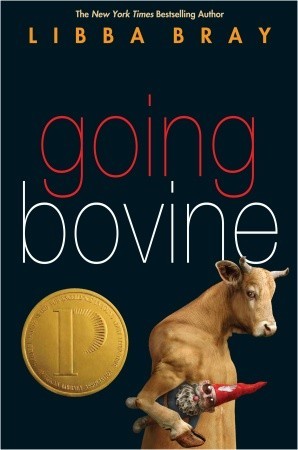
Book Review: Going Bovine by Libba Bray

Book Review: Going Bovine by Libba Bray

Gotta love an author who promotes her book looking this this:

That trailer just cracks me up, and you can get a pretty good sense of just how wacky and weird Libba Bray’s literary creation is by watching her play ukulele in a cow suit.

So… Going Bovine. Big award winner. First published in 2009, it won the 2010 Michael L. Printz Award for young adult fiction. I wanted to love this book, and in parts, I really did.

Going Bovine is the story of Cameron, underachieving nobody shuffling through an underwhelming life: home life unremarkable, school no great shakes, and as for friends — well, they’re more like a group of misfits who tolerate each other because of their common loser/stoner status. Until one day things get weird, Cam starts having seizures and episodes, and ends up in the hospital diagnosed with Creutzfeldt–Jakob disease — that’s mad cow disease to you and me.

Elements of the absurd abound. Cam is below notice in his school until his diagnosis; next day, his school is holding a pep rally in his honor, cheerleaders want to connect with him, and the school faculty seems to think brown and white ribbons (you know, a cow motif) are an appropriate way to show support.

Cam deteriorates rapidly as the out-of-control prions attack his brain, and is soon hospitalized with no hope of recovery. Or is he? In what is either the hallucinations of a slowly dying brain, a journey into a parallel universe, or the craziest buddy road-trip ever, Cam sets out across the South with Gonzo the neurotic dwarf, Dulcie the punk angel, and Balder, the Viking hero/yard gnome. Along the way, they’re chased by fire giants and the sinister United Snow Globe Wholesalers, making pitstops at CESSNAB (The Church of Everlasting Satisfaction and Snack ‘N Bowl), the Daytona Beach Party House, and Putopia (Parallel Universe Travel Office … pia), en route to Disney World, site of Cameron’s happiest childhood memory and the endpoint of Cam’s quest to save the entire world from being sucked into a wormhole.

Libba Bray’s writing crackles with wit, has enough snark and social commentary to delight even the most cynical, and makes the story of a terminally ill teenager pretty fun to read. She sneaks in a lot of insidious little digs, such as the high school teacher prepping his class for the all-important State Prescribed Educational Worthiness standardized test:

Is Don Quixote mad or is it the world that embraces these ideals of the knight-errant that is actually mad? That’s the rhetorical question that Cervantes seems to be posing to us. But for our purposes, there is a right answer, and you need to know that answer when you take the SPEW test.

Or take the CESSNAB sanctuary, where people seek refuge from the harsh world in order to focus on being happy all the time. Everyone bowls a strike, everyone drinks vanilla smoothies, and when they get a hint of stress, they can go bowl some more or maybe buy stuff. As Cam explains:

I take a deep breath; in my head, I list five things I love about myself. “You know what, Gonzo? I want to help you find what I’ve found. Here, have a key chain,” I say, handing him one of the sunny yellow giveaways they hand out whenever you do something even remotely good, like remember to put the toilet seat down. Sometimes they give you a key chain just for showing up.

There’s a lot to love in this book, and ultimately Cam’s journey is both terribly touching and laugh-out-loud funny. And yet, I couldn’t maintain a steady interest throughout. I was completely engrossed for about the first third of the book, and then it just tapered off for me. The road trip elements seem to go on forever, and after a while, it was just all so over the top that it started seeming completely arbitrary. Lots of craziness, lots of hijinks, lots of bursts of insights into the meaning of it all — but as a whole, it was just all a bit too much.

It’s possible that someone in the target demographic for this book might find it profound in ways that I, as an adult, can’t quite get. Maybe I’m not at the right stage of life to fully appreciate all the quirky glories of Going Bovine. In the end, though, I can only assess the book in terms of my own experience, and unfortunately, I just didn’t connect to Going Bovine in the way that I’d hoped.

Save

Save

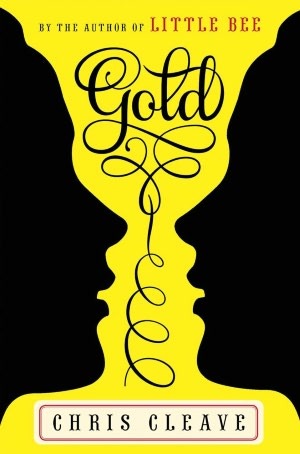
Book Review: Gold by Chris Cleave

gold

When I first read a blurb about Chris Cleave’s new novel, Gold, my initial reaction was basically, “thanks, but no thanks.” A book about athletes? Olympic cycling competitions? Can you actually hear my brain melting?

Luckily, I ended up going with my second, more reasoned reaction, which was more along the lines of “Bicycling? Sounds boring, but… I did like Little Bee, so let’s give it a whirl.” Ha! A whirl! Funny me.

Gold is the story of two British bicycle racers, Zoe and Kate, who have been best friends and arch-rivals since meeting at age nineteen as they joined the elite prospects program of the British national cycling team. Zoe is a damaged soul, who copes with a childhood trauma by pouring everything she has into her competitions. On the track, she’s all power and focus. Off the track, she’s a mess. Kate is kinder and gentler, a fierce competitor but one who also allows herself to feel deeply. Both rise to the top of their sport, competing against each other in the international arena, year after year, to be the one who captures the gold.

Zoe’s extreme need to win is illustrated early on in Gold, when her coach tells her before a race that the worst that can happen is that she wins silver instead of gold, and Zoe responds, “I’d rather fucking die.”

Zoe becomes a superstar after winning four gold medals at the 2004 Athens Olympic Games, while Kate stays home to take care of her infant daughter. Time and again, Kate misses her chance, and as Gold unfolds, the 2012 Olympics represent the final shot for both women – at age 32, Zoe needs to go out with a blaze of glory and Kate is desperate to claim the gold that has narrowly slipped through her fingers throughout her career.

The action in Gold takes place over three pivotal days in the April leading up to the London games. When the IOC makes a sudden rule change, Kate and Zoe’s competition reaches a boiling point, and it becomes clear that only one of them can walk away a winner. As they deal with their hopes, needs, and fears, and their burning thirst for gold, we’re treated to flashbacks that shed crucial light on their tortured past as competitors and friends.

This passage nicely sums up the central internal struggle for Gold‘s characters:

It would be harder for them than they realized, because outside those exalted two minutes of each race, they were condemned to be ordinary people burdened with minds and bodies and human sentimental attachments that were never designed to accelerate to such velocities. They would go through agonies of decompression, like divers returning too quickly from the deep.

Let me stay right up front that I could not put this book down. I started it on Friday night, and finished it on Sunday night right before the stroke of midnight. I stayed up way too late, and even gave up watching some critical TV because I just couldn’t go to bed without knowing how it all ended.

That said, I do have a few minor quibbles about Gold.

Quibble 1: Looming largest is the fact that Zoe is so damaged, so incapable of empathy and compassion, that I had a hard time believing that she and Kate had an actual friendship. Zoe does horrific things to Kate, on and off the track, in order to gain the psychological advantage in competition. Zoe is never “off”; everything she does comes from her need to win. Kate is a feeling, caring woman, and while she takes Zoe in and tries to nurture her, I didn’t quite buy that she would ever trust her.

Quibble 2: Kate is married to Jack, also a gold-medalist in cycling, and their daughter Sophie is an eight-year-old leukemia patient with a Star Wars fixation. I thought the Star Wars elements were a bit overdone; I get that this was supposed to be Sophie’s coping mechanism, but it got in the way of the drama at times and gave Sophie an internal voice that just didn’t ring true for a child her age.

Quibble 3: As an American reader, I wasn’t sure what to make of the superstardom of the British cycling champions. I’m sure I couldn’t name a single American athlete in this sport, and I had to wonder as I read whether cycling really is such a big deal in Britain (note: based on my quick and dirty internet research, the answer would be yes) and whether athletes such as Zoe and Kate really would become faces on billboards, hounded by paparazzi and plastered across tabloids. (This part I couldn’t quite figure out — I’d appreciate enlightenment!)

Quibble 4: The final 10 pages or so seemed a bit tacked on to me, as if the author reached the end and was just trying to tie it all up neatly and quickly. Still, I can’t complain too much. The fact is, I couldn’t stop reading, and once I got to within 50 pages of the end, there was no way I was going to unglue my eyes from this book until I’d read every last word.

Wrapping it all up:

I was concerned that I would be bored by, or at the very least uninterested in, the cycling focus of Gold. Fortunately, I was proven wrong. As a total newbie to the sport of competitive track cycling, I found the descriptions of training regimens, the extreme stress on the body, the physical and psychological strategizing of racing, and the adrenaline-pumping rush of competing in front of a crowd compelling indeed. Being a person whose main form of competition is the annual Goodreads reading challenge, I didn’t think I’d be able to relate to a story about hardcore athletes. Again, I was wrong, and the glimpse into a new world was for me quite fascinating.

I realize I’ve given short shrift in this review to Kate, Jack, and Sophie’s home life and daily struggles. Their family is arguably as much the centerpiece of Gold as the racing is, but I’ve avoided saying too much about this part of the book in order to avoid spoilers and possibly softening the impact of the family’s unfolding calamity for other readers.. Suffice it to say, the relationships were quite lovingly drawn, and I often felt the sorrows of the parents as a punch right to the stomach.

I must say that I wish I’d read Gold when it was released earlier this summer, prior to the London Olympics. I can only imagine how thrilling it would have been to read this book and then watch the real athletes pouring their hearts into their races. Even so, I found myself rushing to Google “Olympic cycling events”  immediately upon finishing this book, and I can tell already that four years from now, when the next Olympics roll around, I’ll be keeping an eye on a new sport.

Save

Genre confusion

It’s finally happened — Facebook is “timelining” me. (Yes, I just used timeline as a verb. I expect a bolt of lightning any minute now.)

One interesting side effect is the random voyage through my personal history that it’s providing. Movies, TV shows, odd things I said that I’m sure I thought were quite witty at the time… it’s all there. A quick scan through my recent Facebook past revealed this forgotten nugget, dated September 16, 2010:

Dawning realization that the book I’m reading may in fact be a romance novel. Bodices have been ripped.

Any idea what I’m talking about? Only one of my all time favorite novels, Outlander by Diana Gabaldon! Of course, at the time, I didn’t yet realize how very much in love I’d fall with this series (and with the main character, Jamie Fraser, but that’s a different topic).

I can be forgiven for my genre confusion, having just read this passage:

Randall slowly drew the knife in a semicircle under one breast. The homespun came free and fell away with a flutter of white chemise, and my breast sprang out. Randall seemed to have been holding his breath; he exhaled slowly now, his eyes fixed on mine.

Followed on the next page by – ta-dum – our hero’s arrival:

“I’ll thank ye,” said a cool, level voice, “to take your hands off my wife.”

By the end of the book, I was hooked, so much so that by October 16, 2010, my status update read:

Have finished four books of a seven-book (so far) series in the past month. Page count: 3926 read, 3740 to go.

What can I say — other than, I’m glad I stuck with it! Despite the ripped bodice and the occasional heaving breast, what I found myself reading was not a romance novel, but a remarkable piece of historical fiction that includes a lovely romance, as well as a crash course in the history of the Jacobite rebellion, battlefield medicine, Scottish culture, and speculative time travel.

So what shelf does Outlander belong on? According to the author (on her website, here):

In essence, these novels are Big, Fat, Historical Fiction, ala James Clavell and James Michener.  However, owing to the fact that I wrote the first book for practice, didn’t intend to show it to anyone, and therefore saw no reason to limit myself, they  include…

history, warfare, medicine, sex, violence, spirituality, honor, betrayal, vengeance, hope and despair, relationships,
the building and destruction of families and societies, time travel, moral ambiguity, swords, herbs, horses,
gambling (with cards, dice, and lives), voyages of daring, journeys of both body and soul…

you know, the usual stuff of literature.

Thanks, Diana G., that clears that up!

So, has this ever happened to you? Have you ever started a book expecting one thing, and found yourself someplace completely different? And if so, were you glad for the detour?

I know I originally picked up my battered, used edition of Outlander because I remembered seeing the title listed in reference to time travel. I’m sure, though, that if the original context had been about romance, I probably never would have thought to give it a try.

So, here’s to trying new genres! Stepping out of our reading comfort zones! Crossing the book store aisles and browsing a new shelf! You just never know where your next new favorite might be lurking.

And thank you, Facebook, for this strange trip down my book-addicted memory lane.