
Wishlist Wednesday

And now, for this week’s Wishlist Wednesday…

The concept is to post about one book from our wish lists that we can’t wait to read. Want to play? Here’s how:

  • Follow Pen to Paper as host of the meme.
  • Please consider adding the blog hop button to your blog somewhere, so others can find it easily and join in too! Help spread the word! The code will be at the bottom of the post under the linky.
  • Pick a book from your wishlist that you are dying to get to put on your shelves.
  • Do a post telling your readers about the book and why it’s on your wishlist.
  • Add your blog to the linky at the bottom of the post at Pen to Paper.
  • Put a link back to pen to paper (http://vogue-pentopaper.blogspot.com) somewhere in your post.
  • Visit the other blogs and enjoy!

My Wishlist Wednesday book is:

Some Kind of Fairy Tale by Graham Joyce

From Amazon:

Acclaimed author Graham Joyce’s mesmerizing new novel centers around the disappearance of a young girl from a small town in the heart of England. Her sudden return twenty years later, and the mind-bending tale of where she’s been, will challenge our very perception of truth.

For twenty years after Tara Martin disappeared from her small English town, her parents and her brother, Peter, have lived in denial of the grim fact that she was gone for good. And then suddenly, on Christmas Day, the doorbell rings at her parents’ home and there, disheveled and slightly peculiar looking, Tara stands. It’s a miracle, but alarm bells are ringing for Peter. Tara’s story just does not add up. And, incredibly, she barely looks a day older than when she vanished.

Award-winning author Graham Joyce is a master of exploring new realms of understanding that exist between dreams and reality, between the known and unknown. Some Kind of Fairy Tale is a unique journey every bit as magical as its title implies, and as real and unsentimental as the world around us.

Why do I want to read this?

First off, Graham Joyce’s The Silent Land was one of my favorite reads in 2011. For those who missed it, here’s what I loved about The Silent Land (per my Goodreads review, April 2011):

A couple on a romantic ski getaway in the Pyrenees is caught in a sudden, early morning avalanche on the ski slopes. When they finally manage to dig themselves out and find their way back down the mountain, they find their hotel and its village have been evacuated, and they’re completely alone. Or is there something else going on? “The Silent Land” is simply told, but does a masterful job of evoking the glory of a snowy mountain, the joy of being with a soulmate, and the disquiet of realizing that some things defy explanation, no matter how hard you try to understand it all. It’s hard to go any further without divulging spoilers, which I won’t do. Suffice it to say that “The Silent Land” is both beautiful and ominous, gave me the chills, and kept me intrigued enough that I ended up reading in all in one day. Definitely recommended.

The writing was so phenomenal, and the storytelling so creative and full of unexpected moments, that I swore I’d read whatever the author published next.

Some Kind of Fairy Tale sounds like something I’d love — I don’t know much more about it than what the publicity blurbs have said, but I’m always up for a good fairy story. Especially when the fairies in question are of the devious, changeling-leaving sort, and not of the twinkly Disney variety.

Fortunately, this is one Wishlist Wednesday book that I won’t have to wait long to read. My copy just arrived at the library, and I plan to dig in over the weekend. I’ll be back with my review ASAP!
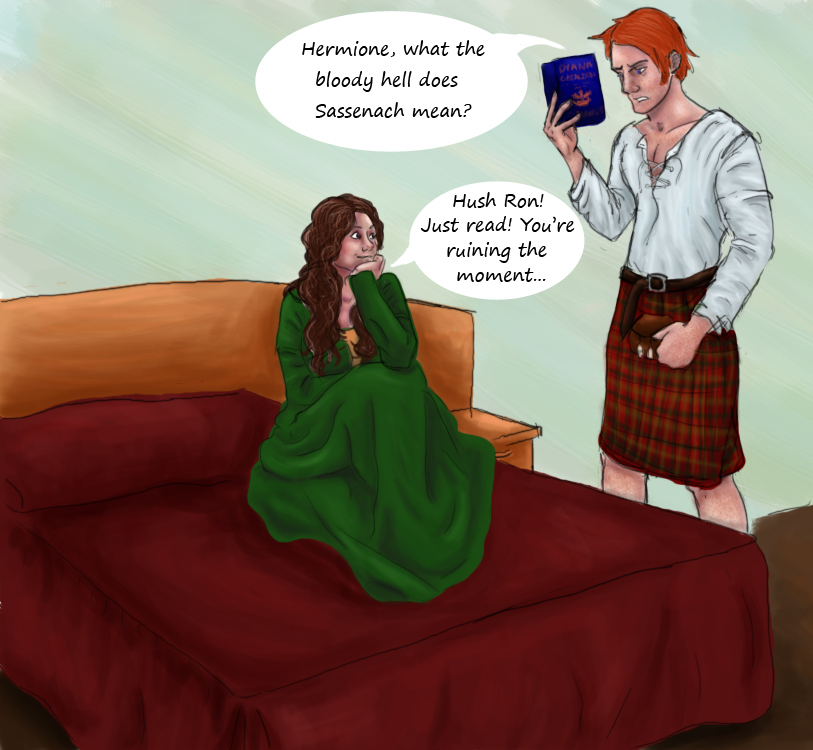
When worlds collide, part 3

A friend sent this to me a while back, and I’ve never succeeded in finding the source:

I just love when my random obsessions co-mingle, and this truly tickled my funny bone. So just how many Harry Potter fans out there also geek out over Outlander (and vice versa)?

In any case, if you recognize this and know the source, let me know so I can give credit where credit is due!

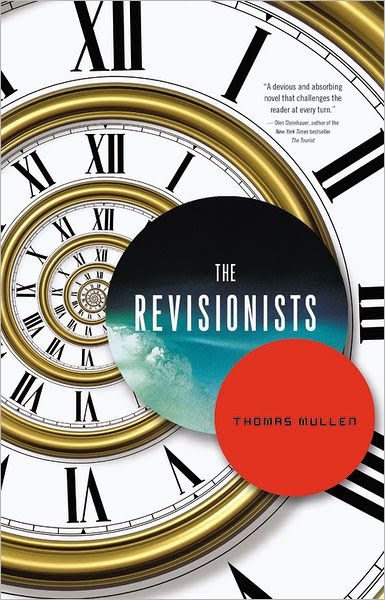
Book Review: The Revisionists by Thomas Mullen

Book Review: The Revisionists by Thomas Mullen

(Hardcover edition published September 2011; paperback due out in October 2012)

Maybe you could drive yourself crazy trying to chart backward all the causes and effects, all the ends and means, tracing everything to some original sin that may or may not have actually occurred but that people accepted as true, or true enough. Maybe staring into the eyes of all that history was a dangerous thing to do, as her mother had calmly warned her. Maybe you were supposed to move forward armed with just enough history to help you figure out the present without obsessing over the past. But how much was enough? Where was the gray area between ignorance and obsession?

The Revisionists was not at all what I’d expected, yet I couldn’t put it down.

I have a soft spot for all things time-travel, and the basic synopses I’d read of this book seemed to put it squarely into that genre: Main character Zed works for a post-disaster society at some point in time several centuries from now. In the “Perfect Present”, there is no war, no racial tension, no hate. Zed’s government agency works to keep the perfect present perfect, by sending agents into the past to thwart “hags” — historical agitators — whose mission is to stop disasters (think 9/11, concentration camps, etc) before they can happen, on the assumption that all these calamities were a necessary step in history in order for the perfect present to come to be.

Confusing? You bet.

And strangely, that’s not at all what this book is really about. Much more than anything else, I’d describe The Revisionists as an espionage-thriller set in DC, filled with intrigue, shadowy quasi-governmental intelligence outfits working against one another, multiple layers of pawns and spymasters, and a reality that slips and shifts from chapter to chapter.

This is not a sci-fi book, when you get right down to it. Zed’s mission is the driving narrative, yet we get no information whatsoever about the mechanics of his time travel and only the barest of descriptions of some futuristic technology. Without saying anything that might inadvertently be a spoiler, I will say that the entire time travel premise is not necessarily what it appears to be, depending on how you choose to interpret certain events and passages.

I was fascinated by this book, and it will probably take me some time to mull over all the twists and turns and come to terms with what may or may not have happened. I do recommend The Revisionists, although I worry that its perfect target audience — people who enjoy a good spy thriller — won’t ever discover it if it continues to be described as a time-travel novel.

Happy Birthday, Harry!

Wishing Harry Potter and his creator J. K. Rowling very happy birthdays today! With apologies to Neville Longbottom, whose birthday came and went yesterday without a whole lot of fuss.

Harry would be 32 years old today… if he was, in fact, an actual person and not a fictional character. Nevertheless, he’s near and dear to my heart, and he’s made my world a more magical place for the past 15 years… so cheers, Harry!

My problem with short stories

For an educated, literate person, I’m an absolute philistine when it comes to short stories.

I know, I know… according to People Who Matter, the short story is writing as an art form, a purer literary expression than the novel, forcing a writer to use an economy of words in order to convey some larger truth. Or so I’ve heard.

But here’s my larger truth: I just can’t get into them. Even when written by authors I adore, I can’t stomach more than a story or two before my eyes start to glaze over. I find myself rushing through, skipping ahead, and pining for a “real” book — aka, a big, meaty novel that I can really sink my teeth into. It happens every time, no matter how good my intentions.

I’ve had this experience countless times, whether with anthologies featuring stories by multiple authors or a book of short stories by a single author. Some recent cases in point:

Smoke and Mirrors by Neil Gaiman: I love Neil Gaiman! I read about 95% of the stories in this collection, and there are some that I know I’ll return to over and over again, especially “Snow, Glass, Apples”, “Nicholas Was…”, and “The Wedding Present”. But, finally, I just had to stop — I thought my brain would shrivel up if I read one single story more.

The Baum Plan For Financial Independence and Other Stories by John Kessel: “The Lunar Quartet” stories in this collection were absolutely brilliant. I read a couple of other stories as well, liked them all well enough, and then put the book down.

Fire Watch by Connie Willis: I picked up this collection because I’d like to read the author’s time travel novels and wanted to read the story that came first (“Fire Watch”), and actually read quite a few of the other stories as well. In addition to “Fire Watch”, I especially liked “A Letter From The Clearys” and “And Come From Miles Around”, although “All My Darling Daughters” was so creepy that I can’t quite say I enjoyed it.

After The Apocalypse by Maureen McHugh: A collection that I actually finished! My Goodreads review is here.

Black Juice by Margo Langan: Includes one of the best, most haunting stories I’ve come across recently, “Singing My Sister Down”. The other stories in the collection are good, but just don’t quite measure up to the first story’s power. And yes, I did skip one or two.

Looking at the list I just put together, I must admit that my problem is not really with individual short stories. Clearly, there are many that I like, or even love. But as a whole, I just can’t feel the same enthusiasm for my reading time when I’m sitting down with a book of stories. Maybe I’m too goal-oriented when I read — I’m always looking ahead and planning what to read next, eager to finish more and more of the books on my to-read shelf — and just don’t get the same sense of satisfaction from a story collection. Maybe it’s that I’m looking for more of a long-term commitment; when I develop a relationship with fictional characters, I want it to last hundreds of pages, not 10 or 20. Or maybe I’m just not sophisticated enough to appreciate the beauty of short fiction.

My 22-year-old daughter — to my delight — discovered the joys of Vonnegut a couple of years ago, and has been reading as much of his work as possible ever since. This week, after finishing a 1,000 page novel (A Clash Of Kings, if you must know), she decided to read something a bit shorter and picked up Vonnegut’s Welcome To The Monkey House. She seemed to love it at first, then came to me a day later to ask to borrow a book (#2 of the Jane True series, if you must know this too), saying “You know what, Mom? I think I’m just not a short story person.”

At least I’m in good company.

My favorite Olympic moment so far

Synchronized diving was way cool. And who doesn’t love a good beach volleyball match?

But my favorite moment so far? It’s obvious for the book lovers out there – click the link for the video:

J.K. Rowling at the Olympics

That giant Voldemort head was good and creepy, too. And my son was much more impressed with Kenneth Branagh’s participation once I muttered the words “Gilderoy Lockhart” to him.

Q&A with the kiddo: A kid’s-eye view of Henry Huggins

Book Review: Henry Huggins by Beverly Cleary

Why should I be the only book reviewer in the family? I thought it might be fun to get my almost-10-year-old’s opinion once in a while. Proudly introducing: Q&A with the kiddo!

Getting my son to read is a struggle, to put it mildly. And when I have the mental energy, I’m sure I’ll be back to document all the ups and downs… but that’s a topic for another day.

Meanwhile, I was truly delighted this week when my son willingly sat down to read a chapter or two a night, without arguments and with only a minimal amount of fidgeting. Getting him to write something about what he reads would feel too much like homework (oh, the horror!), so an interview-style book review seemed like a win-win approach.

Without further ado — Q&A with the kiddo:

Q: What book did you read this week?

A: Henry Huggins

Q: What was it about?

A: This boy named Henry in 3rd grade, he found a dog and didn’t know its name. He gave the dog ice cream from his ice cream cone and then he called the dog Ribsy because he could see his ribs. Then he called his mom and asked if he could keep him. At the end, the owner came and said, “I miss that dog.” They decided to let the dog choose. It took a while, but he picked Henry.

Q: Did you like the book?

A: Yes.

Q: Who was your favorite character?

A: I don’t know. (Blogger’s aside: I think I was starting to annoy the kiddo at this point; he wanted to get back to his video game…)

Q: Can you give me a general description of what the book was like?

A: Exciting and it had some drama in it.

Q: Would you want to read more about Henry and Ribsy?

A: Yes.

Q: Was this a good reading level for you?

A: Yes.

Q: Who do you think should read this book?

A: Basically anybody. Most kids in 3rd and 4th grade would like it.

So there you have it. We’ll be back with more book opinions from my kiddo, assuming I can get him to sit down and read again any time soon!

Another series? Spare me!

Do you remember this terrific Sesame Street song?

http://www.youtube.com/watch?v=hnoJwfnzmqA

“Every story has a beginning, middle, and an end…”

Words to live by… except nowadays, when just about every other book I pick up is part of a series. Seriously? Whatever happened to starting and ending a story within the covers of a single book?

It’s frustrating beyond words, especially when you don’t know what you’re getting into from the outset. I remember picking up a copy of The Hunger Games when it first came out, and wondering, as I approached the end, how the author could possibly wrap things up with so few pages left to go. The answer, of course, is that she didn’t. Yes, I’ve since read and loved the entire trilogy, but I wish I’d read the reviews more carefully ahead of time so I wouldn’t have been taken by surprise. Same thing happened to me just a couple of years ago when I read Haters by David Moody. I absolutely had no idea that the story wasn’t complete in one book until I saw those dreaded words on the last page: “to be continued”.

Why so many series, trilogies, sequels? One cynical answer is that there’s more money to be made from three books than one. I especially wonder when I look at the young adult fiction shelves: does every story need so many parts? Or is this an after-effect of the Twilight phenomenon, which proved that teens (and adults) will get hooked on a story and then buy more, more, and more?

And then there are the series that just never seem to end. Charlaine Harris has announced that next year’s Sookie Stackhouse novel will be the last… but in my opinion, this is a series that passed its sell-by date a few years ago. Whether the blame lies with the publisher, the marketing team, the agents, or someone else entirely, it’s hard to see the stretching out of this series as anything other than good business sense. You’d be hard-pressed to claim that these books still have much to offer in terms of plot or character development; in fact, in the most recent few installments, I firmly believe that if the author had cut all the pages devoted to Sookie’s daily beauty routines, we might have been able to condense it all into one decent book instead of three or four mediocre ones.

Even when the writing is excellent and I’m immediately engrossed in the plot, it’s the year or so of waiting in between installments that really drives me nuts. And at my “advanced” age, who knows if I’ll even remember what happened in book one by the time book two comes out?

My new resolution, which I’m trying to keep without too much waffling, is to begin a new series only if I know that the entire series has already been published. A friend had been after me to read Jim Butcher’s Codex Alera series for quite some time, knowing how much I enjoy the Dresden Files books. I resisted and resisted – “I don’t need another series in my life!!” – but when I heard that the sixth and final book had been released, I started from #1 and read all the way through the series, barely coming up for breath in between. And you know what? It was fantastic! I enjoyed the books, and I loved being able to follow the characters along their varied trajectories in a seamless journey, without losing the thread of the plotlines due to the long intervals in the publishing schedule.

The same friend has been urging me to read Patrick Rothfuss’s Kingkiller Chronicles. I’m sure I’ll love the books… but for now, I’ve declined my friend’s entreaties. My response so far: “Tell me when there’s a publication date for the third book in the trilogy, and then we can talk.”

Not to say that I don’t have series that I faithfully follow and adore. Give me a never-ending supply of Outlander novels by Diana Gabaldon, and I’ll be happy as a clam. (So what if Claire and Jamie are in their 90s? I bet they’ll still be one hot couple!) Likewise, I’ll wait as long as it takes until George R. R. Martin publishes books six and seven in the amazing A Song of Ice and Fire series.

But picking up a new series at this point? I think I’ll pass. Give me a beginning, middle, and an end, all in one tidy volume, and I’m yours.

Tally ho, Alaska bound!

My lovely daughter, now a college graduate, is about to embark on a year-long service project in Juneau, Alaska. In her honor, let’s talk Alaska books. I’m putting together a list of books, fiction and non-fiction, that are set in Alaska and convey a bit of local flavor, drama, and adventure. Based purely on my own arbitrary set of rules, I’m leaving out travel guides (no Fodor’s or Frommer’s) and straight-up history; anything else goes.

Here’s what I have from my own personal library:

A couple that I’ve read:

Alaska by James Michener. Michener’s historical novels make good doorstops, but they really do  provide an excellent overview of the history of a place, told in a way that’s both informative and engaging. An easy solution for those of us who always choose fiction over non-fiction.

If You Lived Here, I’d Know Your Name: News from Small-Town Alaska by Heather Lende. A warm-hearted memoir of one woman’s experiences, both introspective and amusing.

A couple still on my to-read shelf:

Tisha: The Story of a Young Teacher in the Alaska Wilderness by Robert Specht and Anne Purdy. According to the blurb on Amazon: “Anne Hobbs is a prim and proper 19-year-old schoolteacher who yearns for adventure. She finds this and much more in a town with the unlikely name of Chicken, located deep in the Alaskan interior. It is 1927 and Chicken is a wild mining community flaming with gold fever. Anne quickly makes friends with many of the townspeople, but is soon ostracized when she not only befriends the local Indians but also falls in love with one.”

The Blue Bear: A True Story of Friendship, Tragedy, and Survival in the Alaskan Wilderness by Lynn Schooler. Again from Amazon: “With a body twisted by adolescent scoliosis and memories of the brutal death of a woman he loved, Lynn Schooler kept the world at arm’s length, drifting through the wilds of Alaska as a commercial fisherman, outdoorsman, and wilderness guide. In 1990 Schooler met Japanese photographer Michio Hoshino and began a profound friendship forged by a love of adventure and cemented by their mutual obsession with finding the elusive glacier bear, an exceedingly rare creature, seldom seen and shrouded in legend. But it was only after Hoshino’s tragic death from a bear attack that Schooler succeeded in photographing the animal — and only then that he was able to complete his journey and find new meaning in his own life.”

Coming Into The Country by John McPhee. Amazon description: “Coming into the Country is an unforgettable account of Alaska and Alaskans. It is a rich tapestry of vivid characters, observed landscapes, and descriptive narrative, in three principal segments that deal, respectively, with a total wilderness, with urban Alaska, and with life in the remoteness of the bush.”

What else? Add your ideas and recommendations in the comments!

My shelves runneth over (a bookish sort of survey)

My piles of books are having babies overnight, I swear. The stacks keep growing. My shelves are all double-layered, with a few extra paperbacks squeezed in on top of all the neat, orderly books. I have bags of books on my office floor, which will remain where they are until I get some more shelves or until the magic book fairy turns my living room into a Tardis-style library that’s bigger on the inside.

I do take books out of the library. I lend my books (reluctantly, and only after extracting severe promises to maintain my books’ pristine conditions). I sell the books I can live without back to my local friendly used book dealers — although I often walk away from these transactions with more used books to take back home with me. I give away the books I really don’t want any more, and sometimes the ones I’ve picked up but then never really felt like reading. And yet… my shelves runneth over, my house is filled to bursting with books, and I keep getting more.

So what’s a book lover to do? What do you do with your books after you’ve read them?