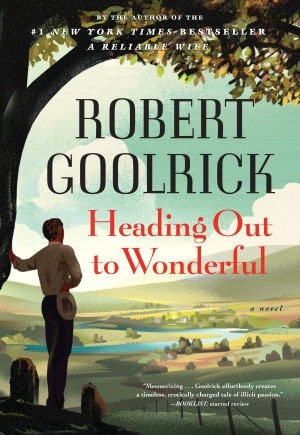
Book Review: Heading Out To Wonderful by Robert Goolrick

Book Review: Heading Out To Wonderful by Robert Goolrick


I’m struggling to figure out just what I want to say about Heading Out To Wonderful. The writing is lovely, and I became involved enough in the plot that I stayed up way past my bedtime to finish the book. On the other hand, I’m not sure that the whole is greater than the sum of its parts.

Heading Out To Wonderful is set in the sleepy rural town of Brownsburg, Virginia in 1948, post-war years when life in America was on the cusp of change. The author lovingly describes the quality of life in Brownsburg:

Brownsburg, Virginia, 1948, the kind of town that existed in the years right after the war, where the terrible American wanting hadn’t touched yet, where most people lived a simple life without yearning for things they couldn’t have…

And also:

A particular town, then, Brownsburg, in a particular time and place. The notion of being happy didn’t occur to most people, it just wasn’t something they thought about, and life treated them pretty well… the notion of being unhappy didn’t occur much either.

Into this small town arrives Charlie Beale, an attractive and pleasant man who appears in his truck one day, bringing nothing but two suitcases, one filled with butcher knives and one filled with cash. Charlie seeks out work with the local butcher, buys a plot of land out by the river, and settles in.

Charlie remains something of an enigma throughout the book. He is 39 years old, athletic and graceful, skilled with his hands and his knives. He served in Europe in the war, but doing what exactly, we never find out. The only clue we get about his wartime experiences is that his butcher knives are German; we can only speculate as to where or how he acquired them.

Charlie doesn’t speak about his childhood or background except in vague generalities. Where did all that cash come from? We don’t know. Charlie is full of yearning, for a place, for land, for connections, and for goodness. Somehow along the way, Charlie lost his sense of hope, and so he set out traveling, looking for “something wonderful”. His new friend and employer Will tries to reset Charlie’s expectations:

Let me tell you something, son. When you’re young, and you head out to wonderful, everything is fresh and bright as a brand-new penny, but before you get to wonderful you’re going to have to pass through all right. And when you get to all right, stop and take a good, long look, because that may be as far as you’re ever going to go. Brownsburg ain’t heaven, by any means. But it’s perfectly fine. It’s all right.

Charlie seems to have found “all right” in Brownsburg. He earns the friendship of the townspeople, and is the adored companion of Will’s young son Sam. Charlie might even have been content at last, until he meets Sylvan Glass, a 17-year-old “hillbilly” girl, bought and paid for by the richest man in town, now a trophy wife who dreams of glamour and Hollywood. What follows is a year-long affair which consumes Charlie and disrupts the lives of everyone in town. Reading about Charlie and Sylvan, we know that something disastrous has been set in motion; I could only wait to see what shape the disaster would ultimately take.

A sense of foreboding hangs over the story from the outset. It’s clear that nothing good can come out of the affair. By the time I reached the half-way mark in the book, it became very difficult to put down, and I had to keep reading to see which way it would go. To avoid spoilers, I won’t say anything about the book’s climax, other than to say that events unfold that are at the same time tragic yet not unexpected.

At the conclusion, I was disturbed by the lack of overall coherence. Many plot elements that are compelling are introduced, but I didn’t see the follow-through. The black and white communities live completely separate lives in Brownsburg. Both Charlie and Sylvan develop relationships that reach out across the color lines, yet I didn’t feel that this part of the story particularly went anywhere. Concepts of sin and salvation are introduced as Charlie struggles to fit into the spiritual life of the community, but again, I didn’t feel the points were carried through as the plot unfolded.

Ultimately, dramatic as the story is, Heading Out To Wonderful left me a bit puzzled at the end, wondering about the point of it all. Robert Goolrick is a terrific and thoughtful writer – I loved his previous novel, A Reliable Wife, with its dark secrets and twisty-turny plot developments. Unfortunately, despite the lovely prose, Heading Out To Wonderful doesn’t quite deliver.

Hurray for public libraries!

Posted by the Grand Forks Public Library (http://www.gflibrary.com/)

Wishlist Wednesday

What fun! I’m so happy to have discovered Wishlist Wednesday, hosted by the lovely Pen to Paper blog. The concept is to post about one book from our wish lists that we can’t wait to read. Want to play? Here’s how:

  • Follow Pen to Paper as host of the meme.
  • Please consider adding the blog hop button to your blog somewhere, so others can find it easily and join in too! Help spread the word! The code will be at the bottom of the post under the linky.
  • Pick a book from your wishlist that you are dying to get to put on your shelves.
  • Do a post telling your readers about the book and why it’s on your wishlist.
  • Add your blog to the linky at the bottom of this post.
  • Put a link back to pen to paper (http://vogue-pentopaper.blogspot.com) somewhere in your post.
  • Visit the other blogs and enjoy!

My Wishlist Wednesday book is:

Horns by Joe Hill

From Amazon:

Ignatius Perrish spent the night drunk and doing terrible things. He woke up the next morning with one hell of a hangover, a raging headache . . . and a pair of horns growing from his temples. Once, Ig lived the life of the blessed: born into privilege, the second son of a renowned American musician, and the younger brother of a rising late-night TV star, Ig had security and wealth and a place in his community. Ig had it all, and more – he had the love of Merrin Williams, a love founded on shared daydreams, mutual daring, and unlikely midsummer magic. Then beautiful, vivacious Merrin was gone – raped and murdered, under inexplicable circumstances – with Ig the only suspect. He was never tried for the crime, but in the court of public opinion, Ig was and always would be guilty. Now Ig is possessed with a terrible new power – with just a touch he can see peoples’ darkest desires – to go with his terrible new look, and he means to use it to find the man who killed Merrin and destroyed his life. Being good and praying for the best got him nowhere. It’s time for a little revenge; it’s time the devil had his due.

Why do I want to read this?

Horns has been sitting on my shelf for quite some time now, and so far I haven’t been in the mood. However… I just heard from a friend today that the movie version of Horns will star Daniel Radcliffe, and that’s enough of a reason to give Horns a boost higher on the to-read pile. Plus, I do think Joe Hill is a fantastic writer. His Heart-Shaped Box scared the heck out of me!

Book Review: Talulla Rising by Glen Duncan

Book Review: Talulla Rising by Glen Duncan

I can’t talk about Talulla Rising without talking about its predecessor, The Last Werewolf and what happened in it, especially some major twists toward the end. So consider this your obligatory spoiler alert. SPOILERS AHEAD! Caveat lector — let the reader beware.

Now that that’s out of the way…

The Last Werewolf was one of my favorite books of 2011. Simply put, I was blown away by the language as well as the plot. Glen Duncan’s writing is extraordinary, and the voice he created for lead character Jake Marlowe was remarkable. In a nutshell, The Last Werewolf is a first-person narrative told from the perspective of the titular character Jake, who is, in fact, the very last werewolf in existence. After a lifespan of 200 years, WOCOP (the World Organisation for the Control of Occult Phenomena) has finally succeeded in wiping out the rest of his species and has let it be known that Jake is next. Jake is world-weary, bone-weary, and overall rather sick of it all, so he decides to let WOCOP hunt him down and put an end to it, once and for all.

AND THEN… (and this is where the serious spoilers arise, so — last chance — avert your eyes now!)… Jake meets Talulla, and discovers that he’s not the last after all. Talulla is a recently turned werewolf, who quickly becomes his lover, his soulmate, and his partner in monstrosity. The pair go on the road, a lupine Bonnie and Clyde, but their joy in finding true love is not fated to last. Suffice it to say, The Last Werewolf does not end with a happily-ever-after.

Talulla Rising opens several months after the conclusion of The Last Werewolf. Jake is gone, and Talulla is alone in the world, pregnant, and full of despair. Her pain over the loss of Jake is intense; her fears of impending motherhood are enormous. Can a monster be a mother? What will her child be, and how can she make sure it survives? When her newborn werewolf son, born during Talulla’s full-moon transformation, is brutally ripped from her arms by a familiar team of enemies, events are set in motion that lead to ongoing violence, desperate acts, and unlikely alliances.

Along the way, despite Talulla’s efforts to harden her heart and not let herself love, she becomes a fierce mother/protector, whose only motivation is to save her young, no matter the expense.

Talulla Rising is not for the easily disturbed. If scenes of bodily mayhem make you queasy, this will not be your cup of tea. The violence is brutal, explicit, and quite often disgusting — although, frankly, it is a team of scientists rather than any supernatural beings who carry out the worst of the atrocities committed in the course of this book.

As in the first book, Glen Duncan’s writing is magnificent. His use of words continues to astound, as he twists and turns the English language to his will. I found Talulla’s voice a little too similar to Jake’s at times, but that’s a minor complaint.

While the first book had plenty of action, it focused to a great degree on Jake’s internal dialogue. Talulla Rising is much more plot-driven, with events and disasters piling up at a tremendous clip.

When I finished The Last Werewolf, the story felt complete, and I had no idea that a sequel was planned. Likewise, after finishing Talulla Rising, I read this Q&A with Glen Duncan and was surprised to learn that this is, in fact, a trilogy, and that a third and final book is forthcoming. While some plot threads are left dangling at the end, Talulla Rising ends on a satisfying note and is complete on its own, so that it was not immediately evident to me that the author planned a follow-up. That said, I’ve truly enjoyed these two werewolf novels by Glen Duncan, and will certainly gobble up the third as soon as it’s available.

Book Review: Fables (volumes 1 – 3) by Bill Willingham

Fables (volumes 1 – 3) by Bill Willingham

I have quickly fallen in love with the Fables graphic novel series. By the end of volume 1, “Legends in Exile”, I was pretty sure it was just a crush. After reading volume 2, “Animal Farm,” I realized my feelings had deepened and that this just might be the start of a serious relationship. And now, three volumes in, after reading “Storybook Love”, I know it’s the real thing. I’m hooked.

Fables, written by Bill Willingham, is a DC Comics series that originally appeared in comic book format, now compiled in trade paperback volumes. So far, 17 volumes are available in print, with volume #18 due for publication in January of 2013.

Fables tell the story of fairy tale and other assorted mythical and magical characters, forced to flee their homelands after the invasion of the Adversary (about whom we know nothing so far, other than the fact that he’s unstoppable and ruthless. If you’ve read further in the series than I have — hush! I don’t want to know.) The survivors have taken refuge in our world — more specifically, Manhattan — where they live a secret life, concealing their magic from the mundys (that’s us, folks).

The mayor of the Manhattan Fable town is Old King Cole, but he’s merely a figurehead. The true authority lies with deputy mayor Snow White (our fearless heroine!), backed up by sheriff and overall enforcer Bigby Wolf (Big B. Wolf — get it?), whose gruff human exterior hides a predator with a core of integrity. Between the two of them, they ride herd on a mish-mash of misfits, including Little Boy Blue, Prince Charming (such a cad!), the Frog Prince (known as Flycatcher due to his unfortunate snacking habits), and Bluebeard (who reminds me of a really buff version of Walter White of Breaking Bad).

Their less human-looking counterparts reside on a hidden farm in upstate New York, concealed from the outside world, but also chafing under their enforced seclusion. A brilliant plot involving an uprising at the Farm is what truly got me involved in this series. Let’s just say that there’s a lot more to Goldilocks and the three bears than you might assume. And don’t get me started on nasty old Shere Khan either.

Fables is not for children. Mature themes abound, as well as plenty of gruesome deaths, sexy bedroom scenes, conspiracies, deceptions, murder and mayhem. The plotting is detailed and fast-paced, with masterful storytelling at every turn. It’s been a real pleasure for me to discover a tale well-told in a format that’s fresh and engaging. For someone who’s relatively new to the world of graphic novels, I’m really having a ball with this series, and I’m finding it seriously difficult to put Fables down in order to pick up a “real” novel.

Onward we go. So long as I have more volumes of Fables close at hand, it would appear that I’m not going to get anything else done.


A word from my reluctant reader

“Mom, it’s not that I can’t read. I just prefer not to.”

Courtesy of my 9-year-old. Proof that being an insatiable reader isn’t genetic after all.

Quickie Book Review: Code Name Verity by Elizabeth Wein

Code Name Verity is one of those books that makes me wonder why certain novels get marketed as young adult fiction. In my mind, and on my bookshelves, it just goes on the shelf marked Incredibly Well-Written and Moving Fiction. So there! It will be in very good company, right next to The Book Thief and The Fault In Our Stars, two other so-called YA novels that anyone with any sense ought to read immediately.

Code Name Verity is breathtaking, suspenseful, emotional, and even funny at times. I don’t want to give anything away, but here are the bare bones: This is the story of two young women who manage to find a friendship that elevates them above the harshness of life in wartime. Set in England and France during WWII, Code Name Verity… well, dammit, just read the book! You’re better off starting with a clean slate and not knowing anything before you read it.

Suffice it to say, I was blown away and couldn’t put it down. I took the book out of the library after reading a glowing review, but I think I’ll have to quickly purchase my own copy so I can re-read it at leisure.

Why a quickie book review? It’s simple, really: A) I loved this book and want everyone to know!, and B) this is a book better appreciated with no foreknowledge, so the less said the better.


I pre-ordered The Casual Vacancy. I’m just not sure I want to read it.

Let’s be honest, shall we? If you came across this description of a soon-to-be-released book, would you want to read it?

When Barry Fairweather dies unexpectedly in his early forties, the little town of Pagford is left in shock. Pagford is, seemingly, an English idyll, with a cobbled market square and an ancient abbey, but what lies behind the pretty façade is a town at war. Rich at war with poor, teenagers at war with their parents, wives at war with their husbands, teachers at war with their pupils…. Pagford is not what it first seems. And the empty seat left by Barry on the town’s council soon becomes the catalyst for the biggest war the town has yet seen. Who will triumph in an election fraught with passion, duplicity and unexpected revelations?

(book description lifted from the nice people at Amazon)

Sounds okay, but it wouldn’t rise to the top of my to-read pile (which I swear grows a few inches taller every time my back is turned, but that’s another story for another day). I tend toward the dark, the weird, the magical or mysterious, the slightly off-kilter in my must-reads. A story about small town politics? Well, maybe when I have nothing else to do… and when I’ve run out of Stephen King or Christopher Moore to fill in the slow moments.

BUT… and it’s a very big but (ha! I can hear my 9-year-old saying, “Mom! You just said ‘big butt’!”), this is no ordinary, run-of-the-mill tale of life in a charming English town. This is The Casual Vacancy, the debut adult novel by J.K. Rowling! Changes the picture a bit, doesn’t it?

According to Amazon’s stats as of today, The Casual Vacancy is currently #223 in their sales ranking, with still two months to go until its release date in late September. If this wasn’t a book by J. K. Rowling but rather by some unknown author, I’d imagine that the preorders on this would be non-existent. BUT (again with the big but…) this is the queen of bestsellers, the creator of Harry Potter! Who doesn’t want to read whatever she writes next?

I can only imagine the conversations between J. K. and her agent and her publisher. “Well done, you’ve finished the most successful book series in the history of the universe! What are you going to do next?” “Ummmm….”

I suppose it would have been easiest for J. K. to coast for a bit, write more tales set in the Potter ‘verse. C’mon, don’t we all want to know more about Neville? That Teddy Lupin seems like an interesting guy, right?

And too, she doesn’t actually have to do anything for the rest  of her life, and she’ll still be more or less a gazillionaire forever, thanks to Harry.

It takes a certain amount of courage to go off in a new direction, to say to her legions of fans, “Hey, I know you lot want more wizards and magic — but I’m over it. Moving on, here!” And no matter what she writes next, there’s certain to be an intense amount of scrutiny and incredibly high expectations. The schadenfreude crowd would love, I’m sure, to be able to say, “Oh, J. K. Rowling? One-trick pony. She has nothing else to say after Harry Potter.”

So, onward to The Casual Vacancy. I wonder — is this a story she was dying to tell? Did she have a sudden burst of inspiration, see whole new worlds opening up before her? Has she always wanted to explore small-town English politics?

Or, perhaps, is The Casual Vacancy just a first tentative step toward moving into a post-Harry Potter writing life? Get that first book out there, like throwing a bone to a hungry dog, let all the people salivating over her next work see that she’s capable of writing something outside the HP world. If The Casual Vacancy is released to big fanfare and the world reads it, shrugs its collective shoulders, and realizes that J. K. Rowling is a novelist who will be around for a while writing lots of different books, then maybe the pressure will be off.

Who knows, maybe it’s the next book after The Casual Vacancy that ‘s the one that she’s just dying to write, and The Casual Vacancy is just a test balloon to get us all to back off and ease up on the expectations.

As for me, I’m sure I will read it. I love Harry Potter, world without end, and I’m willing to give J. K. the benefit the doubt, even if it means reading a book about Muggles.

Although it would definitely be cool if a dementor or two showed up in Pagford.

♦♦♦♦♦♦♦♦

What about you? Are you planning to read The Casual Vacancy?

Women who run, and the readers who resent them

During my recent re-read of A Discovery of Witches, Deborah Harkness’s huge bestseller from 2011, I noticed something that hadn’t struck me as forcefully the first time around.

Man, that Diana Bishop runs a lot.

Oh, to be sure, there’s an explanation for why her fanatical running routines get such prominence in the story. Diana’s a spell-bound witch, you see, which means that she has a huge store of power inside her that she can’t access and use via magic. All that back-up  results in an excess of adrenaline, and to release it, Diana runs. Constantly. And rows. Up and down the river, in the fog, occasionally with her eyes closed, but you get the point. That woman MOVES.

Earlier this year, I read Ocean’s Touch, an erotic story by Denise Townsend centered on a lonely widow and the sexy selkie who reawakens her to the possibilities of life and love. (Yes, I said sexy selkie. Deal with it.)  Meredith is smart, sad, responsible… and she runs. A lot. Miles at a time.

And there’s more. It seems like every other book I read lately features a strong, sexy, intelligent woman with an intense, highly demanding fitness routine. A couple months back, I read the Mercy Thompson series by Patricia Briggs, in which the heroine is a car mechanic, a shape-shifter, and a highly trained expert in a specialized martial arts discipline.

Even in the supremely silly Austenland by Shannon Hale, the Darcy-obsessed main character is so stymied by her faux-Regency immersion vacation that she must sneak outside for an early morning run in the gardens, corset and all. (Lesson learned: Corsets are not appropriate activewear. Invest in yoga pants instead).

Leaving aside Austenland, whose lead character simply cannot be taken seriously, the running and exercise habits of fictional women seem to be a sort of short-hand to denote certain character traits: intensity, intelligence, fierce independence, determination to go it alone. In the first three examples I mentioned, Diana, Meredith and Mercy start their stories as talented women who are walled off from their passions. When I read about a woman who’s a serious runner or other type of athlete, I generally know what to expect — this is a woman to be reckoned with, and often someone with issues to work out.

And where does that leave all of us, we the readers? If you’re like me, a low-to-moderate achiever on the scale of devotion to fitness, it’s a bit tough to take sometimes. Not only is Diana Bishop a Yale professor and a powerful witch, but she runs ten miles a day! Not only can Mercy fix a VW with her eyes closed, she can also kick your butt! Thank you, dear authors, for yet another reason to feel inadequate.

Perhaps this factors into why I love Jane True so very much. Jane is the creation of Nicole Peeler, and is the hilarious heroine of Tempest Rising and four other books (so far). Jane reads, works in a bookstore, and her appetite for hot sex is matched only by her appetite for delicious food. (Okay, to be fair, Jane also swims in the ocean on a daily basis, but that’s just to recharge her magical mojo… too much to explain here, but in Jane’s case, the exercise is part of her magic, not just a piece of her perfect fitness regimen.) Besides the fact that end I up laughing out loud whenever I read these books, I think I love Jane because if I met her in real life, I wouldn’t be intimidated by her perfectly toned abs and her runner’s legs — I’d be too busy pouring the hot chocolate and cutting up some pie to go with.

A final glimpse of the world of Jane True, in which our heroine finds herself confronting some hard choices in a diner with her would-be lover:

I wanted them all, but I also knew I was being greedy. Then Anyan’s deep voice rumbled from next to me.

“Why don’t I get the three-sausages and mash with the special sausages, and you get the same thing with the traditional ones, and the vegetarian, and we can share?”

At his words, I nearly choked on my emotions. You’re perfect, I thought…

My aha moment

I’m not talking about the 80s pop band, famous for Take On Me. (Dammit! Now it’s stuck in my head!)

And until I just did a quick Google search, I had no idea that Oprah has somehow cornered the market on “aha”, turning it into something very likely trademarked if written with the appropriate punctuation and capitalization.

I’m talking epiphany here, as in “Eureka! I’ve found it!” Or in my case — “OMG, I finally figured it out!”

e·piph·a·ny

a sudden, intuitive perception of or insight into the reality or essential meaning of something, usually initiated by some simple, homely, or commonplace occurrence or experience.

(Thank you, Dictionary.com!)

For the past year or so, I’ve been complaining about the lighting in my house. When I’m ready to read, I move lamps, angle light bulbs just so, or burrow into corners of the couch where the overhead illumination shines perfectly on my page. And wouldn’t you know it? It’s just never quite right.

Suddenly, a few weeks ago, it finally hit me. Maybe it’s not the lighting. Maybe — gasp — it’s my eyes. Sure, I should have caught a clue sooner. Perhaps all that squinting at the teeny, tiny print on my IPhone should have woken me up to the cold hard facts.

The solution was staring me in the face, as it were:

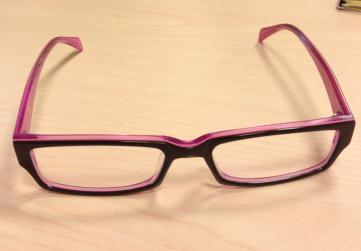
Behold, my very first pair of reading glasses! I swear, it was like being struck by a bolt of lightning when I put them on for the first time. My house wasn’t poorly lit after all. Hallelujah! The letters on the page had sharp edges, like little tiny razor blades. The print was practically glowing, it was such a beautiful sight!

It’s love, I swear it. These babies come with me wherever I go. I love them so much, I might marry them. And, I must say, I think I look pretty good when I rock my new specs. To paraphrase the Doctor’s wise words about fezzes, “Reading glasses are cool.”

I haven’t felt this enlightened since the day I realized that I needed HDMI cables in order to get a high def picture on my giant HDTV. (I’m embarrassed to admit that I had said TV for almost a year before that particular epiphany hit me.)

So my bursts of insight come to me in their own sweet time. So my epiphanies aren’t exactly earth-shaking. I’m okay with that. My new reading glasses rock my world, and considering how many hours a day, a week, a year I spend with my nose buried in a book, that’s really a life-changing “aha”!