A bookish sort of tribute to Neil Armstrong


I was sad to hear the news today about the passing of Neil Armstrong, a true American icon and hero. I’ve always been fascinated by the history of the US space program, from childhood — watching the moon landing on our grainy black-and-white TV — through adulthood, with tragedies and triumphs viewed on television and the internet, visits to air and space museums and the Kennedy Space Center, where we gawked at the lunar capsules and launch pads, and of course, since I’m me, with fact, figures, and fictions absorbed through the pages of books.

And so, I thought I’d give an overview of my own collection of space books — some old, some new — as a tribute to a man who inspired us all to look to the stars (and to practice faux moon jumping in our backyards when no one was looking).


The Right Stuff by Tom Wolfe (1979)

Tom Wolfe’s account of the early development of the US space program, focusing on the Mercury astronauts and what it meant to be the best, is a classic; a combination of history, social commentary, and sharply drawn wit. (I was amused to pull my copy off the shelf for the first time in years and see the hardcover price of $12.95. Ah, those were the days!)

Space by James Michener (1982)

As with all great Michener novels, Space is a heady mix of history and fiction, following the trajectory of space exploration from its post-war inception through the Mercury, Gemini, and Apollo programs, climaxing with a fictional Apollo mission to the dark side of the moon. I loved this book’s combination of historical fact and fictional drama, filled with characters of both national stature as well as the supporting players on the home front. It’s been years since I’ve read this book, but I vividly recall the emotional roller coaster that it took me on.

Packing for Mars by Mary Roach (2010)

Mary Roach cracks me up, plain and simple. A science writer with the phrasing and timing of a stand-up comedian, I don’t think there’s a subject out there that Mary Roach couldn’t make hilarious. In Packing for Mars, she examines the day-to-day challenges of sending human beings into space, an environment our bodies are clearly not cut out for. She answers the question on everyone’s mind (just how do astronauts go to the bathroom?), explains the best options for surviving an elevator crash, and crams in a ton of useful knowledge, all the while being incredibly entertaining.

Two more from my to-read shelf, recent additions from various used book bonanzas of the past year:

Rocket Men: The Epic Story of the First Men on the Moon by Craig Nelson (2009)

I was so happy to find a copy of this one! From the Booklist review:

Using interviews, NASA oral histories, and declassified CIA material, Nelson has produced a magnificent, very readable account of the steps that led to the success of Apollo 11. In the 40 years since the first moon landing and the 52 years since Sputnik was launched, it isn’t always remembered now what an experiment the Apollo program was, nor that the space race was as much a military as a scientific campaign. The space program was launched using the knowledge of rockets available at the end of World War II and former Third Reich scientists working in both American and Soviet programs. When it came to sending men into orbit and beyond, routines and equipment had to be invented and tested in minute increments. Nelson’s descriptions take us back, showing the assorted teams and how they worked together. We meet the astronauts and find out why they were eager to take on this mission, and we also meet the hypercareful technicians, without whom neither men nor craft would have left the ground. Nelson shows, too, how the technology and the politics of the times interrelated. Leslie Fish, songwriter, summed it up perfectly, “To all the unknown heroes, sing out to every shore / What makes one step a giant leap is all the steps before.” Nelson brightly illuminates those steps.

Riding Rockets: The Outrageous Tales of a Space Shuttle Astronaut by Mike Mullane (2006)

After reading Mary Roach’s praise for this memoir, I knew I just had to get a copy. From Amazon:

In 1978, the first group of space shuttle astronauts was introduced to the world — twenty-nine men and six women who would carry NASA through the most tumultuous years of the space shuttle program. Among them was USAF Colonel Mike Mullane, who, in his memoir Riding Rockets,strips the heroic veneer from the astronaut corps and paints them as they are — human.

Mullane’s tales of arrested development among military flyboys working with feminist pioneers and post-doc scientists are sometimes bawdy, often comical, and always entertaining. He vividly portrays every aspect of the astronaut experience, from telling a female technician which urine-collection condom size is a fit to hearing “Taps” played over a friend’s grave. He is also brutally honest in his criticism of a NASA leadership whose bungling would precipitate the Challenger disaster — killing four members of his group. A hilarious, heartfelt story of life in all its fateful uncertainty, Riding Rockets will resonate long after the call of “Wheel stop.”

I owe a great deal of my life-long fascination with the space program to my early memories of Neil Armstrong’s first steps on the moon.

RIP, Neil Armstrong, and thank you.

Coincidence at King’s Cross?

My son and I started a new book this week as his bedtime read-aloud. We’ve made it through about five chapters so far, and here are some key points:

  • There is a special platform at King’s Cross Station in London which leads to a hidden, magical world
  • Regular humans have no idea this magical world exists
  • Our hero is a nice boy being raised by people who are not his parents
  • He lives in the non-magical world, and doesn’t know that he belongs in the world of magic
  • He is not treated very well: he is considered the kitchen boy, works hard dawn to dusk, goes to a run-down, second-rate school, and sleeps in a cupboard
  • The favorite son of the family is a fat, spoiled boy of about the same age, who has a room overflowing with more toys and gadgets than he can possibly ever use or enjoy
  • The fat boy’s mom speaks to him in baby-talk (“Where does it hurt, my pettikins?”), sees him as sensitive and frail, and gives him everything he wants

Sound familiar?

Psych. This is The Secret of Platform 13, written by Eva Ibbotson, and published in 1994… which, by the way, is about three years prior to the introduction of the Boy Who Lived to the rest of the world.

Coincidence? I’m sure this was all hotly debated when Harry Potter first appeared in 1997 (so I’m a little late to the party). And seeing as I’m only about a third of the way through Platform 13, I’m in no position to state whether the similarities continue. It’s a little hard to believe that two different children’s authors came up with such similar elements within such a short time span without there being… oh, let’s call it cross-pollination.

I had a hard time buying it when the author of a bestselling series of vampire books claims to never have read any other vampire fiction. Really? Do you live in a media-less cave, perhaps? Of course, writers of children’s fiction read other writers’ works, and it’s natural to be influenced by what you’ve read, especially when it’s the good stuff. And as far as I can tell, based on the five chapters I’ve read, The Secret of Platform 13 is indeed the good stuff.

It’ll be interesting to see how the story plays out, and whether the seemingly familiar elements will continue to pop up. Somehow, I doubt that we’ll be seeing a wizarding school, a sport played on broomsticks, or a flying motorbike, but I could be wrong.

Genre confusion

It’s finally happened — Facebook is “timelining” me. (Yes, I just used timeline as a verb. I expect a bolt of lightning any minute now.)

One interesting side effect is the random voyage through my personal history that it’s providing. Movies, TV shows, odd things I said that I’m sure I thought were quite witty at the time… it’s all there. A quick scan through my recent Facebook past revealed this forgotten nugget, dated September 16, 2010:

Dawning realization that the book I’m reading may in fact be a romance novel. Bodices have been ripped.

Any idea what I’m talking about? Only one of my all time favorite novels, Outlander by Diana Gabaldon! Of course, at the time, I didn’t yet realize how very much in love I’d fall with this series (and with the main character, Jamie Fraser, but that’s a different topic).

I can be forgiven for my genre confusion, having just read this passage:

Randall slowly drew the knife in a semicircle under one breast. The homespun came free and fell away with a flutter of white chemise, and my breast sprang out. Randall seemed to have been holding his breath; he exhaled slowly now, his eyes fixed on mine.

Followed on the next page by – ta-dum – our hero’s arrival:

“I’ll thank ye,” said a cool, level voice, “to take your hands off my wife.”

By the end of the book, I was hooked, so much so that by October 16, 2010, my status update read:

Have finished four books of a seven-book (so far) series in the past month. Page count: 3926 read, 3740 to go.

What can I say — other than, I’m glad I stuck with it! Despite the ripped bodice and the occasional heaving breast, what I found myself reading was not a romance novel, but a remarkable piece of historical fiction that includes a lovely romance, as well as a crash course in the history of the Jacobite rebellion, battlefield medicine, Scottish culture, and speculative time travel.

So what shelf does Outlander belong on? According to the author (on her website, here):

In essence, these novels are Big, Fat, Historical Fiction, ala James Clavell and James Michener.  However, owing to the fact that I wrote the first book for practice, didn’t intend to show it to anyone, and therefore saw no reason to limit myself, they  include…

history, warfare, medicine, sex, violence, spirituality, honor, betrayal, vengeance, hope and despair, relationships,
the building and destruction of families and societies, time travel, moral ambiguity, swords, herbs, horses,
gambling (with cards, dice, and lives), voyages of daring, journeys of both body and soul…

you know, the usual stuff of literature.

Thanks, Diana G., that clears that up!

So, has this ever happened to you? Have you ever started a book expecting one thing, and found yourself someplace completely different? And if so, were you glad for the detour?

I know I originally picked up my battered, used edition of Outlander because I remembered seeing the title listed in reference to time travel. I’m sure, though, that if the original context had been about romance, I probably never would have thought to give it a try.

So, here’s to trying new genres! Stepping out of our reading comfort zones! Crossing the book store aisles and browsing a new shelf! You just never know where your next new favorite might be lurking.

And thank you, Facebook, for this strange trip down my book-addicted memory lane.

Fictitious fiction, TV-style

Earlier this week, I put together a photo collection of TV characters reading books. Why? Because I wanted to. And I read. And I watch TV. And it gave me a good excuse to search for cool pictures.

The one that was hardest to find was from an episode of Sons of Anarchy [SPOILER ALERT], in which the dearly departed Piney (RIP) sat in his mountain cabin, drinking heavily and reading a Stephen King novel.

Boards were a-buzz the day after the episode originally aired. Shock, outrage, and sorrow were rampant. Me? I wanted to know what book Piney was reading, and so, apparently, did lots of other book-loving viewers. The question kept coming up: Was it The Stand? Nah, not thick enough. Christine? Nah, the artwork didn’t seem right.

Show creator Kurt Sutter was kind enough to put the debate to rest by sharing this image, with the explanation:

February 11, 2012did anyone notice what piney was reading right before clay killed him? asked SK if he wanted to plug a book, he said have piney reading CYCLE ZOMBIES. our art department created this —

Mystery solved! Wouldn’t you love to read Cycle Zombies by Stephen King?

Wishlist Wednesday

And now, for this week’s Wishlist Wednesday…

The concept is to post about one book from our wish lists that we can’t wait to read. Want to play? Here’s how:

  • Follow Pen to Paper as host of the meme.
  • Please consider adding the blog hop button to your blog somewhere, so others can find it easily and join in too! Help spread the word! The code will be at the bottom of the post under the linky.
  • Pick a book from your wishlist that you are dying to get to put on your shelves.
  • Do a post telling your readers about the book and why it’s on your wishlist.
  • Add your blog to the linky at the bottom of the post at Pen to Paper.
  • Put a link back to pen to paper (http://vogue-pentopaper.blogspot.com) somewhere in your post.
  • Visit the other blogs and enjoy!

My Wishlist Wednesday book is:

The Unbecoming of Mara Dyer by Michelle Hodkin

From the author’s website:

Mara Dyer believes life can’t get any stranger than waking up in a hospital with no memory of how she got there.
It can.

She believes there must be more to the accident she can’t remember that killed her friends and left her strangely unharmed.
There is.

She doesn’t believe that after everything she’s been through, she can fall in love.
She’s wrong.

Why do I want to read this?

It sounds mysterious, intriguing, suspenseful… with a hint that some sort of conspiracy or larger force is at play. The synopsis doesn’t tell me much, but I like how dire it all sounds. I actually came across this book after seeing a blurb for the sequel, The Evolution of Mara Dyer, which is due out in October.

Once again, I may be breaking my own rule about not starting any more trilogies — I really have to stop doing that! Still, my library branch has a copy available, so I think I’ll dive in, give The Unbecoming a try, and then make a decision about continuing with the story.


Read a book. All the cool people are doing it.

Taking a brief pause to appreciate TV characters who read… for no real reason except that it gives me a good excuse to Google stuff. Without further ado:

Damon Salvatore thinks sparkly vampires are stupid.

Sawyer rockin’ the reading glasses.

Don Draper is a very serious reader.

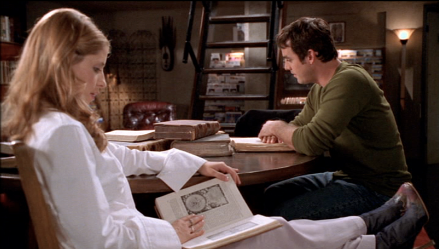
Good slayers always do their homework first. But where are the Scoobies?

Good slayers always do their homework first. But where are the Scoobies?

No, the other Scoobies!

Joey found Little Women kinda scary.

Gemma hitting the medical texts. Career change?

Trying to read here, Varys.

Never too old for a bedtime story.

Updated 8/24/2012 to add:

Piney reading a one-of-a-kind Stephen King novel. That’s “Cycle Zombies”, and it exists only in TV land.

That’s all I’ve got! If you come up with any other good ones, please share.

11/5/2012: Updated to add this additional cute photo:

Some scary things happen in “The Angels Take Manhattan” episode of Doctor Who, but this reading-friendly picnic scene is just adorable.

Q&A with the kiddo: A kid’s-eye view of…

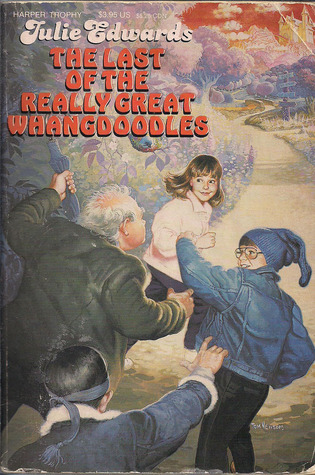
Book Review: The Last of the Really Great Whangdoodles by Julie Edwards

(Mom’s squeal: That’s JULIE ANDREWS, by the way! How can you go wrong with a book written  by Mary Poppins??)

From Amazon:

The Whangdoodle was once the wisest, the kindest, and the most extraordinary creature in the world. Then he disappeared and created a wonderful land for himself and all the other remarkable animals — the ten-legged Sidewinders, the little furry Flukes, the friendly Whiffle Bird, and the treacherous, “oily” Prock. It was an almost perfect place where the last of the really great Whangdoodles could rule his kingdom with “peace, love and a sense of fun”– apart from and forgotten by people.

But not completely forgotten. Professor Savant believed in the Whangdoodle. And when he told the three Potter children of his search for the spectacular creature, Lindy, Tom, and Ben were eager to reach Whangdoodleland.

With the Professor’s help, they discovered the secret way. But waiting for them was the scheming Prock, who would use almost any means to keep them away from his beloved king. Only by skill and determination were the four travelers able to discover the last of the really great Whangdoodles and grant him his heart’s desire.

Proudly presenting this week’s book review, courtesy of my 10-year-old son: Q&A with the kiddo!

In which I ask my kiddo to describe a book he’s enjoyed recently and he gives his opinions, more or less unfiltered by mom. The kiddo’s big sister picked this one out to read to him at bedtime, and it was a huge success. I think he would have liked the book anyway, but certainly the added bonus of quality time with his favorite non-parental person was a big plus.

Without further ado — Q&A with the kiddo:

Q: What book did you read this week?

A: The Last of the Really Great Whangdoodles

Q: What was it about?

A: It’s about these kids who went to the zoo once. They were talking about what’s the most unique animal that they know. This guy came up and said “I think it’s a whangdoodle”. They asked him what a whangdoodle is and he said that it’s sort of like a moose that can change color and has a sweet tooth. The tooth has flowers and stuff on it. They became friends. The children went home and talked about him. One of the kids said, “I don’t believe you.” The scientist said, “Go look it up in the dictionary” and it was there. Then it was Halloween. The kids went to whangdoodle land and met the last whangdoodle. The kids were bragging about the scientist and they brought him back to whangdoodle land and he made another whangdoodle. Then they went back home.

Q: What do the Whangdoodles look like?

Sort of like a moose with giant antlers. They can change colors with their feelings or whenever they want to. They also have a really sweet tooth with flowers on it. They can also take the shapes of other objects.

Q: Did you like the book?

A: Yes. A lot. One of the best books I ever read.

Q: Who are the main characters?

A: Ben, Lindy, Tom, the professor, and the Prock. The Prock is the prime minister. He looks like a human. Also, the whangdoodles.

Q: Can you tell me something funny from the book?

A: The way they say I love you is “umbeldumbeldum”.

Q: Would you want to read more by this author?

A: Depends on what the book is about.

Q: Was this a good reading level for you?

A: My sister read it to me. I didn’t understand everything, but for the words I didn’t understand I asked her. I probably could have read it on my own, but it would have taken me a year.

Q: Who do you think should read this book?

A: You (that means me, good old mom). Kids my age or maybe a year older. Kids who like adventures, intense stories, or stories about creatures would like it.

So there you have it. We’ll be back with more book opinions from my kiddo, whenever I can get him to talk books again.

The Monday agenda

Not a lofty, ambitious to-be-read list consisting of 100+ book titles. Just a simple plan for the upcoming week — what I’m reading now, what I plan to read next, and what I’m hoping to squeeze in among the nooks and crannies.

Continuing with the Monday agenda concept started a few weeks ago, it’s time to see how well last week’s reading agenda worked out and sketch out the plan for the coming week.

This week’s fresh catch. Thank you, O Great Public Library!

From last week:

Ashfall by Mike Mullin: Thoroughly enjoyed this young adult novel of disaster and survival (reviewed on this site on 8/15/2012).

1001 Nights of Snowfall by Bill Willingham: Fantastic addition to the world of Fables. If you’re a fan of the series, this is a must-read.

Small Damages by Beth Kephart: Still haven’t gotten my copy, but expect it any day. This one moves back to my to-read list for now.

Drums of Autumn by Diana Gabaldon (group re-read): Another couple of terrific chapter this week, with thought-provoking discussions, as always.

Non-agenda reading: Because there’s always room for change! Who needs to be confined by an agenda, when there’s a world of books out there? I also read Rape Girl by Alina Kline (reviewed 8/18/2012) and — for some light, fun diversion — Dr. Horrible and Other Horrible Stories by Zack Whedon.

And this week’s new agenda:

Going Bovine by Libba Bray: I loved Beauty Queens by this author, and am finally getting around to reading this earlier young adult novel, winner of the 2010 Michael L. Printz Award for Excellence in Young Adult Literature. I’ve read about a third of Going Bovine so far, and I don’t know whether to laugh or cry. Can a book about a boy with a fatal illness be funny? You see my dilemma.

I hit the motherlode at the library over the weekend, and now have some tough decisions to make. As far as I can tell, my next book will be:

Gold by Chris Cleave. The subject matter doesn’t really call to me, but I did love Little Bee, and I just found out that Chris Cleave will be speaking locally in October. Perhaps I’ll be pleasantly surprised.

In graphic novel world, I have a tough call to make: Start reading Joe Hill’s Locke & Key series, or stay in the world of Fables with the Jack of Fables series?

Drums of Autumn by Diana Gabaldon (group re-read): Chapters 40 and 41 on deck for this week.

I’m sure I’ll also dig into a library book or two… in all of my non-existent spare time.

That’s my agenda. What’s yours? Add your comments to share your bookish agenda for the week.

Are you there, Judy Blume? It’s me, a grateful reader.

Judy Blume’s books have never been made into movies. Astonishing, right?

While reading about an upcoming film festival, I stumbled across an article about Judy Blume, whose novel Tiger Eyes will be the first of her works ever to make to it to the big screen. I have no idea why it’s taken so many years… but that’s not what this post is about.

Reading about the movie made me think of the impact Judy Blume’s books had on me and my friends, back when we were awkward, curious pre-adolescents just learning about what life had in store for us. I’ll admit it — this was in the 1970s. (Yes, I’m old! Deal with it.) We were subjected to those awful health-ed movies in school (“It’s Wonderful Being A Girl” — ugh!), which left us all horrified by the thought of the messy indignities soon to be inflicted upon us. Does any word cause more blushing and squirming than the word “puberty”?

And then… like a ray of sunshine… we discovered Judy Blume. Suddenly, we had a new language for what awaited us. Are You There God? It’s Me, Margaret was the book to read when we were pre-teens. As Margaret and her friends struggled with identity, family, religion, and boys, we cheered and cried along with her, and modeled our conversations and expectations after what Margaret and her friends went through. I still have the letters my camp friends and I sent each other that year, full of questions about boys and “did you get IT yet?” We learned about periods, about bra-stuffing, about gossip and its harm, about friendship and being true. Puberty, growing up, popularity — all of it was laid out for us in terms we could understand, and the world became just a bit less scary.

Deenie came along, and taught us about beauty, family pressure, responsibility, and — oh, yeah — masturbation. I can’t think of another book from that time that dealt with the issues quite so frankly, and with such lack of judgement. Deenie came to terms with the good and bad of her own body: touching herself felt good, wearing a back brace for her scoliosis made her feel self-conscious, her good looks didn’t have to determine what she did with her life — girl power, 1970s-style!

And then there was Forever. That book was passed around among the girls in my camp cabin so rapidly, I’m surprised it still had pages left by the end of the summer. Sex! Teens! And it was all okay! This story of first love and first sexual experiences was eye-opening for us. Most of the stories we’d encountered so far were along the lines of cautionary tales: scary teen pregancies, girls getting bad reputations… but Forever was a first love story, where a girl and boy explored themselves and each other, and had a good time doing so. (I don’t remember the characters’ names at all, but I’d bet that everyone who read Forever at that time remembers who Ralph was!).

So reading about Judy Blume after all this time makes me wonder: Do pre-teens still read her books? I’m not talking about her books for younger children, which I know have never gone out of style: Fudge, Freckle-Juice, Sheila the Great, etc. Do girls still read Are You There God? It’s Me, Margaret when they’re learning about getting their periods? Is Forever still relevant to teens thinking about exploring their sexuality?

If I had to guess, I’d say probably not. Growing up in the 1970s, there wasn’t all that much to choose from in terms of young adult fiction. I’m not even sure that the “young adult” nomenclature was really even used back then. Contrast that to now, when the young adult market is huge, with shelves upon shelves filled with books that go way beyond the innocence of the books of my youth. The choices are unlimited for young readers today, with novels addressing everything from puberty to pregnancy, divorce to disease, sexuality, gender identity, mental health, and more. It’s fabulous to see the wealth of information out there, the choices available, the avenues for discovery open to youth in transition to adulthood.

So is there still a place for Judy Blume? I hope so. The characters’ experiences might come off as a bit dated, all these years later, but the matter-of-fact approach to growing up and making sense of one’s world can only be a good thing… for those still willing to read something that their mothers read back in the dark ages.


Book Review: Rape Girl by Alina Klein

Book Review: Rape Girl by Alina Kline

I had some serious reservations about reading a book called Rape Girl. It’s just so… off-putting, I suppose you could say, and almost seemed to imply a trivialization of the subject matter. I’m pleased that that did not turn out to be the case.

Rape Girl is a slim novel which tells the tale of 16-year-old Valerie, a girl who just wants to fit in, but who ends up being referred to as “that rape girl” after she reports a sexual assault. Valerie is relatively new in town, a Catholic living in Mormon Utah, being raised by her mother after the death of her father two years earlier. An outsider in many ways, Valerie throws a party while her mother is away for a weekend, and things quickly get out of hand. Valerie has too much to drink (it’s unclear to me whether she simply had too much alcohol or if something was added to a drink, perhaps) and passes out. The next morning, she wakes to find her clothes being removed by the boy she likes, and is unable to fight him off after saying no.

After admitting what happened to her mother and reporting the rape to the police, Valerie is ostracized at school and dumped by her best friend. She drifts through feelings of depression and worthlessness, and experiences the all-too-familiar tragedy of a rape victim being blamed for her own assault. The in-crowd at school rallies round the attacker, Adam, who remains remarkably clueless throughout, more focused on what Valerie’s accusations might do to his future rather than concerned that he may have hurt someone.

Valerie is repeatedly victimized, by the incessant blaming at school, by the ineffectual school principal who chooses to isolate Valerie as a solution to classroom tensions, and by the legal system that sees her case as unwinnable. It is only by finding new sources of support that Valerie is able to move forward and reclaim her life — not necessarily the life that she thought she’d wanted, but a life that seems promising nonetheless.

Rape Girl is very short, and I think the story ultimately suffers a bit because of the length. There are places throughout where more explanation and more background might have been helpful. Valerie’s family life is outlined, but not explored in any great depth. I had a hard time getting a good sense of the mother’s character, and since she is Valerie’s main adult support, it seemed to me that we should have gotten to know her a bit better. In the aftermath of the rape, Valerie is befriended by a girl from a large Mexican family, and perhaps if there was more time spent on character development, Sandrina and her family might have seemed less like a stereotypical token ethnic element. Valerie’s journey toward healing also seemed unrealistically quick; again, this is an area where more exploration might have benefited the overall quality of the storytelling.

Aside from these areas of weakness — a case where more might have been better than less — I found Rape Girl to be a sad but all-too-believable story, and one that could have an important impact on teen readers, both male and female.

Review copy courtesy of namelos publishing via Netgalley.