The Monday agenda

Not a lofty, ambitious to-be-read list consisting of 100+ book titles. Just a simple plan for the upcoming week — what I’m reading now, what I plan to read next, and what I’m hoping to squeeze in among the nooks and crannies.

Back to work, back to real life… but there’s always time to talk about reading! Onward with the Monday agenda:

From last week:

Hmm, how’d I do?

Beautiful Ruins by Jess Walter: I finished this over the weekend (my review is here). Loved this book! I’d been aching for some good fiction, after a week of non-fiction reading, and this one definitely fit the bill. Highly recommended.

The Brides of Rollrock Island by Margo Lanagan: Just started!

I got pretty bogged down with playing with my new bookshelves and hitting the public library’s big used book sale ( you can see my recap here), both of which kept me thinking about books a lot (fun!) but reading a bit less than usual (not so fun).

Drums of Autumn by Diana Gabaldon (group re-read): Intense. Amazing.

And this week’s new agenda:

I just started The Brides of Rollrock Island by Margo Lanagan last night, and it’s pretty much love at first sight. Magical, ominous, unique… it was hard to tear myself away so I could get some sleep.

Why is it that all of my library requests seem to arrive at once? Now checked out and waiting to be read: The Diviners by Libba Bray, The Dog Stars by Peter Heller, Seraphina by Rachel Hartman, and The Forgetting Tree by Tatjana Soli. I’ll be luck to get to any of these this week, because…

The Casual Vacancy is coming! I’ve had J. K. Rowling’s new book (for grown-ups!) on pre-order for months, and it’s finally being released later this week. While the subject matter doesn’t sound all that thrilling to me, I’m certainly willing to give a try to anything JKR writes. Who else is planning to read The Casual Vacancy right away?

Drums of Autumn by Diana Gabaldon (group re-read): Chapters 50 and 51 on deck for this week. Chapter 50 is essential — big reveals, big confrontations. Can’t wait.

So many book, so little time…

That’s my agenda. What’s yours? Add your comments to share your bookish agenda for the week.

Book Review: Beautiful Ruins by Jess Walter

Book Review: Beautiful Ruins by Jess Walter

If not for all the rave reviews out there, I might never have picked up Beautiful Ruins on my own. And that would have been a shame.

Based on the dustjacket flap, this didn’t really sound like a book for me. Hollywood producers. Scandal on the set of Cleopatra in the 1960s. Richard Burton and Elizabeth Taylor, for God’s sake. Do I care about any of this?

As it turns out, the answer is yes. Beautiful Ruins is a vast book, in terms of subject matter if not actual page length. (For the record, the book is 337 pages long). What sounded to me like a relatively simple story of worlds colliding is in actuality a tale that spans decades and continents, with a cast of characters so large that it shouldn’t work — but it does.

Beautiful Ruins starts in 1962 in a small Italian fishing village — so small that neighboring villages look down at it, so isolated that arrival by boat is the only access, a place so not of note that no one arrives here by accident, ever. Into this village comes Dee Moray, a young beautiful wannabe starlet, believing herself to be dying and awaiting a final assignation with her lover. Dee is sent to stay at the one hotel in the village, run by Pasquale, son of the recently deceased innkeeper, come home to fulfill his father’s unrealistic dream of turning the family inn into a tourist attraction.

Dee has been sent packing to Porto Vergogna from the set of the Burton/Taylor movie fiasco, Cleopatra. The reasons for her exile unfold throughout the story, and all is not as it seems. Pasquale is smitten and finds a new purpose in championing Dee’s tragic cause.

Meanwhile, in modern-day Hollywood, a young assistant on the verge of walking away from her job with a legendary producer and giving up on the business once and for all is roped back in by the sudden appearance of an old man seeking a woman once encountered, briefly but intensely, fifty years earlier.

Adding to all this, we see bits of screenplays and manuscripts, a stage play and a movie pitch, and meet people across the years, from 1960s to present, with stops in Seattle, Idaho, Edinburgh, Rome, and Florence. Bit players come and go; some have a huge impact on the unfolding drama, some appear only long enough to spin events off into a new direction.

Amazingly, it works. What I’d initially thought would be a story following two main plot threads evolved into a story with seemingly endless characters and lives, all taking different trajectories, separate but connected by coincidences and happenstance. The characters’ intersections are fascinating, and I couldn’t help wondering at the dexterity with which the author keeps all of the plot points moving forward and continuing to matter.

My quibbles, if any, are that there are a few minor characters whom I would have like to learn more about and seen fleshed out to a greater degree, such as the shiftless musician we encounter midway through the book, and others whose role is so minor that fewer pages devoted to them might have been better, such as the self-deluding young screenwriter who ends up functioning as translator throughout the book. Likewise, a subplot concerning the Donner party (of all things!) was a bit overplayed and seemed unnecessary.

Still, Beautiful Ruins was both absorbing and moving, and I found myself completely engrossed in the characters’ lives. Ultimately, for many of the characters, a choice (or several choices) had to be made. Pasquale reflects, late in the book, on a childhood memory concerning a decision he once had to make, and remembers his mother’s advice:

“Sometimes,” she said, “what we want to do and what we must do are not the same.” She put a hand on his shoulder. “Pasqo, the smaller the space between your desire and what is right, the happier you will be.”

For the characters in Beautiful Ruins, navigating this space is what forms the core of the choices they must make, and the decisions they make and the actions they take set the course for their chances of happiness. Seeing these choices play out is what makes this book so fascinating.


Flashback Friday: The Ginger Tree by Oswald Wynd

It’s time, once again, for Flashback Friday…

Flashback Fridays is a chance to dig deep in the darkest nooks of our bookshelves and pull out the good stuff from way back. As a reader, a blogger, and a consumer, I tend to focus on new, new, new… but what about the old favorites, the hidden gems? On Flashback Fridays, I want to hit the pause button for a moment and concentrate on older books that are deserving of attention.

My rules — since I’m making this up:

  1. Has to be something I’ve (you’ve) read myself (yourself) — oh, you know what I mean!
  2. Has to still be available, preferably still in print
  3. Must have been originally published 5 or more years ago

Other than that, the sky’s the limit! Join me, please, and let us all know: what are the books you’ve read that you always rave about? What books from your past do you wish EVERYONE would read? Pick something from five years ago, or go all the way back to the Canterbury Tales if you want. It’s Flashback Friday time!

Add your link below — join in for Flashback Friday!

My pick for this week’s Flashback Friday:

The Ginger Tree by Oswald Wynd

(published 1997)

A lush, sweeping story, at once historical fiction, an exploration of non-Western culture and mores, and an in-depth journey into a woman’s soul.

From Amazon:

In 1903, a young Scotswoman named Mary Mackenzie sets sail for China to marry her betrothed, a military attache in Peking. But soon after her arrival, Mary falls into an adulterous affair with a young Japanese nobleman, scandalizing the British community. Casting her out of the European community, her compatriots tear her away from her small daughter. A woman abandoned and alone, Mary learns to survive over forty tumultuous years in Asia, including two world wars and the cataclysmic Tokyo earthquake of 1923.

Mary’s story is romantic and heartbreaking, and rings all too true given the historical context. She is scorned by her European compatriots, discarded by both husband and lover, and separated from her children, and has simply nowhere to turn and no one to rely upon except herself. Mary’s journey is full of sorrow, yet ultimately her determination and survival are quite inspiring.

The writing in The Ginger Tree is lovely, and I was amazed by how well a male writer captured a woman’s emotions and inner turmoil in language that felt true and honest. This book is firmly ensconced on my favorites shelf, and I consistently recommend it to friends looking for an engaging, powerful story. If you enjoy historical fiction and strong, intelligent female characters, don’t miss The Ginger Tree.

So, what’s your favorite blast from the past? Leave a tip for your fellow booklovers, and share the wealth. It’s time to dust off our old favorites and get them back into circulation!

Note from your friendly Bookshelf Fantasies host: This is my baby-steps attempt at a blog hop! Join in, post a Friday Flashback on your blog, and share your link below. Let’s get this party started!


Scoring big at the Big Book Sale

Nirvana. Paradise. Garden of Eden. The Promised Land.

If you’re a book lover living in the San Francisco Bay Area, you can get to heaven simply by heading over to Ft. Mason this week, where the Friends of the San Francisco Public Library are holding their 48th Annual Big Book Sale. According to the event website, over 500,000 items are on sale, all benefiting the SFPL’s literacy programs. It’s an amazing event, truly. Filling a warehouse-sized building, there are tables and tables filled with books of every shape, size, and subject, from tattered to pristine, from fiction to the most esoteric of topics and then some. For most of the sale, all hardcovers are $3 and paperbacks are $2 — but if you want the biggest bargain of all, stop by on Sunday when everything is $1.

Tuesday night was member preview night, which I’ve attended for the past several years. Doors opened at 4:00; when I arrived at about 3:30, the line snaked all the way around the building and down the side of the adjacent pier. I couldn’t help but get a thrill walking by all the early birds on the way to the back of the line — these are my peeps! A crowd full of book folks! People as crazed as I am, showing up with boxes, tote bags, and granny carts, chattering excitedly about what they hoped to find and what tables they planned to hit first.

My friend and I used our waiting time wisely, scoping out the map of the floor plan and plotting our order of attack: Start with science fiction and fantasy, then horror, then move on to regular fiction. Time allowing, we’d probably split up after that: me to kids’ books, graphic novels, and science; her to literary criticism, travel, and occult. Of course, once the doors opened, we were swept up in the mass rush for good books, four hours flew by in the blink of an eye, and I never did make it much further than fiction. C’est la vie.

I went to the sale with a very short wish list this year. Having spent this past weekend putting books on my new bookshelves, I went to the sale damned sure that I’d keep my purchases to a minimum. I have plenty to read in my house already!*

*I’m quite certain that if I bought no new books and took nothing out of the library for an entire year, and spent the year reading only those books already on my shelves which I haven’t read yet,  I would not run out of reading material by the end of that year. I actually thought about setting this up as a challenge for myself — my year of no new books! — but where’s the fun in that?

However, my good intentions flew out the window once I entered the sale. My tally for the night: 44 books for $88. I never did find the book I most hoped to find. (Note: If you go to the sale and happen to spot a copy of Doc by Mary Doria Russell, grab it for me!)

I did walk out with quite a satisfying haul:

  • For someone who professes not to be a fan of short stories, I sure ended up with a bunch of short story collections. Among them, four (4!!!) books of Stephen King stories, Sherman Alexie’s Ten Little Indians, Roald Dahl’s Book of Ghost Stories, a Norton anthology of science fiction, and a big fat volume entitled Treasures of Fantasy.
  • I managed to pick up some mint condition copies of classic works of science fiction by Philip K. Dick, Robert Heinlein, and Greg Bear.
  • Lots of people seemed to have off-loaded ARCs this year. My finds included ARCs of Why We Broke Up by Daniel Handler, Bitterblue by Kristin Cashore, Seraphina by Rachel Hartman, and The House of Velvet and Glass by Katherine Howe.
  • I found lovely hardcover copies of The Thorn Birds and The Good Earth, both books I read and adored years ago, but which I’d lost or misplaced in various moves over the years.
  • I replaced a few books, lost when loaned out to friends who never returned them… you know who you are. Don’t worry, all is forgiven. Just don’t ask to borrow any more books.
  • Picked up — dirt cheap — various volumes in series I’ve been meaning to read, including books by Karen Marie Moning, Seanan McGuire, Patrick Rothfuss, and Jasper Fforde.
  • Plus, several other fiction titles, some very new, some I’ve always wanted to read, some I’ve read as library books but always wished to have on my shelves.

Ahhh. The pleasure of being surrounded by people who adore books, pawing through stacks and piles of paperbacks and hardcovers, looking for the gems among the thousands of books on display.

Then there are the books which I have already and love insanely. Every time I’d see a Diana Gabaldon book, I’d have to touch it and say hello. (Don’t judge me; I wasn’t being creepy or anything.) Whenever I came across something by Christopher Moore, I’d have to stifle a giggle — just seeing his books makes me laugh.

Of course, on the flip side, every time I came across a book I’d bought during the past year for more than $3, I wanted to kick myself. When will I learn? Every year, I leave the Big Book Sale resolved to not buy any more books until the next sale rolls around. Sadly, I never manage to live up to my resolutions.

What more can I say? Awesome event, great selections, amazing bargains, and all for a good cause. Check it out!

Wishlist Wednesday

And now, for this week’s Wishlist Wednesday…

The concept is to post about one book from our wish lists that we can’t wait to read. Want to play? Here’s how:

  • Follow Pen to Paper as host of the meme.
  • Please consider adding the blog hop button to your blog somewhere, so others can find it easily and join in too! Help spread the word! The code will be at the bottom of the post under the linky.
  • Pick a book from your wishlist that you are dying to get to put on your shelves.
  • Do a post telling your readers about the book and why it’s on your wishlist.
  • Add your blog to the linky at the bottom of the post at Pen to Paper.
  • Put a link back to pen to paper (http://vogue-pentopaper.blogspot.com) somewhere in your post.
  • Visit the other blogs and enjoy!

My Wishlist Wednesday book is:

The Shadowy Horses by Susanna Kearsley
(originally published 1997; new edition to be released October 2012)

From Amazon:

The invincible Ninth Roman Legion marches from York to fight the northern tribes. And then vanishes from the pages of history.

Archaeologist Verity Grey has been drawn to the dark legends of the Scottish Borderlands in search of the truth buried in a rocky field by the sea.

Her eccentric boss has spent his whole life searching for the resting place of the lost Ninth Roman Legion and is convinced he’s finally found it—not because of any scientific evidence, but because a local boy has “seen” a Roman soldier walking in the fields, a ghostly sentinel who guards the bodies of his long-dead comrades.

Here on the windswept shores, Verity may find the answer to one of the great unsolved mysteries of our time. Or she may uncover secrets someone buried for a reason.

Why do I want to read this?

I’ve recently read two other books by Susanna Kearsley: The Winter Sea and The Rose Garden. Both were exceptionally well-crafted novels which combined a contemporary story with an historical twist — they’ve been described as “time slip” novels, where the main character finds herself displaced into another time period and must struggle to fit in, solve a mystery, or both. The author has a lovely flair for describing settings such as Scottish castles and Welsh countrysides, and her characters are fully developed with rich inner lives and deeply-felt emotions.

Based on my previous experiences with her work, I’d be happy to give The Shadowy Horses a try. The description really appeals to me as well: I’m grown quite fond of stories set in and around Scotland, I love good historical fiction, and I find the story of the disappearance of the Ninth Roman Legion quite fascinating. I know the fate of the legion has inspired other works of fiction and, most recently, the movie “The Eagle” (with Channing Tatum), and I’m sure Ms. Kearsley is more than up to the task of giving us a fresh take on one of history’s great unsolved mysteries.

Quick note to Wishlist Wednesday bloggers: Come on back to Bookshelf Fantasies for Flashback Friday! Join me in celebrating the older gems hidden away on our bookshelves. See the introductory post for more details, and come back this Friday to add your flashback favorites!

It’s survey time! Bookshelvers, unite!

I’m obsessing over my shiny new bookshelves. What goes on the new shelves? What stays on the old ones? Are some shelves more special than others? Which books belong together? Which books should never touch? I could spend hours, days, weeks searching for the answers to these important questions… and so I turn to you, o wise booklovers: Tell me all your secrets!

Thanks for sharing! Check back for results!


The Monday agenda

Not a lofty, ambitious to-be-read list consisting of 100+ book titles. Just a simple plan for the upcoming week — what I’m reading now, what I plan to read next, and what I’m hoping to squeeze in among the nooks and crannies.

No work this Monday morning, but the start of a reading week nonetheless… Here’s the latest:

From last week:

Hmm, how’d I do?

A Stolen Life by Jaycee Dugard: Done. I couldn’t quite bring myself to write a review. Suffice it to say, this is a powerful, sad, painful book; one that’s important to read but hard to enjoy. I admire the author’s courage and strength very much, and give her a lot of credit for coming forward and sharing her story.

Stiff by Mary Roach: Finally! I’ve had this one on my to-read list for years, glad to have finally tackled it. Not for the faint of heart (or stomach), but truly fascinating and surprisingly funny. My review is here.

In graphic novels, I read Anya’s Ghost by Vera Brosgol. Delightful. From my Goodreads review:

Fabulous graphic novel about a lonely teen-aged girl who makes a new best friend – who happens to be a ghost. When loner Anya — an outsider who has conquered her Russian accent but not her low self-esteem or poor body image — falls down an abandoned well, she meets the ghost of Emily, who just wants to help. Or does she? Emily’s “help” soon takes on a more sinister tone, until Anya is forced to make a decision about her own life and what she stands for.

Crisply told and nicely illustrated, with a keen eye toward teen emotions and struggles, Anya’s Ghost is charming and funny, and at the same time manages to be sensitive and perceptive. Definitely a winner.

Drums of Autumn by Diana Gabaldon (group re-read): Onward we go. We’re finally at what is probably the most critical set of chapters in the book, and the discussion is fascinating.

And this week’s new agenda:

My brain cells are practically screaming for fiction.

First up: I finally got my copy of Beautiful Ruins by Jess Walter from the library. Really looking forward to this one.

Next: Looks like I’ll get to another of my Wishlist Wednesday books without much of a wait. I plan to dig into The Brides of Rollrock Island by Margo Lanagan later this week.

And then: I’m feeling non-committal, but I’ll try to get to one of the pending titles on my Kindle, probably Jane by Robin Maxwell.

Drums of Autumn by Diana Gabaldon (group re-read): Chapters 48 and 49 on deck for this week. I think my favorite characters need some lessons in healthy communication skills.

And furthermore:

My new bookshelves are calling! Playing with books may take time away from the actual reading of books this week, but it’s just so much fun that I don’t mind at all. One side effect of my shelving project: Discovering all the books I bought last year and forgot about, as they sat hidden in bags and piles. Hello, old friends! What a happy reunion we’re all having!

So many book, so little time…

That’s my agenda. What’s yours? Add your comments to share your bookish agenda for the week.

Can we build it? Yes, we can!

Remember this?

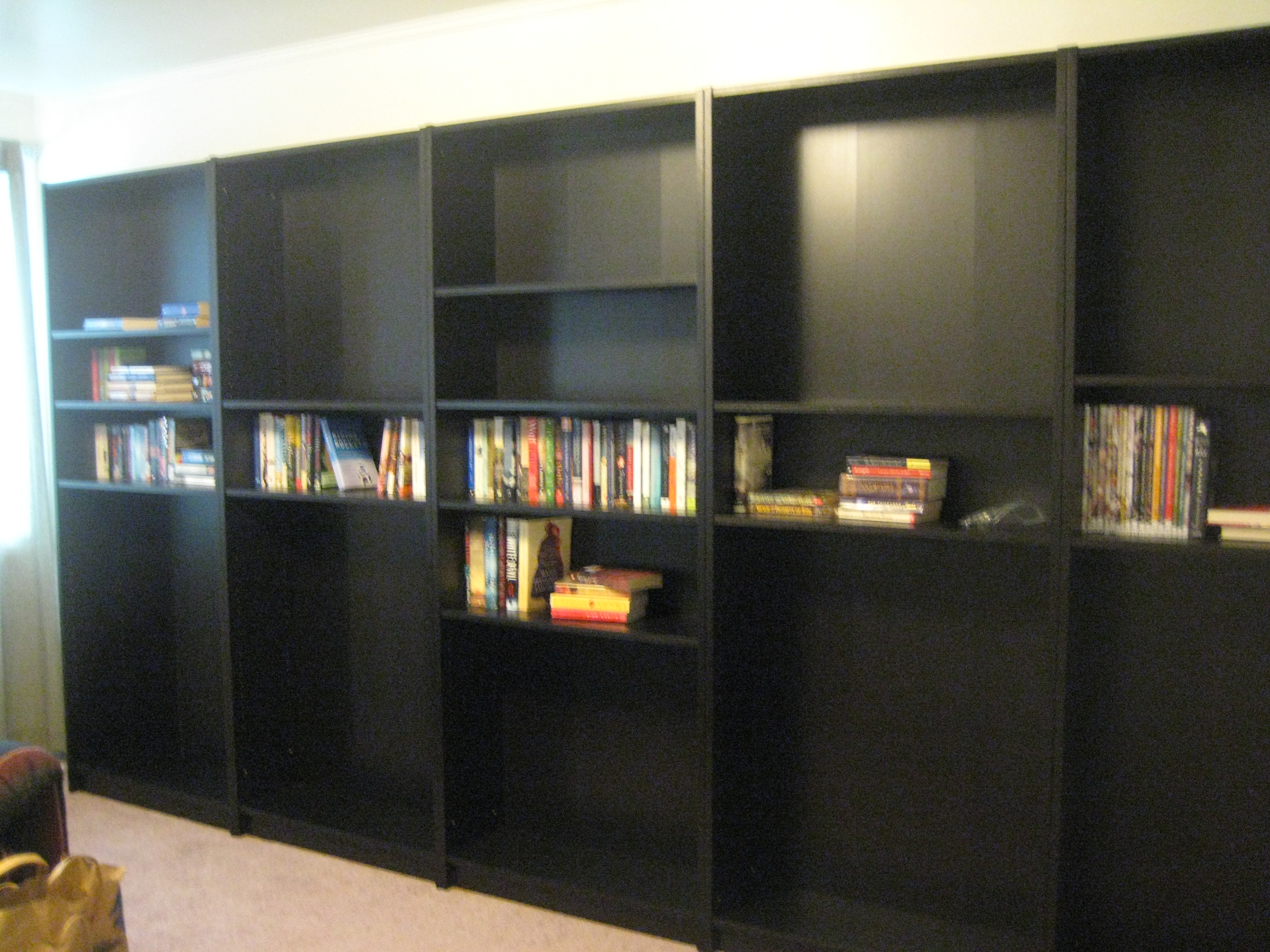
The glory of an empty wall.

And these?

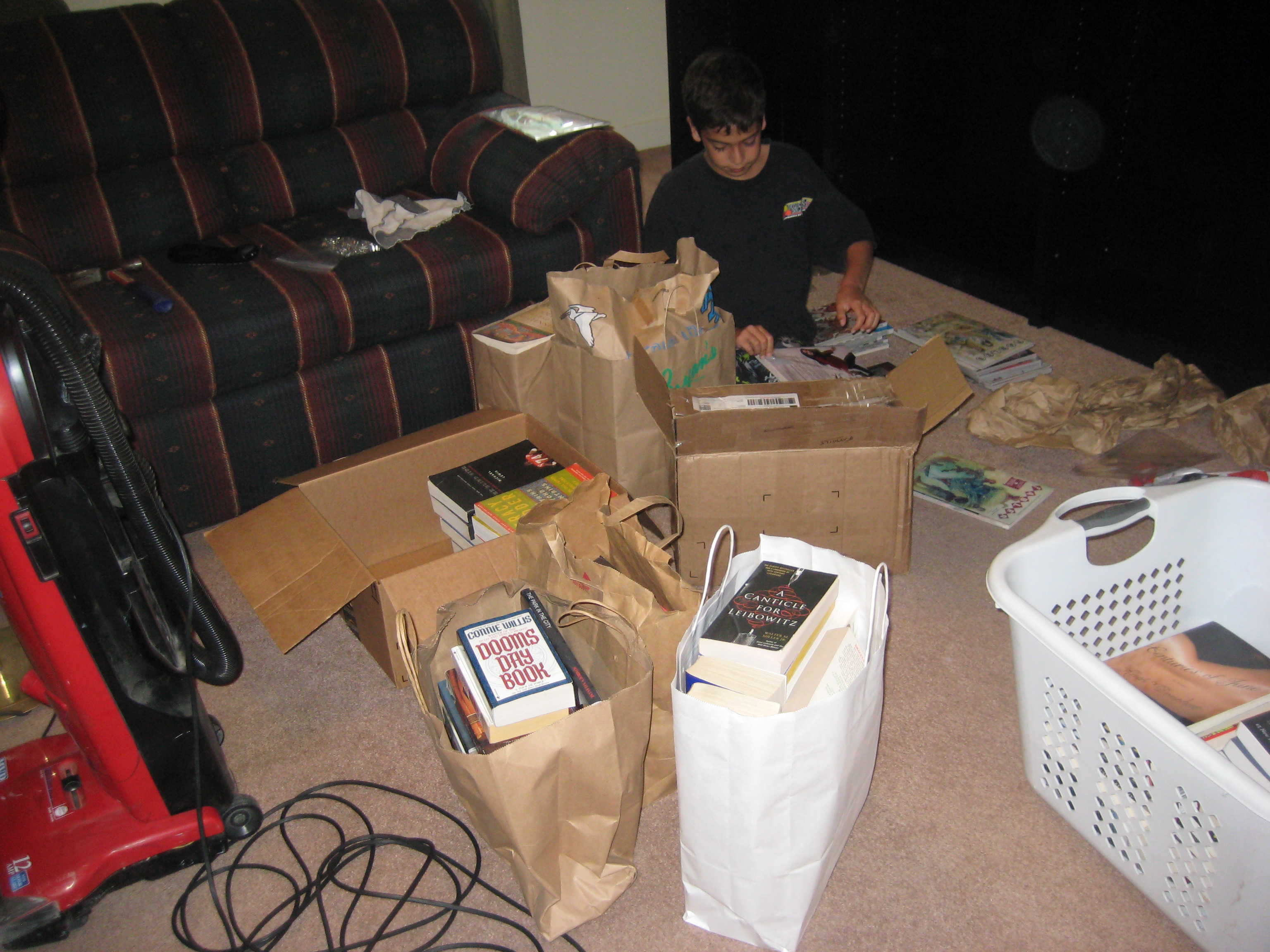
Lonely, shelfless books, left to fend for themselves in brown paper bags.

Wall, meet books. Books, meet wall. NEW BOOKSHELVES ARE IN THE HOUSE!

Our great and glorious bookshelf-building project commenced this weekend, and I’m so happy, I probably glow.

Here’s what’s happened so far:

An unimpressive pile of boxes? Think again. Treasure lurks within.

Step 1: The nice Ikea delivery people dropped off these skinny, unassuming cardboard boxes.

World’s best 10-year-old assembler of shelving units.

Step 2: With some skilled help, we begin sticking pegs into holes and other challenging carpentry tasks.

That’s one, one, one bookshelf up against the wall.

Step 3:  The first is done! Four more to go. Can we do it?

Going strong! Up to three!

Step 4: The master builder (aka, my husband) gets involved. We live in earthquake country, so no furniture installation is complete without wall brackets and other fun anti-falling-down measures.

FIVE! The magic number is FIVE!

Step 5: Built, mounted, dusted, and ready! Now all we need are some books. Where can we get some of those?

Where to start?

Oh, yeah, we’ve got books.

The first shelf.

An auspicious moment: placing the very first set of books on the very first shelf. I felt like saying a quick Shehechiyanu (it’s a Jewish thing). Pride of place went to my various graphic novel collections, which have been languishing in undignified piles for far too long. Love ya, Buffy! You too, Fables! Welcome home!

Shaking with excitement or exhaustion? Or just poor photography skills? Either way, it’s a glorious sight!

Et voila! I plan to spend the next several day sorting and shelving. What joy! And just in the nick of time, too. Tomorrow night is the Big Book Sale of the public library, and I can’t imagine that I’ll be coming home empty handed.

I HAVE SHELVES! I feel like a kid in a candy store. Time to go indulge!


Various & sundry stuff on an overcast Sunday morning (including a book review at no extra charge!)

The sky is gray, we received an overseas phone call at 6:45 am (really, people, learn about time zones!), and I’m a little too draggy to put on sweats and shoes and go for an invigorating walk by the sea, as is my wont most weekend mornings. So instead, I’m hiding away in my office nook/basement computer room, hoping that my family won’t complain too much if I ignore them temporarily while I write and muse about… whatever.

First up, I finished reading Stiff by Mary Roach! I stayed up until 12:30 last night (had I known about the upcoming 6:45 am wake-up call, I might more wisely have chosen to go to bed), and can proudly say that I know a lot more about cadavers than I did a few days ago. So herewith…

Book Review: Stiff by Mary Roach

Mary Roach is to science what Christopher Moore is to religious history. Both are knowledgeable writers with a deep understanding of their subject matter — yet they manage to make these subjects absolutely hilarious. (Granted, the comparison isn’t entirely apt, but any chance to make a Lamb reference works for me).

In Stiff, Roach investigates what happens to human bodies after death. She gives a comprehensive look at what happens to bodies donated to science, and devotes chapters to the use of cadavers in automotive testing, ballistics testing, and more. Further chapters cover the purported healing powers of mummy parts, the question of whether decapitated heads remain alive and aware for brief moments post-beheading, methods of preserving bodies (embalming and plastination), and covers the unsavory history of anatomists and body snatchers.

The author certainly does not shy away from disgusting details, and she’s there first-hand to tour a decomposition study as well as to witness the harvesting of organs for donation. Her research is thorough, and she clearly is not afraid to ask the questions ordinary people might wonder about but would feel undignified asking.

Mary Roach has a way with words that never fails to entertain, even while covering incredibly morbid  topics. And yet, it’s clear that she has the utmost respect for the scientists and researchers whose work she describes, as well as for the deceased and their families.

Her chapter on organ donation is especially lovely and inspiring, as was her description of the newer standards in medical school anatomy classes, in which students are encouraged and expected to show gratitude toward their cadavers and find ways to honor them, as in this passage describing a memorial service held by anatomy students at UCSF for their year’s cadavers:

One young woman’s tribute describes unwrapping her cadaver’s hands and being brought up short by the realization that the nails were painted pink. “The pictures in the anatomy atlas did not show nail polish,” she wrote. “Did you choose the color? Did you think that I would see it? I wanted to tell you about the inside of your hands. I want you to know you are always there when I see patients. When I palpate an abdomen, yours are the organs I imagine. When I listen to a heart, I recall holding your heart.”

I learned a lot from reading Stiff — on a subject that I never would have thought I’d want to explore. My only quibble is that perhaps it went on a bit too long. Sure, it was fascinating, and in Roach’s talented hands, quite entertaining as well. Still, by the end, I had definitely had enough and was ready to be done. I would recommend this book to anyone interested in a behind-the-scenes look at science, told from the perspective of someone just like us, someone who’s not a scientist but just wants to know what happens. Mary Roach has a way with words that’s funny, sarcastic, and hard to predict; read her work and you’ll find yourself laughing at things you just can’t believe you’d laugh at. I loved her more recent Packing for Mars, and I’m very glad to finally have gone back and read Stiff as well.

And furthermore:

My plans for today including continuing my incredibly satisfying project of building Ikea bookshelves and installing them in what is currently a spare room — I’m hoping the designation “library” will catch on. Let’s respect the books, people! I have high hopes for my new little reading nook, and even my kid is getting into the project. He’s quite handy with a hammer and screwdriver, and has been asking all morning if he can help put the shelves in. (My answer: Shelves, yes. Books, no. The placing of books on the shelves has taken on a practically religious significance for me, and I plan to meditate on careful placement for quite some time).

The Sunday book review section didn’t have all that much that grabbed me this week, although it did mention a new collection of stories in tribute to Ray Bradbury which sounds quite good. Margaret Atwood and Neil Gaiman have contributed stories, among other terrific writers, so methinks this will be a good one to pick up and read in small pieces.

Now that I’ve finished Stiff, and after reading Jaycee Dugard’s powerful memoir earlier this week, I’m ready to dive back into fiction! As usual, I have a stack of library books begging for some love and attention, and I can’t wait to dig in!

Finally, I’ll just add that my son and I are really enjoying Chomp by Carl Hiassen as a read-together bedtime story. I’d never read any of his kids books before, but based on our experiences with Chomp so far, we’ll be reading a lot more of his books in the future. Chomp is funny and exciting, with lots of elements to appeal to a 10-year-old boy (and his mom). I’ll be back with a review once we’re done.

Happy weekend! And for those who celebrate the Jewish new year, l’shanah tovah! May you have a sweet and healthy new year — filled with lots of great reading, I hope!

And a pretty image to end the day…

I came across this image during a recent Google search for something else, and fell in love:

The artist is Cyril Rolando, and you can see more of his work here.

Sweet dreams!