Book Review: The Impossible Lives of Greta Wells by Andrew Sean Greer

Book Review: The Impossible Lives of Greta Wells by Andrew Sean Greer

The Impossible Lives of Greta Wells

The impossible happens once to each of us.

From the very first line, author Andrew Sean Greer sets the stage for a magical, impossible, emotional journey as we follow one woman through three different lives in three very different times.

Who among us hasn’t at one time or another sighed, “I was born in the wrong era” or some similar sentiment?

In The Impossible Lives of Greta Wells, we meet a woman who gets a strange and miraculous chance to experience her life not just in her current world of the mid 1980s, but also in 1918 and 1941. After being treated for severe depression with electro-convulsive therapy, Greta slips into alternative versions of her life, where the familiar and the strange collide. It’s not time travel, but rather a shift in reality, a journey to an alternate universe in which Greta and the people in her life are the same people, but facing very different choices and circumstances.

Greta is a twin, and her brother Felix is the center of her universe. It is Felix’s death in 1985 during the “plague years” of the AIDS epidemic that pushes Greta first into depression and then on her impossible journey into two other versions of herself. In 1985, Greta’s long-term lover Nathan has just left her after she pushed him away during Felix’s illness. In 1918, Greta is a young wife to Nathan, an army doctor away in the trenches of WWI, but she faces her own set of disappointments and fears. And in 1941, with America on the brink of war, Greta and Nathan are married with a child, but Greta has suffered the loss of her beloved aunt Ruth and is beset by worries over Felix’s own unhappiness.

As Greta moves between lives, she leaves a footprint. She becomes convinced that her purpose is to perfect the alternate lives she inhabits — but she’s not the only one. 1918 Greta and 1941 Greta are on this journey as well, so that “our” Greta finds her own world changed by the imprints left by the others as they circle through one another’s lives.

Confused yet? It is a lot to track, and at times (many times) I found myself flipping back to double-check just which version of Greta’s life I was in now, and just where we’d left off that time around.

It’s fascinating to visit New York of 1918 and 1941, to see the roles available to women — housewives, mothers, lovers — and how those changed over time. Equally fascinating, and quite touching as well, is the view into life for a gay man in those times. In 1985, Greta is destroyed by Felix’s loss . She finds him alive and well in 1918 and 1941, but living lives defined by hiding, pretending, and sublimating. Part of Greta’s quest is to help Felix be happy in the worlds left to him; in his “real” life, Felix was an exuberantly joyful man, and although he (like so many others) died too soon, he was able to live his brief life to the fullest, surrounded by friends and loved by a good man. As 1985 Greta meets Felix again and again, she pushes him to find a way to live in his world and at the same time to seek love and truth in whatever way he can.

The writing in The Impossible Lives of Greta Wells is lyrical and lovely, full of moments of quiet emotion and heart-breaking truths. In Greta’s first visit to 1918, she is literally stopped in her tracks by seeing a familiar young man on the street — a man who in her own world of 1985 was but one of the many young men struck down by AIDS:

Laughing again, turning, looking around at me: familiar young men appearing in this unfamiliar world. Men who had died months or years before from the plague miraculously revived! There, in an army uniform, was the boy who made jewelry from papier-mâché beads; he died in the spring. And that one soldier, the stark blond Swede jumping from the streetcar, once sold magazines; he’d died two years before, one of the first: the cave’s canary. Who know how many more were off to war? Alive, each one, alive and more than alive — shouting, laughing, running down the street!

Of course, in the joy of seeing these young men alive once more, Greta is overlooking the fact that other perils await. There’s a war on, and although armistice is around the corner, some of these bright young men, “miraculously revived”, will not make it through the war. It was interesting to see the parallels drawn by the author between the great calamities each age: In 1918 and 1941, it was world war that took the lives of so many as such a young age; in 1985, it was the AIDS plague that seemed to wipe out a generation, so that by the time Greta attends the most recent in a string of funerals, there’s almost no one left to be mourners, all of the deceased’s friends having been taken already.

I couldn’t stop reading, once I’d started, and I probably made a mistake in gobbling it up quite so fast. The Impossible Lives of Greta Wells has an engrossing plot, but in my rush to see what happens next, I didn’t take as much time as I should have to savor the rich characters and the extraordinary use of language. This is not a long book, but it felt jam-packed — with the jumps through time, with vivid period details, with sights and smells that take you immediately into the worlds of 1918, 1941, and 1985 — so that by the time I reached the end, I felt like I’d experienced something much more than 289 pages of a fictional tale.

The simplest way for me to sum up? I was swept away by the magical possibilities of living three versions of a life, and was enchanted by Greta’s journey. Filled with fully-realized characters and given life by a unique premise, The Impossible Lives of Greta Wells is a reading experience to enjoy in the moment, and then to ponder for hours afterward.

__________________________________________

The details:

Title: The Impossible Lives of Greta Wells
Author: Andrew Sean Greer
Publisher: HarperCollins
Publication date: 2013
Genre: Adult Fiction
Source: Purchased

Quote: Openly Straight by Bill Konigsberg

We were dancers and drummers and standers and jugglers, and there was nothing anyone needed to accept or tolerate. We celebrated.

How I Live Now: Movie Trailer!

Last year, I wrote a Flashback Friday post about How I Live Now by Meg Rosoff, one of my all-time favorite books. And now, looky here! The movie trailer is out… and it looks amazing!

Have you read the book? Are you excited about the movie?

Book Review: Openly Straight by Bill Konigsberg

Book Review: Openly Straight by Bill Konigsberg

Openly StraightThe main thing I want to say about Openly Straight is that I loved it. But that’s not a very helpful book review, is it?

Okay, I’ll get more specific. What’s it about and why did I love it?

Openly Straight is the story of Seamus Rafael Goldberg (but call him Rafe, unless you’re his best friend Claire Olivia, in which case “Shay Shay” is acceptable). Rafe is going into his junior year of high school and is frankly quite tired of being the gay kid. Not that he’s ashamed or wishes he was other than he is. It’s just that Rafe has grown up in Boulder, Colorado with parents who are totally loving free spirits — parents who threw him a party when he came out in 8th grade, complete with party hats that said “Yay! Rafe is Gay!” on them (I kid you not). Rafe’s mom is the president of Boulder’s PFLAG chapter, and Rafe regularly speaks at local schools about being gay, answering kids’ questions and in general being the face of “gayness”. To the extent that when the civil rights movement was discussed in history class, Rafe was asked for the “gay perspective”, and random girls at school approach Rafe to get “gay” input on current events.

Finally, Rafe decides to change his life and enrolls at the Natick School, an all-boys boarding school in Massachusetts. Tiny detail he neglects to share with his parents: At Natick, he intends to not be gay. That is, he’ll still know he’s gay, but he’s not going to tell anyone. He’s tired of being seen first and foremost as gay, rather than just as Rafe, and he’s determined to start fresh with a new school and see what it’s like to just be one of the guys.

And at first, it’s kind of brilliant. He gets invited to play football! He’s accepted by the jocks! Guys include him in their guy-talk, and he’s seen as that cool new kid from Colorado. But as Rafe forms one particularly close friendship with a truly wonderful boy, the downside of his plan becomes apparent. Can he form a real friendship — and maybe more — when he’s hiding such a key piece of himself from the world? When does not telling — a passive act of omission — turn into actively lying?

It’s quite the dilemma. When Rafe finally tells his parents and Claire Olivia what he’s doing, they’re appalled and question him about going back in the closet. Rafe states that he’s not back in the closet; he knows who he is, but he chooses to keep it private — but is he just fooling himself? On the one hand, it’s easy to see the appeal for Rafe. Finally, he’s able to make friends and go through school without labels. He’s just the new kid, a decent soccer player, pretty fun to hang around, but not especially different than the rest of the gang. Rafe is careful to keep his head down. Despite his interest in writing, he declines to join the literary magazine for fear of drawing the jocks’ attention to his non-jock-like interests. And yet, as the school year progresses, Rafe comes up against more and more situations that make him uncomfortable, and the lies start piling up.

There’s a love story at the heart of Openly Straight, and it’s beautifully told, from the first moments when the eye contact lasts longer than Rafe expects, through the soul-baring late night conversations between two friends. Rafe’s love interest is a straight (until now) boy who has a heart of gold, and eventually it’s clear to both of them that their friendship has moved beyond brotherhood into some new and unknown territory.  Except, of course, it’s not really unknown to Rafe, and because he started off school “openly straight”, the other boy believes that they’re exploring something new together while Rafe knows that for him, it’s not just exploration — it’s something he’s sure of. Heartbreak is inevitable, and boy, when it comes, it’s devastating.

Rafe is a smart, wonderful, lovable main character. Through his first-person narration, we can easily understand why he makes the choices that he makes, even as we wonder whether those choices will come back to bite him. (Obviously, they do). What’s wonderful about Openly Straight is that Rafe really struggles to do right. He doesn’t want to deceive, and he refuses to feel shame. But he can’t avoid the question — and neither can we as readers — whether anything he does and any connections he makes are actually real if he’s only sharing a part of who he is.

There aren’t any easy answers for Rafe. The deeper he gets, the more he realizes that he’s trapped himself in a situation that can only go badly. No matter how much he wants to fix things, some hurts and deceptions leave permanent marks. Does Rafe learn from his choices and his mistakes? Absolutely. But there are still consequences, and I suppose part of growing up is learning that good intentions don’t necessarily override damage done.

Openly Straight makes some great points without ever feeling heavy-handed, as when a boy in English class claims that Natick is a “tolerant” place, and the teacher questions the intention of the words “tolerate” and “accept”:

I thought about that. It reminded me of the excerpt from Edmund White’s A Boy’s Own Story that Mr. Scarborough had assigned us. White had talked about the strange sort of tolerance his roommates had had for him back at his boarding school in the 1950s. I remembered underlining the word tolerance. I mean, if you accept something, you take it for what it is. Tolerance is different. Less. So is acceptance at the top of the pyramid? Is that what everyone wants in the best of all possible worlds? Acceptance? I rolled the idea around in my head. It didn’t feel right, somehow.

For Rafe, part of his growth in the story is coming to the realization that acceptance isn’t enough; it’s being welcomed and celebrated for yourself — all parts of who you are and what makes you you — that really is the goal. And while he’s been comfortable being out for years, Rafe has to wonder whether he’s been accepting who he is all along without fully celebrating his own self. By the book’s end, Rafe is taking definite strides toward a new way of being open and being who he is — with less worry about how others see him, and a new commitment to interacting with the world while showing his real self.

Openly Straight is a lovely, funny, sweet book that moves along quickly yet gives its characters room to breathe and live. I felt like I really knew Rafe (and I often wanted to hug him and tell that everything would work out). With relatable characters and a unique premise, this book challenges the reader in very interesting ways. Many books in the YA market today tell a version of the coming-out tale; what makes this book so special is that it deals with life after coming out. Rafe’s journey is relevant to anyone, gay or straight, who’s had to deal with fitting in, wondering how others see them, and figuring out just how they want to be seen.

__________________________________________

The details:

Title: Openly Straight
Author: Bill Konigsberg
Publisher: Arthur A. Levine Books
Publication date: June 2013
Genre: Young Adult
Source: Well, it’s kind of a funny story. I was approved to read a review copy of this book, but was unable to access it. (Thank you anyway to NetGalley and the publisher!). In the end, I borrowed this book from the library. So it goes. And given how much I loved the book, I’m sure I’ll end up buying it one of these days!

Flashback Friday: Brideshead Revisited

Flashback Friday is my own little weekly tradition, in which I pick a book from my reading past to highlight — and you’re invited to join in!

Here are the Flashback Friday book selection guidelines:

  1. Has to be something you’ve read yourself
  2. Has to still be available, preferably still in print
  3. Must have been originally published 5 or more years ago

Other than that, the sky’s the limit! Join me, please, and let us all know: what are the books you’ve read that you always rave about? What books from your past do you wish EVERYONE would read? Pick something from five years ago, or go all the way back to the Canterbury Tales if you want. It’s Flashback Friday time!

My pick for this week’s Flashback Friday:

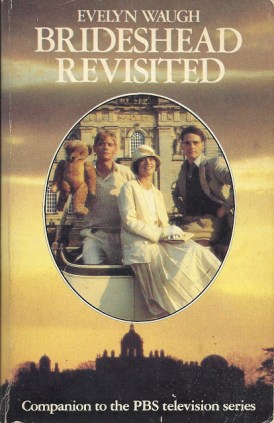
Brideshead Revisited by Evelyn Waugh

(first published 1945)

From Goodreads:

The most nostalgic and reflective of Evelyn Waugh’s novels, Brideshead Revisited looks back to the golden age before the Second World War. It tells the story of Charles Ryder’s infatuation with the Marchmains and the rapidly-disappearing world of privilege they inhabit. Enchanted first by Sebastian at Oxford, then by his doomed Catholic family, in particular his remote sister, Julia, Charles comes finally to recognize only his spiritual and social distance from them.

And also:

Evelyn Waugh’s most celebrated work is a memory drama about the intense entanglement of the narrator, Charles Ryder, with a great Anglo-Catholic family. Written during World War II, the story mourns the passing of the aristocratic world Waugh knew in his youth and vividly recalls the sensuous pleasures denied him by wartime austerities; in so doing it also provides a profound study of the conflict between the demands of religion and the desires of the flesh.

At once romantic, sensuous, comic, and somber, Brideshead Revisited transcends Waugh’s familiar satiric exploration of his cast of lords and ladies, Catholics and eccentrics, artists and misfits, revealing him to be an elegiac, lyrical novelist of the utmost feeling and lucidity.

Brideshead Revisited is an elegantly written look into the life of a grand family (think Downtown Abbey’s Crawleys, but ardently Catholic). Charles is our every-man, the outsider who finds a way into the aristocratic home of the Marchmains by way of his friendship with their wayward son Sebastian.

With ruminations on the social class system of England between the world wars, the impact of religion and faith, and the conflict between romantic love and family obligation, Brideshead Revisited is at once a sweeping period piece and a morality tale. By viewing this world through Charles’s eyes, we get to see the life of the Marchmains as something strange and new — and yet it’s clear just how very much Charles wants to be a part of that world, through brotherhood, friendship, and romantic love.

Ultimately, it’s the religious convictions of the family that determine the fate of the romantic entanglements in Brideshead Revisited, and while some readers express frustrations over the decidedly non-romantic outcomes, the motives and thought processes of the characters are part of what makes this novel so fascinating. As a character study and as a portrait of a time gone by, Brideshead Revisited is a rich, rewarding read, and is still as relevant today as it was when written.

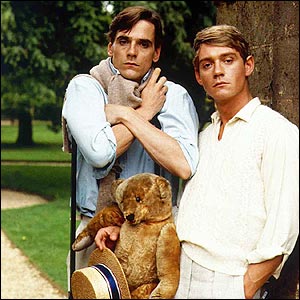
Keeping with my trend of providing movie tie-ins for recent Flashback Friday posts, I will point out that there have been several radio and TV productions of Brideshead Revisited, perhaps most memorably the 1981 TV mini-series starring Jeremy Irons. A word of explanation regarding the picture: Sebastian, the dissolute son of the Marchmains, was notorious at Oxford for his odd habits, among them the constant carrying of a teddy bear named Aloysius. Adorable, right?

Note from your friendly Bookshelf Fantasies host: To join the Flashback Friday fun, write a blog post about a book you love (please mention Bookshelf Fantasies as the Flashback Friday host!) and share your link below. Don’t have a blog post to share? Then share your favorite oldie-but-goodie in the comments section. Jump in!

♥♥♥♥♥♥♥♥

Do you host a blog hop or book blog meme? Do you participate in a meme that you really, really love? I’m building a Book Blog Meme Directory, and need your help! If you know of a great meme to include — or if you host one yourself — please drop me a note on my Contact page and I’ll be sure to add your info!

Outlander casting news: Here’s Frank!

The dual role of Frank Randall/Black Jack Randall has been cast! And it’s a great choice: Tobias Menzies (Rome, Game of Thrones) will be playing this key part in the upcoming Starz series.

Thursday Quotables: When You Were Here / Openly Straight

cooltext1045178755

Welcome back to Thursday Quotables! This weekly feature is the place to highlight a great quote, line, or passage discovered during your reading each week.  Whether it’s something funny, startling, gut-wrenching, or just really beautifully written, Thursday Quotables is where my favorite lines of the week will be, and you’re invited to join in!

If you’d like to participate, it’s really simple:

  • Follow Bookshelf Fantasies, if you please!
  • Write a Thursday Quotables post on your blog. Try to pick something from whatever you’re reading now.
  • Link up via the linky below (look for the cute froggy face).
  • Make sure to include a link back to Bookshelf Fantasies in your post (http://www.bookshelffantasies.com).
  • Have fun!

This week, I’m featuring two different passages from two different books — one that made my heart ache, and one that put a smile on my face.

Thursday Quotable #1:

My body is filled with complete emptiness and complete longing at the same time, only there’s not enough space in me for both, so they fight and argue and run masking tape down my middle to divide me.

Source:  When You Were Here
Author: Daisy Whitney
Little, Brown and Company, 2013

Thursday Quotable #2:

If it were up to my dad, my entire life would be on video.

Anything I do, he grabs his phone. “Opal,” he’ll yell to my mother, “Rafe is eating corn flakes. We gotta get this on film.”

Source:  Openly Straight
Author: Bill Konigsberg
Arthur A. Levine Books, 2013

What lines made you laugh, cry, or gasp this week? Do tell!

Link up, or share your quote of the week in the comments.

Wishlist Wednesday

Welcome to Wishlist Wednesday!

The concept is to post about one book from our wish lists that we can’t wait to read. Want to play? Here’s how:

  • Follow Pen to Paper as host of the meme.
  • Do a post about one book from your wishlist and why you want to read it.
  • Add your blog to the linky at the bottom of the post at Pen to Paper.
  • Put a link back to Pen to Paper somewhere in your post.
  • Visit the other blogs and enjoy!

My wishlist book this week is:

Hollow Earth

Hollow Earth by John Barrowman & Carole E. Barrowman

From Goodreads:

Imagination matters most in a world where art can keep monsters trapped—or set them free.

Lots of twins have a special connection, but twelve-year-old Matt and Emily Calder can do way more than finish each other’s sentences. Together, they are able to bring art to life and enter paintings at will. Their extraordinary abilities are highly sought after, particularly by a secret group who want to access the terrors called Hollow Earth. All the demons, devils, and evil creatures ever imagined are trapped for eternity in the world of Hollow Earth—trapped unless special powers release them.

The twins flee from London to a remote island off the west coast of Scotland in hopes of escaping their pursuers and gaining the protection of their grandfather, who has powers of his own. But the villains will stop at nothing to find Hollow Earth and harness the powers within. With so much at stake, nowhere is safe—and survival might be a fantasy.

Why do I want to read this?

Reason #1:

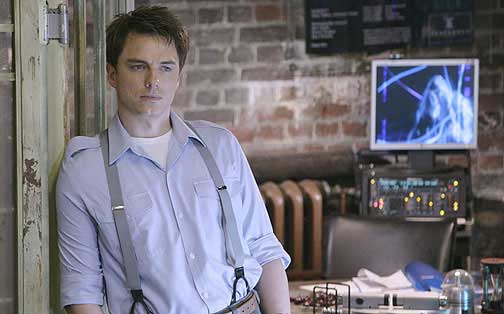
Excuse me for getting all fangirl-y… but it’s written by CAPTAIN JACK HARKNESS! John Barrowman can, apparently, do everything. He sings, he dances, he hunts aliens, and now (in partnership with his sister) he writes children’s books! This man is just golden (and so, so pretty in his captain’s coat. See below if you don’t believe me).

Fangirlishness aside, I really do want to read Hollow Earth! It sounds like a promising, exciting start to a middle grade adventure (the sequel, Bone Quill, has just been released as well). I love the concept of the twins being able to enter paintings, and wonder what the connection to Hollow Earth and the trapped terrors will be. Add to that the Scottish setting, and I think it sounds pretty terrific!

I’ve just ordered myself a copy of both books, and plan to dive in as soon as my reading schedule eases up a bit. (Ha! Like that ever happens… ) Meanwhile, I’ll amuse myself with more pictures of Captain Jack, in all his Torchwood/Doctor Who glory:

What’s on your wishlist this week?

So what are you doing on Thursdays and Fridays? Come join me for my regular weekly features, Thursday Quotables and Flashback Friday! You can find out more here — come share the book love!

Book Review: When You Were Here by Daisy Whitney

Book Review: When You Were Here by Daisy Whitney

When You Were HereThe death of a parent hits hard in this moving young adult novel by Daisy Whitney. Danny Kellerman, high school senior and class valedictorian, watched his mother slip away from him after a five-year battle with cancer. Despite telling Danny that she was holding on for his graduation, she passed away two months before the big event, and Danny has been walking through life in a fog ever since. He’s financially well-provided for, but that’s about the only thing going right for him. Danny’s father died in a sudden accident years earlier, and his older sister Laini walked away from the family soon after that. Even the love of Danny’s life, girl-next-door Holland who promised to love him forever, dumped him abruptly a month after she started college. Danny’s only source of comfort is his loyal dog Sandy Koufax, but it’s not enough. After blowing up on stage at graduation, smashing a car, and watching his friends celebrate life while he views it all from a haze of numbness, Danny knows something has to give. When he receives a letter from the caretaker of his family’s Tokyo apartment, hinting at a secret life his mother lived during trips to Japan for medical treatments, Danny decides that a summer in Tokyo might be just what he needs to get himself back on track and figure out what he has left.

Secrets abound in Tokyo. Why did everyone who encountered his mom remember her as being so happy? What did the mysterious doctor prescribe for her that gave her so much hope? And why, once he arrives in Tokyo, does Danny keep uncovering bits and pieces of his mom’s life there that make no sense to him?

As Danny explains to Kana, the girl who seems to have insight into his mother’s time in Japan:

“And I guess, most of all, I want to understand why nothing’s working for me. Why she was the happy one when she was dying, and I just can’t seem to manage anything when I’m living.”

When You Were Here is less about death and dying than about life and living. I found it very sad to read about Danny’s pain and loneliness — and yet I was also filled with admiration for this boy who held his home together while the most important person in his life was suffering. Danny makes no pretense about his love for his mother, and yes, the circumstances are extraordinary (how many teen-aged boys take their mothers to chemo treatments and clean up when they’re sick?), but it’s still quite touching to read his unembarrassed statements about her role in his life.

Likewise, Danny’s love for Holland is strong and true , despite the pain he experiences over what he sees as her desertion. Again, he is refreshingly honest about his feelings when it comes to Holland, and that’s a nice treat in a book about a boy of that age.

I did feel that the book veered a bit close to preachiness in parts, as Danny comes to certain realizations about his mother. The takeaway message that gets hammered home is that what counts is how you live your life, not how long you live, and that we need to find happiness in our small moments rather than focus on sorrow. That’s valid, but at times it did feel a bit heavy-handed.

That’s a minor quibble, however. Ultimately, by digging into his mother’s secrets, Danny is able to reconnect with feeling — feeling anything, both joy and sadness — rather than walking through life numb and alone. As Danny opens himself back up to emotions, he makes important discoveries about his mother, his sister, Holland, and himself, and finds a path forward past mourning and into a new future for himself.

When You Were Here is not a long book, but it is lovingly written and full of honesty and depth. Danny is a smart, likeable character, and it’s hard not to ache for him as we read about how much he’s already had to go through at such a young age. When You Were Here presents a portrait of a teen in a unique situation, and shows the power of love in all its varieties and shades to heal unfathomable hurts and to forge connections that might seem impossible. Don’t miss it.

__________________________________________

The details:

Title: When You Were Here
Author: Daisy Whitney
Publisher: Little, Brown and Company
Publication date: June 2013
Genre: Young Adult
Source: Won in a giveaway! (with thanks to The Perpetual Page-Turner)

Top Ten Tuesday: Top Ten Books I Wish Had Sequels (so I could stay in those worlds just a little bit longer…)

Public domain image from www.public-domain-image.comTop Ten Tuesday is a meme hosted by The Broke and the Bookish, featuring a different top 10 theme each week.

This week’s theme is Top Ten Books I Wish Could Have Had Sequels. According to the description, the point here is to identify books or series that are complete (i.e., not open-ended or on-going) — but where you want more anyway! That sounds easy to me. How many times have I finished a book or series with tears — not because of the actual plot developments, but because I just didn’t want to leave that world? Here are my top 10 choices for fictional worlds I want to live in forever:

I never did get my acceptance letter…

1) Harry Potter: Well, obviously! J. K. Rowling may think she’s written all she needs to about Harry and friends, but I beg to disagree! I’d read about Harry and the gang any time, any place. They can be grown-up, middle-aged, and dealing with their mortgages — I don’t care. Take me back to Hogwarts, please! Don’t abandon me to the Muggle world just yet…

2) Lord of the Rings: I guess it’s clear that I belong in a fantasy world. I know there’s a lot of additional material available regarding Middle Earth, but I want more of THIS story. Tell me what Aragorn did once he was king! How did Frodo make out after he sailed away? I love the characters in LOTR so much, and I want to know what happened with the rest of their lives, even if they mostly sat around singing songs and smoking their pipes!

3) The Sparrow and Children of God by Mary Doria Russell: Children of God is the sequel to The Sparrow, and the story is certainly complete after the second book. Still, I’d like to know what happened to the children and descendants of the main characters, and how society developed back on the planet of Rakhat after all these events took place.

4) All Men of Genius by Lev AC Rosen: Here’s a book that just cries out for a sequel… and I believe the author still hopes to write one. The world of All Men of Genius is original and engaging and just SO MUCH FUN. Please, please, please do more!

5) The Blue Sword by Robin McKinley: I believe that the author has said that she’s written all that she intends to in this world — the kingdom of Damar — but I’d love to see another adventure involving the unforgettable Harry Crewe and King Corlath.

6) The Time Traveler’s Wife by Audrey Niffenegger: Again, this story had a very definitive ending, as it should have. And yet… I’d love to see TTW: The Next Generation. After all, there’s still Alba. What was her life like? How did she manage her gift? How was her experience impacted by the scientific discoveries brought about by Henry and his research? I’d really love to know.

7) His Dark Materials by Philip Pullman: Just rip out my heart and leaving me hanging, why don’t you? I need more Lyra, I need more Will, I need to know that they find a way to see each other again!

8) Codex Alera by Jim Butcher: The series had a great ending — but I would have happily continued reading about Tavi, Kitai, and their realm.

9) Gone With The Wind by Margaret Mitchell: Yes, I do know that there was an officially sanctioned sequel (Scarlett by Alexandra Ripley) — but it wasn’t written by Margaret Mitchell, so for me, it doesn’t count. I actually disliked Scarlett very, very much, and unless it came from the pen of Margaret Mitchell, I refuse to believe that that’s how Scarlett’s story was supposed to go. So there!

10) Twilight series by Stephenie Meyer: Because I want to know whether spending eternity with your stalker the guy you fell for in your teens — with everything about him always staying exactly, exactly the same — is really that great a life. And just how many times can you sit through high school?

I’m sure there are plenty of book worlds that I’d love to go back to. Which obvious ones did I miss? What books do you think would be even more perfect with a sequel or two? And seriously, can someone please convince JKR to write another HP book or seven?

If you enjoyed this post, please consider following Bookshelf Fantasies! And don’t forget to check out our regular weekly features, Thursday Quotables and Flashback Friday. Happy reading!

♥♥♥♥♥♥♥♥

Do you host a blog hop or book blog meme? Do you participate in a meme that you really, really love? I’m building a Book Blog Meme Directory, and need your help! If you know of a great meme to include — or if you host one yourself — please drop me a note on my Contact page and I’ll be sure to add your info!