Wishlist Wednesday

Welcome to Wishlist Wednesday!

The concept is to post about one book from our wish lists that we can’t wait to read. Want to play? Here’s how:

  • Follow Pen to Paper as host of the meme.
  • Do a post about one book from your wishlist and why you want to read it.
  • Add your blog to the linky at the bottom of the post at Pen to Paper.
  • Put a link back to Pen to Paper somewhere in your post.
  • Visit the other blogs and enjoy!

My wishlist book this week is:

Hollow Earth

Hollow Earth by John Barrowman & Carole E. Barrowman

From Goodreads:

Imagination matters most in a world where art can keep monsters trapped—or set them free.

Lots of twins have a special connection, but twelve-year-old Matt and Emily Calder can do way more than finish each other’s sentences. Together, they are able to bring art to life and enter paintings at will. Their extraordinary abilities are highly sought after, particularly by a secret group who want to access the terrors called Hollow Earth. All the demons, devils, and evil creatures ever imagined are trapped for eternity in the world of Hollow Earth—trapped unless special powers release them.

The twins flee from London to a remote island off the west coast of Scotland in hopes of escaping their pursuers and gaining the protection of their grandfather, who has powers of his own. But the villains will stop at nothing to find Hollow Earth and harness the powers within. With so much at stake, nowhere is safe—and survival might be a fantasy.

Why do I want to read this?

Reason #1:

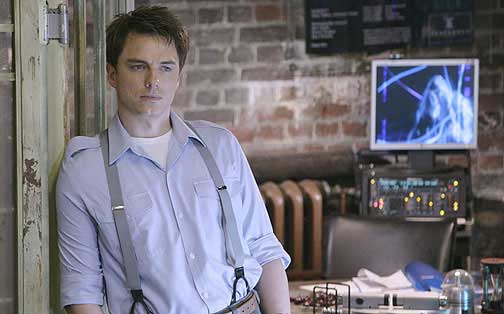
Excuse me for getting all fangirl-y… but it’s written by CAPTAIN JACK HARKNESS! John Barrowman can, apparently, do everything. He sings, he dances, he hunts aliens, and now (in partnership with his sister) he writes children’s books! This man is just golden (and so, so pretty in his captain’s coat. See below if you don’t believe me).

Fangirlishness aside, I really do want to read Hollow Earth! It sounds like a promising, exciting start to a middle grade adventure (the sequel, Bone Quill, has just been released as well). I love the concept of the twins being able to enter paintings, and wonder what the connection to Hollow Earth and the trapped terrors will be. Add to that the Scottish setting, and I think it sounds pretty terrific!

I’ve just ordered myself a copy of both books, and plan to dive in as soon as my reading schedule eases up a bit. (Ha! Like that ever happens… ) Meanwhile, I’ll amuse myself with more pictures of Captain Jack, in all his Torchwood/Doctor Who glory:

What’s on your wishlist this week?

So what are you doing on Thursdays and Fridays? Come join me for my regular weekly features, Thursday Quotables and Flashback Friday! You can find out more here — come share the book love!

Book Review: When You Were Here by Daisy Whitney

Book Review: When You Were Here by Daisy Whitney

When You Were HereThe death of a parent hits hard in this moving young adult novel by Daisy Whitney. Danny Kellerman, high school senior and class valedictorian, watched his mother slip away from him after a five-year battle with cancer. Despite telling Danny that she was holding on for his graduation, she passed away two months before the big event, and Danny has been walking through life in a fog ever since. He’s financially well-provided for, but that’s about the only thing going right for him. Danny’s father died in a sudden accident years earlier, and his older sister Laini walked away from the family soon after that. Even the love of Danny’s life, girl-next-door Holland who promised to love him forever, dumped him abruptly a month after she started college. Danny’s only source of comfort is his loyal dog Sandy Koufax, but it’s not enough. After blowing up on stage at graduation, smashing a car, and watching his friends celebrate life while he views it all from a haze of numbness, Danny knows something has to give. When he receives a letter from the caretaker of his family’s Tokyo apartment, hinting at a secret life his mother lived during trips to Japan for medical treatments, Danny decides that a summer in Tokyo might be just what he needs to get himself back on track and figure out what he has left.

Secrets abound in Tokyo. Why did everyone who encountered his mom remember her as being so happy? What did the mysterious doctor prescribe for her that gave her so much hope? And why, once he arrives in Tokyo, does Danny keep uncovering bits and pieces of his mom’s life there that make no sense to him?

As Danny explains to Kana, the girl who seems to have insight into his mother’s time in Japan:

“And I guess, most of all, I want to understand why nothing’s working for me. Why she was the happy one when she was dying, and I just can’t seem to manage anything when I’m living.”

When You Were Here is less about death and dying than about life and living. I found it very sad to read about Danny’s pain and loneliness — and yet I was also filled with admiration for this boy who held his home together while the most important person in his life was suffering. Danny makes no pretense about his love for his mother, and yes, the circumstances are extraordinary (how many teen-aged boys take their mothers to chemo treatments and clean up when they’re sick?), but it’s still quite touching to read his unembarrassed statements about her role in his life.

Likewise, Danny’s love for Holland is strong and true , despite the pain he experiences over what he sees as her desertion. Again, he is refreshingly honest about his feelings when it comes to Holland, and that’s a nice treat in a book about a boy of that age.

I did feel that the book veered a bit close to preachiness in parts, as Danny comes to certain realizations about his mother. The takeaway message that gets hammered home is that what counts is how you live your life, not how long you live, and that we need to find happiness in our small moments rather than focus on sorrow. That’s valid, but at times it did feel a bit heavy-handed.

That’s a minor quibble, however. Ultimately, by digging into his mother’s secrets, Danny is able to reconnect with feeling — feeling anything, both joy and sadness — rather than walking through life numb and alone. As Danny opens himself back up to emotions, he makes important discoveries about his mother, his sister, Holland, and himself, and finds a path forward past mourning and into a new future for himself.

When You Were Here is not a long book, but it is lovingly written and full of honesty and depth. Danny is a smart, likeable character, and it’s hard not to ache for him as we read about how much he’s already had to go through at such a young age. When You Were Here presents a portrait of a teen in a unique situation, and shows the power of love in all its varieties and shades to heal unfathomable hurts and to forge connections that might seem impossible. Don’t miss it.

__________________________________________

The details:

Title: When You Were Here
Author: Daisy Whitney
Publisher: Little, Brown and Company
Publication date: June 2013
Genre: Young Adult
Source: Won in a giveaway! (with thanks to The Perpetual Page-Turner)

Top Ten Tuesday: Top Ten Books I Wish Had Sequels (so I could stay in those worlds just a little bit longer…)

Public domain image from www.public-domain-image.comTop Ten Tuesday is a meme hosted by The Broke and the Bookish, featuring a different top 10 theme each week.

This week’s theme is Top Ten Books I Wish Could Have Had Sequels. According to the description, the point here is to identify books or series that are complete (i.e., not open-ended or on-going) — but where you want more anyway! That sounds easy to me. How many times have I finished a book or series with tears — not because of the actual plot developments, but because I just didn’t want to leave that world? Here are my top 10 choices for fictional worlds I want to live in forever:

I never did get my acceptance letter…

1) Harry Potter: Well, obviously! J. K. Rowling may think she’s written all she needs to about Harry and friends, but I beg to disagree! I’d read about Harry and the gang any time, any place. They can be grown-up, middle-aged, and dealing with their mortgages — I don’t care. Take me back to Hogwarts, please! Don’t abandon me to the Muggle world just yet…

2) Lord of the Rings: I guess it’s clear that I belong in a fantasy world. I know there’s a lot of additional material available regarding Middle Earth, but I want more of THIS story. Tell me what Aragorn did once he was king! How did Frodo make out after he sailed away? I love the characters in LOTR so much, and I want to know what happened with the rest of their lives, even if they mostly sat around singing songs and smoking their pipes!

3) The Sparrow and Children of God by Mary Doria Russell: Children of God is the sequel to The Sparrow, and the story is certainly complete after the second book. Still, I’d like to know what happened to the children and descendants of the main characters, and how society developed back on the planet of Rakhat after all these events took place.

4) All Men of Genius by Lev AC Rosen: Here’s a book that just cries out for a sequel… and I believe the author still hopes to write one. The world of All Men of Genius is original and engaging and just SO MUCH FUN. Please, please, please do more!

5) The Blue Sword by Robin McKinley: I believe that the author has said that she’s written all that she intends to in this world — the kingdom of Damar — but I’d love to see another adventure involving the unforgettable Harry Crewe and King Corlath.

6) The Time Traveler’s Wife by Audrey Niffenegger: Again, this story had a very definitive ending, as it should have. And yet… I’d love to see TTW: The Next Generation. After all, there’s still Alba. What was her life like? How did she manage her gift? How was her experience impacted by the scientific discoveries brought about by Henry and his research? I’d really love to know.

7) His Dark Materials by Philip Pullman: Just rip out my heart and leaving me hanging, why don’t you? I need more Lyra, I need more Will, I need to know that they find a way to see each other again!

8) Codex Alera by Jim Butcher: The series had a great ending — but I would have happily continued reading about Tavi, Kitai, and their realm.

9) Gone With The Wind by Margaret Mitchell: Yes, I do know that there was an officially sanctioned sequel (Scarlett by Alexandra Ripley) — but it wasn’t written by Margaret Mitchell, so for me, it doesn’t count. I actually disliked Scarlett very, very much, and unless it came from the pen of Margaret Mitchell, I refuse to believe that that’s how Scarlett’s story was supposed to go. So there!

10) Twilight series by Stephenie Meyer: Because I want to know whether spending eternity with your stalker the guy you fell for in your teens — with everything about him always staying exactly, exactly the same — is really that great a life. And just how many times can you sit through high school?

I’m sure there are plenty of book worlds that I’d love to go back to. Which obvious ones did I miss? What books do you think would be even more perfect with a sequel or two? And seriously, can someone please convince JKR to write another HP book or seven?

If you enjoyed this post, please consider following Bookshelf Fantasies! And don’t forget to check out our regular weekly features, Thursday Quotables and Flashback Friday. Happy reading!

♥♥♥♥♥♥♥♥

Do you host a blog hop or book blog meme? Do you participate in a meme that you really, really love? I’m building a Book Blog Meme Directory, and need your help! If you know of a great meme to include — or if you host one yourself — please drop me a note on my Contact page and I’ll be sure to add your info!


The Monday Agenda 8/5/2013

MondayAgendaNot a lofty, ambitious to-be-read list consisting of 100+ book titles. Just a simple plan for the upcoming week — what I’m reading now, what I plan to read next, and what I’m hoping to squeeze in among the nooks and crannies.

How did I do with last week’s agenda?

Out of the EasyThe Shade of the Moon (The Last Survivors, #4)When You Were Here

Out of the Easy by Ruta Sepetys: Done! My review is here.

The Shade of the Moon by Susan Beth Pfeffer: Done! My review is here.

When You Were Here by Daisy Whitney: Reading now, about 175 pages into it, and I’m really liking this one so far!

The Silver Chair by C. S. Lewis: My kiddo and I just started reading The Silver Chair one over the weekend — the 2nd to last book left in our Narnia read! We’re really enjoying the series, and I’m wondering why I never read these books back when I was a kid!

Fresh Catch:

Several new books found their way to  me this week:

Fairest, Vol. 2: Hidden KingdomSeason of the Witch: Enchantment, Terror, and Deliverance in the City of LoveOpenly StraightTo Kill a MockingbirdThe Unwritten, Vol. 4: Leviathan

Two graphic novels, a non-fiction book set in San Francisco, a young adult novel, and a new copy of a classic. Not a bad haul for one week!

What’s on my reading agenda for the coming week?

Openly StraightThe Impossible Lives of Greta WellsForgive Me, Leonard Peacock

I’m about half-way through with When You Were Here by Daisy Whitney, and looking forward to finishing in the next day or so.

Next, three books that I’m really and truly excited about — I just hope I can make a big dent in most (if not all) of them:

Openly Straight by Bill Konigsberg

The Impossible Lives of Greta Wells by Andrew Sean Greer

Forgive Me, Leonard Peacock by Matthew Quick

And of course, marching forward with The Silver Chair.

So many book, so little time…

That’s my agenda. What’s yours? Add your comments to share your bookish agenda for the week.

boy1

Book Review: The Shade of the Moon by Susan Beth Pfeffer

Book Review: The Shade of the Moon by Susan Beth Pfeffer

The Shade of the Moon (The Last Survivors, #4)

The Shade of the Moon is a continuation of Susan Beth Pfeffer’s Last Survivors series, which began with Life As We Knew It, The Dead and the Gone, and This World We Live In.

In the first three books in the series, the Evans family is the primary focus as they live through a horrific global disaster. When an asteroid strikes the moon and knocks it closer to Earth, “life as we knew it” comes to an end, as the changed gravitational forces lead to tsunamis, earthquakes, and volcanic eruptions — which in turn lead to an ash layer blocking the sun and causing world-wide winter. Agriculture fails, civilization begins to fall apart, and day-to-day survival is constantly a struggle.

The Shade of the Moon picks up four years after the original asteroid strike, and three years after the end of the original trilogy of books. The first three books revolved around teen daughter Miranda; in The Shade of the Moon, Miranda is a background character as the focus is now on her younger brother Jon. Jon was always the baby of the family, but as the story opens, he is now 17 years old, living in an enclave of the privileged — people deemed so important to the future of mankind that they live in guarded communities with access to food, clean air, nice homes, and health care. The not-so-fortunate live outside the enclave but work as laborers — although the “clavers” refer to the laborer population as “grubs”, which gives you a pretty good idea of the esteem in which they hold them.

Jon is a “claver” because he is a “slip” — through a connection, he was able to get a pass to live in the enclave, even though he doesn’t come from an important family or have the status of true clavers. Because he’s a slip, he has to constantly be on guard not to mess up, not to go against the grain. Protesting the treatment of grubs, especially as a slip, is a sure way to get himself, and probably his loved ones too, thrown out of the enclave and sent to the mines, or worse.

My question as I began reading The Shade of the Moon was: When did my disaster book turn into a dystopian novel?? This was not exactly what I’d expected, and not really what I was looking for. What I found so compelling in the first three books was the story of a family’s struggle for survival. It was quite a human story, with parents sacrificing for their children, children forced to grow up too quickly, people coming together in adversity and wondering whether a future would exist for any of them.

In The Shade of the Moon, life has moved on, but the survivors now live in a caste-based society in which human life has little or no value, at least if the humans in question are grubs. Claver boys are encouraged to go raise hell in the grubber town — and it’s clear that their version of fun involves random beatings, arson, and even rape. Clavers debate whether the grubs should have a clinic in their town — why waste resources on them? The grubs may have had lives of note before (Jon’s housekeeper is a former professor of philosophy), but that doesn’t matter. Clavers have domestics to manage their households, and domestics can be beaten, starved, and mistreated in myriad ways, so long as their productivity isn’t compromised.

In reading the Last Survivors books, I accepted the premise even if I wasn’t sure whether the science of the global disaster was at all realistic. In The Shade of the Moon, it’s not the science, but the sociology, that has me puzzled. I’ve certainly read plenty of books set in dystopian societies; that’s not the problem. The issue for me in The Shade of the Moon is how quickly this new dystopia has become the norm. It’s only been four years since the initial disaster, and less than that since the enclaves were set up and developed. Frankly, that just doesn’t seem like enough time for such a dramatic change in beliefs and attitudes to have become so strongly internalized by the people in this world. The members of the enclave don’t just enforce the caste system as a means of self-preservation — they truly believe that “grubs” are less, are not fully human, and are not worthy of adequate food or even a decent burial. Ultimately, I didn’t buy it, and my inability to suspend my disbelief was a constant distraction from the story itself.

That said, The Shade of the Moon is fast-paced, and once I got past the early chapters, it was compelling enough to make me keep going and to want to know how it would all turn out. Author Susan Beth Pfeffer doesn’t pull any punches, and she certainly isn’t kind to the characters we come to care about. The members of the extended Evans family are all wonderful and rich characters, but that doesn’t protect them from the very bad things that come their way in this book. I understand that young adult fiction needs a teen lead character, but Jon is less interesting to me than the rest of his family — and after spending the previous books with Miranda, I missed her throughout The Shade of the Moon, in which she’s older and therefore only relevant to the story as she relates to Jon and his struggles. The Shade of the Moon is also yet another YA book that features an “insta-love” relationship, and I just didn’t buy that either.

If you’ve read the first three books, should you read The Shade of the Moon? Mixed feelings on this question. This new book isn’t so much a continuation of the previous story as a new direction entirely. You’re not necessarily missing out if you don’t continue — but if dystopian settings appeal to you, then you might want to give The Shade of the Moon a try.

In fact, The Shade of the Moon may even work (possibly better) as a stand-alone. Once you understand the backstory, it can be read as a novel of a dystopian world, and while the family connections may not be as clear or powerful, the plot itself works along the lines of all the other “dystopians” in the market — a cruel, divided society with harsh rules, a courageous young person or two willing to risk their own safety in order to make a stand, and hey, even a love story!

It was unclear to me at the end whether there will be more books in the series, although I suspect that there will be. I suppose I’d like to know what happens to the characters and whether their lives improve, but I’m not sure that I’d feel all that compelled to continue. I’d recommend The Shade of the Moon for those who particularly enjoy the dystopian society genre — but if “dystopians” aren’t your thing, I’d say this one is not a must-read.

__________________________________________

The details:

Title: The Shade of the Moon
Author: Susan Beth Pfeffer
Publisher: HMH Books for Young Readers
Publication date: August 13, 2013
Source: Review copy courtesy of Edelweiss, in exchange for my honest review.
Book Review: Out Of The Easy by Ruta Sepetys

Book Review: Out Of The Easy by Ruta Sepetys

Out of the Easy

In New Orleans in 1950, being the daughter of a prostitute is a guarantee that you’ll never amount to much. But 17-year-old Josie Moraine intends to change her fate. Raised more by the tough-but-loving brothel madam Willie than by her own careless mother, Josie is whip-smart and determined. A hard worker, Josie cleans the brothel each morning, brings Willie all the miscellaneous objects she finds along the way, then works in a bookshop alongside handsome Patrick before retiring to her small bedroom upstairs in the store.

Josie sailed through school, mostly friendless due to constant mocking and disdain about her mother, and is saving up for a college education, even though she realizes that the odds of actually attending college are not in her favor. Meanwhile, Josie knows everyone in the French Quarter and everyone seems to know her.

When two strangers enter Josie’s world, her life suddenly changes as she realizes that people can see the good in her and treat her with respect and kindness. But as Josie sets new goals for herself and starts planning an escape, her old life seems to hold her more and more tightly, and no matter how she struggles, she keeps getting sucked back down into the dirt and squalor of life in the Quarter.

The plot of Out of the Easy follows Josie’s fight to claim a new life for herself, as she deals with a murder investigation, abandonment, threats, and betrayal, extortion, loss, illicit propositions, and the glimmer of a chance at love.

That sounds like a lot, doesn’t it?

This is definitely not your typical young adult novel. Josie does not live in a world of black-and-white morals, and she doesn’t always make the best decisions. She’s dealing with the life she was dealt, and she really does pretty well for herself. How many seventeen-year-olds could live on their own, make their own way, deal with corruption every day without succumbing to it, and still dream of a better life?

The essence of life in the Quarter is sharply painted through the author’s descriptions of the sights, the smells, the sounds. There’s a grittiness and joy amidst the decadence and dirt, and the people in Josie’s world know how to live their lives to the fullest. Along the way, we meet servants, prostitutes, “information men”, and johns, and most are well-developed characters in their own right, making Josie’s world feel very lived in and real. Madam Willie is especially memorable, if a bit stereotypical, as the sharp-tongued, sharp-nailed businesswoman who scolds Josie yet loves her dearly and makes sure her destiny does not lie within the walls of a whorehouse.

Unfortunately, while I enjoyed the plot and the characters, the writing style got in the way quite a bit. For me, it came down to the old writing advice of “show, don’t tell” — and I felt that there was just too much “telling” going on in Out of the Easy. The sentence structure throughout was repetitive, with declarative sentences telling events in line after line:

I took a deep breath and stepped back. I started humming. Charlie stopped bucking. I continued humming and once again picked the towel up off the floor. I walked behind Charlie… I applied pressure to his forehead… I heard the key in the lock…

Those are lines from a page chosen at random, but I can literally open to any page and find the same pattern of noun/verb, noun/verb, noun/verb throughout the entire book. And yet, despite the focus on action sentences, much of the action happens “off-screen” or is resolved within a page or two. We find out through other characters’ conversations about a key development with Josie’s mother; we are introduced to a major threat to Josie — and then see it easily resolved within a chapter. Something about the writing style just left me feeling unsatisfied — it felt more like reading a journal about a set of events rather than being allowed to enter a fictional world and be swept away by it.

And yet, there are some lovely smaller moments. Early on, Josie goes to a rich-people’s party Uptown, and notices a table filled with family photos in sterling frames:

I stared at the pictures. If someone meant something to you, you put their photo in a silver frame and displayed it, like these. I had never seen anything like it. Willie didn’t have any framed photos. Neither did Mother.

Toward the end of the story, it’s significant that Josie does at that point finally have a few cherished photos in frames of their own. It’s a small moment, one presented without much fuss, but it gives a hint at the power of the story and the writer’s ability to create emotions and impact out of a few low-key details.

Overall, I enjoyed Out of the Easy and have no hesitation about recommending it. Still, I felt that there was a certain momentum lacking in the story and in the depth of the characters. I found the setting unusual and interesting, and the characters are a memorable and flavorful bunch, but there was something in the writing that kept me at a distance from the heart of the story throughout the book — so that ultimately, although I was interested, I walked away feeling unsatisfied. I suppose I expected more; what I got was fine, but it just wasn’t as strong or as deep as I’d hoped.

Flashback Friday: Fail-Safe

Flashback Friday is my own little weekly tradition, in which I pick a book from my reading past to highlight — and you’re invited to join in!

Here are the Flashback Friday book selection guidelines:

  1. Has to be something you’ve read yourself
  2. Has to still be available, preferably still in print
  3. Must have been originally published 5 or more years ago

Other than that, the sky’s the limit! Join me, please, and let us all know: what are the books you’ve read that you always rave about? What books from your past do you wish EVERYONE would read? Pick something from five years ago, or go all the way back to the Canterbury Tales if you want. It’s Flashback Friday time!

My pick for this week’s Flashback Friday:

Fail SafeFailSafeNovel.jpg

Fail-Safe by Eugene Burdick and Harvey Wheeler

(first published 1962)

From Goodreads:

Something has gone wrong. A group of American bombers armed with nuclear weapons is streaking past the fail-safe point, beyond recall, and no one knows why. Their destination — Moscow.

In a bomb shelter beneath the White House, the calm young president turns to his Russian translator and says, “I think we are ready to talk to Premier Kruschchev.” Not far away, in the War Room at the Pentagon, the secretary of defense and his aides watch with growing anxiety as the luminous blips crawl across a huge screen map. High over the Bering Strait in a large Vindicator bomber, a colonel stares in disbelief at the attack code number on his fail-safe box and wonders if it could possibly be a mistake.

First published in 1962, when America was still reeling from the Cuban missle crisis, Fail-Safe reflects the apocalyptic attitude that pervaded society during the height of the Cold War, when disaster could have struck at any moment.

Fail-Safe is one of many Cold War era novels which vividly portray the fear of living in a nuclear age. Concepts like Mutually Assured Destruction were real and terrifying, and to Americans, the Soviets were the ultimate big bad. Fail-Safe perfectly captures the paranoia and helplessness of a populace facing potential annihilation at a moment’s notice.

The title refers to systems that ensure the success of a mission — but when the systems fail, there’s no way to intercede, and politicians world-wide are left to scramble for a solution to a situation that appears to have no ending but the utter destruction of mankind. As the world teeters on the brink of nuclear devastation, both sides work frantically to find a solution to what appears to be a hopeless situation.

I remember reading this book on the edge of my seat, finding it harder and harder to breathe as it went along. Fail-Safe builds in intensity and tension, page by page, until it’s practically unbearable. And oh, that ending!

I won’t give anything away, but if you want to read a book that truly conveys the terror of the Cold War and nuclear brinkmanship, Fail-Safe is an awfully good place to start.

Note from your friendly Bookshelf Fantasies host: To join the Flashback Friday fun, write a blog post about a book you love (please mention Bookshelf Fantasies as the Flashback Friday host!) and share your link below. Don’t have a blog post to share? Then share your favorite oldie-but-goodie in the comments section. Jump in!

♥♥♥♥♥♥♥♥

Do you host a blog hop or book blog meme? Do you participate in a meme that you really, really love? I’m building a Book Blog Meme Directory, and need your help! If you know of a great meme to include — or if you host one yourself — please drop me a note on my Contact page and I’ll be sure to add your info!

Thursday Quotables: Out of the Easy

cooltext1045178755

Welcome back to Thursday Quotables! This weekly feature is the place to highlight a great quote, line, or passage discovered during your reading each week.  Whether it’s something funny, startling, gut-wrenching, or just really beautifully written, Thursday Quotables is where my favorite lines of the week will be, and you’re invited to join in!

If you’d like to participate, it’s really simple:

  • Follow Bookshelf Fantasies, if you please!
  • Write a Thursday Quotables post on your blog. Try to pick something from whatever you’re reading now.
  • Link up via the linky below (look for the cute froggy face).
  • Make sure to include a link back to Bookshelf Fantasies in your post (http://www.bookshelffantasies.com).
  • Have fun!

This week’s Thursday Quotable:

We walked up St. Peter to Royal, back toward the shop. Neither of us spoke. We moved through the afterbirth of celebration, kicking cans and cups out of the way, stepping over pieces of costumes that had been abandoned through the course of the evening. Jesse grabbed a string of milky glass beads hanging from a doorway. He handed them to me, and I put them over my head. The day had a peace about it, like Christmas, when the world stops and gives permission to pause. All over the city, Orleanians were at rest, asleep in their makeup, beads in their beds.

In case you ever wondered what New Orleans was like the morning after Mardi Gras…

Source:  Out of the Easy
Author: Ruta Sepetys
Philomel Books, 2013

What lines made you laugh, cry, or gasp this week? Do tell!

Link up, or share your quote of the week in the comments.

Wishlist Wednesday

Welcome to Wishlist Wednesday!

The concept is to post about one book from our wish lists that we can’t wait to read. Want to play? Here’s how:

  • Follow Pen to Paper as host of the meme.
  • Do a post about one book from your wishlist and why you want to read it.
  • Add your blog to the linky at the bottom of the post at Pen to Paper.
  • Put a link back to Pen to Paper somewhere in your post.
  • Visit the other blogs and enjoy!

My wishlist book this week is:

Rose Under Fire by Elizabeth Wein

From Goodreads:

Rose Justice is a young American ATA pilot, delivering planes and taxiing pilots for the RAF in the UK during the summer of 1944. A budding poet who feels most alive while flying, she discovers that not all battles are fought in the air. An unforgettable journey from innocence to experience from the author of the best-selling, multi-award-nominated Code Name Verity. From the exhilaration of being the youngest pilot in the British air transport auxiliary, to the aftermath of surviving the notorious Ravensbruck women’s concentration camp, Rose’s story is one of courage in the face of adversity.

Why do I want to read this?

After sobbing my way through Code Name Verity, I really want to read Rose Under Fire — although I’m also a little hesitant about putting myself through an emotional wringer again. Elizabeth Wein’s writing in Code Name Verity is so beautiful and so heart-wrenching, and given the subject matter of Rose Under Fire, I have no doubt that this will be another incredible yet emotionally exhausting read.

What do you think of the three covers, above? As far as I could figure out, the cover on the left is the paperback version currently available in the UK; the middle is the US hardcover version, and the right is the Canadian hardcover edition. Both the US and Canadian editions will be released in September.

What’s on your wishlist this week?

So what are you doing on Thursdays and Fridays? Come join me for my regular weekly features, Thursday Quotables and Flashback Friday! You can find out more here — come share the book love!

Top Ten Tuesday: Top Ten Favorite Beginnings/Endings In Books

Public domain image from www.public-domain-image.comTop Ten Tuesday is a meme hosted by The Broke and the Bookish, featuring a different top 10 theme each week.

This week’s theme is Top Ten Favorite Beginnings/Endings in Books. For me, I’ll focus mainly on opening lines or passages, but with a few endings thrown in as well. (No spoilers, I promise!)

Great beginnings:

1) A Tale of Two Cities by Charles Dickens: Can you get more perfect than this?

It was the best of times, it was the worst of times, it was the age of wisdom, it was the age of foolishness, it was the epoch of belief, it was the epoch of incredulity, it was the season of Light, it was the season of Darkness, it was the spring of hope, it was the winter of despair, we had everything before us, we had nothing before us, we were all going direct to Heaven, we were all going direct the other way…

2) Gone With the Wind by Margaret Mitchell:

Scarlett O’Hara was not beautiful, but men seldom realized it when caught by her charm as the Tarleton twins were.

3) The Time Traveler’s Wife by Audrey Niffenegger: I love the entire prologue (and the entire book). This isn’t the first paragraph in the prologue, but it sums up the mood of the book so vividly:

Long ago, men went to sea, and women waited for them, standing on the edge of the water, scanning the horizon for the tiny ship. Now I wait for Henry. He vanishes unwillingly, without warning. I wait for him. Each moment that I wait feels like a year, an eternity. Each moment is as slow and transparent as glass. Through each moment I can see infinite moments lined up, waiting. Why has he gone where I cannot follow?

4) Outlander by Diana Gabaldon: The entire introductory piece is so wonderful that I have to include the whole thing:

People disappear all the time. Ask any policeman. Better yet, ask a journalist. Disappearances are bread-and-butter to journalists.

Young girls run away from home. Young children stray from their parents and are never seen again. Housewives reach the end of their tether and take the grocery money and a taxi to the station. International financiers change their names and vanish into the smoke of imported cigars.

Many of the lost will be found, eventually, dead or alive. Disappearances, after all, have explanations.

Usually.

5) The Sparrow by Mary Doria Russell: The prologue is too long to include in its entirety, but here’s the very first sentence:

It was predictable, in hindsight.

And the last sentence of the prologue:

They meant no harm.

I love how the prologue lets us know that the actions in this story were taken with the best of intentions… but that things went horribly wrong. The rest of the novel explains the how and why, but the prologue is just perfect in setting the tone and the mood for everything that follows.

6) The Hitchhiker’s Guide to the Galaxy by Douglas Adams:

Far out in the uncharted backwaters of the unfashionable end of the Western Spiral arm of the Galaxy lies a small unregarded yellow sun.

Orbiting this at a distance of roughly ninety-eight million miles is an utterly insignificant little blue-green planet whose ape-descended life forms are so amazingly primitive that they still think digital watches are a pretty neat idea.

7) The Graveyard Book by Neil Gaiman:

There was a hand in the darkness, and it held a knife.

Ending with a bang:

8) A Tale of Two Cities by Charles Dickens: Yes, again! One of my very favorite book lines:

It is a far, far better thing that I do, than I have ever done; it is a far, far better rest that I go to than I have ever known.

9) Gone With the Wind by Margaret Mitchell: Proving that baseless optimism is as least quote-worthy:

I’ll think of it all tomorrow, at Tara. I can stand it then. Tomorrow, I’ll think of some way to get him back. After all, tomorrow is another day.

10) Harry Potter and the Deathly Hallows by J. K. Rowling: Is there a more satisfying ending than these three words?

All was well.

BONUS BEGINNING:

I was all ready to wrap up this post and consider it done, when my son pointed out to me that I left out something important. So here’s one more great beginning that really shouldn’t be overlooked:

The Hobbit by J. R. R. Tolkien:

In a hole in the ground there lived a hobbit. Not a nasty, dirty, wet hole, filled with the ends of worms and an oozy smell, nor yet a dry, bare, sandy hole with nothing in it to sit down on or to eat: it was a hobbit-hole, and that means comfort.

If you enjoyed this post, please consider following Bookshelf Fantasies! And don’t forget to check out our regular weekly features, Thursday Quotables and Flashback Friday. Happy reading!

♥♥♥♥♥♥♥♥

Do you host a blog hop or book blog meme? Do you participate in a meme that you really, really love? I’m building a Book Blog Meme Directory, and need your help! If you know of a great meme to include — or if you host one yourself — please drop me a note on my Contact page and I’ll be sure to add your info!