Outlandish Obsessions

Let’s see. In about 9 hours… no, make that 8 hours and 45 minutes… I’ll finally be watching the new Outlander episode!


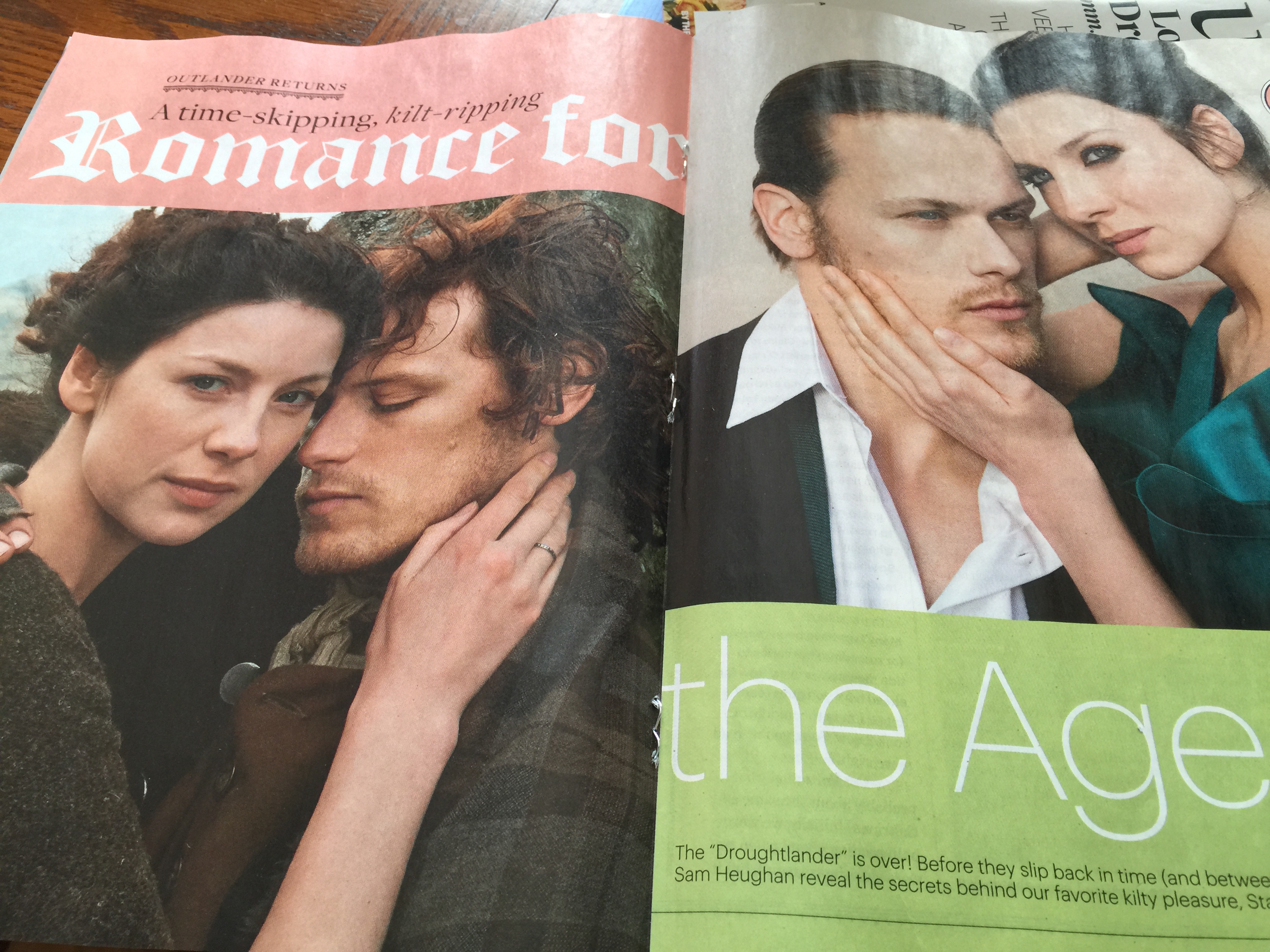
After six months of “Droughtlander”, the 2nd half of the first season starts today. Finally! I’ve been pretty calm for most of the past six months, but for the last week, my excitement has been building — as evidenced by randomly working Outlander into every possible conversation, madly rewatching the first 8 episodes, and picking up my battered old copy of Outlander and reading all the relevant chapters for tonight’s episode one more time!

How obsessed am I? Well, just for fun (and to distract myself from counting down the hours until tonight’s episode), I decided to take stock of all of my Outlander-related books. Turns out, I have quite a few!

misc 135

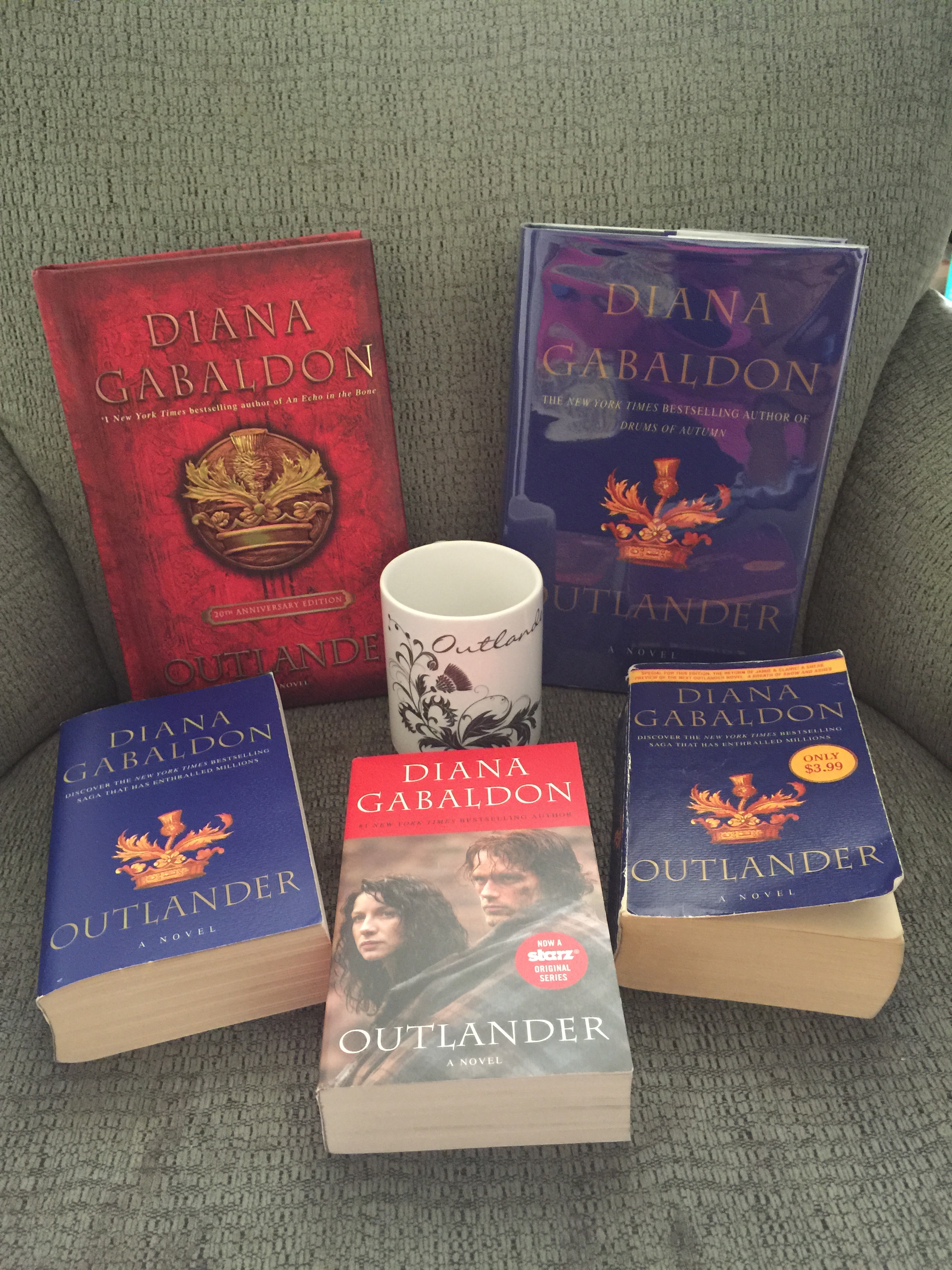
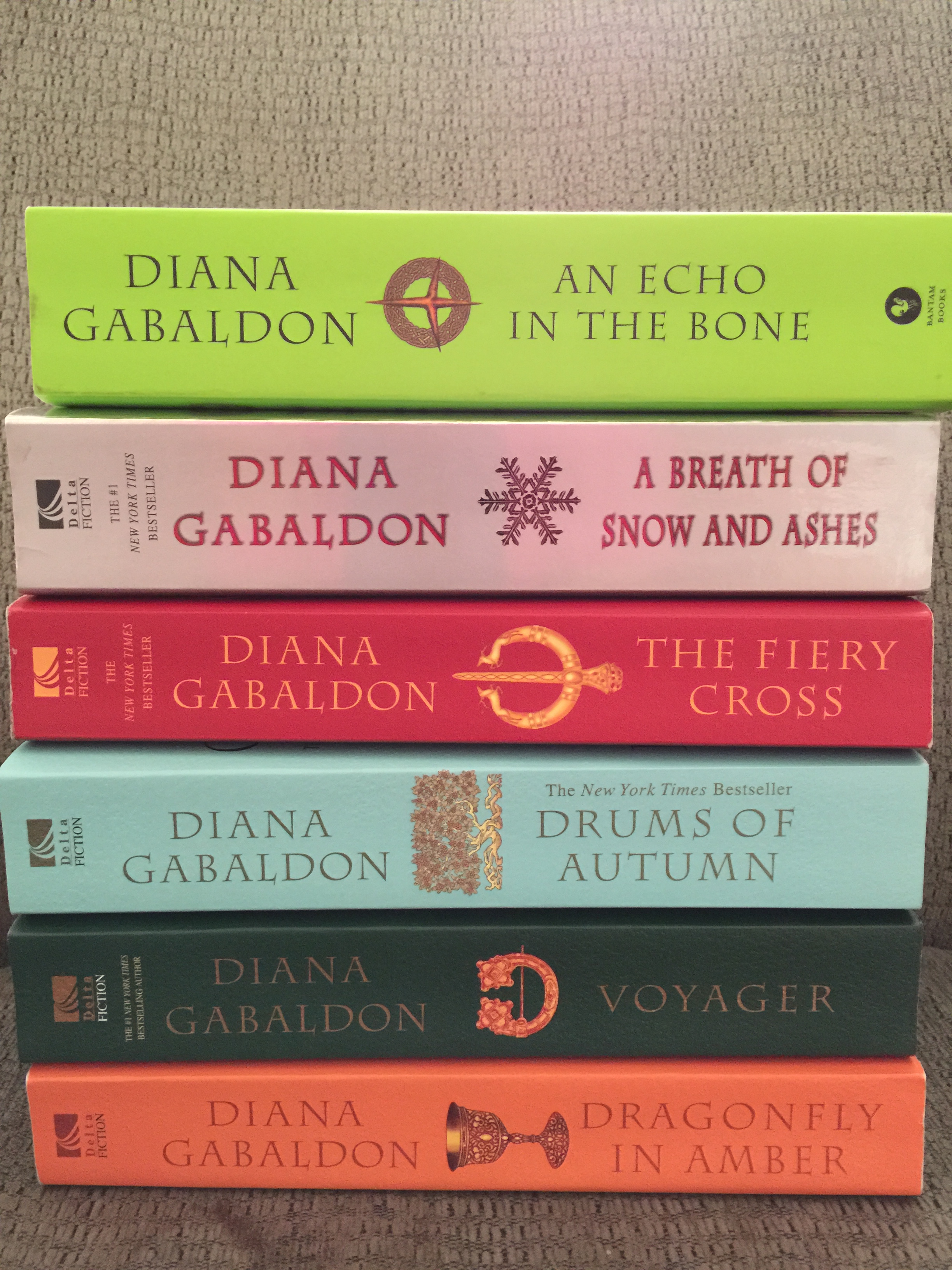
Breaking it down a bit, I have five copies of Outlander itself, including a signed hardcover (in blue), the 20th anniversary edition hardcover (in red), the battered old paperback (only $3.99, according to the cover!) that was my first introduction to all this madness, a newer paperback in better condition, and the TV tie-in version, because who can resist?

misc 131

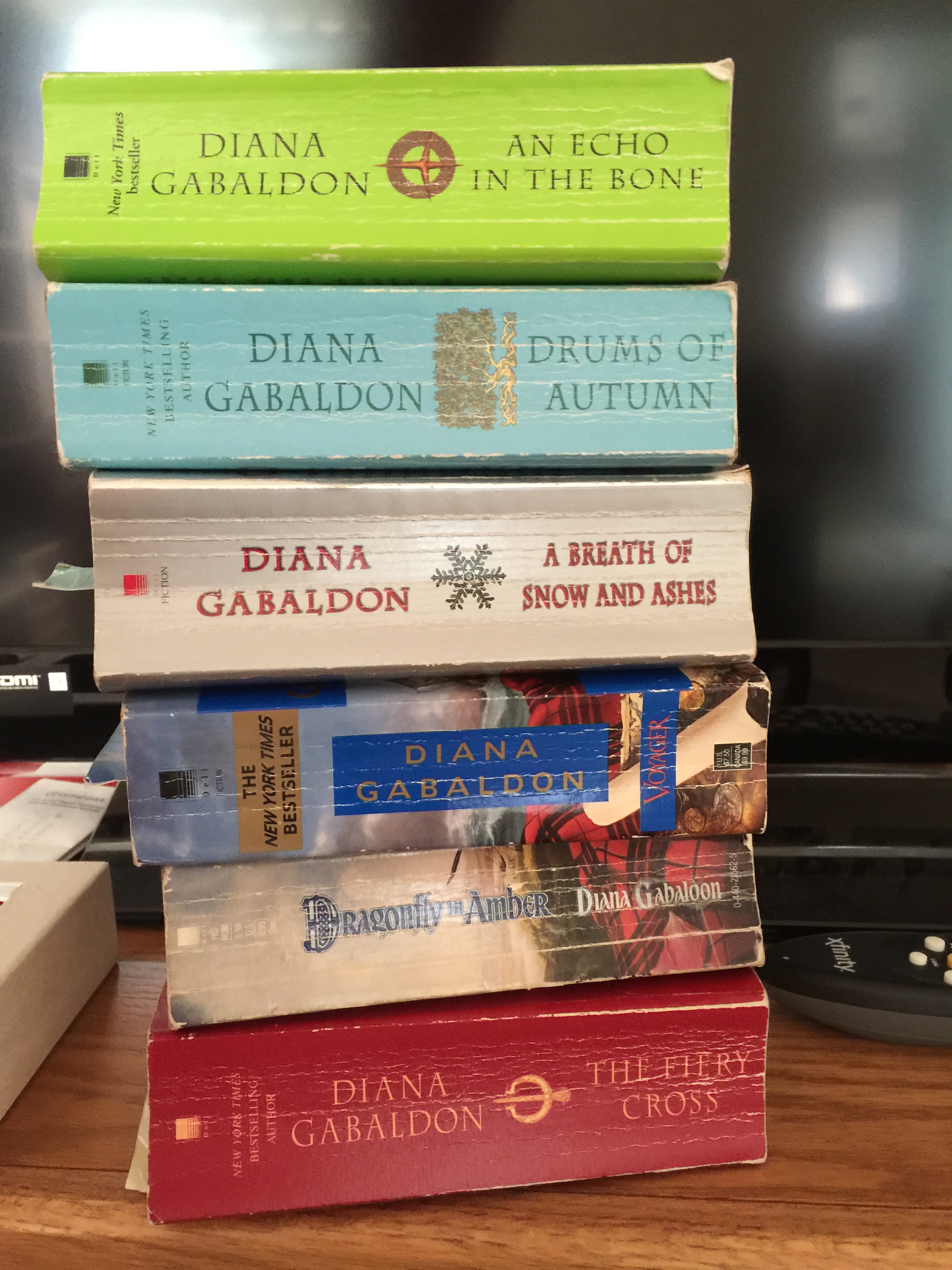
Then there are all the other books, which I have in both large-sized paperbacks and mass market paperbacks:

misc 130misc 136

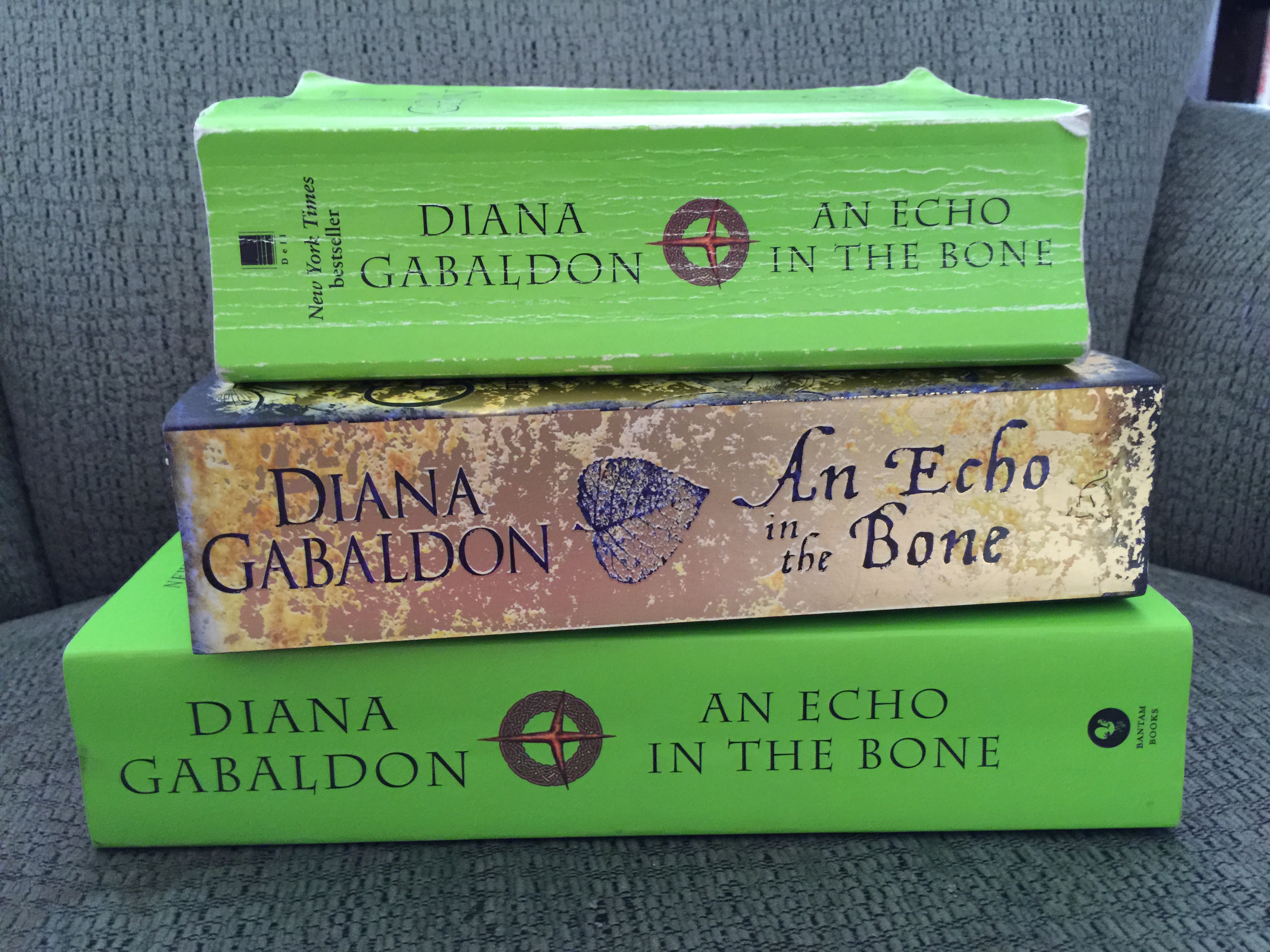
Just how many copies of An Echo in the Bone do I have? Well, three. Because I also needed the UK version, which has some reference pieces at the back not included in the US editions.

misc 134

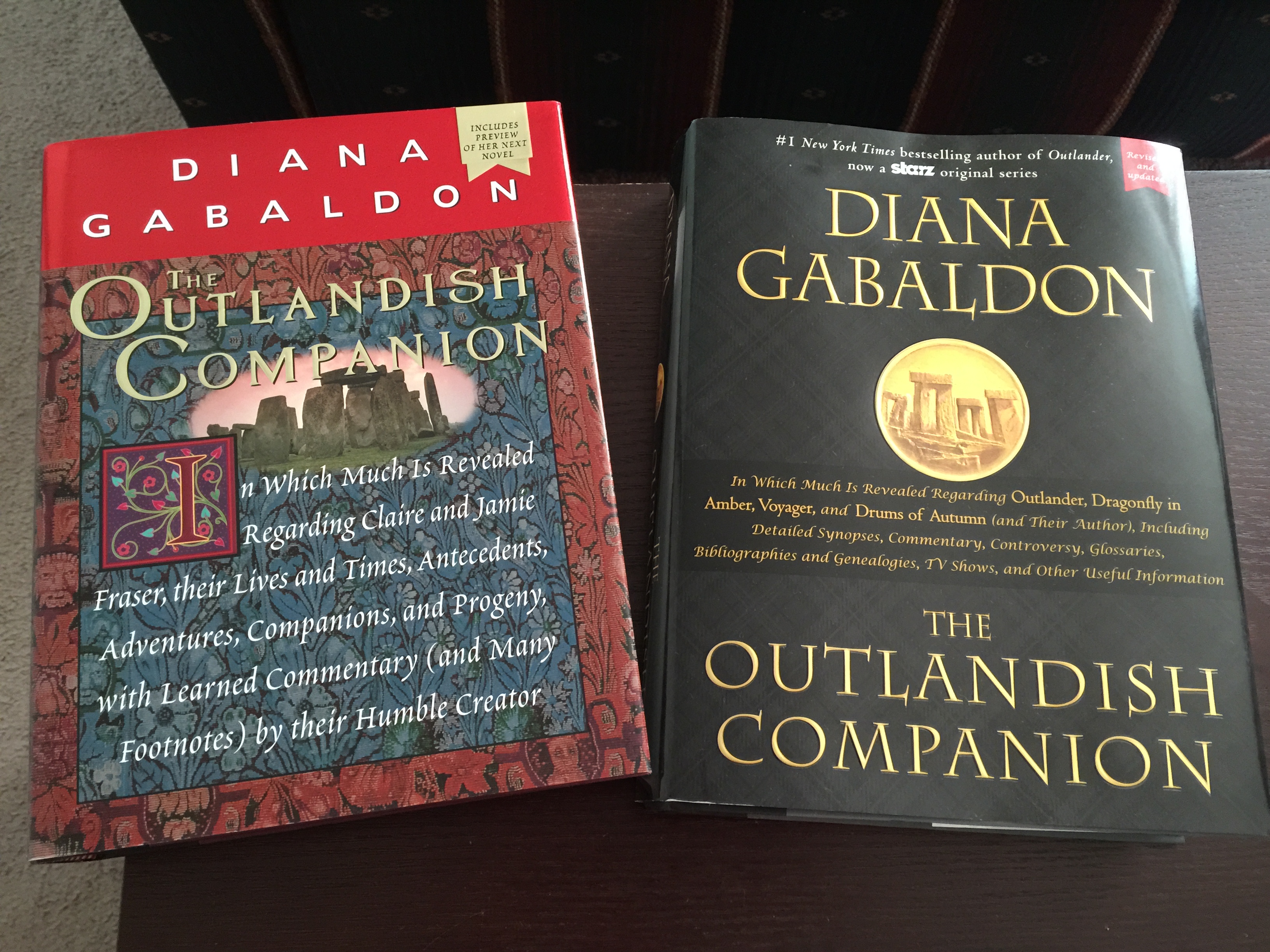
Speaking of reference, Diana Gabaldon has just released a newly revised edition of The Outlandish Companion, volume I… so yeah, now I have the old and the new versions:

misc 129

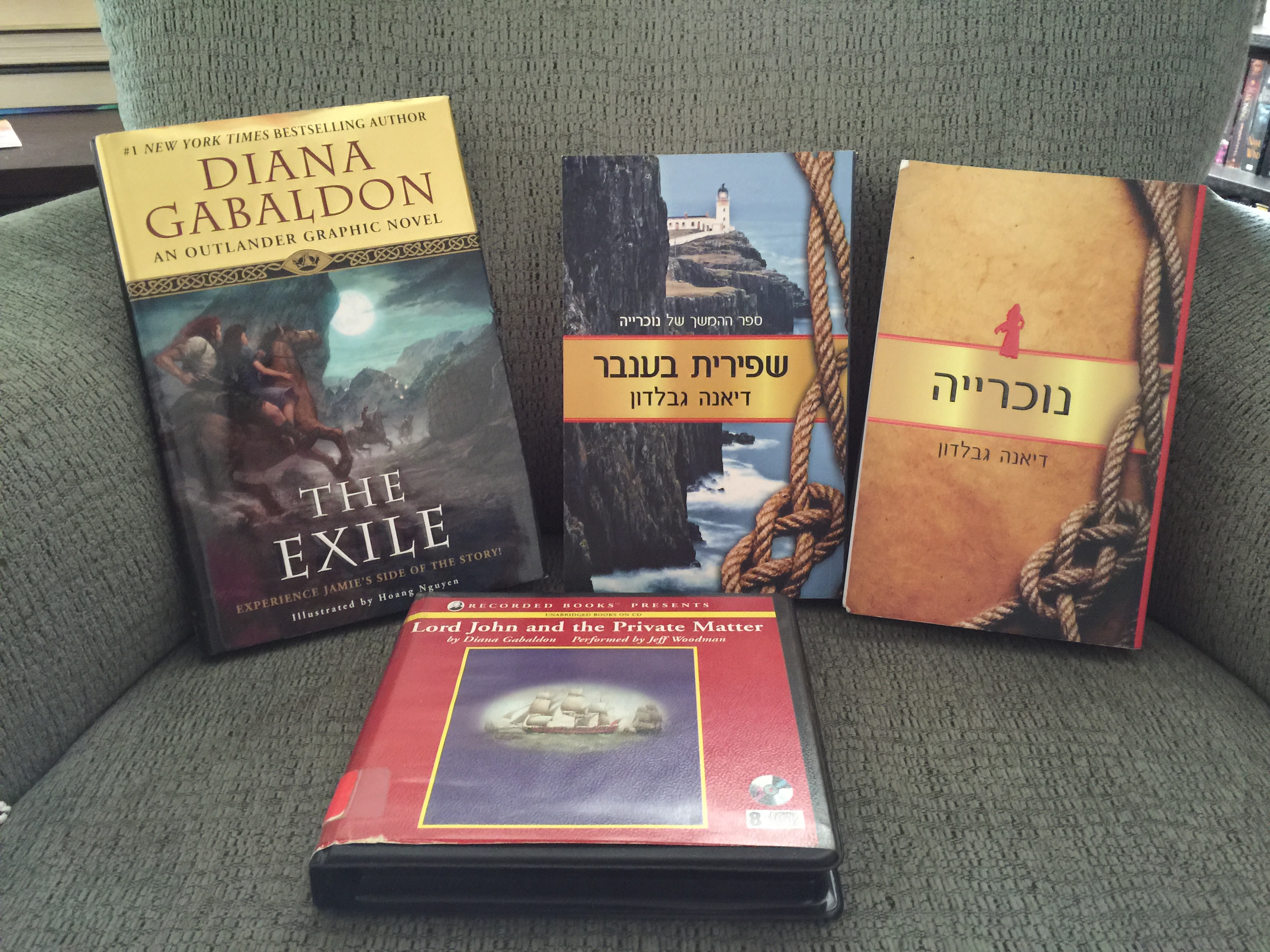
There are also some miscellaneous items, like The Exile (a graphic novel retelling of Outlander), audiobook CDs of one of the Lord John books, and then (score!), Hebrew editions of Outlander and Dragonfly in Amber, picked up on my last trip to Israel after much scouring of bookstores. (FYI, those are the only two books in the series — so far — available in Hebrew; otherwise, I’d have more. Believe me, I looked for them!)

misc 133

What else is on my super-duper, magical Outlander shelf? The Lord John books, a few anthologies that include Outlander novellas, hardcovers of The Scottish Prisoner and Written in My Own Heart’s Blood, and the collected novellas found in A Trail of Fire.

All in all, I count 34 Outlander-ish books currently in my house… which does not even take into account the fact that I have Kindle editions of them all as well. Because you never know when you’ll be away from home and in sudden, desperate need of looking up a good Jamie-ism or two!

Insanity? Devotion? I suppose it’s all a matter of perspective. I can safely say that I have more Gabaldon books in my house than books by any other author. Except maybe J. K. Rowling, but that’s counting my kids’ bookshelves as well as my own, and I’m not sure that’s fair.

And look! After taking all these photos and writing this post, I only have 8 hours and 3 minutes to go! Thank you for allowing me to share my madness with you for this little while.

Now what am I going to do?

Watch clips of the stars being adorable?

Head out to the store for a bottle of whiskey? Re-read the Outlander article in the newest Entertainment Weekly? Go gaze at picture of the Scottish Highlands on Pinterest? The possibilities are endless!

Thank you, EW! This one's a keeper.

Thank you, EW! This one’s a keeper.

Or maybe just keep watching previews, over and over, until 9 pm rolls around.


Read, skim, or skip?

About two weeks ago, I wrote a post about how following other blogs is key to building community in the blogging world, and yet it can potentially take up so much time that it’s impossible to stay on top of it all and still have any time to work on our own writing projects (not to mention little things like eating, sleeping, and saying hello to our friends and families). You can check it out here if you’d like.

Since I wrote that post (which, by the way, led to some really interesting input and discussion), I’ve been thinking more about the whole issue. I have quite a few blogs that I follow. Some are by people I feel I’ve developed a real connection with; others are blogs that I might visit occasionally or blogs that caught my eye with an especially interesting post or two. Still, the overall traffic can be overwhelming, between my WordPress feed, my Bloglovin’ feed, the daily email digests, and the Twitters links. There simply isn’t a way to read EVERY SINGLE THING, EVERY SINGLE DAY.

I’ve read comments over the past couple of years about people’s blog-reading habits. Some folks say that while they spend the most time writing book reviews, they tend to not read reviews on other people’s blogs. Some prefer discussion posts, some prefer funny pieces, some are all about the memes.

Clearly, not everything is going to be read, or read thoroughly. I’m sure we all have our own approaches to keeping up. I’ve realized that I can divide up my actions into three simple categories:

cooltext1920646192

So how does it all shake out? More or less, these are my habits:

Book reviews:

  • Is it by a blogger whose work I always enjoy? Read.
  • Is it for a book that I read recently, especially one that I liked enough to want to discuss? Read.
  • Is it for a book that I plan to read soon? Skim. (I don’t want to know too much, but I’d still like the general idea of whether you liked it or not.)
  • For a book that’s completely out of my interest zone? Skip.

Memes:

  • A meme I’m participating in? Read… usually.
  • Top Ten Tuesday posts? 90% of the time, if the topic grabs me — Read. The other 10%? No interest in the topic, so I skip.
  • Weekly reading wrap-ups (like It’s Monday. What Are You Reading or WWW Wednesdays, for example): Read.
  • Book hauls, shelf stacking, in the mailboxes: Skip. I’m just not that interested in these unless they’re folded into some other sort of post, like a reading update or a weekly recap.
  • Teasers, random book excerpts, quotes: Read. I like these little snippets, and I’ve found a few good books through these kind of posts that I maybe might have missed otherwise. Plus (shameless plug here), I host a quote meme (Thursday Quotables! Come check it out!), so clearly I like this sort of thing.

Other book stuff:

  • Cover reveals: Skip.
  • Author Q&As: If it’s someone I’m interested in — Read. Someone I’m not familiar with but who seems interesting or quirky: Skim.
  • Chit-chat or discussion posts related to reading, reading habits, etc.: Read. Usually.
  • Month in review posts: Skip. If I’ve been following a blog, then I’ve already seen all the posts for the month, so I don’t need another post summing up what I’ve already seen.
  • Giveaways: Read. Don’t we all love free books?

Bloggy stuff:

  • Technical tips and tricks, like making blog graphics or cool resources for bloggers: Read.
  • Blogging tips, like increasing traffic or considering self-hosting: Skim, to see if there are some good nuggets in there. Skip, if it’s not something I’m considering.
  • Discussion posts about being a blogger: Read, usually, unless it’s a topic I feel I’ve seen time and time again. Still, it’s always interesting to get a fresh take!

Non-bookish stuff:

  • Personal updates: Read. If you’re a book blogger and you take the time to put yourself out there and share your personal moments or challenges, I want to honor that.
  • Other non-bookish miscellany: Read or skim. I entered the blogging world specifically to chat books, and I’m not terribly interested in branching out too far. Still, if someone I talk books with also writes about other topics, chances are I’ll at least check it out to see what’s going on.

Automatic skips:

  • Anything with GIFs. Sorry. I just can’t. I know, I know, people love these. But they make my brain and eyes hurt, and I just can’t enjoy reading anything with GIFs flashing around on the page.
  • Cover reveals.
  • Posts with hard-to-read fonts, colors, or too many typos.
  • Challenges: I don’t do challenges, and reading other people’s challenge update doesn’t seem all that interesting to me.
  • Blog award posts: I seem to have 5 – 10 of these in my feeds each day, and as much as I may love the individuals, I just can’t read these any longer.
  • Rants about Goodreads, author behavior, and blogging/reviewing politics. There’s only so much time in a day, and I’d rather focus on the positive.
  • Wow, I sound like a total grouch, don’t I? I’m not putting down any of the above, really. I know people like different things, and what’s boring or a turn-off to some may be totally hilarious or thought-provoking to others.

Really, the read/skim/ skip division is the only way for me to keep my sanity and not get swamped with all the keeping up I need to do. So don’t hate me if I don’t read your meme posts or LOL over your clever graphics! I’m happy to be an enthusiastic audience for the posts that grab me… and I hope you’ll read the stuff of mine that catches your eye or strikes your fancy — and skip the stuff that bores you!

What type of posts do you always read? What do you skim? What do you skip?

Share your thoughts, please!

All the Books I Meant to Read… (Fall 2014)

It’s time for another round-up of all the books I meant to read…

In what’s likely to become a seasonal feature, I’m taking a moment to salute the ARCs that I didn’t end up reading, whether for lack of time or simply because I wasn’t in the right mood at the right time.

Here are books released from September through November that I thought sounded great — but I just didn’t get around to. Tell me, please: Which of these have you read? Do any especially appeal to you? Would you consider any of these a must-read?

__________________________________________________

Winterkill by Kate A. Boorman

Emmeline knows she’s not supposed to explore the woods outside her settlement. The enemy that wiped out half her people lurks there, attacking at night and keeping them isolated in an unfamiliar land with merciless winters. Living with the shame of her grandmother’s insubordination, Emmeline has learned to keep her head down and her quick tongue silent.When the settlement leader asks for her hand in marriage, it’s an opportunity for Emmeline to wash the family slate clean—even if she has eyes for another. But before she’s forced into an impossible decision, her dreams urge her into the woods, where she uncovers a path she can’t help but follow. The trail leads to a secret that someone in the village will kill to protect. Her grandmother followed the same path and paid the price. If Emmeline isn’t careful, she will be next.

__________________________________________________

Bitter Greens by Kate Forsyth

The amazing power and truth of the Rapunzel fairy tale comes alive for the first time in this breathtaking tale of desire, black magic and the redemptive power of love

French novelist Charlotte-Rose de la Force has been banished from the court of Versailles by the Sun King, Louis XIV, after a series of scandalous love affairs. At the convent, she is comforted by an old nun, Sœur Seraphina, who tells her the tale of a young girl who, a hundred years earlier, is sold by her parents for a handful of bitter greens…

After Margherita’s father steals parsley from the walled garden of the courtesan Selena Leonelli, he is threatened with having both hands cut off, unless he and his wife relinquish their precious little girl. Selena is the famous red-haired muse of the artist Tiziano, first painted by him in 1512 and still inspiring him at the time of his death. She is at the center of Renaissance life in Venice, a world of beauty and danger, seduction and betrayal, love and superstition.

Locked away in a tower, Margherita sings in the hope that someone will hear her. One day, a young man does.

Award-winning author Kate Forsyth braids together the stories of Margherita, Selena, and Charlotte-Rose, the woman who penned Rapunzel as we now know it, to create what is a sumptuous historical novel, an enchanting fairy tale retelling, and a loving tribute to the imagination of one remarkable woman.

__________________________________________________

The Wonder of All Things by Jason Mott

On an ordinary day, at an air show like that in any small town across the country, a plane crashes into a crowd of spectators. After the dust clears, a thirteen-year-old girl named Ava is found huddled beneath a pocket of rubble with her best friend, Wash. He is injured and bleeding, and when Ava places her hands over him, his wounds disappear. 

Ava has an unusual gift: she can heal others of their physical ailments. Until the air show tragedy, her gift was a secret. Now the whole world knows, and suddenly people from all over the globe begin flocking to her small town, looking for healing and eager to catch a glimpse of The Miracle Child. But Ava’s unique ability comes at a great cost, and as she grows weaker with each healing, she soon finds herself having to decide just how much she’s willing to give up in order to save the ones she loves most. 

Elegantly written, deeply intimate and emotionally astute, The Wonder of All Things is an unforgettable story and a poignant reminder of life’s extraordinary gifts.

__________________________________________________

A Sudden Light by Garth Stein

When a boy tries to save his parents’ marriage, he uncovers a legacy of family secrets in a coming-of-age ghost story by the author of the internationally bestselling phenomenon, The Art of Racing in the Rain.

In the summer of 1990, fourteen-year-old Trevor Riddell gets his first glimpse of Riddell House. Built from the spoils of a massive timber fortune, the legendary family mansion is constructed of giant, whole trees, and is set on a huge estate overlooking Puget Sound. Trevor’s bankrupt parents have begun a trial separation, and his father, Jones Riddell, has brought Trevor to Riddell House with a goal: to join forces with his sister, Serena, dispatch Grandpa Samuel—who is flickering in and out of dementia—to a graduated living facility, sell off the house and property for development into “tract housing for millionaires,” divide up the profits, and live happily ever after.

But Trevor soon discovers there’s someone else living in Riddell House: a ghost with an agenda of his own. For while the land holds tremendous value, it is also burdened by the final wishes of the family patriarch, Elijah, who mandated it be allowed to return to untamed forestland as a penance for the millions of trees harvested over the decades by the Riddell Timber company. The ghost will not rest until Elijah’s wish is fulfilled, and Trevor’s willingness to face the past holds the key to his family’s future.

__________________________________________________

Let me know if you especially recommend any of the above… or if any have caught your eye enough to make you go out and get a copy!

Five reasons why you should read Fables

There are certain books and series that I tend to rave about — a lot — and anyone who visits my blog from time to time has probably stumbled across my random gushes about one or another of my favorites. One book series that I’m always pushing on unsuspecting friends is Fables, the comic book series by Bill Willingham (available in trade paperback volumes, which is how I read them).

Fables, Vol. 20: Camelot

The newest volume in the series is #20, Camelot. Let me tell you, #19 was a heart-breaker, and I opened #20 with trepidation. Would the pain continue? Would there be any happiness left anywhere in the world of #20? How could the story possibly move forward?

I just read #20 today, and — big surprise — loved it. I won’t say too much about the story. If you’re already a Fables fan, you’ll want to go into this one with no advance knowledge. What I will say is that the story moves forward in new and unexpected ways, with a narrative that follows several storylines simultaneously, so that it’s not all tragedy, all the time. The groundwork is prepared for new conflict, and while ominous signs abound, in many ways this volume serves as a bridge from the awful events of the previous book to the next big challenge for our beloved characters. There’s some hope, but also a clear warning that we readers aren’t going to get everything we want — not by a long shot.

Most devastating of all is the fact that there are only two volumes remaining in the series, as creator Bill Willingham has announced that he’s wrapping up the series. How can this wonderful world be done? I can’t even.

So, if you’ve never read Fables, why should you? Here are five reasons why this series deserves to be on your must-read list:

1) World-building extraordinaire: The world of Fables is huge and magnificent. The premise is that all storybook creatures and magical beings are real, and having been banished from their own lands by an evil emperor, now live in hiding in the human world. The laws of Fabletown are complex, with layers upon layers of history and mythology. With each new chapter, the world expands in different and surprising directions, and the internal logic of the series expands to encompass each new facet of the Fables cosmos.

2) Incredible characters: At first glance at volume 1, you may think that the female characters are too comic-style feminine, with their short skirts and heels and flowing long hair. Look again. The women here rock, from tough-as-nails Snow White to bad-ass superspy Cinderella. These women are nobody’s damsels in distress, and while there are love stories and dashing princes, the women are the ones to watch. Not that the male characters are anything to sneeze at. My two favorites are Bigby Wolf — yes, the Big Bad Wolf who’s a chain-smoking tough guy in his human form, and Ambrose, aka Flycatcher, aka the Frog Prince, whose story is surprisingly tragic and heroic. But scratch the surface of any of the books, and you’ll find richly developed characters to care about.

3) Tragedy and triumph: Good versus evil plays out throughout the series, but it’s not all black and white. There are power struggles, horrible losses, wars that threaten all of existence, and heroes who are ready to sacrifice all for the greater good. It doesn’t get more dramatic than some of the long-running story arcs of Fables.

4) Storytelling that takes its time: Because there are so many volumes in the Fables saga, the storytelling can unfold with its own rhythm. Pieces come together that may only have been hinted at; characters and events come back in unexpected ways; an event that seems like a happy ending in one volume may have unforeseen (and usually dire) repercussions down the road.

5) A sense of humor: Even at its bleakest, the writing and dialogue in the Fables books is sharp, witty, and not without its own wicked sense of humor. There’s usually a lighter story thrown in amidst the sadder parts, and there are certainly enough comic relief characters around to lighten the mood whenever needed. Sure, you may be heartbroken at certain places in the story, but I guarantee you’ll be smiling at least a few times during each of the volumes of the series.

I said I’d stick to five, so there you have it. But if I were to go on, I’d just add that the 20 volumes published so far make up the main Fables storyline, but aren’t the entire Fables world. There’s a spin-off series about Jack of Fables that fills up another 9 volumes, stand-alone stories about Cinderella and Snow White, and yet another spin-off series, Fairest. In other words, it’ll take a very long time to run out of reading material!

Even if you don’t normally read comics/graphic novels, give Fables a shot. For excellent storytelling set in a fantasy world overflowing with fascinating characters and complicated plotlines, you really can’t do much better.

All the Books I Meant to Read… (summer 2014)

I hate to say it, but summer is on its way out… Yes, technically it’s not fall until later in September, but really, we all know that summer is over once August ends, kids are back in school, and it’s no longer picnic season.

I had a zillion and one books that I meant to read this summer, but life happens, and sadly, there were stacks of books that just fell through the cracks. Inspired by this terrific post over at Chrissi Reads, I thought I should take a moment to salute the ARCs that I didn’t end up reading, whether for lack of time or simply because I wasn’t in the right mood at the right time.

Here are the books released in July and August that I thought sounded great — but I just didn’t get around to. Tell me, please: Which of these have you read? Do any especially appeal to you? Would you consider any of these a must-read?

The Awakening of Miss Prim by Natalia Sanmartin Fenollera

In this #1 international bestseller, a young woman leaves everything behind to work as a librarian in a remote French village, where she finds her outlook on life and love challenged in every way.

Prudencia Prim is a young woman of intelligence and achievement, with a deep knowledge of literature and several letters after her name. But when she accepts the post of private librarian in the village of San Ireneo de Arnois, she is unprepared for what she encounters there. Her employer, a book-loving intellectual, is dashing yet contrarian, always ready with a critique of her cherished Jane Austen and Louisa May Alcott. The neighbors, too, are capable of charm and eccentricity in equal measure, determined as they are to preserve their singular little community from the modern world outside.

Prudencia hoped for friendship in San Ireneo but she didn’t suspect that she might find love—nor that the course of her new life would run quite so rocky or would offer challenge and heartache as well as joy, discovery, and fireside debate. Set against a backdrop of steaming cups of tea, freshly baked cakes, and lovely company, The Awakening of Miss Prim is a distinctive and delightfully entertaining tale of literature, philosophy, and the search for happiness.

__________________________________________________

Half a King by Joe Abercrombie

“I swore an oath to avenge the death of my father. I may be half a man, but I swore a whole oath.”

Prince Yarvi has vowed to regain a throne he never wanted. But first he must survive cruelty, chains, and the bitter waters of the Shattered Sea. And he must do it all with only one good hand.

The deceived will become the deceiver.
 
Born a weakling in the eyes of his father, Yarvi is alone in a world where a strong arm and a cold heart rule. He cannot grip a shield or swing an axe, so he must sharpen his mind to a deadly edge.

The betrayed will become the betrayer.
 
Gathering a strange fellowship of the outcast and the lost, he finds they can do more to help him become the man he needs to be than any court of nobles could.

Will the usurped become the usurper?
 
But even with loyal friends at his side, Yarvi finds his path may end as it began—in twists, and traps, and tragedy.

I do really want to read Half A King… but hesitate about reading the first book in a new series. Sounds good, though!

__________________________________________________

Some Boys by Patty Blount

Some boys go too far. Some boys will break your heart. But one boy can make you whole.

When Grace meets Ian she’s afraid. Afraid he’ll reject her like the rest of the school, like her own family. After she accuses the town golden boy of rape, everyone turns against Grace. They call her a slut and a liar. But…Ian doesn’t. He’s funny and kind with secrets of his own.

But how do you trust the best friend of the boy who raped you? How do you believe in love?

A gut-wrenching, powerful love story told from alternating points of view by the acclaimed author of Send.

__________________________________________________

Secrets of the Lighthouse by Santa Montefiore

Ellen Trawton is running away from it all – quite literally. She is due to get married to a man she doesn’t love, her job is dragging her down and her interfering mother is getting on her nerves. So she escapes to the one place she know her mother won’t follow her – to her aunt’s house in rural Ireland. Once there, she uncovers a dark family secret – and a future she never knew she might have.Meanwhile, Caitlin Macausland is mourning the future she can never have. She died tragically in what the village thinks is suspicious circumstances, and now she is stuck in a limbo, unable to move on.

And between the two of them is an old lighthouse – the scene of so much tragedy. Can each woman find the peace she so desperately longs for? And can they find the way to live again?

__________________________________________________

The House We Grew Up In by Lisa Jewell

Meet the Bird family. They live in a honey-colored house in a picture-perfect Cotswolds village, with rambling, unkempt gardens stretching beyond. Pragmatic Meg, dreamy Beth, and tow-headed twins Rory and Rhys all attend the village school and eat home-cooked meals together every night. Their father is a sweet gangly man named Colin, who still looks like a teenager with floppy hair and owlish, round-framed glasses. Their mother is a beautiful hippy named Lorelei, who exists entirely in the moment. And she makes every moment sparkle in her children’s lives.

Then one Easter weekend, tragedy comes to call. The event is so devastating that, almost imperceptibly, it begins to tear the family apart. Years pass as the children become adults, find new relationships, and develop their own separate lives. Soon it seems as though they’ve never been a family at all. But then something happens that calls them back to the house they grew up in — and to what really happened that Easter weekend so many years ago.

Told in gorgeous, insightful prose that delves deeply into the hearts and minds of its characters, The House We Grew Up In is the captivating story of one family’s desire to restore long-forgotten peace and to unearth the many secrets hidden within the nooks and crannies of home.

__________________________________________________

Small Blessings by Martha Woodroof

From debut novelist Martha Woodroof comes an inspiring tale of a small-town college professor, a remarkable new woman at the bookshop, and the ten-year old son he never knew he had.

Tom Putnam has resigned himself to a quiet and half-fulfilled life. An English professor in a sleepy college town, he spends his days browsing the Shakespeare shelves at the campus bookstore, managing the oddball faculty in his department and caring, alongside his formidable mother-in-law, for his wife Marjory, a fragile shut-in with unrelenting neuroses, a condition exacerbated by her discovery of Tom’s brief and misguided affair with a visiting poetess a decade earlier.
Then, one evening at the bookstore, Tom and Marjory meet Rose Callahan, the shop’s charming new hire, and Marjory invites Rose to their home for dinner, out of the blue, her first social interaction since her breakdown. Tom wonders if it’s a sign that change is on the horizon, a feeling confirmed upon his return home, where he opens a letter from his former paramour, informing him he’d fathered a son who is heading Tom’s way on a train. His mind races at the possibility of having a family after so many years of loneliness. And it becomes clear change is coming whether Tom’s ready or not.

A heartwarming story with a charmingly imperfect cast of characters to cheer for, Small Blessings’s wonderfully optimistic heart that reminds us that sometimes, when it feels like life has veered irrevocably off track, the track shifts in ways we never can have imagined.

__________________________________________________


Let me know if you especially recommend any of the above… or if any have caught your eye enough to make you go out and get a copy!

Announcing Fields & Fantasies: A New Book Club!

I’m delighted to announce that starting this month, I’m teaming up with the fabulous Diana of Strahbary’s Fields to introduce a new virtual book discussion platform, Fields & Fantasies Book Club!

Each month, we’ll pick a book to discuss, and we hope you’ll join in. At the end of the month, Diana and I will each write up our thoughts and will “talk” to each other about our reactions, what we loved, and what — if anything — left us scratching our heads.

We’re so excited to kick off Fields and Fantasies!

To start things off, our book pick for July is The Fever by Megan Abbott.

The FeverThe panic unleashed by a mysterious contagion threatens the bonds of family and community in a seemingly idyllic suburban community.

The Nash family is close-knit. Tom is a popular teacher, father of two teens: Eli, a hockey star and girl magnet, and his sister Deenie, a diligent student. Their seeming stability, however, is thrown into chaos when Deenie’s best friend is struck by a terrifying, unexplained seizure in class. Rumors of a hazardous outbreak spread through the family, school and community.

As hysteria and contagion swell, a series of tightly held secrets emerges, threatening to unravel friendships, families and the town’s fragile idea of security.

A chilling story about guilt, family secrets and the lethal power of desire, The Fever affirms Megan Abbot’s reputation as “one of the most exciting and original voices of her generation” (Laura Lippman).


Future Fields & Fantasies picks include:

August: The Museum of Extraordinary Things by Alice Hoffman

September: The Possibilities by Kaui Hart Hemmings

We hope you’ll join in and jump into the discussion. And if you have an idea for a book you’d like us to feature in the future, just let one of us know!

Author Q&A: Meet Erin Lindsay McCabe, author of I Shall Be Near To You

By now, anyone who reads my blog has seen me raving about the outstanding debut novel I Shall Be Near To You by Erin Lindsay McCabe. Today, I’m thrilled to welcome Erin to Bookshelf Fantasies, where she very kindly (and patiently) takes the time to answer my over-abundance of questions:

IShallBeNearWhat first inspired you to write this book?

The original inspiration for I Shall Be Near To You was the collected letters of Sarah Rosetta Wakeman, who disguised as a man and served in the 153rd New York State Volunteers for two years. I found An Uncommon Soldier, the book of her letters, in 1998 while looking for a primary source upon which to write the final paper for the US Women’s History class I was taking. I had no idea women had fought in the Civil War until I came across that book. When I saw Rosetta’s picture and then read her letters, I was just taken with her—her feisty spirit, her tenderness, her determination. Of course, I didn’t know then that I was going to eventually write a book inspired by her. I just thought her story, and the stories of the other women who fought, was fascinating and I had so many questions that weren’t answered by the historical records available.

How long did the writing process take for I Shall Be Near To You?

I started writing the book in the Spring of 2007. It took me two years to write a complete draft, and then I spent another year revising it in my MFA program. Then I worked with two different agents over the next two years, revising it more. The book sold in December 2012, and then of course there were more edits after that! So, I guess I worked on it for 6 years all told, plus the 10 years I spent wishing I could figure out what to do with the real Rosetta’s story other than write a college paper about her.

Was Rosetta a real historical figure? Were there many women who did what Rosetta did in the Civil War?

Yes, Sarah Rosetta Wakeman was a real woman. She is one of about 250 documented women who disguised as men and enlisted in both the Union and Confederate armies. Their service is beautifully surveyed in the book They Fought Like Demons. And of course, estimates are that there were even more women who were just never found out—perhaps as many as 400-1000 total.

What was it about Rebel Rose and Clara Barton that made you want to include them in the story, rather than sticking solely to fictional characters?

I’ve gotten some criticism for including real characters—that it seems too coincidental that the fictional Rosetta would have run into these women. But one of the moments the real Rosetta wrote about in her letters home was her experience guarding both a female soldier who was imprisoned after leading her men into battle for “not doing according to regulation” and two female Rebel spies. I was so curious about what that must have been like—to be guarding women who were imprisoned for doing what she herself was doing—but it’s just mentioned in passing in Rosetta’s letters. So I knew I wanted to explore that more in a fictionalized context. I also really wanted to include women in the novel who represented the variety of ways women served during the war. I loved the idea of showing Clara Barton doing something that is considered very feminine (nursing wounded soldiers) but doing it in a context that was very unconventional at the time. She was the first official female combat nurse but she had to fight for the right to be on the battlefields. I had also discovered when I visited Antietam, that the memorial commemorating Clara Barton’s service at Antietam is placed right near where the 97th New York State Volunteers (the fictional Rosetta’s regiment) encamped the night before the battle and Clara Barton served in battlefield hospitals near The Cornfield where the 97th fought. So it seemed entirely plausible to me that as Rosetta searches the hospitals after the battle, she might come across Clara Barton. And then, finally, Clara Barton is known to have nursed a wounded female soldier named Mary Galloway after Antietam.

What would someone like Rosetta have experienced after the war? Admiration, scorn, something else?

That’s one of the questions I really pondered as I wrote the book, and the larger question of how any soldier goes back to civilian life after having experienced the horrors of battle. Unfortunately, there’s so little known about the female soldiers during their time in the military, and even less is known about what they did after. A few (Jennie Hodgers, Otto ) are known to have continued living as men. Some (Sarah Emma Edmonds, Martha Parks Lindley, Mary Galloway) went back to living as women, marrying and having children. Most of the rest just disappeared from the historical record. My sense is that most of them didn’t talk about their experience, and when they did, it was within the confines of their family. A few did, in later years, apply for veteran’s benefits and receive them, thanks to the support of their comrades who seemed to hold the women in high regard.

I really admired the amount of detail included about life in the army camps and what a foot soldier’s daily routine might have looked like. How did you compile all of this information?

It was a challenge! A lot of my information came straight out of soldiers’ letters. For instance, in one letter the real Rosetta says that the skirmish drill was “the prettiest drill ever was drill” so then I knew I had to find out about how to do a skirmish drill. I consulted an officer’s handbook and also a soldier’s handbook to get details about the actual drills, the way orders might be called out, the kinds of food and supplies soldiers might carry, and so on. I talked to the battlefield historian at Antietam about what kinds of duties the soldiers had after the battle ended. But one of my frustrations was that the kinds of things I was most interested in (the everyday, day-in and day-out life of a soldier) were not the kinds of things that made it into the history books, which so often focus on the generals and strategies and the movements of the troops. So it was really about finding the details I needed hidden away in first-hand accounts. Fortunately the soldiers often wrote about the food they ate or the duties they had. I also gleaned many of the battlefield and wound descriptions from soldiers’ letters. I was initially surprised at how many of the soldiers just completely glossed over those kinds of details, but I was equally surprised by how gruesome their descriptions were when they chose to include them. And finally, I attended a reenactment, which really helped me with the details about camp life and also with what a group of muskets firing all at once sounded like, what the smoke from the cannons looked like, and so on.

What were your main priorities and/or challenges in researching the book?

I think my first two priorities were to tell a story that I would want to read myself and to write a story that would pay tribute to and honor the women and men who served during the Civil War. After that, the biggest challenge was getting the historical details right without making the book feel research-y. It was really important to me that the book be as accurate as possible—I didn’t want there to be any reason for a reader to discount the story of the women who fought because I hadn’t done my research well enough. I think there is probably something on every single page that is researched—whether it’s a detail about farm life, or a word that I had to double-check to make sure was in usage, to a song the soldiers might sing, to what the scenery looked like. It sounds daunting when I think about it now, but as I was working on it, it was just part of the process, and the research really fed my creativity. There were some things I never got cut-and-dried answers for despite my best attempts—like how fast news might travel or how quickly a letter could be sent—and sometimes I spent hours and hours trying to figure out a tiny detail (did the upper bridge at Antietam have two arches or three?) that doesn’t probably matter to most readers, but that I knew would matter to anyone who spent time at Antietam. The research about the battles themselves, particularly the movement of the troops, was a huge challenge. Trying to figure out where exactly my soldiers would be on the battlefield and at what point was hard. I pored over battlefield maps and photos trying to get it right. And then writing the battle scenes themselves was very difficult emotionally, but it was incredibly important to me that readers would get a sense of what it was like to be there in the thick of the battle—because so many women were!

And a few questions for Erin about her writing career:

When did you first realize you wanted to be a writer?

I’m really not sure! I have always loved writing—the physical act of my pen moving across paper. I was that annoying kid in high school who thought writing essays was fun. And I remember thinking when I was pretty young—in elementary or junior high school—that I wanted to write a novel, but I just didn’t know what about.

What did your early writing days look like?

I started keeping a diary when I was seven, and in junior high I had about a hundred pen pals (that’s not an exaggeration). I was always writing little stories or sock puppet plays or designing magazines (all the articles written by yours truly). In junior high I started trying to write poetry, and in college I tried writing some short stories, but they always kept getting longer and longer. I started dabbling with writing a novel a few years before I wrote I Shall Be Near To You, kind of on a dare from my husband. It turned out to be a wonderful thing because I discovered I could actually write a cohesive story that was novel-length (though it wasn’t all that good) and I learned a lot about what my writing process is like. When I got to the middle of I Shall Be Near To You and it felt like it was all falling apart, I was able to remember I had felt the same way before (and I feel the same way again, working on my current project), which is oddly comforting.

Do you have a background in history? Is the Civil War a period of special interest?

When I look back at what I read as a kid, it often had a historical bent to it though I wasn’t all that interested in history as it was taught in school—dates, facts, battles, generals, politicians. Studying literature in college though, I really began to see the overlap between what authors write about and what’s happening in history. That’s when I became a history minor. I’m just so interested in the stories of real people’s daily lives and what life was like in the past. I’ve had a fascination with the Civil War since watching Ken Burns’ Civil War documentary as a 13 year old, and I think that’s one thing that documentary really does well—you get a sense of what individuals experienced. Though I wouldn’t call myself a history buff, in the sense that there’s one period of time that I am a real expert in, I am always drawn to the Victorian and Edwardian periods, probably because a) there’s horses and b) it’s the time right before and at the beginning of the suffrage movement. I’m really interested in how women coped with having so little political, economic, and social freedom.

Do you intend to make historical fiction your specialty, or will we see future books in other genres?

Historical fiction is what I gravitate toward, but I’m not ruling out exploring other genres.

What are you working on now/next?

Right now I’m working on another historical novel—this one is inspired by the adopted daughter of a female serial killer. I’m maybe half to two thirds done with a first draft of it, so I’m right in the middle of the phase where I feel like the whole thing is falling apart.

What is your writing routine like? Do you have a particular spot or time that you prefer for writing?

I try to write at least five days a week and I try to hit a daily goal of 1000 words. I used to always write in the morning after walking my dog, before I went off to teach. And for much of the time I was working on I Shall Be Near To You, I wrote late at night after my husband was asleep. I like having a good chunk of time (two to three hours) so that I feel like I can really dig in. Now my routine is much more scattered because I have a three-year old son. I used to write during his naps, but now that he’s stopped napping I’ve had to figure out a new routine. I’m still working on that—right now I have a babysitter come twice a week in the morning and then sometimes my son and I meet my husband at the coffee shop after he gets off work and when they leave I stay and work for a couple hours. I’m finding it harder and harder to write late at night, because I just get too sleepy (and sleep-writing, while very amusing to re-read in the morning, is not very productive)! But I do still write after everyone else is asleep.

Anything about you as a person you’d like to share? Favorite foods, movies, music?

I think anyone who knows me knows that I love all things potato. Also anything sugary and chocolatey and buttery. I adore female musicians—I listened to so much Neko Case and Gillian Welch while writing I Shall Be Near To You. But I also love Regina Spektor, Tori Amos, Sarah Maclachlan, The Yeah Yeah Yeahs, Sleater Kinney, Sharon Jones, Adele, Liz Phair, Tracy Chapman, Amy Winehouse, Lily Allen… In general I like music that has something deeper to say about the human experience, that is layered instrumentally and lyrically, that has a moment of poetic realization or surprise to it, when the musician reveals something with their words or with the music that you didn’t realize before or weren’t expecting—Weezer, System of a Down, The Decemberists, Interpol, Iron & Wine, REM, TV on the Radio, Morphine all come to mind. My husband says my iPod is a 1990s time capsule, and looking at this list I realize he’s probably right! He also says that to figure out which song on an album is my favorite, just find the slowest, saddest one. And I’m a sucker for anything with a banjo or a fiddle or bagpipes in it. As for movies, I’ll pretty much watch any costume drama (recently, I really liked the new version of Wuthering Heights, and this little movie called Meek’s Cutoff, and the new Jane Eyre). I love a love story, especially a quirky one (Princess Bride, Amelie, Moulin Rouge, Silver Linings Playbook). I was blown away by Winter’s Bone. I don’t watch too many new movies these days, but that last movie I saw in the theater was Baz Luhrman’s The Great Gatsby. I think I giggled through the whole thing, it tickled me so much.

What were your favorite books as a child?

The Little House on the Prairie books for sure. Anne of Green Gables. I was a voracious reader—I read a lot of the classics, things like Heidi, Jane Eyre, Little Women, The Secret Garden, The Little Princess, Chronicles of Narnia—and then I read stuff like Nancy Drew, The Saddle Club, tons of Lurlene MacDaniel books (I loved when a book made me cry), and anything with horses in it (My Friend Flicka, Misty of Chincoteague, The Black Stallion books). I have great memories of my dad reading The Adventures of Tom Sawyer and Huck Finn to my brother and me. He did really good voices for the characters and he always quit reading for the night at a cliffhanger.

What books have you read recently that you loved?

When I’m actively writing, I have a hard time reading fiction, partially because I’m doing non-fiction reading for research, partially because I so often have to choose between either writing or reading, and partially because I get worried if I read certain books, I’ll be unduly influenced by them. That said, I read a bunch of books this Fall and Winter that I really liked—Burial Rites, The Kept, Bittersweet (which I read as an ARC, it’s out this 5/12), Quiet Dell, The Maid’s Version. But I think the book that I loved the most was Boleto. I guess it’s a western and a coming of age story, but it’s so much more than that. It’s quiet and beautiful and poignant and the main character is endearing and heartbreaking. It’s a slim little thing, but it feels deep and it’s just so well-written. I envy and admire the way Alison Hagy has managed to write about horses without being sentimental or cheesy.


 Thank you, Erin, for your insights and your time!

To learn more about Erin Lindsay McCabe and her writing, visit her website at http://erinlindsaymccabe.com.

See previous Bookshelf Fantasies posts about I Shall Be Near To You:
Guest Review: I Shall Be Near To You
Five Reasons Why You Should Read I Shall Be Near To You… ASAP!


The Trouble with Trilogies

I have a problem with trilogies. But not just trilogies.

Sequels, series, you name it. Anything that’s to be continued is just trouble for me right now.

Why?

Because after a certain point, I just don’t care. If I have to wait a year to find out what happens next, most of the time, I simply won’t still be interested enough to bother with it.

Why are there so many trilogies in the YA fiction world now? Why is it practically the norm to turn every potentially good story into a series? Whatever happened to a beginning, middle and end all in one book?

I loved The Diviners by Libba Bray. I preordered book 2, which was supposed to be out this summer. Lo and behold, the release has been delayed until 2015. Guess what? By the time Lair of Dreams comes out, I don’t know that I’ll feel like bothering any more. Sure, I loved the characters and the setting of the first book. The plot was different and interesting and made me want to know more. But I was also mostly satisfied with how it ended, and in fact my only quibble about the book was the fact that it was clearly building up to an ongoing story, even though the main plot of The Diviners did have a pretty great wrap-up.

Another example: I just DNF’d a book that concludes a YA trilogy that I’d enjoyed so far, by an author whose writing I admire very much. But yeah… I read the first two books, and I liked them a lot. But time has gone by, and I don’t feel a burning need to know more about the story, and when I read the first couple of chapters, I realized I’d be totally fine with not reading the book. Just. Didn’t. Care.

So what’s this mini-rant all about? I guess I’m just fed up with stories being stretched into three (or more) books when they could be told in one. The trilogy I just walked away from could have made one really good book, and I can think of a few others where the same would be true. Is it just publishers wanting to sell more books? Does a series have a glamor to it that a stand-alone doesn’t?

Look, I do read series. Take Outlander or A Song of Ice and Fire, for instance. These books are huge, and the worlds they contain are vast, and each book is an event. Or, for example, some of the great ongoing urban fantasy series, such as the Dresden Files books or the Mercy Thompson series. Each book in these is a new chapter, a new adventure, in a carefully created world that continues to grow and expand. I love all of the above — and will keep reading them until the authors are done, or until an asteroid wipes out life on Earth, or something equally cataclysmic occurs.

The problem with so many of the series out there, particularly (but not exclusively) in YA, is that a lot of them feel like filler. With many of the YA trilogies I’ve read over the years, the story is stretched and padded and chopped in order to make three books out of a story that, with some good editing and tightening up, could have been one great book. I’m tired of the “to be continued” ending that exists just to keep us coming back for more (or, to put it more cynically, exists just to keep us taking out our credit cards).

Not that my complaint is about the money, really: It’s about the storytelling. Tell me a great story, make me care, introduce me to amazing characters, and have a compelling story arc. With an ending.

Like I said, some series are great and deserve every page and every volume. But sadly, there are a lot that miss the mark by a long shot.

So, yeah, today I walked way from book 3 in a trilogy that I actually thought had a pretty good start.

If it’s been a year and I haven’t thought about the earlier books in all that time, even if I liked them when I read them, then chances are when the big finale finally rolls around, I won’t be around for it. Because I just won’t care any more.

Just something to think about.

Five Reasons Why You Should Read I Shall Be Near To You… ASAP!

My spotlight book this week is I Shall Be Near To You by Erin Lindsay McCabe. Earlier this week, my wonderful guest reviewer Mary shared her thoughts on this beautiful novel. (Click here for Mary’s review.) Later on, I’ll be featuring a Q&A with the author. For today, I’m here to tell you why you NEED to read this book!

IShallBeNear

Here are my top five reasons why this may be the book for you:

1) Strong female character: Simply put, Rosetta Wakefield is one awesome woman. A young bride who decides that she will not sit home while the man she loves marches off to war, Rosetta takes her future into her own hands. Ignoring family disapproval and potential shame, not waiting for her husband’s agreement, Rosetta sets a course for herself and doesn’t look back. She joins the Union army, drills with the troops, pushes past overwhelming fear, and marches into battle — and simply won’t take no for an answer. Sure, there are fictional fantasy characters who use fancy martial arts, or stakes, or bows and arrows to face down bad guys. But Rosetta is a real-world heroine, based on historical records, who arms herself with her mind and her will to fight, steels herself with her love for her husband, and dares everything in order to achieve her own ends.

2) Bringing history to life: If you’re like me, you learned about the Civil War, about the battles of Bull Run and Antietam, in history class during middle school or high school. Maybe you had to learn the details, or write an essay on the strategic importance of certain battles. Maybe you had to memorize the dates or the names of the generals. Boring, right? Put all that aside, and read I Shall Be Near To You. I don’t think I’ve read another book that brings the battlefield’s sights, sounds, and smells to life quite so viscerally. As seen through Rosetta’s eyes, war truly is hell. It’s bloody and confusing and terrifying, consisting of little more than marching into almost certain death because that’s what the troops have been ordered to do. There’s no place to hide, no refuge, and no rhyme or reason to the chaos and horror.

3) An intense, passionate love story: Rosetta and Jeremiah are childhood sweethearts whose love is sincere, deep, and committed. Rosetta can’t be anywhere but by Jeremiah’s side, and despite his worries about what’s proper and safe for his wife, Jeremiah loves Rosetta too much to send her away. Their stolen moments are deeply emotional, deeply sexual, and absolutely pure in their mutual love and devotion.

4) Nitty-gritty, nuts-and-bolts details: What would enlisted troops eat in between battles? Where did the food come from? Or more essential questions: How could a woman hide in plain sight among an army of men? What about bathroom needs and other bodily functions? Ever notice how some of those “sweeping”, “epic” romances or historical novels gloss over the less-pleasant realities of day-to-day life? It’s all gowns and swords and drama… but not here. In I Shall Be Near To You, Rosetta’s adventure is believable because it is so deeply grounded in real life. Yes, there are obstacles. Yes, there are all sorts of things that Rosetta has to figure out in order to manage in a male environment without detection. The author gives us enough to make us feel just how much Rosetta has to overcome in order to achieve her goals — and just how much she has to sacrifice and put up with in order to stay by Jeremiah’s side.

5) Writing that’s just right: Rosetta is a young woman with some education but not a lot, raised on a farm and taught the essentials, but she’s never been a fine, sophisticated lady — and her speech is pitch-perfect in reflecting just who she is. Speaking plainly but not without her own sense of poetry, Rosetta is forthright to the point of almost impropriety, speaking out when nice young girls should demur to their men or their mothers-in-law or to practically anyone else. Rosetta speaks in colloquialisms, but it’s not overdone or cloying. Instead, her narration tells us just who she is simply by the words she uses and how she describes her life, her dreams, and the man she loves. It’s not fancy, but it consistently rings true, and Rosetta conveys such a depth of emotions in her plain words that it’s like being hit by a lightning bolt at times.

That’s five. Need more?

At just over 300 pages, I Shall Be Near To You tells a tightly crafted tale that wastes no energy and never goes astray. I walked away from this book with a greater understanding of love and loss, the terrors of warfare, and the simple joys of being with the right person and sharing a dream.

It’s beautiful. It’s powerful. Read this book.

Bookish Bits & Bobs

So much exciting book news lately! Well, exciting in my little corner of the bookish world, in any case… so I thought I’d write a quick post to tell you all what really had me jumping for joy (or scratching my head) in the last couple of weeks:

student-147783_1280

  • It was announced that David Nicholls, author of the wonderful One Day, will have a new book out this fall! Us is scheduled for publication in September; read more about it here.
  • I’m not entirely sure how I feel about this one: Anne Rice is writing a new Lestat book! Prince Lestat is due out in October, and will be the first in a new series revisiting the author’s vampire superstar. Read about it here. I don’t know — I loved Anne Rice’s first few vampire books back in the day, but so many years have gone by that I don’t really feel a need to revisit that world. Plus, to be honest, I haven’t loved the last few books of her that I’ve read. How about you? Will you read a new Lestat book?
  • Now this really is exciting! According to Patricia Briggs’s Facebook page, the author has just signed a contract for a new Alpha & Omega book, the 4th in the series. The book will be called Dead Heat, and will be published in spring 2015. *happy dance*
  • Beowulf by… Tolkien? According to this report, J. R. R. Tolkien’s previously unpublished translation of Beowulf will by published by HarperCollins in May.
  • Quick: When you think of Keith Richards, what’s the first thing that comes to mind? I’ll bet it wasn’t “children’s book author”, was it? In one of the more surprising book announcements of the year, it turns out the Keith will be publishing a books for kids called Gus & Me this fall. Gus & Me will tell the story about Keith’s grandfather and how he introduced Keith to music. Okay, maybe not as juicy as Life, but I’ll still check it out!

That’s it for now! What book news are you most excited about?