Book Review: The Last Survivors series by Susan Beth Pfeffer

Reading Ashfall by Mike Mullin this week brought to mind another powerful young adult series about a global natural disaster and its aftermath. I read The Last Survivors series (by Susan Beth Pfeffer) last year. This trilogy also deals with teens struggling for survival in the wake of a catastrophe. I have no idea if the science of this series makes any sense whatsoever, but despite that, the books are gripping and well-written, and I thought I’d pass along these mini-reviews for any YA fans who missed the books when they came out:

Book 1: Life As We Knew It

This young adult novel starts on familiar ground — the diary of a teen-aged girl, with the not-too-unusual interests of boys, high school, figure skating, and the internet. Miranda’s world quickly changes when an asteroid collides with the moon, knocking its orbit out of whack, and creating worldwide catastrophe. Tsunamis, floods, volcanoes, and earthquakes destroy life as it once existed, and Miranda’s world narrows to the singular focus of survival. Miranda and her family struggle to stretch their meager food supply and to survive the ghastly winter once the sun has been blocked by volcanic ash, and it’s a mesmerizing peek into a life of desperation. The author does a masterful job of portraying the bleakness, the suffering, and the despair of the family as they count the few remaining cans in the pantry and realize how many days they have left before they starve. I could feel the piercing cold in my bones as I read Life As We Knew It, and couldn’t put it down. Well done!

Book 2: The Dead and the Gone

The Dead and The Gone is a companion book rather than a sequel to Life As We Knew It. The same events unfold in this book as in Life As We Knew It, but this time around the story centers on Alex Morales, a 17-year-old boy living in Manhattan with his large, Catholic, Puerto Rican family. As the disaster unfolds in the city, the horror is magnified by the lack of resources and lack of compassion in the metropolitan setting. Alex struggles to care for his two younger sisters, not knowing if their parents have survived, and must barter and “body shop” (stripping sellable goods off the dead) in order to bring home the precious cans of food he needs to keep his sisters fed. Throughout their ordeal, their faith and love sustain them, and Alex’s bravery is quite remarkable. This book does not dwell quite so much on the events involving the moon, so that a reader who hasn’t read Life As We Knew It might find the narrative a bit abrupt. However, reading it as a second book in a series, The Dead and The Gone was a moving story which left me eager for the third.

Book 3: This World We Live In

I was probably least moved by This World We Live In, in which the lives of the main characters from books one and two intersect. I found Miranda and Alex quite compelling on their own in the earlier books, but their mingled story in the third book felt overly contrived to me. In This World We Live In, Miranda’s father and his new family arrive on Miranda’s doorstep with Alex in tow, and the struggle for survival continues. New hope is found, lost, and found. The blended families have to deal with even more tragedy, and must set out in search of long-lasting solutions yet again. I suppose the author felt a need to wrap up the trilogy by bringing the storylines together, but this third book seemed a bit superfluous to me. Am I glad I read it? I suppose so — I’m a “completist”, so it would have irritated me to know there was a third book out there and not read it. Still, I was much more captivated by the stories in the first two books, and I could see reading them as stand-alone novels.

All in all, I think the author did a terrific job of conveying the terror of living through disaster, the overwhelming fear experienced by young people who must grow up too fast and shoulder adult responsibilities, and the helplessness of trying to hold a family together when the world has fallen apart. I recommend this series, either as individual novels or as a trilogy, and look forward to reading more by this author.

Book Review: Ashfall by Mike Mullin

Book Review: Ashfall by Mike Mullin

In the world of young adult fiction, the sub-genre of global natural disasters is one I find particularly intriguing. When life as we know it is suddenly wrenched away from us, what’s left, and how do we survive? In the best of these types of YA novels, we follow a sympathetic main character on a trajectory from childhood to unexpected early adulthood, as physical survival and the struggle to retain human morality force the character to shoulder responsibility and find his or her untapped strengths and determination.

I’m happy to place Ashfall in the “best of” category. Ashfall is the story of 15-year-old Alex, a normal, somewhat sullen suburban teen boy whose world is swept out from under him:

I was home alone on that Friday evening. Those who survived know exactly which Friday I mean. Everyone remembers where they were and what they were doing, in the same way my parents remembered 9/11, but more so. Together we lost the old world, slipping from that cocoon of mechanized comfort into the hellish land we inhabit now. The pre-Friday world of school, cell phones, and refrigerators dissolved into this post-Friday world of ash, darkness, and hunger.

Alex has refused to go on a family visit to cousins in Illinois and is therefore home alone in Cedar Falls, Iowa when all hell breaks loose – more specifically, when the long-inactive supervolcano located under Yellowstone erupts with spectacular and devasting impact. Civilization dissolves practically immediately as the world is inexorably coated with a heavy layer of ash. Scavenging, looting, mistrust, and violence are rampant among the survivors of the initial disaster, and starvation is lurking right around the corner. Within days, Alex begins to shrug off the last vestiges of his childhood, leaving the questionable safety of his neighbors’ protection and striking out cross-country through a ruined, nightmarish landscape on a quest to reunite with his parents and younger sister.

Along the way, Alex is forced, time and again, to choose between self-interest and doing the right thing. He receives help when he expects none, and chooses to help others, even when doing so imperils his own meager supply of food and water and could mean the difference between life and death. What’s interesting here is that Alex is not portrayed as a selfless hero. The author shows us Alex’s internal struggle, his thought processes, and his decision to be a person who tries to do right. It’s not easy for him, but it’s a sign of Alex’s maturation that he realizes that securing food and shelter will not be enough for him if he has to shed his essential goodness; physical survival without the survival of his humanity will not suffice.

We follow Alex along a difficult and sometimes gruesome path. He meets Darla, a strong-willed, feisty, talented farm girl with her own tragedies to confront and accept. Darla becomes Alex’s travel companion and soul mate, and their deepening trust and affection for one another help give Ashfall much of its heart. What could have been merely an exciting adventure story becomes a much more personal journey toward love, family, and adulthood.

When I picked up Ashfall, I had expected to read a story about physical survival in a nightmarish, post-disaster world. I’m pleased to be able to say that Ashfall provides a deeper, more moving experience than expected.

The sequel to Ashfall, Ashen Winter, is due out in October 2012, and I’m very much looking forward to reading it. I’ve become quite fond of Alex and Darla, and I can’t wait to see how their story continues to unfold.

Book Review: Some Kind of Fairy Tale by Graham Joyce

Book Review: Some Kind of Fairy Tale by Graham Joyce

Fifteen-year-old Tara Martin disappeared without a trace on a beautiful spring day when the bluebells were all in bloom. Twenty years later, on Christmas Day, Tara knocks on her parents’ door, still looking like a teenager and with a strange tale to tell. Tara’s reappearance causes relief, joy, and turmoil for the family she left behind, as well as for her former boyfriend Richie, whose life went completely off the rails after he was accused of foul plan in Tara’s disappearance.

Tara’s return is not, perhaps, as she expected:

Twenty years is, after all, a long time. We are not the same people we were. Old friends, lovers, even family members: they are strangers who happen to wear a familiar face.

Tara tells an impossible tale, of a romantic man on horseback, travels to a different world, and what to her was a six-month stay in a land both strange and beautiful. Tara’s brother Peter is determined to figure out the truth of what happened to Tara, and enlists the aid of his wife, his former best friend Richie, and a retired psychiatrist to sift through the conflicting threads of her story.

Graham Joyce is a gifted writer whose words and tempo are lilting and lovely. He has a talent for taking the every day and making it mysterious, adding a rhythm to the routine occurrences within a family that bring in the larger world and its unknowability. Characters are sharply drawn and defined, including Peter, a tired but devoted family man, passionately in love with his wife, hurt by the loss of his friend, joyful yet resentful of Tara’s return; Mrs. Larwood, the elderly neighbor who may in fact have her own tale to tell; and Richie, stuck in the past, alone and loveless, having put his life on hold once Tara disappeared.

I had expected Some Kind of Fairy Tale to be a more or less traditional tale of a mortal crossing over into the land of the fae. As it turns out, it is and it isn’t. The changing points of view within the story heighten the mystery, and make it impossible to come to any one particular conclusion — although the end of the story certainly made one explanation seem more likely than others.

Each chapter begins with a quote, and I found these entirely delightful, so much so that I’d like to collect them all and refer back to them time and again. A favorite: “When I examine myself and my methods of thought, I come to the conclusion that the gift of fantasy has meant more to me than any talent for abstract, positive thinking.” (Albert Einstein)

The author’s previous novel, The Silent Land, is one of the most exquisite pieces of fiction I’ve ever read. Some Kind of Fairy Tale did not have the same impact on me and I wouldn’t rate it quite as highly, but it is quite lovely in its own right and I can recommend it whole-heartedly.

Graham Joyce warns us of the shifting nature of the narrative and the truths contained therein early on:

Of course, everything depends on who is telling the story. It always does.

It’s entirely possible that I don’t entirely understand what really transpired in this haunting tale. Then again, maybe we’ll all understand it differently, and I think that’s as it should be.


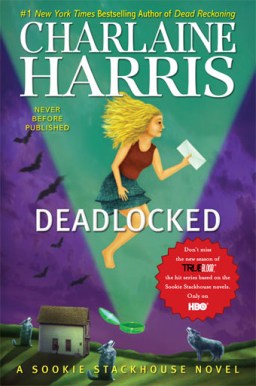
Book Review: Deadlocked (Sookie Stackhouse, #12)

Book Review: Deadlocked by Charlaine Harris

Oh, Sookie. I think it’s time to say good-bye. Twelve books in, the Southern Vampire series has run its course and then some.

Things I know after reading Deadlocked:

– where Sookie shops for groceries
– how she likes to dry her hair
– whether or not she shaves her legs each day
– how much thought she puts into what she wears
– how she makes sweet potato pie
– that she applies make-up more heavily on days when she’s feeling down…

I could go on and on… which is what Charlaine Harris does in this book. Endless, endless detail about the minutiae of Sookie’s life. If only we were spared even a few of her countless showers, this book would have been a lot shorter.

Not to say that there aren’t plot developments — but not really enough of them, or ones weighty enough to sustain an entire novel. Clearly, the author is trying to spin out the story until we get the final book in 2013. However, I do feel that Deadlocked, with a bit of pruning and editing, could have encompassed a good wrap-up and spared us the year of waiting we’ll now have until the next book comes out.

So what do we get? A mystery that’s not very mysterious, a bunch of werewolf drama, fae intrigue and plotting, a random phone call from an ex-lover, and some very slow-moving changes in Sookie and Eric’s relationship. That’s about it. If I understand the end correctly (and I think I do), then the stage is set for what I’ve believed for some time will be the series finale and Sookie’s happily ever after. I won’t go into detail, because that would be a bit spoilerific. I guess I’ll have to wait a year to find out if I’m right.

Sookie, it’s been a fun ride, but I won’t be sorry to see your story brought to a conclusion, at long last. It’s really time.

Book Review: Ocean’s Surrender by Denise Townsend

Book Review: Ocean’s Surrender by Denise Townsend

Is it hot in here?

Or could it be the hot and heavy Ocean’s Surrender that’s generating enough steam to curl my hair?

Following up on her first selkie/human erotic love story, Ocean’s Touch, Denise Townsend gives us another story of love, sexual awakening, female empowerment… and plenty of selkie sexy times.

In Ocean’s Surrender, main character River is damaged, hurting, and afraid to open her heart. After suffering horrific abuse at the hands of a former boyfriend, River shuts herself off from the possibility of loving again, focusing all her energy on caring for her sweet, developmentally disabled brother Jason. Fen is a selkie – a magical creature of the sea who can assume human form (gorgeous human form, I might add) — whose empathic powers hear the call of River’s suffering and draw him toward her. Fen’s mission is to open River’s heart again by helping her past the pain, guilt, and self-blame that have been tormenting her.

With Fen’s guidance, River comes to realize that she’s not at fault for the terrible events in her past, and learns to trust herself enough to start trusting others, including the very hot and sexy paramedic who has been in love with her for the past year.

Denise Townsend, in Ocean’s Surrender and its predecessor, has created a story that is compelling and well-told, with pathos and humor. At the same time, she includes very graphic sex scenes that not only make sense in terms of the overall plot, but are in fact key to crucial elements of the plot development.

It’s through River’s sexual experiences with Fen that she begins to heal, and from that healing arrives at a place where she can reclaim her own sexuality and ability to love. Those encounters and the resulting changes in River are what allow her, finally, to reach out to the man who loves her and to start rebuilding a full and complete life again.

And those sex scenes! You know how in old Hollywood movies, whenever the romance would start getting a little hot, the camera would pan away to a candle, a curtain, or some other inanimate object? That definitely doesn’t happen here. No pans, no slow-fades. The sex scenes are honest and raw, body parts are named (“c-words” galore!), and the action is explicit without ever being gross. There’s a joy here in the characters’ sexual discovery and exploration; yes, it’s steamy, but it’s also quite lovely.

Overall, I’d describe Ocean’s Surrender as a beautifully written erotic love story, with just the right mix of a meaningful storyline, magical fantasy elements, and really terrific erotic scenes. Creative, sexy, and fun, this one is a winner.

Note: With grateful appreciation to the author for providing me with an ARC to review.

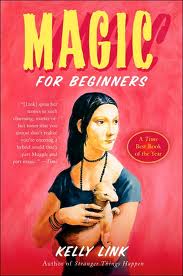
Book Review: Magic for Beginners by Kelly Link

Book Review: Magic For Beginners by Kelly Link

After finally putting down the borrowed copy of Magic for Beginners which I’d been reading on and off for the past week, I can make two definitive statements:

1)      Kelly Link is a very gifted writer.

2)      I suck at short stories.

I really gave it my all, but I couldn’t quite bring myself to read all eight stories in this collection. I managed to get through six (although for two, my reading might better be described as skimming). If you read my blog post from a few days ago (see it here), you’ll know that I pick up short story collections rarely and reluctantly, but in this case, I’d heard enough high praise for Kelly Link to decide to give it a go.

I absolutely loved the first story in the collection, “The Fairy Handbag”, narrated by a teen girl whose recently deceased, oddball grandmother has appointed her the guardian of a magical handbag. According to Grandmother Zofia, the people in her little village of Baldesziwurlekistan all picked up and moved into the handbag hundreds of years ago in order to escape a terrible invasion, and have lived there happily ever since. “The Fairy Handbag” is weird and wonderful, and I was thoroughly enchanted.

Also very good was “The Stone Animals”, about a family who leaves Manhattan and moves into a country home upstate, only to discover that, slowly but surely, all of their possessions have become haunted. I’m not sure what any of it actually meant, but I love some of the imagery used, especially this brief glimpse of the pregnant wife who can’t stop painting and repainting the rooms in the house:

He found Catherine standing on a ladder in the kitchen, one foot resting on the sink. She was wearing her gas mask, a black cotton sports bra, and a pair of black sweatpants rolled down so he could see she wasn’t wearing any underwear. Her stomach stuck out so far, she had to hold her arms at a funny angle to run the roller up and down the wall in front of her.

The story entitled “Magic for Beginners”, equally weird and oddly touching, is the tale of a fifteen-year-old boy and his friends who are obsessed with a mysterious TV show called The Library. Or is this story about characters on a TV show called The Library who are obsessed with a TV show called The Library? At one point, main character Jeremy wonders “about what kind of television shows the characters in television shows watch.” Kind of made my head spin.

Kelly Link’s writing is lyrical and full of unconventional images and similes. Just two of the many that made me smile:

He feels like a tennis ball in a game where the tennis players love him very, very much, even while they lob and smash and send him back and forth, back and forth.

And…

The disco ball spins and spins. It makes Jeremy feel kind of carsick and also as if he has sparkly, disco leprosy.

Kelly Link has great talent, and I truly enjoyed the stories I read. The fact that I couldn’t get through all of them certainly has more to do with me as a reader rather than with the quality of the book. If you enjoy short stories, and get a kick out of worlds weird and twisted, I’d definitely suggest giving this collection a whirl.

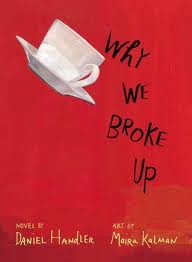
Book Review: Why We Broke Up by Daniel Handler & Maira Kalman

Book Review: Why We Broke Up by Daniel Handler; illustrated by Maira Kalman

Min Green and Ed Slaterton were young and in love… and then they broke up. Why We Broke Up, written by Daniel Handler and gorgeously illustrated by Maira Kalman, is Min’s letter to Ed, hastily and tearily written by Min on her way to dump on Ed’s doorstep all of the accumulated mementos from their brief but intense relationship.

The writing is supercharged with teen-aged emotion and humor. Min is part of the “arty” crowd, an avid film buff who relates everything in life to old movies. When she falls unexpectedly for golden boy Ed, co-captain of the basketball team and center of all that’s popular in their high school, you’d think it was the Montagues and Capulets all over again. Neither Min’s nor Ed’s friends approve, but these two are in orbit around each other.

The point of view is quite interesting. We’re meant to sympathize with Min, yet I can’t help but feel that her perspective is not always reliable. Ed points out to Min repeatedly that he likes her because she’s different — meaning different from him and his friends — but Min never seems to work her way around to being able to reciprocate. Instead, it’s Ed’s popularity and the seeming ease with which he breezes through life which Min consistently adds to the list of reasons of why they broke up. She seems to try to mold Ed into her idea of an acceptable boyfriend, but can’t bring herself to enjoy any of the pursuits that make Ed who he is. Min fails to do more than acknowledge in passing that Ed is largely being cared for by his older sister while his mother is ill — yet as readers, we can infer that his mother is terminal, and thus Ed’s actions may be understandable in a different light, one which Min ignores completely.

Still, these two sparkle together, and their love and lust take them to some touching and surprising places before they’re through with one another. Min speaks with the voice of a girl experiencing first love, and her heartbreak when it falls apart is piercingly true. Min’s internal collapse when she realizes that it’s all over is particularly well-written — a three-page venting that anyone who’s been a teen-aged girl can relate to, in which she lists all the ways in which she’s not special, not different, not anyone of note. It’s dismaying, yet so true a first reaction to rejection that I had to stop and marvel that a male author could capture a girl’s inner voice so accurately.

The writing sparkles, the pictures are lovely, and the story is just a delight. Don’t let the young adult classification fool you — this is good literature, enjoyable for anyone who appreciates witty characters, heartfelt emotions, and a story well-told. Don’t miss it.

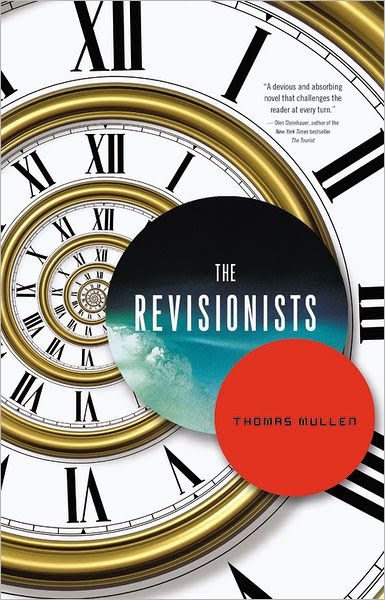
Book Review: The Revisionists by Thomas Mullen

Book Review: The Revisionists by Thomas Mullen

(Hardcover edition published September 2011; paperback due out in October 2012)

Maybe you could drive yourself crazy trying to chart backward all the causes and effects, all the ends and means, tracing everything to some original sin that may or may not have actually occurred but that people accepted as true, or true enough. Maybe staring into the eyes of all that history was a dangerous thing to do, as her mother had calmly warned her. Maybe you were supposed to move forward armed with just enough history to help you figure out the present without obsessing over the past. But how much was enough? Where was the gray area between ignorance and obsession?

The Revisionists was not at all what I’d expected, yet I couldn’t put it down.

I have a soft spot for all things time-travel, and the basic synopses I’d read of this book seemed to put it squarely into that genre: Main character Zed works for a post-disaster society at some point in time several centuries from now. In the “Perfect Present”, there is no war, no racial tension, no hate. Zed’s government agency works to keep the perfect present perfect, by sending agents into the past to thwart “hags” — historical agitators — whose mission is to stop disasters (think 9/11, concentration camps, etc) before they can happen, on the assumption that all these calamities were a necessary step in history in order for the perfect present to come to be.

Confusing? You bet.

And strangely, that’s not at all what this book is really about. Much more than anything else, I’d describe The Revisionists as an espionage-thriller set in DC, filled with intrigue, shadowy quasi-governmental intelligence outfits working against one another, multiple layers of pawns and spymasters, and a reality that slips and shifts from chapter to chapter.

This is not a sci-fi book, when you get right down to it. Zed’s mission is the driving narrative, yet we get no information whatsoever about the mechanics of his time travel and only the barest of descriptions of some futuristic technology. Without saying anything that might inadvertently be a spoiler, I will say that the entire time travel premise is not necessarily what it appears to be, depending on how you choose to interpret certain events and passages.

I was fascinated by this book, and it will probably take me some time to mull over all the twists and turns and come to terms with what may or may not have happened. I do recommend The Revisionists, although I worry that its perfect target audience — people who enjoy a good spy thriller — won’t ever discover it if it continues to be described as a time-travel novel.

Q&A with the kiddo: A kid’s-eye view of Henry Huggins

Book Review: Henry Huggins by Beverly Cleary

Why should I be the only book reviewer in the family? I thought it might be fun to get my almost-10-year-old’s opinion once in a while. Proudly introducing: Q&A with the kiddo!

Getting my son to read is a struggle, to put it mildly. And when I have the mental energy, I’m sure I’ll be back to document all the ups and downs… but that’s a topic for another day.

Meanwhile, I was truly delighted this week when my son willingly sat down to read a chapter or two a night, without arguments and with only a minimal amount of fidgeting. Getting him to write something about what he reads would feel too much like homework (oh, the horror!), so an interview-style book review seemed like a win-win approach.

Without further ado — Q&A with the kiddo:

Q: What book did you read this week?

A: Henry Huggins

Q: What was it about?

A: This boy named Henry in 3rd grade, he found a dog and didn’t know its name. He gave the dog ice cream from his ice cream cone and then he called the dog Ribsy because he could see his ribs. Then he called his mom and asked if he could keep him. At the end, the owner came and said, “I miss that dog.” They decided to let the dog choose. It took a while, but he picked Henry.

Q: Did you like the book?

A: Yes.

Q: Who was your favorite character?

A: I don’t know. (Blogger’s aside: I think I was starting to annoy the kiddo at this point; he wanted to get back to his video game…)

Q: Can you give me a general description of what the book was like?

A: Exciting and it had some drama in it.

Q: Would you want to read more about Henry and Ribsy?

A: Yes.

Q: Was this a good reading level for you?

A: Yes.

Q: Who do you think should read this book?

A: Basically anybody. Most kids in 3rd and 4th grade would like it.

So there you have it. We’ll be back with more book opinions from my kiddo, assuming I can get him to sit down and read again any time soon!

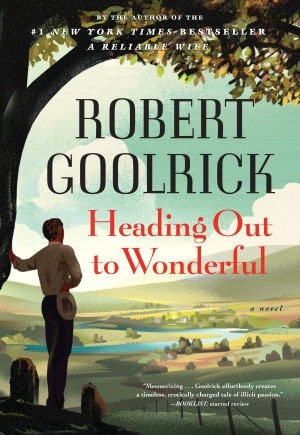
Book Review: Heading Out To Wonderful by Robert Goolrick

Book Review: Heading Out To Wonderful by Robert Goolrick


I’m struggling to figure out just what I want to say about Heading Out To Wonderful. The writing is lovely, and I became involved enough in the plot that I stayed up way past my bedtime to finish the book. On the other hand, I’m not sure that the whole is greater than the sum of its parts.

Heading Out To Wonderful is set in the sleepy rural town of Brownsburg, Virginia in 1948, post-war years when life in America was on the cusp of change. The author lovingly describes the quality of life in Brownsburg:

Brownsburg, Virginia, 1948, the kind of town that existed in the years right after the war, where the terrible American wanting hadn’t touched yet, where most people lived a simple life without yearning for things they couldn’t have…

And also:

A particular town, then, Brownsburg, in a particular time and place. The notion of being happy didn’t occur to most people, it just wasn’t something they thought about, and life treated them pretty well… the notion of being unhappy didn’t occur much either.

Into this small town arrives Charlie Beale, an attractive and pleasant man who appears in his truck one day, bringing nothing but two suitcases, one filled with butcher knives and one filled with cash. Charlie seeks out work with the local butcher, buys a plot of land out by the river, and settles in.

Charlie remains something of an enigma throughout the book. He is 39 years old, athletic and graceful, skilled with his hands and his knives. He served in Europe in the war, but doing what exactly, we never find out. The only clue we get about his wartime experiences is that his butcher knives are German; we can only speculate as to where or how he acquired them.

Charlie doesn’t speak about his childhood or background except in vague generalities. Where did all that cash come from? We don’t know. Charlie is full of yearning, for a place, for land, for connections, and for goodness. Somehow along the way, Charlie lost his sense of hope, and so he set out traveling, looking for “something wonderful”. His new friend and employer Will tries to reset Charlie’s expectations:

Let me tell you something, son. When you’re young, and you head out to wonderful, everything is fresh and bright as a brand-new penny, but before you get to wonderful you’re going to have to pass through all right. And when you get to all right, stop and take a good, long look, because that may be as far as you’re ever going to go. Brownsburg ain’t heaven, by any means. But it’s perfectly fine. It’s all right.

Charlie seems to have found “all right” in Brownsburg. He earns the friendship of the townspeople, and is the adored companion of Will’s young son Sam. Charlie might even have been content at last, until he meets Sylvan Glass, a 17-year-old “hillbilly” girl, bought and paid for by the richest man in town, now a trophy wife who dreams of glamour and Hollywood. What follows is a year-long affair which consumes Charlie and disrupts the lives of everyone in town. Reading about Charlie and Sylvan, we know that something disastrous has been set in motion; I could only wait to see what shape the disaster would ultimately take.

A sense of foreboding hangs over the story from the outset. It’s clear that nothing good can come out of the affair. By the time I reached the half-way mark in the book, it became very difficult to put down, and I had to keep reading to see which way it would go. To avoid spoilers, I won’t say anything about the book’s climax, other than to say that events unfold that are at the same time tragic yet not unexpected.

At the conclusion, I was disturbed by the lack of overall coherence. Many plot elements that are compelling are introduced, but I didn’t see the follow-through. The black and white communities live completely separate lives in Brownsburg. Both Charlie and Sylvan develop relationships that reach out across the color lines, yet I didn’t feel that this part of the story particularly went anywhere. Concepts of sin and salvation are introduced as Charlie struggles to fit into the spiritual life of the community, but again, I didn’t feel the points were carried through as the plot unfolded.

Ultimately, dramatic as the story is, Heading Out To Wonderful left me a bit puzzled at the end, wondering about the point of it all. Robert Goolrick is a terrific and thoughtful writer – I loved his previous novel, A Reliable Wife, with its dark secrets and twisty-turny plot developments. Unfortunately, despite the lovely prose, Heading Out To Wonderful doesn’t quite deliver.