A book with the kiddo: Dinosaur Summer by Greg Bear

Book Review: Dinosaur  Summer by Greg Bear
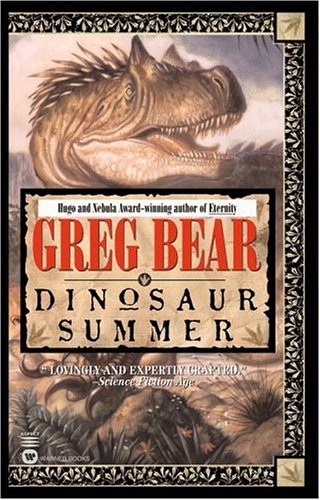
dinosaur summerDinosaur Summer takes the 1912 novel The Lost World (by Sir Arthur Conan Doyle) as its starting point, imagining a world in which The Lost World is not fiction, but rather a history of a real discovery of dinosaurs living in an isolated world on a South American plateau.

It is 1947 when Dinosaur Summer opens, and the world has pretty much lost interest in the marvels of Conan Doyle’s discoveries. Dinosaurs had become so commonplace in the years since 1912 that all circuses had to have them — but in the post-war years, there just isn’t enough public demand to keep the dinosaur circuses running, and finally, the very last one is about to close for good.

15-year-old Peter Belzoni lives with his father Anthony, who is wild, impetuous, and prone to drinking too much. Anthony decides to bring Peter on the adventure of a lifetime by securing gigs for both of them with National Geographic, to photograph and write about an epic undertaking: the return of the last circus dinosaurs to their original homes on the El Grande plateau. Accompanying the expedition are filmmakers, trainers, and various local guides and authorities — and as the team sets sail and then journeys through the jungles and rivers of South America, the trip becomes more and more dangerous.

I read this book with my 11-year-old son, based on the recommendation of an old friend who is a terrifically well-read sci-fi connoisseur. But note: Dinosaur Summer is not a kids’ book! As far as I can tell, this is adult science fiction — but with an angle that definitely appealed to my kiddo.

We enjoyed the action, the drama, the danger, and the humorous dialogue. In Dinosaur Summer, the lost world of El Grande has evolved on its own, in isolation from the rest of the world. Consequently, the animal species are unique (and fictional, for the most part). The author helpfully includes a “What’s Real, and What’s Not” afterword, and the kiddo and I had a good time looking  up illustrations of similar dinosaur, reptile, and mammalian species. Most memorable (and life-threatening) are the death eagles (yikes), and weirdest are communisaurs, mole-like dinosaurs who live in hives serving a queen.

Dinosaur Summer has drawings throughout by illustrator Tony DiTerlizzi. You can see a few from the book on his website.

A few minor quibbles: The story occasionally bogs down in details about political conflicts between the Venezuelan government, the army, the indigenous tribes, and the oil companies. Likewise, much of the catalyst for the expedition has to do with Hollywood interest, and there are a lot of characters introduced connected to the movie studios, to the point that the action drags a bit as we are introduced to producers, cameramen, studio heads, and more. Frankly, the names become overwhelming at times — although it was amusing to see some real-life Hollywood folks included here as characters in the story. (Most notably, special effects pioneer and movie great Ray Harryhausen is featured prominently as both a member of the expedition and a mentor to Peter, and I can only imagine how much he must have enjoyed the tribute when the book was published.)

Of course, it’s entirely possible that the draggy bits mentioned above wouldn’t have been an issue if I’d just sat and read this book on my own. It’s just that in reading it aloud, the passages and chapters that were so crammed with Hollywood names and political drama just didn’t flow. I will say, however, that this didn’t seem to bother my kiddo in the slightest — I think he just ignored the parts that he didn’t get, and focused on the action… of which there is plenty!

Some of the scenes toward the end are on the gory side for a bed-time story, not that my son seemed to mind. Still, I felt a teeny bit like a bad mother reading to him about dinosaurs chomping and eviscerating right before tucking in his blankets and turning off the light!

All in all, both my son and I were fascinated by Dinosaur Summer, which nicely blends high-stakes adventure with a surprisingly touching story of a boy growing up, figuring out who he is, and developing a more adult relationship with his difficult father. I recommend this book for adults looking for an old-school adventure, as well as for middle school to teen readers who don’t mind having to work a bit for a good story.

_________________________________________

The details:

Title: Dinosaur Summer
Author: Greg Bear
Publisher: Warner Books
Publication date: 1998
Genre: Science fiction
Source: Purchased

Book Review: Harrowgate by Kate Maruyama

Book Review: Harrowgate by Kate Maruyama

HarrowgateA horror story that is really a tale of love and loss, Harrowgate surprised me with its deep emotional impact and sheer hypnotic pull.

As Harrowgate opens, geologist Michael is rushing home to his pregnant wife Sarah. He’d been out in the field on a remote assignment, and after receiving a cryptic message about an emergency, it has taken him close to two weeks to navigate the Jeep rides and multiple airplane transfers that finally bring him to his New York apartment building. Unable to reach his wife or anyone else, Michael is unsure what to expect. It’s early for the baby to arrive, but surely not so early as to be dangerous. Or is it? Michael is relieved to arrive home and find his wife and healthy son waiting for him — but his bliss is tempered by the presence of an odd stranger, a doula named Greta, who seems to have some sort of hold over Sarah.

At first, Sarah insists that Michael shouldn’t touch the baby — but soon after, Greta urges Michael to be with Sarah and baby Tim as much as possible, to not leave the apartment for any reason, not even to pick up diapers or groceries. Greta’s encouragement sounds more like a warning or a threat, though, and there’s something not quite right about this person who just keeps showing up.

Questions begin to pile up: Why doesn’t Sarah want Michael to answer the phone or go out? Why does the doorman give him such pitying looks? Is Sarah so exhausted by new motherhood that she hasn’t noticed the refrigerator full of spoiled food?

The answers, as they come, are chilling and awful. Michael uncovers the truth about his family’s tenuous grip on happiness — but knows too that this happiness has a dark side, and that his ability to hold onto his family may be slipping away.

To go into any further plot details would be a huge disservice, as Harrowgate is a book to be explored and savored, best enjoyed without any advance knowledge of what is really going on. Looming dread and dismay permeate the book, and while this isn’t a gore-filled horror novel, it does leave the reader thoroughly spooked.

There’s something so creepy about horror stories revolving around birth and babies. Perhaps it’s the contrast of joy and innocence with the darkness looming on the other side. I’ve heard this book compared to Rosemary’s Baby or Breed, but beyond the New York setting and the strange events around a birth, the storylines have little in common.

What Harrowgate actually put me in mind of the most, while reading, was The Silent Land by Graham Joyce, one of my very favorite books. In both, there’s a central story of love that should be perfect — except the reader can feel the edge of something wrong surrounding everything joyful that happens.

And there is quite a lot of joy in Harrowgate, despite the fact that it’s also very, very sad. At its core, Harrowgate is a love story. The love between Michael and Sarah, and the love they both feel for their baby Tim, creates a power in the little haven inside their apartment that keeps the rest of the world at bay.

While I wish the ending has explained things a little more clearly, I was mostly satisfied with the wrap-up. The emotional depths explored in this book carry such strong notes of tragedy and relentless loss, and yet the journey Michael takes in exploring how very much he loves his wife and child is also quite lovely to read.

You don’t have to be a horror fan to enjoy Harrowgate. For anyone who enjoys a touch of creepy gothic mystery set within a familiar landscape, I’d recommend giving Harrowgate a try. Well-written and compelling, this brief novel sucked me in and made it impossible to quit reading before the end.

_________________________________________

The details:

Title: Harrowgate
Author: Kate Maruyama
Publisher: 47North
Publication date: 2013
Genre: Horror
Source: Borrowed from a friend

Book Review: Snowblind by Christopher Golden

Book Review: Snowblind by Christopher Golden

SnowblindIn the small town of Coventry, Massachusetts, falling snow does not bring a winter wonderland. In a devastating blizzard, eighteen people from Coventry die tragically through accidents or simply getting lost in the blinding storm. Twelve years later, another blizzard is on the way — but heavy snows and winds are not all that’s coming to town. As the storm builds, the dead begin to return. What do they want? And who will survive this time around?

In Christopher Golden’s Snowblind, the darkening skies are ominous, and it quickly becomes clear that no one is safe. For the love of all things great and good, stay inside, people of Coventry! But even staying indoors offers no guarantees against the storm: There are bad things out there in the wind and snow, and all they need is one small crack, one little draft, to slip inside the house and come for you.

Reminiscent of the scope of a Stephen King novel, in the early chapters we meet a sprawling array of characters, including police officers and school teachers, auto mechanics and thrill-seeking teens, and children just old enough to want to hide their fears, but young enough to know that the faces they see out in the storm are real.

The first part of the book, set during the first blizzard, is excellent. We don’t know what’s coming — but it’s clear that whatever it is, it’ll be bad. As we meet the characters and then see them, one after another, head out into the snow, the tension builds. Something is out there, and it’s deadly. Reading these chapters, I was on the edge of my seat — and despite living far away from any hint of winter weather, I couldn’t help jumping a bit whenever I heard the wind blow outside.

About a third of the way in, the action jumps to twelve years later, and here I felt the story sagged a bit. It’s interesting to see what’s become of the survivors of the earlier blizzard and how they’ve moved on — or not — with their lives. Children have grown into damaged young adults; a young woman who’d lost her love is now bitter, middle-aged, and prone toward overindulging on her nightly glasses of wine; a couple has never quite gotten past their guilt and memories from years earlier; and a rookie cop is now a detective who swears he won’t let another kid die on his watch. And yet, there’s quite a lot of build-up before the new storm arrives, and the action grinds more or less to a halt in places in favor of exploring the characters’ emotional states.

The final storm and conclusion isn’t quite as scary as I would have liked. The set-up is terrific, but the explanation of what really happened in the storm and the characters’ struggles to survive don’t convey quite the level of terror that a book like this really needs. Perhaps the climax is too scattered: because we’re tracking so many storylines, there’s no one scene or focus that really shouts “this is it!”

I liked Snowblind very much, and thought the initial set-up and early scenes were excellent — just the right mix of character introduction, impending threat, and disastrous outcome. Because there are no answers at that point, just the sense that something VERY BAD is out in the blizzard, it’s scary indeed to read. Unfortunately, the rest of the book doesn’t quite live up to the earlier section, and the conclusion didn’t feel like a very satisfying pay-off, fright-wise.

Of course, I had the benefit of reading Snowblind from the comfort of my warm home, on a day with clear blue, sunny skies. Had I been reading it with all of this month’s winter storms brewing outside, I might not have maintained quite such a level of calm. If you read Snowblind, stay warm, and watch out for drafts! And if you hear scratching on your roof, don’t worry: It’s PROBABLY just the wind.

_________________________________________

The details:

Title: Snowblind
Author: Christopher Golden
Publisher: St. Martin’s Press
Publication date: January 21, 2014
Genre: Horror
Source: Review copy courtesy of St. Martin’s Press via NetGalley

Book Review: What Nora Knew by Linda Yellin

Book Review: What Nora Knew by Linda Yellin

What Nora KnewFor 39-year-old Molly, romance is something you see in the movies. Still bitter about her divorce five years earlier from her cheating ex-husband, Molly is in a nice, comfortable relationship with a nice, comfortable chiropractor. Working as a features writer for an online magazine, specializing in pieces about zany challenges like skydiving, taking a vibrator through a security checkpoint, or learning to be a Rockette, she excels at being daring in every aspect of her life — except when it comes to love. When Molly’s boss gives her an assignment to write about love, using Nora Ephron as a guidepost, she fails utterly, but finally gets the kick in the pants she needs to take a long, hard look at her life and her attitude toward love. And, as you’d expect, Molly finds herself drawn to the guy she doesn’t want to be drawn to, and finally has to confront what’s stopping her from taking the big leap… and taking a big chance on crazily romantic, head-over-heels, passionate love.

So what did I think? Let’s start with what I liked: What Nora Knew is a fast-paced, frenetically fun look at being single and being in the dating pool, from the vantage point of a woman on the verge of hitting the big 4-0. The main character is savvy and smart, and has been around the block enough times to have learned some very hard truths about the odds of finding “the one”. I liked that she’s a woman with a career that’s important to her, and that she’s willing to fight and take chances to make her writing dreams come true. The taste of New York is upbeat and exciting, and I enjoyed the use of Nora Ephron’s big romantic movies — Sleepless in Seattle, You’ve Got Mail, and When Harry Met Sally — as a template for finding and recognizing the person who makes you want to take a chance.

There are some very quippy, quirky moments that strike a great note of cynicism blended with humor. The tone overall is light and brisk, with many quote-worthy moments — such as this interview between Molly and an older gentleman on the subject of finding true love:

“How did you know she was the one?”

He shrugged. “You marry someone. Wait thirty years. If she’s still there — she’s the one.”

What didn’t I like? Well, let’s face it, in this type of book, you just never see people worrying about their paychecks or their rent. Molly works for a living, but she also comes from a well-off family, gets invited to the Hamptons for summer weekends, and eats in the best restaurants — even if it is on the company expense account. I got a little tired of reading about rich people doing rich people things. A trip to Tiffany’s? Ho hum.

I didn’t really buy the love interest or the chemistry between the two. Molly’s destined guy is pretty much an enigma throughout the book; he’s a bestselling author who speaks in platitudes, and Molly seems to be faulted in the book for not taking him at his word — but honestly, I never knew if he was on the level and could totally get why she’d mistrust him as well.

In this type of book, with romance as the focus, being single pretty much equals being a loser. Even Molly’s hard-nosed businesswoman sister and 80-something-year-old grandmother find romance — clearly, the problem must be Molly. The idea that if you don’t fall into passionate and romantic love, then there’s something wrong with you really is not going to help the self-esteem of any single women reading this book. So if we all try to emulate a fictional character in a Nora Ephron movie, we’ll finally find the true love we’ve been promised? This may work in a novel that aims for madcap, but I’d hate to see someone apply this philosophy in real life.

The humorous tone works on and off throughout the book. It does get to be a bit much at times, and I often felt that the author went overboard with attempts to portray Molly’s escapades as wacky and wild. But who knows? Perhaps I’m just too serious and cynical by nature to be able to throw caution to the wind and just go with it.

It’s a cute premise, and not without a great sense of fun, but overall? I’d have to put What Nora Knew squarely on the chick-lit shelf — and in general, I’m not a fan of chick-lit. It’s a fluffy diversion, and if you like this sort of thing, you’ll have a good time. For me? It’s not the type of book I’d usually seek out, and it won’t make any of my “best of” lists, but it kept me entertained while I was reading it, and that’s something.

_________________________________________

The details:

Title: What Nora Knew
Author: Linda Yellin
Publisher: Gallery Books
Publication date: January 21, 2014
Genre: Adult fiction
Source: Review copy courtesy of Gallery Books via NetGalley

Book Review: The Golem and the Jinni by Helene Wecker

Book Review: The Golem and the Jinni by Helene Wecker

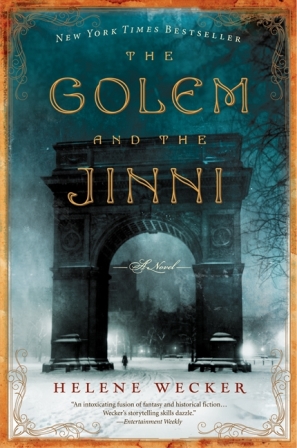
The Golem and the Jinni PBI’m so excited to be a part of the blog tour for the paperback release of The Golem and the Jinni!

The Golem and the Jinni was certainly one of the buzziest books of 2013. Written by a debut author, this book started showing up everywhere! For myself, I sat up and took notice as soon as I read the title (and saw that gorgeous cover) — then paid even more attention as the initial reviews rolled in, all marveling over the originality of the story and the beauty of the writing.

Well, guess what? All that praise? Totally justified.

I finally read The Golem and the Jinni as one of my last books in 2013 — and wanted to kick myself for waiting so long to read it!

In brief, The Golem and the Jinni is the story of two mythical beings from two very different cultures: The Golem is a creature from Jewish mysticism, a human-like creature of clay whose purpose is to obey and protect its master. (Most famously, there is the legend of a golem created by the Rabbi of Prague in the 16th century to defend the Jewish ghetto against attack. Once the golem’s mission was completed, it returned to inanimate clay.) The Jinni is a legendary being from Arabian tales, a desert spirit of fire with the ability to take on different forms — but don’t confuse the Jinni in The Golem and the Jinni with the big blue guy from Disney’s Aladdin!

In this lovely novel, a female golem and a male jinni — both with human appearance — find themselves, accidentally and unwillingly, in New York in 1899, and must find a way to blend in, survive, and adapt to living among humans. Chava, the golem, is taken in by a kindly rabbi and finds a home in the Jewish Lower East Side, by all appearances a modest young widow who keeps to herself while working in a bakery and taking in mending. Ahmad, the jinni, can work wonders with metals of all kinds and finds refuge and employment with a tinsmith in the Little Syria neighborhood, but is filled with rage at his lack of freedom and spends each night wandering the city. When Chava and Ahmad cross paths, they recognize in each other a kindred spirit, and form a bond that’s full of disagreement and polarity, but also a deep understanding of what it means to be trapped, to hide one’s true nature, and to long for freedom and purpose.

I loved everything about The Golem and the Jinni. The writing here is lovely, conveying the feeling of listening to a master storyteller. There’s a sense of mythology and otherworldly power pervading the story, and yet it is most firmly rooted in the day-to-day realities of life in the early days of the 20th century. New York comes alive within the pages, filled with immigrant communities, ethnic loyalties, the sights and smells of a cramped city without modern conveniences; yet it is also a city striving to improve itself and modernize from moment to moment. From the Bowery to Central Park, the characters explore the nooks and crannies of Manhattan, its beauty and its ugliness, as well as the people who call it home.

We come to care deeply about Chava and Ahmad, and yet can also understand the sentiments and superstitions of the people who meet them and, without understanding why, sense innately that these two are different and perhaps dangerous. Embedded within the story is an examination of what it means to have a purpose in life, and whether anyone can truly overcome his or her essential nature and make themselves over into someone new. As Chava and Ahmad struggle to change their destinies and find freedom, they confront their own limitations and must either find a way to start fresh — or admit defeat, and allow themselves to be destroyed.

There are small moments of great beauty — for example, Ahmad’s ability to create delicate silver and gold animals using only his hands — as well as excitement, danger, and even peace. The scenes of bustling New York are set in contrast with Ahmad’s memories of his lost life in the desert, pursuing a Bedouin encampment and ultimately falling victim to its vengeance. In The Golem and the Jinni, the author skillfully weaves together a modern-day tale with something out of legend, and the blending is masterfully done.

I simply can’t recommend this book highly enough! Start to finish, The Golem and the Jinni is captivating and magical, and an absolute treat to read.

About the Author:

Helene WeckerHelene Wecker grew up in Libertyville, Illinois, a small town north of Chicago, and received her Bachelor’s in English from Carleton College in Minnesota. After graduating, she worked a number of marketing and communications jobs in Minneapolis and Seattle before deciding to return to her first love, fiction writing. Accordingly, she moved to New York to pursue a Master’s in fiction at Columbia University.

She now lives near San Francisco with her husband and daughter. The Golem and the Jinni is her first novel.

_________________________________________

The details:

Title: The Golem and the Jinni
Author: Helene Wecker
Publisher: HarperCollins
Publication date: 2013
Genre: Adult fiction
Source: Review copy courtesy of TLC Book Tours.

tlc logoFor further information, visit the author’s website or stop by TLC Book Tours to view other blog tour hosts.

Book Review: How To Save A Life by Sara Zarr

Book Review: How To Save A Life by Sara Zarr

How to Save a LifeLove and loss, belonging and alienation — these weighty topics are the backbone of How To Save A Life, a moving but never oppressive young adult novel by talented author Sara Zarr.
Jill, a high school senior, is so choked by grief over her father’s death ten months prior that she’s practically consumed by the anger she carries with her. Having pushed all of her friends away and barely hanging onto her on-again, off-again boyfriend Dylan, Jill lives with her mother Robin in their lovely Denver home, struggling to make it through each day without having to confront her loss all over again. Meanwhile, Robin has so much love to give that she decides to adopt a baby — a spur of the moment decision that sends Jill around the bend.

Mandy is the pregnant 19-year-old, almost too naive for words, who comes into Robin and Jill’s lives, carrying a burden of secrets and lies and desperate need. Mandy’s life has been a horror, with a mother incapable of mothering, who has subjected Mandy to a string of her awful boyfriends and filled Mandy’s head with constant lectures on how to attract a man, how to catch a man, how to keep a man. Mandy insists on an open adoption — but no lawyers or social workers — and when Robin eagerly agrees, Mandy catches a train from Omaha to Denver and moves in with Robin and Jill.

As we see events unfold in alternating chapters narrated by Jill and Mandy, we are privy to each girl’s slightly skewed and unhealthy view of their worlds. Jill’s sad truth is that as much as she loves her mother, her father was the one she was closest to, the one who taught her everything, was her champion and idol, and she is only half of herself without him. Mandy has nothing, and as she settles into what is intended to be a temporary arrangement with Robin and Jill, she realizes that she’s never felt a sense of home before in her life, and realizes how very much she wants that — not just for her unborn baby, but for herself.

Jill is initially aghast at what she sees as a poorly thought-out, spontaneous decision by Robin, and she is hostile and suspicious around Mandy. But little by little, Jill and Mandy start to connect, and Jill realizes that maybe she can help Mandy as well as her mother, and who knows? maybe even herself.

The voices of the two girls are distinct and authentic, and although Mandy struck me as too odd to be real at first, it quickly becomes clear that there are reasons why she acts and thinks the way she does. Robin is wonderful and supportive — in fact, she may be slightly too ideal to be true, but that’s hardly important here. What matters is that the author gives each girl a strong foundation and believable character growth. Jill and Mandy bring much needed change to each others’ lives, and in a way force each other to snap out of their unhealthy or isolating behaviors and mindsets and start thinking about the future.

The narrative flows quickly, and we come to care deeply about all three of the women involved: Jill, Mandy, and Robin. There’s heartbreak and pain, but also tentative steps forward, the easing of sorrow, and the creation of new lines of connection and belonging.

I found How To Save A Life moving and engaging, emotionally rich yet not without moments of humor and fun as well. I read Sara Zarr’s recently published Roomies (written with coauthor Tara Altebrando) last month, and loved it as well. Based on these two wonderful novels, I’m eager to read more by this author as soon as I can.

_________________________________________

The details:

Title: How To Save A Life
Author: Sara Zarr
Publisher: Little, Brown and Company
Publication date: 2011
Genre: Young adult contemporary fiction
Source: Library

Book Review: Perfect by Rachel Joyce

Book Review: Perfect by Rachel Joyce

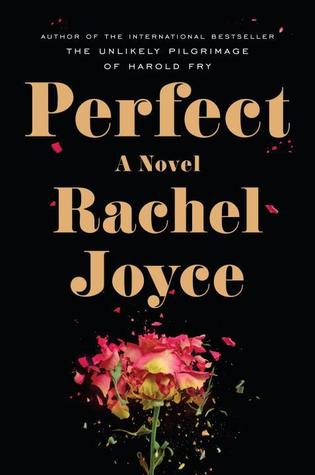
PerfectSynopsis (Goodreads):

On a foggy spring morning in 1972, twelve-year-old Byron Hemming and his mother are driving to school in the English countryside. On the way, in a life-changing two seconds, an accident occurs. Or does it? Byron is sure it happened, but his mother, sitting right next to him in the car, has no reaction to it. Over the course of the days and weeks that follow, Byron embarks on a journey to discover what really happened-or didn’t-that fateful morning when everything changed. It is a journey that will take him — a loveable and cloistered twelve-year-old boy with a loveable and cloistered twelve-year-old boy’s perspective on life — into the murkier, more difficult realities of the adult world, where adults lie, fathers and mothers fight without words, and even unwilling boys must become men. By the end, Byron will finally reconcile the dueling realities of that summer, a testament to the perseverance of the human spirit and the power of compassion.

Having read the author’s previous novel, The Unlikely Pilgrimage of Harold Fry, I expected to enjoy Perfect. Sadly, this wasn’t the case.

Perfect is written in the third-person, with alternating chapters focusing on Byron during that fateful summer of 1972 and a middle-aged adult named Jim struggling through his present-day menial job and serious OCD and emotional problems. As the story unfolds, Byron watches his mother disintegrate as her perfect facade begins to show cracks, and we also see Jim start to find a connection to an unusual woman who makes a dramatic entrance into his life.

In Byron’s part of the story, Byron and his best friend become fixated on a news story about the world clock being adjusted by two seconds in order to realign with the earth’s rotation. These two seconds take on a major significance for the boys, so that when the accident occurs, Byron is convinced that it’s because of the two extra seconds. It just doesn’t work. I was never convinced that these boys (or any boys) would fixate on this issue to the degree that they do, and it’s an odd element that adds nothing to the story.

Both Byron and the adult Jim are less than reliable observers, and so in both parts of the narrative, we view the action from very shaky ground. Unfortunately, this also has the effect of distancing the reader from the story. I always felt that I was getting a report on events, rather than witnessing them myself, and thus felt no immediacy or sense of connection as Byron’s family life spirals out of control.

Byron’s mother Diana is the central figure in the confusing and tragic events of the summer of 1972, but she remains an enigma. We know that she had a somewhat disreputable past; we see that her husband controls her every move; we learn that she has reinvented herself since being married and strives to always be a perfect wife and mother. Once Diana’s perfection is marred by the accident that may or may not have occurred, she slowly slips away from herself and her family, as without that illusion, she is left with nothing.

The portrait of Jim is interesting, as we learn bit by bit what happened to leave him in such a state, unable to function without his all-consuming rituals, constantly afraid of disaster. However,the love story that leads him to redemption is not credible in the least. How many books have we read featuring a flamboyantly eccentric, loud woman who comes into a meeker character’s life and shows him that love is possible? I don’t know about you, but I feel like I’ve seen this story a hundred times before. It’s not fresh, and it doesn’t work in this novel.

As in The Unlikely Pilgrimage of Harold Fry, the big reveal at the end of the book is meant to be a shocking twist. It is not. By mid-way through the book, it was plain to me what was really going on, and I didn’t feel that there was any true pay-off in what is intended to be a big, emotionally charged scene.

Not to say, however, that Perfect lacks interesting or redeeming qualities. There’s a twisted relationship that develops in the aftermath of the accident, and it is fascinating to see how Diana’s doubts and guilt lead her to become the victim of an opportunistic stranger, with Byron’s attempts to help only exacerbating and hastening Diana’s downfall. The changing landscape of the moors and villages in Perfect serve to reflect the social dynamics of the time, and as the economy worsens over the decades, we see that reflected in the surrounding housing communities and countryside as well. The tension between the wealthy private school families and the lower-class townies comes into play in the main storyline, and adds an interesting dimension to the unfolding drama and the tragic events that occur.

Despite being a quick read, Perfect simply doesn’t satisfy. The quirky characters and cause-and-effect plot devices never feel real or believable, and as a result, I was unmoved by the confrontations and resolutions that should have been emotionally rich. Lacking any connection to the characters and just not buying some of the major events and their catalysts, I would have to consider Perfect a disappointment.

_________________________________________

The details:

Title: Perfect
Author: Robin Joyce
Publisher: Random House
Publication date: January 14, 2014
Genre: Adult contemporary fiction
Source: Review copy courtesy of Random House via NetGalley

Getting graphic: My Sunday reading

Fables: Snow White (volume 19) by Bill Willingham

Fables, Vol. 19: Snow White (Fables, #19)I thought I’d dedicate my sunny Sunday to sitting outdoors, enjoying the blue skies, and devouring my newly arrived copy of Fables, volume 19. Devour it I did, and boy, was it delicious!
I think I’ve made it perfectly clear by now that I’m a huge fan of Fables. So what did I think of volume 19?

First and foremost, it’s Fables! Which is practically synonymous with awesomesauce. Is there any way I’d give a Fables volume less than a 5-star rating at this point? I adore everything about this series, and this volume definitely delivers.

We get a great wrap-up of the Bufkin story to kick things off on a light note, but the rest of the volume takes us to some pretty dark places… and leaves off with a cliffhanger of sorts that makes me want to jump out of my skin (or call up the author and say, “Do something! Take it back! Make it all better!). The action in volume 19 overlaps time-wise with the events of volume 18, which mostly took place in a different world. In volume 19, we see what everyone else was doing while the cubs went missing — and it’s intense and quite unexpected. We split our time mainly between the new Fabletown and the kingdom of Haven, and as always, it’s wonderful to spend time with beloved characters — who by now feel like old friends.

My chief complaint about this series is that I binge-read it when I first started, reading the first 15 or so volumes straight through. Now that I’m caught up, it’s a long six-month wait in between volumes, and I feel like my head might explode by the time the next one is published in 2014!

I guess the bright side here is that I’m behind on the Fairest spin-off series, so at least I don’t have to leave the world of Fables entirely just yet.

Runaways by Brian K. Vaughan
Volume 1: Pride and Joy

Runaways, Vol. 1: Pride and Joy (Runaways, #1)

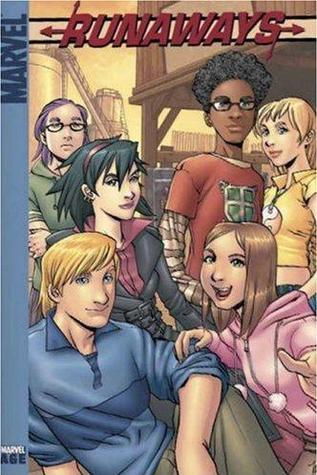
As if I needed any further convincing… reading Runaways just cements the fact the Brian K. Vaughan can do no wrong! I’d been hearing for years that Runaways is essential reading. Okay, okay, people — you were right!

I sat down and read the first volume of this series, Pride and Joy, and I can see what all the fuss is about. Granted, volume 1 really just lays the groundwork, but the premise is a doozy! As the book blurb makes it clear, all teens think their parents are evil. But in Runaways, this group of six teens is actually right about their parents. After stumbling accidentally onto their parents’ secret membership in something called The Pride, the kids realize there’s a lot more to their parents’ get-togethers than they’d been led to believe. And these kids aren’t powerless either. One way or another, whether through their own inherent super-powers or just access to some really cool toys, these six have to use their strengths to outwit their parents, hide away from all sorts of nefarious bad guys, and maybe try to figure out what the heck’s going on… and stop it.

I don’t know where all this is going yet, but I absolutely intend to find out! Volume 1? Total win.

And hey! There’s a psychic dinosaur involved! If that doesn’t spell awesome, then I don’t know what does.

Runaways by Brian K. Vaughan
Volume 2: Teenage Wasteland

Runaways, Vol. 2: Teenage Wasteland

After a break of oh, at least an hour or two, I couldn’t resist and continued on with volume 2, Teenage Wasteland. And all I can say is… this is going to be good. I love the story so far, I love the exploration of each teen’s developing powers, and I love the context of a big bad conspiracy of evil parents trying to control the world — if only they can get their own kids under control first.

I can’t believe it’s taken me this long to finally read Runaways… but I think it’s safe to say that I’m hooked now, and will probably gobble up the entire series much more quickly than is probably good for me. Then again, who needs to sleep?

Book Review: The Promise of Amazing by Robin Constantine

Book Review: The Promise of Amazing by Robin Constantine
(to be released December 31, 2013)

The Promise of AmazingIn this young adult tale of opposites attracting, Wren is the good girl, burdened by her average status. She’s mainly known for being quiet, and ranks right smack-dab in the middle of her class at her all-girls Catholic high school. Bad boy Grayson, expelled by his all-boys private school after being exposed for running a business as — in his words — a “term-paper pimp”, is suffering through his uninteresting days in public school, isolated from his friends and removed from his glory days as a lacrosse star.

Wren and Grayson meet cute — or meet gross, depending on your perspective — when he chokes on a cocktail weenie at her family’s catering hall and she saves his life by performing the Heimlich. Followed promptly by him vomiting on her shoes. Despite the life endangerment and the puke, the two have a moment of connection… and thus starts the romance of Wren and Grayson.

Yes, it’s pretty much an insta-love connection. Neither can stop thinking about the other, and they have a few awkward encounters before realizing that whatever is between them might hold the “promise of amazing”. Told in alternating chapters, we hear each character’s thoughts about the other, as each tries to forge a new path in hopes of being worthy of the other.

Of the two, Grayson has the most to overcome. His term-paper pimpdom is only the tip of the iceberg in terms of shady dealings. He’s hiding a big secret involving a truly revolting scheme involving him and the other privileged boys from his former school. When Wren ponders that Grayson doesn’t feel that he’s good enough for her, I wanted to yell, “It’s true!” Yes, everyone deserves a second chance, an opportunity to reform — but Gray’s past is pretty awful, and I’m not sure that he deserves such a quick and easy redemption, one in which he never actually pays for the terrible things he’s done, other than a week of Wren feeling angry at him.

It’s gratifying to see Wren learn to stand up for herself more and grow a spine, finally speaking up for herself with the popular mean girl and with the guidance counselor who doesn’t seem to see Wren’s true potential. I enjoyed Wren’s down-to-earth connection with her two best friends, as well as her healthy relationships with her parents and her older siblings.

Both Wren and Grayson come from fairly well-off families, and the sense of entitlement permeates the entire story. Even though Wren’s family business is going down the tubes, there’s never a sense that their financial well-being is at stake. Grayson, too, comes from money, and while his home life is divided between divorced and remarried parents, the overall sense is that he has a stable, worry-free life on his hands, which makes his past actions seems even less comprehensible and more the actions of a bored, spoiled rich kid.

I didn’t hate The Promise of Amazing, and in fact, it’s a fast-paced story that is easy to get caught up in, so much so that I couldn’t tear my eyes away because I needed to know what happened next. But in terms of message and storytelling? Well, no. Grayson is not an admirable character, and despite his desire to change and be worthy of Wren, I just couldn’t get past his serious wrong-doing and his lack of atonement. Having to ‘fess up to Wren and possibly lose her was painful, sure — but even then, it all got patched up pretty quickly, no lasting damage. Without going into detail about what he’s done, suffice it to say that Gray didn’t really seem to earn the redemption that he’s granted in this novel.

Things I liked:

Wren is a quiet girl, but that doesn’t mean she’s not smart or savvy, and she’s certainly not weak. Let’s hear it for the quiet ones! As Wren puts it, “Being quiet was not a conscious protest. It was my nature.” And by the end of the book, when she asserts herself in a payback plot, she points out that “he had toyed with the wrong quiet chick.” On behalf of introverts everywhere, thank you!

Things I didn’t like:

Once Gray’s secret comes to light and Wren unburdens herself to her best friends, one takes the position that Gray’s past actions are “kind of… hot.””

I didn’t say I approved. What he did was awful, but he sort of got karmic payback getting kicked out school. Don’t you think? And, well, he hasn’t done any of this in a while, right? Like months. A guy with a past is hot.

Um, really? His horrible actions are all okay, because they were “like months” ago — and now it’s kind of hot? That’s taking the bad boy thing to a whole new level of wrongness, in my opinion.

This bizarre take on teen morality continues a bit further on:

What I’m getting at is — so what if he’s been with other girls? It only means he’s experienced. You’ve been with other guys — is he all jacked up over that? We’re sixteen… this is how it’s supposed to be.

As I write this, I realize that this twisted take on right and wrong bothers me a lot more than I realized while I reading the book. I just can’t buy the basic premise of the bad boy being reformed by the good girl. Maybe in some stories, it works, but here it feels too easy. The worst consequence that anyone truly faces in The Promise of Amazing is an expulsion from private school — although the term-paper pimpage seems to have been quieted up sufficiently that Gray won’t face damaged college prospects — and a few teary misunderstandings on the path to true love.

Teen love can be grand and full of drama. But to be convincing, it has to have stakes and feel earned. In The Promise of Amazing, the main thing that’s amazing is how quickly Wren and Gray fall in love, and how easily all of their differences  — and his shady past — can be overcome.

_________________________________________

The details:

Title: The Promise of Amazing
Author: Robin  Constantine
Publisher: Balzer + Bray
Publication date: 2013
Genre: Young adult/contemporary
Source: Review copy courtesy of Balzer + Bray via Edelweiss

Book Review: Dear Mr. Knightley by Katherine Reay

Book Review: Dear Mr. Knightley by Katherine Reay

Dear Mr. KnightleyThis debut novel combines the wit of Austen with the gritty pluck of Bronte, but with a modern-day setting that adds several unexpected twists and a deeper level of truth and examination than I’d expected.

In Dear Mr. Knightley, main character Samantha (who goes by Sam) is a college grad on the verge of aging out of the support systems available to former foster kids. With the prodding of her mentor, Father John, who runs the group home in which she lives, Sam applies for a grant from an anonymous foundation. This grant will enable her to enroll in graduate school, and will cover all expenses while she pursues her degree. The only catch is that Sam must write a series of letters to her benefactor, who uses the pseudonym George Knightley, knowing it will appeal to Sam’s inner Austen-phile and keep his true identity a secret.

Sam’s life has not been easy, and she is plagued by self-doubt. She’s spent all her life feeling unloved and unwanted, and has hidden herself away in the pages of her beloved books. When anxious or faced with a need to connect with people, she hides behind her characters, quoting Lizzy Bennet or Emma or even Edmond Dantes — which lets her keep her walls intact, and ensures that anyone who tries to reach out to her will run in the opposite direction.

But once Sam receives her grant and starts her graduate program in journalism, she realizes that her walls are crumbling — and that she needs to let them. She can’t succeed as a writer if she keeps her heart hidden away; she can’t connect as a friend if she refuses to let anyone know her. As Sam narrates her tale via letters to Mr. Knightley, we witness her fears, her doubts, her pain, and her glimmers of joy. We delight with her when she sees new possibilities, but we can’t help but want to cry every time poor wounded Sam seems to be making another counter-productive decision based on insecurity and lack of confidence.

I enjoyed the writing style here very much. The entire book is told via Sam’s letters to Mr. Knightley, so it’s all first-person and very immediate. She writes from her heart to her anonymous correspondent, allowing herself the freedom in her letters to reveal herself in all the ways she’d never do with a real person. While occasionally seeming more naive than seems reasonable for a 23-year-old, I could suspend my disbelief based on the facts of Sam’s life. If she seems to have odd ideas about friendship, connection, and relationships, it’s understandable, given that she bounced from foster family to foster family, experienced disastrous encounters with her real parents, and finally ended up at the group home for the remainder of her teen and early adult years.

If you happened to read my blog yesterday (here), then you may have seen my mini-freak-out about finding out that a book I was reading was listed on Amazon as “Christian fiction”. This is the book that triggered all of that. And it’s puzzling to me. Had I not come across that designation on Amazon, I don’t think it would have occurred to me to think of this book as anything other than contemporary fiction. Yes, there were passages, especially toward the end, where Sam is encouraged toward “surrender” and finding joy in faith. But it’s not heavy-handed, I didn’t feel like the book itself was proselytizing in any way, and the references to characters’ faith and beliefs felt organic and reasonable within the context of the story. What I had feared might be a problem for me really wasn’t. So, after much ado about nothing, all’s well that ends well! (Sorry… )

The book is a quick read, but it’s not fluffy. It does seem that things always work out for Sam in a big way. Too sugar-coated, perhaps? Yes, it can seem like a fairy tale at points, the way the grants, the internships, the supportive people always come through just when needed. But that is balanced, for the most part, by a refusal to gloss over the harder parts of Sam’s life, so truly, even if it seems unlikely that things could work out so well in real life, there’s no doubt that Sam has earned all that comes her way by the end.

I mentioned earlier that I liked the writing style — and I really did, except for a certain phrasing oddity that kept jumping out at me: Whenever characters use the work “couple”, it’s phrased as “a couple papers”, “a couple internships”, “a couple days ago”. What happened to the “of”??? Is this a regional quirk, perhaps? I have no idea, but it really bugged me. This is a minor quibble, though; for the most part, I enjoyed Sam’s voice very much. Some epistolary novels seem forced, using the letter format as a gimmick that doesn’t always allow for fully fleshed-out storytelling. This is not the case in Dear Mr. Knightley: Through Sam’s letters, we get insight into her heart and mind in a way that might not have worked otherwise, and because we know that Sam herself is a skilled writer, it makes sense that her letters are so articulate and thoughtful.

If you’ve read the 1912 novel Daddy-Long-Legs by Jean Webster, then the secrets and resolution of Dear Mr. Knightley won’t be a surprise. But even knowing how it would work out, I still enjoyed the author’s skill in weaving the backbone of the older book into this fresh novel, finding a way to take a set of circumstances that might seem old-fashioned and apply them to a modern setting in a way that’s believable.

I’m glad that I didn’t let the genre issue keep me from exploring and enjoying this touching, delightful book. Skillfully weaving together threads of classic literature into a modern-day setting that rings true, Dear Mr. Knightley is a lovely look at the journey of a special young woman. I’m happy to have read it, and I’m happy to recommend it.

_________________________________________

The details:

Title: Dear Mr. Knightley
Author: Katherine Reay
Publisher: Thomas Nelson
Publication date: 2013
Genre: Contemporary fiction
Source: Review copy courtesy of Thomas Nelson via NetGalley