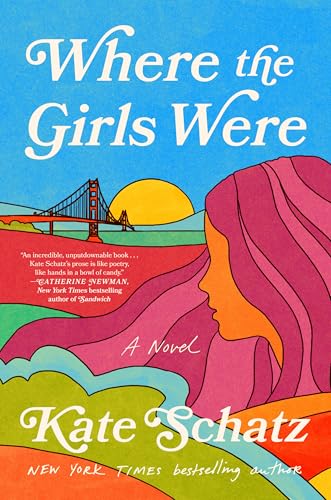
Title: Where the Girls Were
Author: Kate Schatz
Publisher: The Dial Press
Publication date: March 3, 2026
Length: 368 pages
Genre: Historical fiction
Source: Review copy courtesy of the publisher via NetGalley
Rating:
In this electrifying and heartfelt historical coming-of-age novel, set against the tumultuous backdrop of 1960s San Francisco, a pregnant teenager reckons with womanhood and agency after being sent to a home for unwed mothers.
It’s 1968, and the future is bright for seventeen-year-old Elizabeth “Baker” She’s the valedictorian of her high school, with a place at Stanford in the fall and big dreams of becoming a journalist. But the seductive free-spirited San Francisco atmosphere seeps into her carefully-planned, strait-laced life in the form of a hippie named Wiley. At first, letting loose and letting herself fall in love for the first time feels incredible. But then, everything changes.
Pregnancy hits Baker with the force of whiplash—in the blink of an eye, she goes from good girl to fallen woman, from her family’s shining star to their embarrassing secret. Sent to a home for unwed mothers, Baker finds herself trapped in an old Victorian house packed with a group of pregnant girls who share her shame and fear. As she reckons with her changing body, lack of choice, and uncertain future, Baker finds unexpected community and empowerment among the “girls who went away.”
Where the Girls Were is a timely unearthing of a little-known moment in American history, when the sexual revolution and feminist movement collided with the limits of reproductive rights—and society’s expectations of women. As Baker finds her strength and her voice, she shows us how to step into your power, even when the world is determined to keep you silent.
Where the Girls Were is a powerful look at the changing world of young women in the late 1960s, centered on high school senior Baker — the bright, ambitious daughter of a suburban family that hides financial woes behind a veneer of pool parties and social engagements and neighborhood clubs. Baker is her parents’ pride and joy — until she ends up pregnant after her first sexual encounters with a hippie named Wiley.
Devastated and in denial, Baker first attempts to access an abortion through an underground provider, but is scared off before she can go through with it. When she finally confesses to her parents, her mother secures her a spot at a home for unwed mothers in San Francisco, where she’ll stay for the remainder of her pregnancy. Meanwhile, Baker’s family concocts a cover story for her: She’ll be spending a semester in Paris, before returning in the spring to start at Stanford.
At the home, Baker is surrounded by other pregnant teens, all with their own stories to tell. The girls are not allowed outside except for supervised walks — for which they put on fake wedding rings, so as not to scandalize the neighbors. The longer Baker stays at the home, the more she comes to understand about her limited choices, and how little control she has over her own body or decisions about her baby.
“We can tell you’re confused. But let me remind you: you got yourself into this situation. We are helping you out of it. Do you realize how lucky you are to be here?”
Where the Girls Were offers a spot-on depiction of the convergence of 1950s morality and 1960s rebellion. Baker’s world is full of political unrest and anti-war protests and the “turn on, tune in, drop out” mentality, but the free love vibe doesn’t last once pregnancy roles around. And how free can these girls truly be without safe access to either birth control or abortion rights? Baker and the other girls at the home have their choices taken away from them by their families, who seem to value appearance and saving face much more than the feelings or well-beings of their daughters.
Because what she realizes as she talks to the other girls is that she’s not as isolated as she’d believed. She’s not the only one to feel this, to have this happen. Other girls are angry and ashamed. Other girls are embarrassed. Other girls are full of rage. Other girls know how she feels, even if they don’t talk much.
I found Where the Girls Were to be a compelling, moving read, with a realistic depiction of the era and with a main character to truly care about. We get to really know Baker and understand her struggles and her inner life. Seeing her navigate life in the home and figure out how to stand up to those who try to manipulate her is quite inspiring.
At the same time, it’s shocking to see how little information even a well-educated girl like Baker has. Yes, she knows the basics about how pregnancies come about, but she has no information about pregnancy itself — how it progresses, what to expect, what labor entails — not to mention a very fundamental lack of knowledge about how to avoid pregnancy other than being a “good girl”.
Two very minor quibbles to note: First, I wish the ending had been a little less ambiguous. I can understand why the author chose to leave the story where it ends, but I would have appreciated a more definite wrap-up. (Not going into details here in order to avoid spoiling anything…) Second (and this is largely my own reading pet peeve, not necessarily a flaw in the book), I tend not to like when books introduce a large group of characters at once. Here, Baker meets all the girls at the home in one big round of introductions, and perhaps as a result, all but a few particular girls seem to blend together. I wished for a bit more to distinguish some of the girls who figured more as background characters.
Those quibbles aside, I enjoyed this book very much, and strongly recommend it for anyone who enjoys historical fiction, women’s history, and/or fiction set during the 1960s. The story and main character are both terrific and make a big impression.
Reading note: This is actually my 2nd book within a year about a home for unmarried pregnant girls set during roughly the same time period. The other, Witchcraft for Wayward Girls by Grady Hendrix, is a horror novel, but the two books share many of the same themes and feature girls in similar circumstances. Really interesting to compare and contrast!

For further reading: In the author’s notes, she references a non-fiction book, The Girls Who Went Away: The Hidden History of Women Who Surrendered Children for Adoption in the Decades Before Roe v. Wade by Ann Fessler. Sounds fascinating! I’ve added this to my TBR, and hope to track down a copy. Find out more, here.

Purchase links: Amazon – Audible audiobook – Bookshop.org – Libro.fm
Disclaimer: When you make a purchase through one of these affiliate links, I may earn a small commission, at no additional cost to you.
 Bookshelf Fantasies
Sounds so good
I think you’d really like it!
This does sound like a compelling and moving read…and one that I would probably really like. Fingers crossed my library has a copy.
I hope you can grab a copy! I just put in a request for the non-fiction book the author recommended, and I’m hoping it’s not too long a wait.
An interesting time in history.
Very interesting, and this book portrays it so well!
My first thought was that it sounds similar to Witchcraft for Wayward Girls! I might need to read this at some point😁
Very interesting to be able to compare the two books! No covens or witchcraft in this one… 🙂
Im glad you enjoyed this one overall, it sounds like a moving and interesting read. I havent read anything set in those kind of homes before, although I did read one about the Magdalene laundries during my teens though. Id like to read it again sometime as i dont really remember it now though
I’ve read one book about the Magdalen laundries too — fascinating and so sad.
Yes, an interesting period indeed with rebellion meeting the shocking straitlaced. These sort of stories are fascinating, like Tammy mentions, it sounds like the Wayward Home story but without witchcraft and also put me in mind of the Magdalene laundries – which I haven’t read about but watched an adaptation of – absolutely shocking and even more so given how long the home lasted.
Lynn 😀
Both comparisons are good ones! It’s particularly shocking here to see this kind of home in San Francisco in what we’re used to thinking of as the hippie era. It’s very well written!