
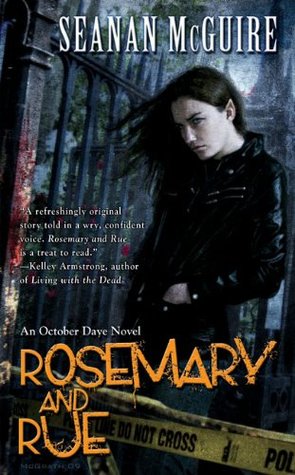
Audiobook Review: Rosemary and Rue by Seanan McGuire


October “Toby” Daye, a changeling who is half human and half fae, has been an outsider from birth. After getting burned by both sides of her heritage, Toby has denied the Faerie world, retreating to a “normal” life. Unfortunately for her, the Faerie world has other ideas…

The murder of Countess Evening Winterrose pulls Toby back into the fae world. Unable to resist Evening’s dying curse, which binds her to investigate, Toby must resume her former position as knight errant and renew old alliances. As she steps back into fae society, dealing with a cast of characters not entirely good or evil, she realizes that more than her own life will be forfeited if she cannot find Evening’s killer.

Rosemary and Rue  is the first book in the ongoing October Daye series — and as the first book, it has a lot of heavy lifting to do, in terms of establishing characters, building a world, and setting up the rules of the supernatural system that dictates the possibilities of plot from the starting point onward. Fortunately, Seanan McGuire is supremely talented and inventive, and in Rosemary and Rue, she’s more than up to the challenge of creating a world we’ll want to stay in.

Set in and around San Francisco, R&R starts with a pretty ominous set-up for Toby (October) in the prologue. While chasing her liege lord’s enemy (who’s also his twin brother), Toby walks into a trap and loses the next fourteen years of her life. I won’t say why or how — it’s just too much fun to find out for yourself.

We re-meet Toby in chapter one after she’s returned to a version of her former life, having sworn off anything to do with the world of the fae, determined to live as simply human and ignore the other half of her changeling identity. She’s been burned too badly and has lost far too much to be able to stomach the idea of returning to the intricate systems of fae courts and allegiances and territories. But Evening’s murder sucks her back in against her will, and soon enough Toby is brought face to face with old allies, lovers, and enemies. Her own life is on the line as she tries to solve the murder. If she fails, Evening’s dying curse will take Toby’s life as well.

The plot of R&R follows Toby’s search for clues and her reinvolvement with characters from her past, some well-meaning, some clearly not. As a changeling, Toby’s magical abilities are only so-so, and each time she engages with a pureblood, she’s at risk. As you’d expect in an  urban fantasy series, Toby is a smart-ass, tough woman with her own set of abilities, not least a talent for thinking on her feet, reading a room, and figuring out how to get what she wants. Still, she has vulnerabilities too, both physical and emotional, and she certainly suffers throughout the book as all sorts of baddies are out to get her and stop her investigation.

I love Toby as a character, and love the odd assortment of changelings and purebloods we meet along the way. Also excellent is the use of San Francisco as a setting. While some of the location descriptions didn’t quite gel with the reality of the area, others (such as the use of the Japanese Tea Garden in Golden Gate Park) are just brilliant.

I have to give a shout-out to the most endearing and adorable magical creature in the book, a “rose goblin” named Spike. Picture a cat with thorns instead of fur, and you have the basic idea. Just loved it.

I did wish that Toby’s backstory was spelled out in a little more concrete detail. As with many urban fantasy stories, we start in the middle of the action and learn about Toby’s difficult past through various references as we go along. It’s enough to give a general timeline, but I still have questions. What does it mean that she’s a knight? What was the process to become one? How did she first join Sylvester’s court? Maybe future volumes in the series will provide more specifics.

Even thought the solution to the murder wasn’t that difficult to guess, I still enjoyed the revelations, Toby’s realizations about the various people in her life, and the reasons behind the events. The plot is fast-paced and exciting, and I enjoyed the adventure start to finish.

Narrator Mary Robinette Kowal brings her talents to the variety of characters, with accents and intonations and pitches that distinguish them and make it easy to identify the speaker at any given point — not always easy in audiobooks. As with the Indexing books, she does a great job of making the story flow, and I enjoyed her depiction of Toby’s inner life.

Rosemary and Rue was really a fun listen, and I’m planning on diving right in with book #2.

Note: Woo hoo! I’ve started another series from my reading goals list for 2018!
_________________________________________

The details:

Title: Rosemary and Rue
Author: Seanan McGuire
Narrator: Mary Robinette Kowal
Publisher: DAW Books
Publication date: September 1, 2009
Length (print): 346 pages
Length (audiobook): 11 hours, 20 minutes
Genre: Urban fantasy
Source: Purchased
Save

Save

Save

Save

Save

Save

Save

Save

Save

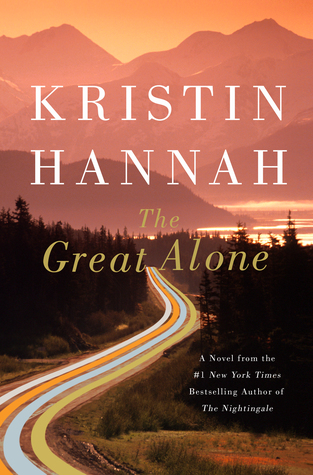
Book Review: The Great Alone by Kristin Hannah


Alaska, 1974.
Unpredictable. Unforgiving. Untamed.
For a family in crisis, the ultimate test of survival.

Ernt Allbright, a former POW, comes home from the Vietnam war a changed and volatile man. When he loses yet another job, he makes an impulsive decision: he will move his family north, to Alaska, where they will live off the grid in America’s last true frontier.

Thirteen-year-old Leni, a girl coming of age in a tumultuous time, caught in the riptide of her parents’ passionate, stormy relationship, dares to hope that a new land will lead to a better future for her family. She is desperate for a place to belong. Her mother, Cora, will do anything and go anywhere for the man she loves, even if means following him into the unknown.

At first, Alaska seems to be the answer to their prayers. In a wild, remote corner of the state, they find a fiercely independent community of strong men and even stronger women. The long, sunlit days and the generosity of the locals make up for the Allbrights’ lack of preparation and dwindling resources.

But as winter approaches and darkness descends on Alaska, Ernt’s fragile mental state deteriorates and the family begins to fracture. Soon the perils outside pale in comparison to threats from within. In their small cabin, covered in snow, blanketed in eighteen hours of night, Leni and her mother learn the terrible truth: they are on their own. In the wild, there is no one to save them but themselves.

In this unforgettable portrait of human frailty and resilience, Kristin Hannah reveals the indomitable character of the modern American pioneer and the spirit of a vanishing Alaska―a place of incomparable beauty and danger. The Great Alone is a daring, beautiful, stay-up-all-night story about love and loss, the fight for survival, and the wildness that lives in both man and nature.

The Great Alone is many things — a portrait of life in rugged Alaska, a story of the damage done by war, a tale of the horrible secrets lurking underneath a family’s facade… and also, a story of love and devotion and commitment.

We first meet Leni as a 13-year-old who never fits in anywhere, thanks to her parents’ inability to settle. Ever since her father returned from his years as a POW in Vietnam, Leni has been pulled from home to home and school to school, as her father’s instability and nightmares make him unable to keep a job or stay put for very long. Meanwhile, Leni’s mother Cora remains madly in love with her husband Ernt, and constantly tells Leni that she wishes she could remember how he was before. Out of options, Ernt comes up with a seemingly crazy idea — they’ll move to Alaska, to a plot of land left him by a war buddy, and live off the land, off the grid, as homesteaders.

Leni, of course, has no say in this, just as she has no say in most of what happens in her life. Cora is desperate to find the answer to making Ernt happy again, so off they go in their battered VW bus, completely unprepared for the realities of the life ahead of them. When they finally reach their land in Kaneq, they find a falling-down dirty cabin, and not much else. Fortunately, the neighbors in this tiny community rally around to teach them what they need to know, with an emphasis on the all-important preparations for their first Alaskan winter.

The land and its surroundings are breathtakingly beautiful, of course… but the winter is harsh, leaving the small family isolated in their cabin for months on end. For Leni and Cora, life becomes increasingly dangerous, not because of the natural threats such as wildlife and climate, but because of the man they live with. Ernt does not do well in the dark, under stress, and he takes out his inner demons on Cora.

Over the years, the family becomes intertwined with their neighbors, and Cora and Leni develop deep bonds with their new friends, but Ernt becomes more and more obsessed with survivalism, his paranoia and nightmares becoming more and more intense. Leni grows up in the shadow of domestic violence, witnessing her father’s brutal treatment of Cora, but unable to do anything to stop it.

And as Leni matures, she falls in love with the boy who was her first friend in Alaska — but her father hates his father and everything he stands for, and it’s clear that the relationship must be kept hidden from Ernt before it pushes him into even more violence.

I have to be honest and admit that I wasn’t so sure about this book for the first third or so. I was interested, but it was slow-going. The description of Alaska and what it takes to build a life there are intriguing, of course, but I’ve read other stories about life in Alaska, so this wasn’t exactly new. I had a hard time at first with the viewpoint, as this section of the book is seen mainly through 13-year-old Leni’s eyes, and there was just something a little limiting about that. Still, it was sadly fascinating to see Leni’s experience of her parents’ toxic marriage — the loving moments, when the two were so obsessed with each other that they couldn’t see anyone else — and the explosively painful moments, when Ernt’s rage would boil over into fists and abuse.

Later, when Leni is an older teen, her story becomes much more compelling. Suddenly, I couldn’t put the book down. (Seriously, I read the 2nd 50% of the book in one sitting.) Leni’s love story builds along a Romeo and Juliet trajectory, and while we can see the inevitable tragedy looming ahead, it’s still a shock when Leni’s life is turned upside down.

In some ways, the story of Ernt’s violence is simply tragic. It’s hard not to hate him as the years go by and his craziness and violence escalate — but there’s an element of pity, too. In today’s world, his PTSD would be recognized for what it is and he’d be able to get help. In the early 1970s, just back from hellish years as a captive in Vietnam, not only was there no psychological help, but he also was subject to the derision of anti-war America when he returned. It might be easy to view Ernt as simply an evil character, but we can’t. He is horrible and abusive and destructive, but his horror stems from his own status as a victim of war and torture. We can absolutely condemn his behavior and his treatment of his family, but I can’t help but feel sorrow too for how different this man might have been without the trauma of Vietnam.

The depiction of domestic violence is harrowing but has a ring of truth. At that time, there was much less support for “battered women”, and a woman who fought back could easily end up either dead or behind bars, without much in the way of legal defense or public awareness. Seeing Leni’s need to protect her mother, and Cora’s inability to find a way to leave, is painful and tragic.

At the same time, I loved the way Leni’s life in Alaska grows. She becomes a part of the community, part of Alaska itself, and this stays with her and changes her in deep and unalterable ways.

I won’t say more about the love story or its outcome, other than WOW and SOB and TEARS and… well, read it yourself to find out!

The Great Alone is powerful and moving, with a unique setting and memorable characters. Check it out.

_________________________________________

The details:

Title: The Great Alone
Author: Kristin Hannah
Publisher: St. Martin’s Press
Publication date: February 6, 2018
Length: 448 pages
Genre: Contemporary fiction
Source: Review copy courtesy of the publisher via NetGalley

Save

Save

Save

Save

Save

Save

Save

Save

Save

Save

Save

Novella: The Only Harmless Great Thing by Brooke Bolander


In the early years of the 20th century, a group of female factory workers in Newark, New Jersey slowly died of radiation poisoning. Around the same time, an Indian elephant was deliberately put to death by electricity in Coney Island.

These are the facts.

Now these two tragedies are intertwined in a dark alternate history of rage, radioactivity, and injustice crying out to be righted. Prepare yourself for a wrenching journey that crosses eras, chronicling histories of cruelty both grand and petty in search of meaning and justice.

The Only Harmless Great Thing is weird and wonderful, cruel and beautiful. Can you possibly believe that two awful chapters from history — the “radium girls” and an electrocuted elephant — would fit together in one story? Author Brooke Bolander pulls off this seemingly impossible task in a new novella that almost defies description — you just need to experience it.

The narration shifts between elephant and human characters, in language that’s often hauntingly strange and beautiful.

At night, when the moon shuffles off behind the mountain and the land darkens like wetted skin, they glow. There is a story behind this. No matter how far you march, O best beloved mooncalf, the past will always drag around your ankle, a snapped shackle time cannot pry loose.

The human parts of the story are heart-breaking and outrage-inducing… but so are the elephants’ sections. As I read, the story of the radium factory workers’ treatment left me feeling furious. The involvement of elephants in the radium story is startling but makes sense in this alternate world in which humans and elephants converse via sign language, and the elephant language (Proboscidian) is taught in universities.

Then came the Atomic Elephant Hypothesis.

The Only Harmless Great Thing is a quick but powerful read, unusual and a little crazy and definitely something that will stick in my mind for quite some time. It made me angry and sad, and also made me think. Highly recommended.

But chains can be snapped, O best beloved mooncalf. Sticks can be knocked out of a Man’s clever hands. And one chain snapping may cause all the rest to trumpet and stomp and shake the trees like a rain-wind coming down the mountain, washing the gully muddy with bright lightning tusks and thunderous song.

PS – The story of Topsy, the elephant electrocuted at Coney Island, is changed and reinvented here in this novella — but yes, there was a real Topsy, and she really was put to death in 1903 by being electrocuted in front of a crowd as part of a public spectacle. It’s a horrible story that seems too outrageous to be true, but sadly, it really happened. You can read more about Topsy’s awful fate here.

PPS – Reading this novella reminded me that I picked up a copy of the non-fiction book The Radium Girls (winner of the 2017 Goodreads Choice Award for history and biography), and really need to read it!

_________________________________________

The details:

Title: The Only Harmless Great Thing
Author: Brooke Bolander
Publisher: Tor
Publication date: January 23, 2018
Length: 96 pages
Genre: Alternate history
Source: Purchased

Save

Save

Save

Save

Save

Save

Save

Save

Save

Save

Save