The Monday agenda

Not a lofty, ambitious to-be-read list consisting of 100+ book titles. Just a simple plan for the upcoming week — what I’m reading now, what I plan to read next, and what I’m hoping to squeeze in among the nooks and crannies.

So what’s on the reading agenda this week?

From last week:

Ashen Winter by Mike Mullin: Done! My review is here.

The Evolution of Mara Dyer by Michelle Hodkin: Quit after reading 150 pages. I just couldn’t get into it, despite having enjoyed the first book in the series.

Anna and the French Kiss by Stephanie Perkins: Done! My review is here.

Beta by Rachel Cohn: Returning to the library unread. I was about to start this one, then discovered from the dust jacket that this book is first in a new series… and I’m trying to swear off new series for a while.

So far, no new books for my kiddo and me. We haven’t settled on our next read-aloud yet, and had a couple of false starts this week with books that neither of us ended up enjoying. Soldiering on! We still have a few more to try, and I’m hoping that one of the ones that I most want to read will also appeal to this opinionated 10-year-old.

Drums of Autumn by Diana Gabaldon: Done! The group re-read has finally come to an end. We’ll be starting the next in the series, The Fiery Cross, in January. And if you happen to be an Outlander fan and want to join the fun, just let me know and I’ll get you connected.

And this week’s new agenda:

I hereby declare: It’s Graphic Novel Week!

I’ve been accumulating a stack of graphic novels over the past few weeks, and I think I’ll dive in and devote my reading week to catching up. So exciting! On the list are:

Buffy the Vampire Slayer, season 9 volume 2: On Your Own: If you thought Buffy’s story ended when the TV show went off the air, and you’ve been missing her ever since, check out the continuing story in graphic novel form.

Angel and Faith: Daddy Issues: Excellent Buffy spin-off.

Soulless manga, volume 2: The manga version of Changeless by Gail Carriger.

A Wrinkle In Time graphic novel: My Hanukkah gift from my daughter. See me gushing with joy about this here.

Fairest, volume 1: A new spin-off from Bill Willingham’s Fables series, which I love madly and deeply.

Werewolves of the Heartland: A Fables stand-alone, centered on my absolutely favorite character from the Fables world. Can’t wait!

Locke & Key: Clockworks: Volume 5 in the superbly creepy series by horror master Joe Hill.

Other than graphic novels, I plan — quite cautiously and with some trepidation — to add in Fairy Tales from the Brothers Grimm by Philip Pullman. Given the fact that I am just a terrible reader of short stories and find it impossible to maintain interest long enough to get through an entire book of stories, even if they’re by an author whom I love (as is the case here), I’m setting myself the rather mild goal of reading this collection of fairy tales bit by bit. I’ll aim for two stories a week — that should let me enjoy the stories without feeling my usual frustration at not reading a “real” novel.

So many book, so little time…

That’s my agenda. What’s yours? Add your comments to share your bookish agenda for the week.

The Monday agenda

Not a lofty, ambitious to-be-read list consisting of 100+ book titles. Just a simple plan for the upcoming week — what I’m reading now, what I plan to read next, and what I’m hoping to squeeze in among the nooks and crannies.

Right down to business: What books are brewing this week?

From last week:

Because It Is My Blood by Gabrielle Zevin: Done! My review is here, but the bottom line is: If you read the first book in the Birthright series, you’ll want to pick this one up.

Ashen Winter by Mike Mullin: Just started, hard to put down.

Magic By The Lake by Edward Eager: My most recent out-loud read with my son, finally finished, and not entirely successful. Neither of us loved it, unfortunately.

And, as always, still going strong with the group re-read of Drums of Autumn by Diana Gabaldon.

And this week’s new agenda:

It’ll take me a few days to finish Ashen Winter, unless I continue staying up past midnight because I just have to see what happens next. After that, I plan to read The Evolution of Mara Dyer by Michelle Hodkin. Still on my library pile: Beta by Rachel Cohn and Anna and the French Kiss by Stephanie Perkins.

And then I plan to shift gears and take a break from young adult fiction for a bit.

In children’s books, my kiddo and I are undecided. I presented him with a big stack of books, but he’s not ready to commit. Me, I’m pulling for A Wrinkle In Time, but that may be a tad too intense for him at bedtime. We shall see.

Drums of Autumn by Diana Gabaldon: Chapters 70 and 71 this week… then one more chapter next week, and we’re done!

So many book, so little time…

That’s my agenda. What’s yours? Add your comments to share your bookish agenda for the week.

Wishlist Wednesday

And now, for this week’s Wishlist Wednesday…

The concept is to post about one book from our wish lists that we can’t wait to read. Want to play? Here’s how:

  • Follow Pen to Paper as host of the meme.
  • Please consider adding the blog hop button to your blog somewhere, so others can find it easily and join in too! Help spread the word! The code will be at the bottom of the post under the linky.
  • Pick a book from your wishlist that you are dying to get to put on your shelves.
  • Do a post telling your readers about the book and why it’s on your wishlist.
  • Add your blog to the linky at the bottom of the post at Pen to Paper.
  • Put a link back to pen to paper (http://vogue-pentopaper.blogspot.com) somewhere in your post.
  • Visit the other blogs and enjoy!

My Wishlist Wednesday book is:

great & terrible beauty

A Great and Terrible Beauty by Libba Bray

From the Random House website:

Gemma Doyle, sixteen and proud, must leave the warmth of her childhood home in India for the rigid Spence Academy, a cold finishing school outside of London, followed by a stranger who bears puzzling warnings. Using her sharp tongue and agile mind, she navigates the stormy seas of friendship with high-born daughters and her roommate, a plain scholarship case. As Gemma discovers that her mother’s death may have an otherworldly cause, and that she herself may have innate powers, Gemma is forced to face her own frightening, yet exciting destiny . . . if only she can believe in it.

Why do I want to read this?

I’ve become quite a fan of Libba Bray over the past few years. I adored her newest novel, The Diviners, and really enjoyed Beauty Queens and Going Bovine as well. Somehow, I missed out on reading her first novel, A Great and Terrible Beauty, and its two follow-up books, Rebel Angels and The Sweet Far Thing.

To be honest, were this not written by Libba Bray, I’m not sure I’d be drawn to it. Victorian era boarding school novels don’t necessarily call to me… but I’m willing to give it a whirl.

Have you read the Gemma Doyle trilogy? And if so, what did you think?

Happy Wednesday!

Quick note to Wishlist Wednesday bloggers: Come on back to Bookshelf Fantasies for Flashback Friday! Join me in celebrating the older gems hidden away on our bookshelves. See the introductory post for more details, and come back this Friday to add your flashback favorites!

Wishlist Wednesday

And now, for this week’s Wishlist Wednesday…

The concept is to post about one book from our wish lists that we can’t wait to read. Want to play? Here’s how:

  • Follow Pen to Paper as host of the meme.
  • Please consider adding the blog hop button to your blog somewhere, so others can find it easily and join in too! Help spread the word! The code will be at the bottom of the post under the linky.
  • Pick a book from your wishlist that you are dying to get to put on your shelves.
  • Do a post telling your readers about the book and why it’s on your wishlist.
  • Add your blog to the linky at the bottom of the post at Pen to Paper.
  • Put a link back to pen to paper (http://vogue-pentopaper.blogspot.com) somewhere in your post.
  • Visit the other blogs and enjoy!

My Wishlist Wednesday book is:

Small Damages by Beth Kephart

From Amazon:

It’s senior year, and while Kenzie should be looking forward to prom and starting college in the fall, she discovers she’s pregnant. Her determination to keep her baby is something her boyfriend and mother do not understand. So she is sent to Spain, where she will live out her pregnancy, and her baby will be adopted by a Spanish couple. No one will ever know.

Alone and resentful in a foreign country, Kenzie is at first sullen and difficult. But as she gets to know Estela, the stubborn old cook, and Esteban, the mysterious young man who cares for the horses, she begins to open her eyes, and her heart, to the beauty that is all around her, and inside her. Kenzie realizes she has some serious choices to make–choices about life, love, and home.

Lyrically told in a way that makes the heat, the colors, and the smells of Spain feel alive, Small Damages is a feast for the heart and the soul, and a coming-of-age novel not easily forgotten.

Why do I want to read this?

I remember reading about this book when it was released this past summer. The reviews were overwhelmingly positive, praising both the lovely writing and the quality of the story. I’m always fond of young adult fiction, and it’s nice to see a good YA novel released that’s set in the here and now — no supernatural forces, no unearthly creatures, no natural disasters, no dystopian governments. Just the story of a girl faced with tough decisions, having to figure out who she is, what matters, and what she wants.

Confession: This is one Wishlist Wednesday book that I actually own already. I picked this up a couple of months ago (thank you, Ebay!), but somehow I managed to lose track of it until this week. So, I solemnly swear, once I make my way through my huge tower of library books, that this will be next on my to-read list.

Happy Wednesday!

Quick note to Wishlist Wednesday bloggers: Come on back to Bookshelf Fantasies for Flashback Friday! Join me in celebrating the older gems hidden away on our bookshelves. See the introductory post for more details, and come back this Friday to add your flashback favorites!

Book Review: The Raven Boys by Maggie Stiefvater

Book Review: The Raven Boys by Maggie Stiefvater

The Raven Boys, book 1 in the new series The Raven Cycle, is the recent release by Maggie Stiefvater, highly praised author of The Scorpio Races and the best-selling series The Wolves of Mercy Falls. At least one unanswered question arises from reading this book: What exactly is a cycle? Is it different from a trilogy or a series? If there are two books in the cycle, would it be a bicycle? Inquiring minds want to know.

I’m a bit stumped by how to review this book, so I’ll just be blunt. It’s not good. I don’t even know where to begin enumerating all the many problems contained within its 408 pages.

Let’s start with the book’s focus — or lack of one. The dustjacket and promotional materials seem to cast Blue Sargent as the main character. Blue is certainly a main character, but there are a few others as well, none of whom exactly clamor for center stage. So, Blue — Blue is the 17-year-old daughter of a psychic who lives in a house full of female psychics. There’s a definite crunchy-granola-earth mother vibe going on there. Blue is not psychic herself, but she acts as a sort of amplifier — when she’s in contact with a psychic or a spirit, all powers are magnified, and the communication between mundane and spirit is clearer and louder. Blue has been told all her life that she’ll kill her true love with her first kiss (cheerful, right?), so she decided early on that there will be no kissing in her life. Easier said than done when you’re seventeen and suddenly have lots of very close, very attractive male friends.

Then there are the boys — the raven boys — who attend the ultra-exclusive Aglionby Academy, a prep school haven for the sons of the extremely, obscenely rich. As a rule, they are privileged, pampered, rude to locals, and self-absorbed. Blue crosses paths with the close-knit group formed by best friends Gansey, Adam, Ronan, and Noah when they come to her mother for a reading. The boys, we discover early on, are engaged in a quest, spear-headed by Gansey but with the involvement of all, to track the ley lines that run through their small Virginia town. Ley lines are focal lines of magical energy, and Gansey’s quest (which apparently he’s been pursuing all over the globe for the last several years, despite the fact that he’s only 17 years old) is to wake up the local ley line as a means of finding Glendower, an ancient king of Wales. Glendower’s bones were possibly transported to the New World centuries earlier and reburied somewhere mysterious… but he’s not really dead, just sleeping. Whoever wakes Glendower will be granted a favor, and each of the raven boys has his own reason for wanting – make that needing – this favor.

Does this make any sense? I read the book, and I’m still confused.

All of this business about ley lines and Glendower comes off as mystical mumbo-jumbo. Gansey is supposed to be a brilliant, manically inspired seeker dedicated to a higher cause, but his character never clicked for me. The quest itself is a muddle. Magical stuff happens, none of it very coherent. Blue gets involved, and there’s a lot of running around seeking the energy focal point, but mostly the plot just jumps from action to riddle to more action to… I don’t even know.

Stereotypes abound. Gansey is the spoiled son of a very wealthy family (he’s got a III at the end of his name, so you know he’s pure country club material). He shows his individuality by insisting upon driving a classic Camaro that’s always breaking down rather than taking one of his father’s pristine high-end vehicles. Ronan is the one with an edge, battling with his older brother, cutting classes, sporting a dangerous tattoo and shaved head — the brilliant loose cannon who must be controlled by his friends in order to avoid expulsion. Adam is the poor local kid, literally trailer park trash, who gets a scholarship to Aglionby as part of his own personal quest to escape the poverty and abuse he faces at home, but too proud to accept any help from his wealthy friends who truly love him. And then there’s Noah, whose circumstances are bizarrely told and, to me anyway, entirely unbelievable.

Blue herself is an enigma. We know that she likes to stand out as a weird girl, but we never see her go to school or talk to a single friend. Does she have any friends? Who knows?

I was at least 100 pages into the book before I could keep the boys straight. They all seemed rather indistinguishable, frankly. Blue’s connection with they boys seemed rushed — but then again, that ‘s my overall impression of the entire book. Rushed, messy, not very well thought-out, and with sentence structure issues that just cry out for a good copy editor… perhaps the goal was just to lay the foundation for the rest of the series, but even so, a first book in a series should be stellar.

I’ve actually read all of the author’s previous works, and have found them rather hit-or-miss. I didn’t care for her faerie books (Lament and Ballad), but I enjoyed the wolf books, particularly Shiver, the first in the trilogy. I also liked The Scorpio Races quite a bit, although with reservations about certain plot points. What I liked best about both Shiver and The Scorpio Races was the author’s use of language to create a mood. Shiver is simply permeated by a sense of tragic longing; you can feel the cold air, sense the loneliness of the winter months, feel the main character’s yearning for the wild unknown represented by the wolves. Likewise, in The Scorpio Races, the writing itself evokes life on a small, windswept island with few options and almost no way out; the effect is practically hypnotic, and lends the book much of its strength and grace.

Here in The Raven Boys, that powerful language conveying atmosphere and mood is missing. What’s left is a plot that’s far from compelling. Perhaps The Raven Cycle will improve and the story will start cohering in the subsequent books. I guess I’ll never know; this is one series that I don’t plan to continue reading.

Book Review: The Diviners by Libba Bray

Book Review: The Diviners by Libba Bray

Roaring 20s. Jazz Age. Prohibition. Flappers.

Libba Bray perfectly captures the excitement and glamour of 1920s Manhattan in her newest young adult novel, The Diviners. Set in New York in 1926, The Diviners is a long book (500+ pages) with a sprawling cast of characters whose lives intersect amid the outward glitter of jazz clubs, boisterous parties, and daring girls looking to get noticed. The bright lights and loud music mask a darker underbelly, as a nation recovers from war, teeters on the brink of the coming economic disaster, reacts to political activism and division, and fails to take note of the growing blackness creeping into the world.

Main character Evie O’Neill is a sparkling, au courant flapper, a 17-year-old shining star stuck in small-town Zenith, Ohio, until her need to show off at a party gets her “exiled” to live with her eccentric uncle in Manhattan. Evie’s uncle, William Fitzgerald, is the director of the Museum of American Folklore, Superstition, and the Occult — or the Museum of the Creepy Crawlies, as it’s known in popular parlance. A confirmed bachelor, Will oversees a dusty collection that no one visits and give lectures on the occult and the supernatural. When Evie arrives, she’s not content to just sit around a fusty old museum and immediately throws herself into the whirlwind of high times in New York.

Unfortunately, there’s a killer on the loose, who begins leaving a trail of ritually mutilated bodies. The killer is soon dubbed The Pentacle Killer by the sensation-seeking tabloid press, and Evie and her uncle are thrust into the action as they begin consulting with the police on the occult symbolism surrounding the bodies.

Evie crosses paths with an array of memorable characters, including showgirl Theta, who ran away from a troubled past and reinvented herself on the New York stage; Theta’s best friend Henry, a talented piano player with a secret life; Memphis, a good-looking Harlem numbers-runner who longs to be a poet; Memphis’s younger brother Isaiah, prone to odd dreams and prophecies; Jericho, Will’s stoic assistant with his own secrets to keep; and many more.

Secrets abound. Each of the main characters has a hidden gift — a secret power — which must remain guarded. But as the killer works toward the climax of a foretold ritual designed to bring about the end of times, Evie and others are called upon to use their talents to unearth the clues that may empower them to save themselves and their world. This group of people, of diverse backgrounds and with differing talents, soon realize that they are part of a prophecied group called the Diviners, who will play a part in defeating a darkness yet to come.

Libba Bray succeeds beautifully in The Diviners in conjuring forth a time and place gone by. Her descriptions of Manhattans’s sights, smells, and sounds, the glamor of the flapper girls, the allure of hot jazz clubs — all are rendered so precisely that you can feel them come alive. Evie and friends use the lingo of the times to great effect: Evie asks for “giggle water” when she’s looking for a nip of gin; she frequently pronounces things “the bee’s knees” or “the cat’s pajamas”; her speech is peppered with “posititutely” and “you bet-ski”… and it’s all quite delicious. Evie is witty, charming, and quick on her feet (“A murder! Oh, my. Let me just change my shoes.”); she uses her flapper attitude to cope with the grief of her older brother’s death in the Great War, and never lets on that there is a sorrow underneath her fun-times demeanor.

Fabulous too is the looming sense of dread, which grows darker and scarier throughout the book as the killer moves closer and closer to fulfilling the prophecies, and it becomes clear that the threat is beyond human, and may well be unstoppable. The supernatural elements are unveiled bit by bit, and the creepiness amps up as the plot hurtles forward.

The Diviners is both an excellent period piece and a creepy occult murder mystery, with heavy doses of prophecies of doom and mystical dreams of strange times to come. If the book had ended with the resolution of the pentacle killings, it would have made a terrific stand-alone novel. However, it doesn’t end there. The Diviners is the first in a series, and I’m a bit uncertain as to where the story may go or how long the series will end up being. The author has established the group of characters who form the Diviners, and it’s clear that they will continue down the path of fighting some mysterious being whose shape has yet to be fully revealed or understood. I look forward to spending more time with the enchanting Evie and her eclectic group of friends and colleagues. I trust that, in Libba Bray’s deliciously talented hands, the story will continue to be engaging, colorful, and creepy. I just hope that the series will have a strong finish, rather than turning into an open-ended story without an end-point. Still, despite my hesitation over getting involved in a new series, it’s clear that The Diviners is something special, and I look forward to seeing what happens next.

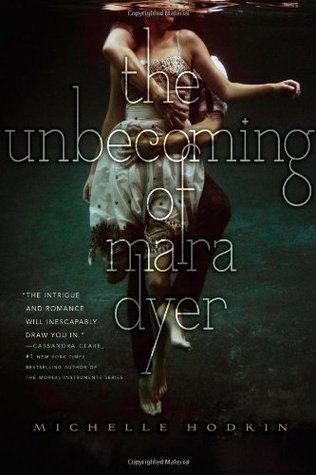
Book Review: The Unbecoming of Mara Dyer by Michelle Hodkin

Book Review: The Unbecoming of Mara Dyer by Michelle Hodkin

16-year-old Mara wakes up in a hospital to some truly horrifying news: She was injured when an abandoned building collapsed with her and three friends trapped inside. Even worse, Mara is the only survivor, yet she has no memory of what happened or why they were there.

Suffering from flashbacks and hallucinations and diagnosed with PTSD, Mara begs her parents to relocate some place new and let her start fresh — a new town and a new school where the daily reminders of her loss won’t confront her everywhere she turns. The family packs up and moves from Rhode Island to Florida, but the trauma for Mara isn’t over.

Mara continues to see things that aren’t there and to have occasional lapses in time that she can’t account for. On top of that, her new private school is not exactly welcoming, and Mara manages to alienate a typical mean girl on her very first day. On the bright side, stunningly attractive Noah seems drawn to Mara, and despite her misgivings, the two eventually develop a strange yet strong connection.

As Mara and Noah’s tension-filled chemistry grows, so too does the mystery. Why can’t Mara remembers some of her actions? Why does she see faces of her dead friends in mirrors? Why do people around her keep ending up dead?

This being the first book in a trilogy, of course there are no quick answers. Unbecoming ends with some insights and revelations, but no major mysteries solved. Clearly, Mara and Noah are involved with forces and powers they don’t understand, and clearly, there are dangers waiting for them in the next installment.

I found this young adult novel addictingly readable, and managed to gobble it all up in the space of 24 hours. The writing is adept and flowing, with snappy dialogue that seems true and authentic for its teen protagonists. Mara is an immensely sympathetic lead character; the reader feels her pain, her confusion, and her sorrow, as well as her more pedestrian worries about fitting into a new school, trying to make friends, and fretting about GPAs and college acceptance letters.

The Unbecoming of Mara Dyer sets out an intriguing set of mysteries, with dynamic characters and relationships, and leaves everything swirling around with enough suspense that I can’t wait to read the next book. Which, luckily for me, won’t be a terribly long wait: The Evolution of Mara Dyer will be released October 23, 2012.

Book Review: Frozen by Mary Casanova

Book Review: Frozen by Mary Casanova

Sadie Rose was rescued from death at age five when she was pulled from a snowbank in the middle of a cold Minnesota night, and hasn’t said a word since. Raised by the wealthy Worthingtons, a senator and his wife, Sadie Rose lives a comfortable but cheerless life in 1920s-era rural Minnesota, protected from all outside forces and influences, seeking shelter in her piano music and random hobbies, with no knowledge or memory of her origins. Until, that is, the fateful day arrives when Sadie discovers a cache of hidden photos of a glamorous, scandalous woman, and recognizes this stranger as her long-lost mother, Bella Rose.

Bit by bit, Sadie recovers pieces of the past, as she recalls her early years living in the brothel where her mother worked, until her mother’s death on the same night that Sadie was pulled from the snow. Bella Rose’s untimely demise was attributed to drink and wantonness, as she was found frozen to death with an empty bottle in her lifeless hand. As Sadie’s memory returns, she realizes that there is more to the story, and as she uncovers the truth, she also rediscovers her own ability to speak.

Frozen is set in northern Minnesota, in a small town on the banks of the great lake separating Minnesota from Canada. Prohibition is the law of the land, and moonshine and smuggling are a way of life. A powerful lumber baron controls everything and everyone in the area, and to cross him is to risk one’s life. Women’s suffrage is gaining momentum, a small group of environmentalists is trying to stop the clear-cutting practices of the lumber industry, and loose women still find ready employment in the wilds of the frontier towns.

The author does a nice job conveying the atmosphere of the time and place in which the story is set, and yet I was left wishing for a bit more meat in the story. Sadie’s journey from silence to finding a voice of her own is a bit sudden, and the catalyst of her transformation — finding her mother’s pictures — wasn’t as clearly defined as it should have been. Frozen has almost too many plot threads — a love story, a mentally ill friend, the investigation into her mother’s past, the environmental protests, local politics — and it’s really more than can be sustained by such a slim tale. The climax and denouement came a bit too easily, and I found the ending unconvincing.

Frozen is being marketed as a young adult novel, and I would imagine that teens interested in a historical setting would enjoy this. For me, as an adult who often adores YA fiction, Frozen fell a little short — a nice effort, pleasant to read, but not substantial enough to feel satisfying.

Review copy courtesy of University of Minnesota Press via NetGalley.

The Monday agenda

Not a lofty, ambitious to-be-read list consisting of 100+ book titles. Just a simple plan for the upcoming week — what I’m reading now, what I plan to read next, and what I’m hoping to squeeze in among the nooks and crannies.

You might think an agenda has no business showing up on Labor Day. What can I say? A reader’s work is never done! It’s time to take stock and plan for the upcoming week.

From last week:

Every Day by David Levithan: Read as fast and furiously as I possibly could. See my review here. The short version? I loved it. Add this one to the list of YA fiction that everyone should read.

Going Bovine by Libba Bray: Finally finished, after several stops and starts. My review is here, but the bottom line is that, despite several laugh-out-loud moments and some truly snazzy writing, I just didn’t enjoy this one nearly as much as I’d hoped.

In graphic novels, I ended up diving into the Jack of Fables series by Bill Willingham (a spin-off from the incredibly wonderful Fables series). I’m on #4 of 9, and so far, I’d say… amusing, but not essential.

My son forced me to read the comic/graphic novel he gobbled up, Giants Beware! by Jorge Aguirre. Quite funny and spirited — definitely a good choice if you’ve got middle-grade readers to entertain.

Drums of Autumn by Diana Gabaldon (group re-read): Need I keep saying it? Terrific book, terrific chapter discussions!

And this week’s new agenda:

I’ve simply got to make some headway with my stack of library books. Next up should be Age of Miracles by Karen Thompson Walker, which I’ve really been looking forward to.

After that:

The Unbecoming of Mara Dyer by Michelle Hodkin

Frozen by Mary Casanova

Plus, I’ll plow on through and finish up the Jack volumes. Must see what that scamp gets up to next!

Drums of Autumn by Diana Gabaldon (group re-read): Chapters 44 and 45 on deck for this week.

So many book, so little time…

That’s my agenda. What’s yours? Add your comments to share your bookish agenda for the week.

Book Review: Every Day by David Levithan

Book Review: Every Day by David Levithan

Every day, main character/narrator A wakes up in a new body with a new life. We never learn how or why; it’s just the simple reality of A’s existence. A can be any ethnicity, gender, identity, or orientation. The only constants are that A is sixteen, and that each visit in a particular body lasts one day, no more, no less.

(I can tell already that this book will be a challenge to discuss, if for no other reason than that pronouns are pretty much off the table. A is neither male nor female; A is whatever the body he/she inhabits for that day is. If I’m confused, I can only imagine how A feels).

A seems to manage this ever-changing life with equanimity. A accepts A’s life; for A, this is normal. A’s modus operandi to to do his/her best with the body of the day, making a good faith effort to get through that body’s normal life as well as possible, whether that means taking history tests, going to a family outing, or playing in a soccer game. Fortunately, A is able to access the memories of whoever’s body he/she is in, so A is more or less able to fake it with teachers, parents, boyfriends, girlfriends. A goes on dates, A hangs out with friends, A does whatever was on the agenda for the day. Each day is something new. Each set of circumstances can be adapted to, and then abandoned for the next.

And then, on day 5994 of A’s existence, A wakes up in the  body of Justin, a rather ordinary, somewhat sullen boy. What’s remarkable about Justin is his girlfriend Rhiannon, whose lack of self-confidence masks an inner and outer beauty that largely goes unappreciated by Justin, but which speaks to A’s heart in a way that’s never happened before. A, as Justin, spends an unforgettable day with Rhiannon, who doesn’t understand why her indifferent boyfriend suddenly seems interested in her soul as well as her body. At the end of the day, A can’t let go, and this is the catalyst for everthing that happens in Every Day. A spends each subsequent day trying to get back to Rhiannon, to convince her that he/she is the same person inside, no matter what’s on the outside, and to try to find a way to make a connection that lasts more than one day.

Even when Rhiannon overcomes her disbelief and allows herself to become involved with A, it’s interesting to see her reaction to A’s physical self vary based on the body he’s in. She holds hands with A without hesitation when he’s in an attractive male body, hangs out with A with a minimum of touching when A is a girl. On a day when A shows up as a morbidly obese boy, Rhiannon can’t hide her discomfort at being out on a date with someone of this appearance, despite knowing that the person she loves is inside.

David Levithan’s writing soars. The author presents with great sympathy and sensitivity the range of experience that represent normal for a 16- year-old. We witness a typical day from the inside of relativity well-adjusted jocks, sensitive girls, hot girls, happy slackers, but too, we see from the inside the misery of suicidal depression, drug addiction, and the desperation of an illegal immigrant forced into domestic servitude. The plot of Every Day is absorbing and compelling, but so too are A’s meditations on identity and belonging. A has been boys and girls, gay and straight, healthy and ill, in a happy family and with a troubled life. Attending a gay pride parade and baffled by some of the protesters, A muses:

In my experience, desire is desire, love is love. I have never fallen in love with a gender. I have fallen for individuals. I know this is hard for people to do, but I don’t understand why it’s so hard, when it’s so obvious.

Of course, I also love A’s thoughts as he browses through a bookstore with Rhiannon:

I show her Feed. I tell her all about The Book Thief. I drag her to find Destroy All Cars and First Days on Earth. I explain to her that these have been my companions all these years, the constants from day to day, the stories I can always return to even if mine is always changing.

Every Day reaches its climax as A faces a moral dilemma: Given an opportunity to find a way to remain in the same body, should A do it? If it means having the ability to have a more or less normal life, does that make it justifiable? Or is it kidnapping, in essence, to poach someone else’s life for the sake of achieving one’s own normalcy?

It’s diffcult to do justice to the glorious writing and thoughtful sentiments of Every Day. I loved this book, and was deeply moved by it. I have no hesitation in recommending Every Day.