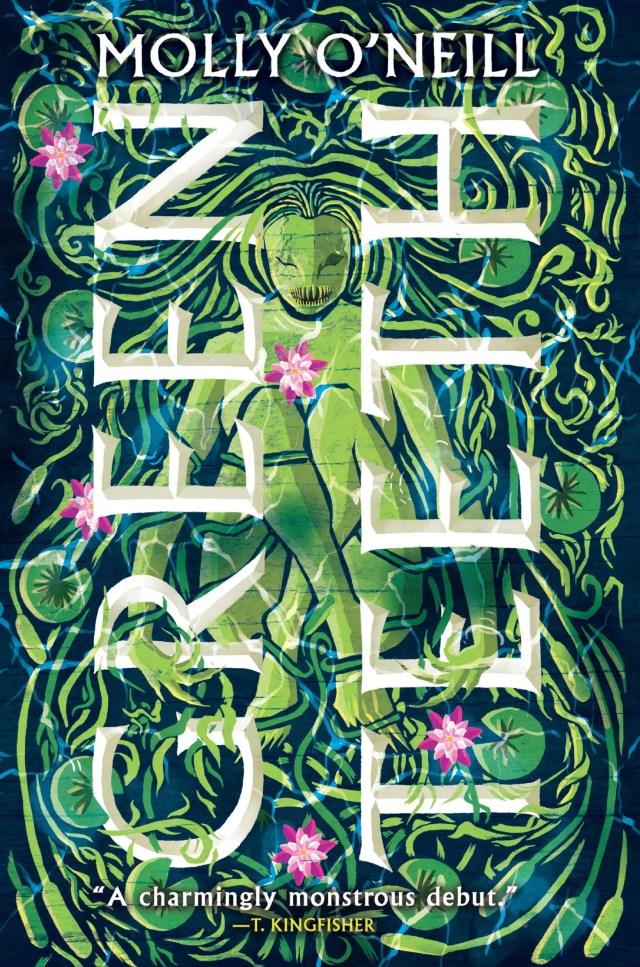
Book Review: Greenteeth by Molly O’Neill

Title: Greenteeth
Author: Molly O’Neill
Publisher: Orbit
Publication date: February 25, 2025
Length: 304 pages
Genre: Fantasy
Source: Review copy courtesy of the publisher via NetGalley
Rating:

Rating: 4 out of 5.

From an outstanding new voice in cozy fantasy comes Greenteeth, a  tale of fae, folklore, and found family, narrated by a charismatic lake-dwelling monster with a voice unlike any other, perfect for fans of T. Kingfisher.

Beneath the still surface of a lake lurks a monster with needle sharp teeth. Hungry and ready to pounce.

Jenny Greenteeth has never spoken to a human before, but when a witch is thrown into her lake, something makes Jenny decide she’s worth saving. Temperance doesn’t know why her village has suddenly turned against her, only that it has something to do with the malevolent new pastor.

Though they have nothing in common, these two must band together on a magical quest to defeat the evil that threatens Jenny’s lake and Temperance’s family, as well as the very soul of Britain.

Greenteeth, a debut novel from author Molly O’Neill, is a delightful fantasy adventure with a unique main character. Jenny Greenteeth is a water-dwelling fae, inspired by a figure from English folklore. According to Wikipedia, “Jenny Greenteeth” is a river hag, a creature who lives in bodies of water and pulls unsuspecting humans to their deaths.

I wasn’t a human, nor a goblin, nor a high fae. I was Jenny Greenteeth, fangs and claws and unholy strength. I was a nightmare, a scary story, the dark shape glimpsed through the weeds.

Yet the Jenny Greenteeth we come to know is much less malevolent that the tales would have us believe. Yes, she loves to eat all sorts of plants and animals that come into her lake, but she doesn’t threaten, and certainly has never lured the nearby townsfolk into her waters. She enjoys a peaceful life, and thinks fondly of the years she spent with her daughter (also called Jenny, as are all women in her line) before little Jenny went off to a lake of her own.

All this changes when she spots a gathering of humans on her shores, led by a stern man in black. A human woman, bound in manacles, is thrown into the lake to drown. Jenny is interested, rescues the woman, and brings her to her underwater cave to learn more. Temperance is a wife and mother, and has been respected as the village healer (and yes, she is a witch), but never had any trouble with her neighbors until the new pastor came along.

Although Jenny has saved her life, Temperance doesn’t dare return to her home. She’s desperate to get back to her family, but when Jenny suggests that she run away and then send for her husband and children, Temperance is reluctant. She loves her village, and suspects there’s more going on than just a witchhunt. Jenny works with Temperance to try to confront the pastor, and discovers that there’s a powerful evil presence at work, one which they can’t overpower or defeat on their own. Joined by Jenny’s goblin friend Brackus, they set out on a quest to learn how to challenge this evil force, and win.

“A witch, a goblin and Jenny Greenteeth are off to seek the King of the Fairies,” he said. “What a delicious disaster this could be.”

Jenny Greenteeth is a wonderful main character. She’s non-human and clearly has a different moral compass and worldview, yet she shows great compassion and an enormous capacity for loyalty and friendship. As she journeys with Temperance and Brackus, her inner workings repeatedly come into conflict with Temperance’s sense of right and wrong. Seeing them navigate their differences and reach for understanding is fascinating and quite touching.

The quest itself is full of danger and adventure and magical obstacles. To be honest, this is the only element of the story that dragged for me — but quite possibly, I’ve just had my fill of quest stories. The specific challenges the trio face are fine, but never felt impossible to me; I was never in any doubt that they’d find a solution without too much difficulty.

Several scenes take place in the court of the high fae, and these were lovely. There’s a sense of power and magic, but also sorrow: The book repeatedly makes clear that the old ways are fading from the world, and that Jenny and all the fae may soon be remnants of a long-gone past.

The final chapters of the book provide a very satisfying ending, and there are some terrific surprises and twists that I won’t reveal here, other than to say that Jenny’s story ends up intersecting with English folklore and mythology in a wonderful, unexpected way.

Jenny and Temperance are both well-developed, strong characters, and I enjoyed spending time with them very much. Brackus is fun too, but less essential, and I’d didn’t get as good a sense of him as an individual. I loved Jenny’s world and her perspective on life as seen from her lake. I can’t say I’ve come across a character quite like Jenny before.

Greenteeth is a wonderful read, and I’ll look forward to whatever Molly O’Neill writes next!

For more on Greenteeth, check out reviews at:

Books, Bones & Buffy
CJRTB Books
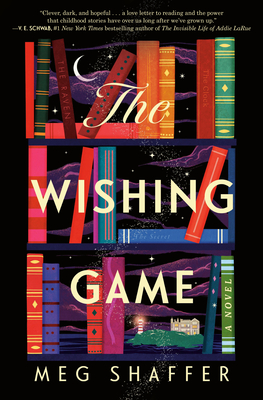

Book Review: The Wishing Game by Meg Shaffer

Title: The Wishing Game
Author: Meg Shaffer
Publisher: Ballantine Books
Publication date: May 30, 2023
Print length: 320 pages
Genre: Contemporary fiction
Source: Purchased

Rating: 4.5 out of 5.

Years ago, a reclusive mega-bestselling children’s author quit writing under mysterious circumstances. Suddenly he resurfaces with a brand-new book and a one-of-a-kind competition, offering a prize that will change the winner’s life in this absorbing and whimsical novel.

Make a wish. . . .

Lucy Hart knows better than anyone what it’s like to grow up without parents who loved her. In a childhood marked by neglect and loneliness, Lucy found her solace in books, namely the Clock Island series by Jack Masterson. Now a twenty-six-year-old teacher’s aide, she is able to share her love of reading with bright, young students, especially seven-year-old Christopher Lamb, who was left orphaned after the tragic death of his parents. Lucy would give anything to adopt Christopher, but even the idea of becoming a family seems like an impossible dream without proper funds and stability.

But be careful what you wish for. . . .

Just when Lucy is about to give up, Jack Masterson announces he’s finally written a new book. Even better, he’s holding a contest at his home on the real Clock Island, and Lucy is one of the four lucky contestants chosen to compete to win the one and only copy.

For Lucy, the chance of winning the most sought-after book in the world means everything to her and Christopher. But first she must contend with ruthless book collectors, wily opponents, and the distractingly handsome (and grumpy) Hugo Reese, the illustrator of the Clock Island books. Meanwhile, Jack “the Mastermind” Masterson is plotting the ultimate twist ending that could change all their lives forever.

. . . You might just get it.

For all the adult readers who miss the sense of wonder and delight that a good children’s books series can bring… have I got a book for you!

The Wishing Game by Meg Shaffer is a quest story for kids who believe in wishes… and then grow up. In this sweet, inventive, lovely tale, the reclusive author of the bestselling Clock Island children’s book series announces that he’s written a new book after a six-year gap… but there’s only one copy, and it will be gifted to the person who wins his contest, which is open to only a select few.

Jack chuckled. “The book exists. And there is only one copy of it in the world. I typed it up and hid it away.”

“And you’re seriously going to entrust it to some stranger?”

“No, but I shall whimsically entrust it to some stranger.”

Shades of Willy Wonka, right?

One of author Jack Masterson’s most devoted fans is Lucy Hart, a kindergarten teacher’s aide whose deepest, most heartfelt wish is to adopt Christopher, an orphaned seven-year-old who’s become the light of her life. Reality interferes in the form of finances: Without an apartment of her own, steady income, and a car, Lucy has no chance of getting approved to foster or adopt. Perhaps, the social worker suggests, it would be kinder to tell Christopher that it’s just not going to happen.

Just as Lucy is verging on despair, the news of Jack’s contest breaks. And Lucy has a secret: At age 13, she ran away to Clock Island and met Jack Masterson. Thanks to being able to solve his riddle, she is one of the four people chosen to compete — and if she wins, she’ll own the exclusive rights to his new book, which she can then sell for enough money to make her dreams of a family with Christopher come true.

Without delving too much further into plot details, let me just say that The Wishing Game is heart-warming, enchanting, whimsical, and full of joy. It’s a book for and about adults, but retains the sense of childish wonder that the best children’s books provide. It’s also a gift for those who love and cherish books, and who believe that stories are more than words on a page.

“Why do only brave kids get their wishes granted?” she asked.

“Because only brave children know that wishing is never enough.”

I loved so much about The Wishing Game. The characters are terrific, especially Lucy, Hugo, and Jack. There’s a romantic storyline, but it’s just one part of the whole, and fits well within the overall weave of the tale. Hugo’s artwork sounds amazing, and I wish it were real! Meg Shaffer does a fantastic job of taking fictional works of art — both Hugo’s paintings and Jack’s books — and making them come to life through her vivid descriptions.

The narrative brilliantly weaves together Lucy’s past — especially the very deep childhood wounds she carries — and the future she hopes for, incorporating a child’s wishes and beliefs into the fabric of an adult life. I loved how all the various pieces come together by the end. Realistic? Maybe not, but this is a book about dreams and wishes. It works.

I came to The Wishing Game after reading the author’s more recent novel, The Lost Story. I do still love The Lost Story best, but The Wishing Game is lovely and wonderful in its own special way, and I’m so happy to have made time to read it.

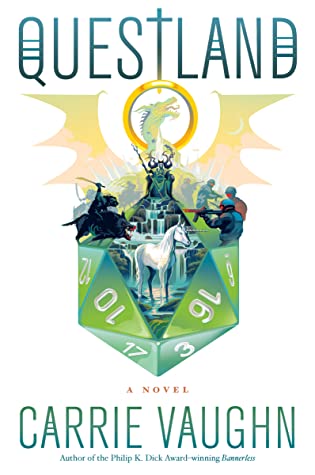
Book Review: Questland by Carrie Vaughn

Title: Questland
Author: Carrie Vaughn
Publisher: John Joseph Adams/Mariner Books
Publication date: June 22, 2021
Length: 304 pages
Genre: Contemporary fiction/fantasy
Source: Review copy courtesy of the publisher via Netgalley
Rating:

Rating: 3.5 out of 5.

YOU FIND YOURSELF IN A MAZE FULL OF TWISTY PASSAGES…


Literature professor Dr. Addie Cox is living a happy, if sheltered, life in her ivory tower when Harris Lang, the famously eccentric billionaire tech genius, offers her an unusual job. He wants her to guide a mercenary strike team sent to infiltrate his island retreat off the northwest coast of the United States. Addie is puzzled by her role on the mission until she understands what Lang has built:  Insula Mirabilis, an isolated resort where tourists will one day pay big bucks for a convincing, high-tech-powered fantasy-world experience, complete with dragons, unicorns, and, yes, magic.


Unfortunately, one of the island’s employees has gone rogue and activated an invisible force shield that has cut off all outside communication. A Coast Guard cutter attempting to pass through the shield has been destroyed. Suspicion rests on Dominic Brand, the project’s head designer— and Addie Cox’s ex-boyfriend. Lang has tasked Addie and the mercenary team with taking back control of the island at any cost.


But Addie is wrestling demons of her own—and not the fantastical kind. Now, she must navigate the deadly traps of Insula Mirabilis as well as her own past trauma. And no d20, however lucky, can help Addie make this saving throw.

To understand the basic premise of Questland, it’s helpful to refer back to Arthur C. Clarke’s famous statement, explicitly referred to in this book:

“Any sufficiently advanced technology is indistinguishable from magic.”

Questland is contemporary fiction, but with technology and fantasy as its underlying themes. In Questland, Professor Addie Cox, an expert in comparative literature with a focus on mythology and fantasy, is approached by tech billionaire Harris Lang with a proposition: Help him reclaim control of his top-secret project, which has been hijacked (supposedly) by his underlings.

The project is a fantasy island in the truest sense of the words: Think Jurassic Park, but instead of T-Rex and velociraptors, insert wizards, goblins, elves, and archers. Insula Mirabilis is conceived of as a fantasy vacation resort, where hardcore gamers and fantasy geeks can immerse themselves in a world in which magic appears to be real. Thanks, of course, to the sufficiently advanced technology to pull it all off.

But Insula Mirabilis seems to have cut off all access and communication with the outside world, and Lang wants it back. Addie is sent to infiltrate the island along with a small band of mercenaries. Addie’s gaming/fantasy brain immediately recognizes her role in all this — their group may have a Cleric and a Ranger, but she’s clearly the Bard.

Her unique knowledge and experience in fantasy worlds quickly becomes important, as the team encounters a Sphinx, a maze, and all sorts of dangerous riddles and traps. Worryingly, the fail-safes for the fantasy elements seem to be turned off — so yes, those arrows and stunners and spider claws can do real damage, and worse.

Addie also carries with her very significant baggage. As a teen, she survived a school shooting, but watched her two closest friends die. Fantasy worlds and gaming became a sort of refuge for Addie:

All I’d ever wanted to do was escape. No, that wasn’t true. All I wanted was for what happened to mean something. Stories meant something, and real life… didn’t.

The plotline of Questland follows Addie and her team’s journey across the island, from the realms of dwarves to the magical and beautiful realm of elves, with random weird encounters with animal villages, Robin Hood and his Merry Men, unicorns, wargs, and more. It’s all so real — but Addie knows it’s not.

My feelings on Questland are mixed. First, delight — who wouldn’t want to inhabit a real-feeling world that incorporates every fantasy element you could possibly desire? It sounds too good to be true, and of course, none of it really is true. For all the mead and antlers and fairy lights, there’s a backroom filled with computers and controllers and transmitters. It may feel like entering a fantasy world, but the ancient stone castle is 3D-printed.

Beyond the delight of the concept, I was often frustrated by the quest itself. The overarching plotline about the corporate takeover veers between being overly complicated and just not very rational. So one faction seizes control of the island — and then everyone there just stays there, wearing costumes and acting as if they live inside the fantasy? To what end, ultimately? If Addie’s team hadn’t arrived, how long would this have gone on?

Still, it’s fun to see Addie use her wits and her geek sensibilities to outsmart the traps and puzzles of the island, getting to be heroic while those around her want to view her as a damsel to be shielded. I wish Addie’s backstory had been even more fleshed out — the pieces dealing with her PTSD and the lingering trauma of her past are sensitively depicted and quite moving.

Never having played D&D or other fantasy-based games or RPGs myself, perhaps I wasn’t quite primed to be the perfect audience for Questland, although I did appreciate how seriously Addie and the island characters take Harry Potter, the Tolkien masterpieces, Narnia, Labyrinth, and more. These aren’t presented in the wink-wink pop culture cool way of many contemporary novels that want to show their characters’ geek cred — instead, in Questland, knowledge of modern fantasy epics is as foundational as a knowledge of Gilgamesh and the Odyssey.

Overall, I enjoyed Questland, but got bored at points with the quest elements. And yet, it’s never a bad thing to see geek culture front and center, being celebrated for all its complexity and wonder. As Addie explains:

I’m not sure any of them really understand — it’s not the stuff. It’s not the magic, the unicorns, the rings. All that’s just things. Fantasy is about what you can’t patent. Honor and heroism and… and… hope.

And as the author says in the end notes:

It’s not just about the sufficiently advanced technology that appears to make magic possible. It’s about a culture hungry for worlds and stories filled with magic. That embraces a sense of wonder instead of being suspicious of it.

If you’re a fan of magical worlds, and especially if you’ve grown up immersing yourself in games and movies that transport you into those worlds, do check out Questland.

**********

Through affiliate programs, I may earn commissions from purchases made when you click through these links, at no cost to you.

Buy now at AmazonBook DepositoryBookshop.org