
Book Review: Sisters of Fortune by Esther Chehebar

Title: Sisters of Fortune
Author: Esther Chehebar
Publisher: Random House
Publication date: July 22, 2025
Length: 320 pages
Genre: Contemporary fiction
Source: Review copy courtesy of the publisher via NetGalley
Rating:

Rating: 2.5 out of 5.

In this hilarious, heart-warming debut novel, three Syrian Jewish sisters chase love and grapple with the growing pains of young womanhood as they seek their place within and beyond their Brooklyn community.

The Cohen sisters are at a crossroads. And not just because the middle sister, Fortune, is starting to question her decision to get married in just a few months. Nina, the eldest sister, is single at 26 (and growing cobwebs by her community’s standards) when she runs into an old childhood friend who offers her the chance to leave behind the pressure to follow in her younger sister’s footsteps. Meanwhile, Lucy, the youngest, a senior at her yeshiva high school, has recently started sneaking around with a mysterious older bachelor that has everybody asking themselves, ‘Fortune, who?

As Fortune inches ever closer to the chuppah, the three sisters find themselves in a tug of war between tradition and modernity, reckoning with what their community wants and with what they want for themselves—and all while learning how to roll the perfect grape leaf under the tutelage of their charismatic grandmother, Sitto, who fled Syria in 1992, and of their mother Sally, whose anxieties are tangled up in her daughters’ futures.

Sisters of Fortune is a sister story about dating, ambition, and coming-of-age under the scope of an immigrant community whose coded language is endearing, maddening, and never boring. The book reckons with what we dream for ourselves, our daughters, and granddaughters. It is concerned as much with where we come from as where we are going—and, above all, with what we are eating for dinner. (And who is making it).

This book about three Syrian Jewish sisters navigating community expectations and the pull of modern life seemed promising, but doesn’t wholly deliver. The three Cohen sisters — Lucy, Fortune, and Nina — deal with parental and community pressure to conform, marry well, and live up to expectations as exemplary wives and mothers. But with one sister’s wedding looming, an older sister remaining unwed and reluctant to play along, and the youngest sister seeming on the verge of a very successful match, the sisters’ lives are suddenly changing in unexpected ways.

Sisters of Fortune includes POV chapters for each sister, but oddly, there’s very little that shows the relationships between the sisters. Instead, each sister seems focused mainly on marriage prospects and dealing with their parents. Their lives are a mix of tradition — cooking, cleaning, preparing Shabbat meals and creating a nice home for their husbands — and modernity — taking the subway to work or school, wearing jeans, getting manicures. Material from so-called bride classes seems a bit out of place — there isn’t a strong sense that the family values quite the level of religious adherence that this material implies.

Between a somewhat messy writing style, too much emphasis on brand names and material wealth, a tendency to include kind of gross moments in random scenes (bits of food flying from someone’s mouth as they talk, engaging in a make-out scene literally minutes after throwing up) and a plot that just sort of peters out toward the end rather than reaching a strong conclusion, I was left mainly unsatisfied by this book.

I did enjoy the scenes with the grandmother and the descriptions of food (although even this felt like too much after a while). There’s a glossary at the end, which will be essential for readers unfamiliar with this culture and its language. I wish there had been a bit more about the family’s backstory; the bits we get are interesting and add depth, but that’s a small part of the story.

This is a fast read, but by the end, I was frustrated by the pacing and the lack of convincing growth for the main characters.

Purchase linksAmazon – Bookshop.org – Libro.fm
Disclaimer: When you make a purchase through one of these affiliate links, I may earn a small commission, at no additional cost to you.
**Save

Save

Save

Save

Save

Save

Save

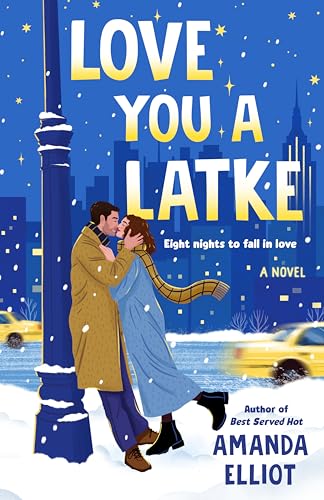
Book Review: Love You a Latke by Amanda Elliot

Title: Love You a Latke
Author: Amanda Elliot
Publisher: Berkley
Publication date: October 8, 2024
Length: 368 pages
Genre: Contemporary romance
Source: Library
Rating:

Rating: 4.5 out of 5.

Snow is falling, holiday lights are twinkling, and Abby Cohen is pissed. For one thing, her most annoying customer, Seth, has been coming into her café every morning with his sunshiny attitude, determined to break down her carefully constructed emotional walls. And, as the only Jew on the tourism board of her Vermont town, Abby’s been charged with planning their fledgling Hanukkah festival. Unfortunately, the local vendors don’t understand that the story of Hanukkah cannot be told with light-up plastic figures from the Nativity scene, even if the Three Wise Men wear yarmulkes.

Desperate for support, Abby puts out a call for help online and discovers she was wrong about being the only Jew within a hundred miles. There’s one other: Seth.

As it turns out, Seth’s parents have been badgering him to bring a Nice Jewish Girlfriend home to New York City for Hanukkah, and if Abby can survive his incessant, irritatingly handsome smiles, he’ll introduce her to all the vendors she needs to make the festival a success. But over latkes, doughnuts, and winter adventures in Manhattan, Abby begins to realize that her fake boyfriend and his family might just be igniting a flame in her own guarded heart.

Let’s hear it for a Hanukkah romance with heart! Love You a Latke by Amanda Elliot combines holiday cheer with the fake dating trope, then adds in deeper emotion and meaningful moments related to community, identity, and assimilation. Does that sound too serious? Never fear, Love You a Latke is fun and has an overall upbeat tone… and plenty of Hanukkah joy.

Abby runs a coffee shop in a small Vermont town, but worries that the tourist trade has fallen off, which may imperil her business’s future. When the head of the local merchant association basically ropes Abby into planning a Hanukkah festival as a tourist draw (after all, any town might have a Christmas festival — but nowhere in Vermont is there a Hanukkah festival!), Abby reluctantly agrees, but quickly realizes she’ll need help to pull it off. Unfortunately, the only other Jew Abby can find in her area is Seth, the annoyingly cheerful customer who comes into her shop every day.

With no other options, Abby asks Seth for help — and he agrees, but with one condition: He’ll help her connect with all the great food and event vendors he knows in New York, who’ll be sure to be perfect for the festival, and in exchange, she’ll come spend Hanukkah with him and his parents. A fake girlfriend is just what he needs to get his mother to ease up on the matchmaking pressure. Desperate for Seth’s help with the festival, Abby agrees to the fake-dating scheme. How hard could it be?

Over the eight days of Hanukkah, Abby warms to Seth and his parents, and rekindles her connection to her Jewish roots. Due to an incredibly toxic relationship with her parents, Abby fled not only them, but the entire Jewish community with which they seem so inextricably linked. Through her time with Seth, as well as by experiencing myriad Jewish and Hanukkah settings and events in New York, Abby begins to realize that she can reclaim an important element of her past — her Judaism — without falling prey to the harshness and negativity of her upbringing.

Of course, there are also romantic sparks being kindled as Abby and Seth light the menorah each night. Their chemistry is lovely, and while Abby struggles to avoid entanglement for way longer than I’d wished, her resistance is understandable given the pain of her past. When Abby and Seth finally do connect, it makes the waiting absolutely worth it.

A subplot throughout the book is Abby’s involvement in the Hanukkah festival. Even though she is nominally in charge, it’s clear that the woman who assigns the job to Abby really wants to retain control — and her idea of a Hanukkah festival is essentially a Christmas festival, but maybe add in a game of dreydel. Part of Abby’s evolution over the course of Love You a Latke is learning to take a stand, claim her own heritage, and refuse to be marginalized or forced to assimilate. It’s all quite awesome.

I just didn’t want Christmas in my Hanukkah, the same way I didn’t want to dip a grilled cheese in my cinnamon roll latte. Both were delicious, but I didn’t want them together

Love You a Latke deals with serious themes about emotional abuse and the lasting damage it can inflict, but the book is not a downer in any way. As Abby starts coming to terms with her life, her past, and her hopes for the future, and recognizing that her life feels richer once she reconnects with the Jewish community she thought she’d left for good, she blossoms and is able to start creating meaningful friendships and romantic connections. She and Seth are great together, but it’s also wonderful to see her connecting with new friends and feeling open to a more positive way of living her life.

The Jewish elements in Love You a Latke are handled very, very well. I loved seeing the community and the holiday represented in non-typical yet very positive ways. Too often, I’ve seen Jewish characters included in romance novel in a tokenized or stereotypical way, but I feel that’s been changing more recently. Love You a Latke brings the Jewish without ever resorting to tired old cliches, and even shows how a new generation of young adults find ways to connect to their heritage and community in all sorts of modern, fresh ways.

Love You a Latke is just the book I needed in this week leading up to Hanukkah! As I light the menorah for the first night of Hanukkah tonight, I’ll be thinking of Abby and Seth and their celebrations too!

For anyone looking for a sweet holiday romance that has something to say, do check out Love You a Latke! Highly recommended.

Audiobook Review: Inheritance: A Memoir of Genealogy, Paternity, and Love by Dani Shapiro


The acclaimed and beloved author of Hourglass now gives us a new memoir about identity, paternity, and family secrets—a real-time exploration of the staggering discovery she recently made about her father, and her struggle to piece together the hidden story of her own life.

What makes us who we are? What combination of memory, history, biology, experience, and that ineffable thing called the soul defines us?

In the spring of 2016, through a genealogy website to which she had whimsically submitted her DNA for analysis, Dani Shapiro received the stunning news that her father was not her biological father. She woke up one morning and her entire history—the life she had lived—crumbled beneath her.

Inheritance is a book about secrets—secrets within families, kept out of shame or self-protectiveness; secrets we keep from one another in the name of love. It is the story of a woman’s urgent quest to unlock the story of her own identity, a story that has been scrupulously hidden from her for more than fifty years, years she had spent writing brilliantly, and compulsively, on themes of identity and family history. It is a book about the extraordinary moment we live in—a moment in which science and technology have outpaced not only medical ethics but also the capacities of the human heart to contend with the consequences of what we discover.

Timely and unforgettable, Dani Shapiro’s memoir is a gripping, gut-wrenching exploration of genealogy, paternity, and love.

I picked up Inheritance on a whim, after a book group friend mentioned plans to attend a talk by the author at an upcoming event. The little bit I heard sounded interesting enough to make me want to know more: The author, raised in an Orthodox Jewish family, discovers through DNA testing that the man who raised her wasn’t actually her biological father.

With the proliferation of inexpensive testing resources like 23andMe and AncestryDNA, anyone can learn a little bit about their genetic background. Author Dani Shapiro’s half-sister had done DNA testing, and Dani decided to do it as well. But when she got her results back, she was startled: According to the data, she was only 52% Ashkenazi Jewish, not the 100% she was certain was her correct heritage. She’d been raised in an Orthodox Jewish home, and her father’s lineage in particular was practically a who’s who of important people in the Orthodox world. She and her half-sister shared a father, but when she compared their results, it turns out that the two women were not actually biologically related at all.

The author was in her mid-50’s at this point, and both her parents were already deceased. She began to follow the scanty available clues, among them memories of her mother stating that she’d been conceived thanks to a medical institute in Philadelphia, and within days, made the discovery that her parents had turned to a fertility center that relied on donor sperm to help infertile couples have children. With only the most preliminary attempts at sleuthing, the author was able to trace connections and find her biological father, a man who was a sperm donor for a period of time as a medical student in Philadelphia in the 1960s.

The book focuses on Dani Shapiro’s search for both the facts of her heritage and conception, and the bigger truth about her identity. Much of Inheritance is spend on understanding the essential question: Who am I? The author, in discovering that the facts of her entire life were false, found herself unmoored and in desperate need of answers. Did her parents truly understand the treatment they sought? Did they know that donor sperm would be used? If they truly knew, how could they hide the truth from her for her entire life? Does this truth change her history, her understanding of her parents’ marriage, her place in the family history?

The author narrates the audiobook, which lends it greater immediacy and emotion. When she describes her soul-searching and her moments of pain and shock, it feels genuine — as though the author was allowing us a peek inside herself, letting us see the turmoil she experienced.

I must admit that there were sections that made me feel very impatient. The degree of shock and dislocation experienced by the author was hard for me to fully understand. I mean, I get being shocked by learning in midlife that there’s a big family secret that was hidden all this time — but the extreme questioning about whether she was still herself and whether she still belonged to her family struck me as over the top. What about people who’ve been adopted? What about all the other people out there whose parents used assisted reproductive technologies involving donor sperm or donor eggs? Why should the use of donor sperm in conception mean that the father who raised her wasn’t really her father?

As a whole, Inheritance spends a great deal of time on introspection and the search for meaning. Which I guess is the point of a memoir, so maybe I’m just not a particularly good memoir reader? In any case, I was much more interested in the unraveling of clues, the discussion of the medical ethics, and the research into fertility approaches in the 1960s than in the contemplative sections on identity and belonging.

That being said, I did find Inheritance quite fascinating as a whole. It’s a relatively quick listen, with lots of food for thought, and elements focused on the author’s Jewish upbringing and how that carries through to her current life particularly resonated for me.

_________________________________________

The details:

Title: Inheritance: A Memoir of Genealogy, Paternity, and Love
Author: Dani Shapiro
Narrated by: Dani Shapiro
Publisher: Knopf Publishing Group
Publication date: January 15, 2019
Length (print): 272 pages
Length (audiobook): 6 hours, 44 minutes
Genre: Memoir
Source: Purchased