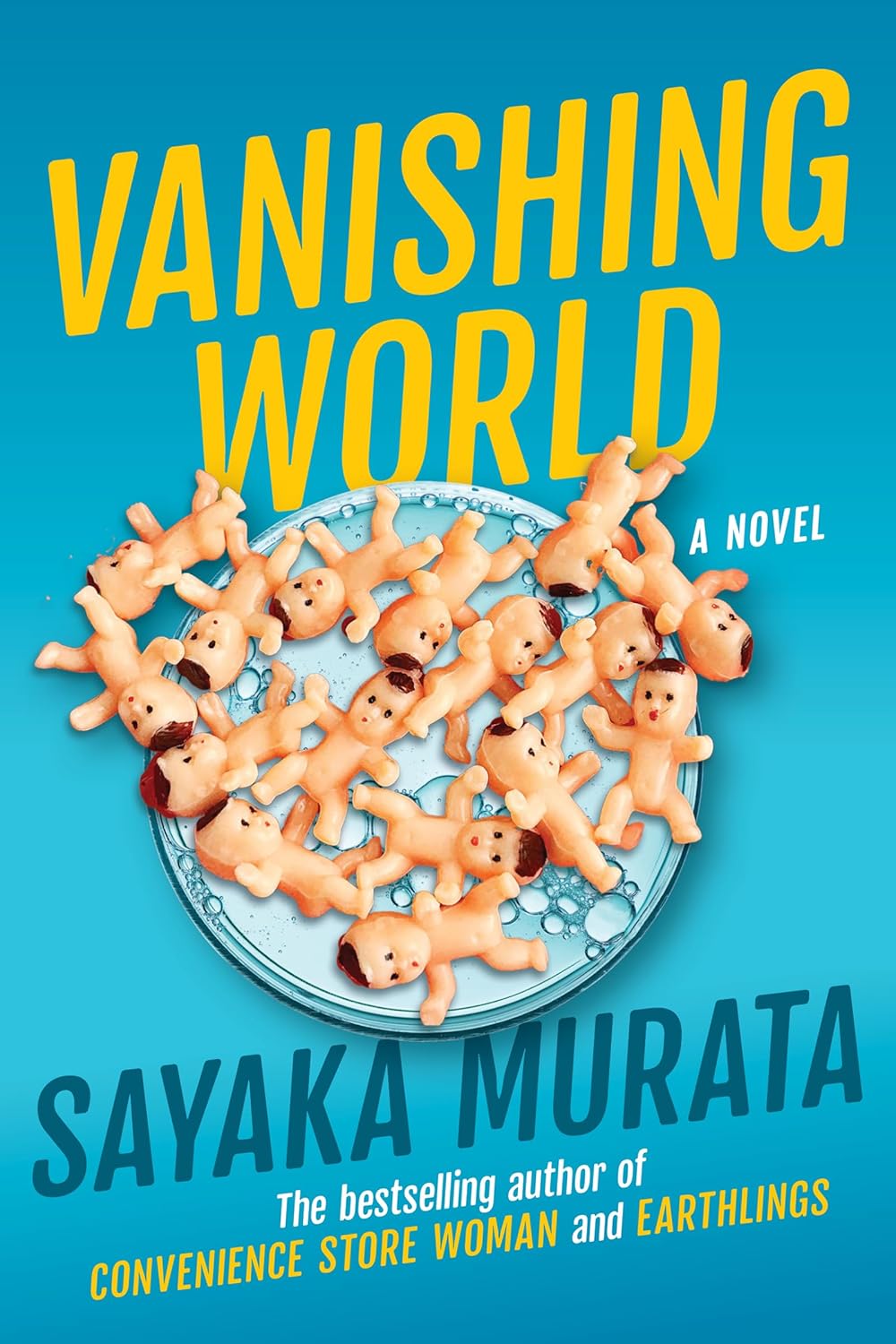
Book Review: Vanishing World by Sayaka Murata

Title: Vanishing World
Author: Sayaka Murata
Publisher: Grove Press
Publication date: April 15, 2025
Length: 240 pages
Genre: Contemporary fiction / science fiction
Source: Library
Rating:

Rating: 2 out of 5.

From the author of the bestselling literary sensations Convenience Store Woman and Earthlings comes a surprising and highly imaginative story set in a version of Japan where sex between married couples has vanished and all children are born by artificial insemination.

Sayaka Murata has proven herself to be one of the most exciting chroniclers of the strangeness of society, x-raying our contemporary world to bizarre and troubling effect. Her depictions of a happily unmarried retail worker in Convenience Store Woman and a young woman convinced she is an alien in Earthlings have endeared her to millions of readers worldwide. Vanishing World takes Murata’s universe to a bold new level, imagining an alternative Japan where attitudes to sex and procreation are wildly different to our own.

As a girl, Amane realizes with horror that her parents “copulated” in order to bring her into the world, rather than using artificial insemination, which became the norm in the mid-twentieth century. Amane strives to get away from what she considers an indoctrination in this strange “system” by her mother, but her infatuations with both anime characters and real people have a sexual force that is undeniable. As an adult in an appropriately sexless marriage—sex between married couples is now considered as taboo as incest—Amane and her husband Saku decide to go and live in a mysterious new town called Experiment City or Paradise-Eden, where all children are raised communally, and every person is considered a Mother to all children. Men are beginning to become pregnant using artificial wombs that sit outside of their bodies like balloons, and children are nameless, called only “Kodomo-chan.” Is this the new world that will purify Amane of her strangeness once and for all?

What did I just read?

Vanishing World falls squarely into the WTF category for me. If there was a point to this work of speculative fiction, then it sailed right over my head.

In Vanishing World, all conception is done via artifical insemination. Copulation is something from history — kind of gross, and why would anyone want to do it? Love is emotional, and can be for real people or people from the “other world” — anime or manga characters, for example, although protagonist Amane objects to calling them “characters”. They’re all her lovers, whether she interacts with them in person or through her feelings about them when she looks at their images.

When a man and woman are ready for children, they marry in order to form a family. Because a husband and wife are family members, sexual contact between them is considered incest, and is simply unimagineable.

As Amane becomes more and more convinced of the need to remove sexual urges and impurities from her life, she and her husband eventually move to Experiment City, where all adults are Mother to all children, women and men can both become pregnant thanks to external wombs, and the children are more or less indistinguishable from one another.

This has to be one of the weirdest books I’ve read in a long time. I honestly don’t know what to make of it — so rather than blather on, I’ll just share a few lines and passages to give a taste of what this book is like:

Copulation was the norm before the war, but when adult men were sent off to fight, research into artificial insemination progressed rapidly in order to produce lots of children for the war effort. People stopped going to all the bother of copulating like animals. We’re a more advanced creature now.

“Sensei, have you ever imagined a world that is parallel to this one? Everyone would still be copulating if there hadn’t been so much progress in artificial insemination, wouldn’t they?”

“Hmm, probably only reluctantly, though. After all, if that was the only way to procreate, then people would have no choice but to resort to primitive copulation. But still, there’s no point imagining that. The human race has advanced.”

His parents gave him a good grilling as he sat hanging his head. “That’s the sort of thing people only do outside the home. I can’t believe you tried to have sex with your wife!”

Still holding hands, we went downstairs to Mizuto’s apartment and sat on the sofa bed in the living room. “Do we have to make any preparations, like with some tools or something?” “No, it’s okay. All we need are our sexual organs.”

I hoped my husband’s love affair would go well too. He was like a little sister I had to keep an eye on.

Recent research has shown that children raised to feel loved by the whole world are more intelligent and more emotionally stable than those brought up under the former family system. Please be present to shower affection on children and thus continue the life of humankind. Please make sure to love all of the children as their Mother. Please make sure to shower affection continually!

Normality is the creepiest madness there is. This was all insane, yet it was so right.

Fortunately, this book was on the shorter side, so even when I felt that the story wasn’t what I’d signed up for, it was a quick enough read that I decided to see it through to the end.

Oh, and that ending! It’s icky. A quick scan of Goodreads and Storygraph reviews shows that even for people who appreciated this book a lot more than I did, the ending freaked them out. (I’ll admit that by the time I got there, I was so ready to be done that I just read it, thought “ewwwwww”, and then closed the book.)

Vanishing World was originally published in Japan in 2015, and has just been released in English translation this month. I previously read Convenience Store Woman by the same author, and I’m pretty sure I liked it, although I couldn’t tell you a thing about it at this point.

As I said as the start of this rambling post, if there was a deeper meaning to Vanishing World… well, I missed it. This was a truly bizarre reading experience that just got odder and odder as it went along. I don’t know what the overall message was supposed to be, and I’m sorry to say that I was mainly left wondering why I stuck with it.

Book Review: Before the Coffee Gets Cold by Toshikazu Kawaguchi


Title: Before the Coffee Gets Cold
Author: Toshikazu Kawaguchi
Publisher: Picador
Publication date: September 19, 2019
Length: 213 pages
Genre: Contemporary fiction
Source: Purchased
Rating:

Rating: 4.5 out of 5.

What would you change if you could go back in time?

In a small back alley in Tokyo, there is a café which has been serving carefully brewed coffee for more than one hundred years. But this coffee shop offers its customers a unique experience: the chance to travel back in time.

In Before the Coffee Gets Cold, we meet four visitors, each of whom is hoping to make use of the café’s time-travelling offer, in order to: confront the man who left them, receive a letter from their husband whose memory has been taken by early onset Alzheimer’s, to see their sister one last time, and to meet the daughter they never got the chance to know.

But the journey into the past does not come without risks: customers must sit in a particular seat, they cannot leave the café, and finally, they must return to the present before the coffee gets cold . . .

Toshikazu Kawaguchi’s beautiful, moving story explores the age-old question: what would you change if you could travel back in time? More importantly, who would you want to meet, maybe for one last time?

I’ve been hearing about Before the Coffee Gets Cold for years now, and finally made the time to sit and enjoy this cozy, sweet tale.

The setup is simple: A tiny basement cafe in Tokyo has only three tables plus a counter, has three clocks on the wall that show different times (although no one knows why), and is the focus of an urban legend that just happens to be true:

If you sit in a particular chair and focus on a time you want to visit, you can travel to the past — but you can’t leave that chair, nothing you do actually changes the future, and you have to finish your coffee before it gets cold, at which point you return to the present.

For many people, the rules are deal-breakers. What’s the point of going back in time if you can’t actually change anything? But as we see through the four chapters of this slim book, each of which highlights a different person’s reason for time traveling, there’s much to be gained with an open heart and open mind.

At just over 200 pages, Before the Coffee Gets Cold is a fast read, and it felt easy and natural to read it pretty much straight through. The storyline is very calm — there’s little action here; rather, it’s a book about connections, emotions, and getting the chance to say the things we wish we’d said in the first place.

Without going into details about the characters and their particular stories, I’ll just say that the cafe staff and its regular visitors have simple yet strong connections, and as their stories unfold, the emotional impact builds as well.

Before the Coffee Gets Cold is a lovely, sweet reading experience — a warm hug of a book that I recommend enjoying on a day when you especially need something bright and uplifting.

Since Before the Coffee Gets Cold was published, four more books have been added to the series. Before the Coffee Gets Cold feels very complete on its own, so while I’d like to eventually read more of these books — assuming the rest will be as lovely as the first! — I feel like I can take my time and pick up the next book on a whim, on a day when I need it.

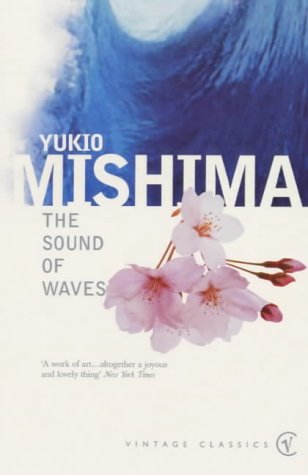
Book Review: The Sound of Waves by Yukio Mishima (Classics Club Spin #38)

Title: The Sound of Waves
Author: Yukio Mishima
Publication date: 1954
Length: 183 pages
Rating:

Rating: 5 out of 5.

Set in a remote fishing village in Japan, The Sound of Waves is a timeless story of first love. It tells of Shinji, a young fisherman and Hatsue, the beautiful daughter of the wealthiest man in the village. Shinji is entranced at the sight of Hatsue in the twilight on the beach and they fall in love. When the villagers’ gossip threatens to divide them, Shinji must risk his life to prove his worth.

I’ve had The Sound of Waves on my Classics Club spin list since I first started participating a couple of years ago, and I was so happy that its number finally came up!

Here’s why: I first read The Sound of Waves eons ago in a World Lit class in high school, and I remember loving it at the time. The main thing I remembered is that the class reading list seemed to consist of tragedy after tragedy. The whole time we were reading The Sound of Waves, I was holding my breath waiting for something terrible to happen… and it never did. Instead, it was a gentle, lovely story about first love, and it even had a happy ending.

I’ve always thought back on that book with warm feelings, and have wondered whether I’d still appreciate it all these years later. I’ve been wanting to reread it, and just needed a little push to do so… which the Classics Club spin provided.

In The Sound of Waves, the story centers on a small island called Uta-Jima, a fishing village that’s self-contained and bound by traditions, seemingly set apart from the larger world. Although it’s set in the post-war years (and was originally published in 1954), it’s easy to forget and imagine that the story is set much, much earlier. Every so often, reminders of the outside world and its modernity appear, and often feel startling. For the daily lives of the villagers, governed by the tides and the fishing seasons, we can easily imagine that nothing has change for centuries.

Shinji, the elder of two boys, is not yet twenty years old, but is responsible for his mother and brother, ever since his father’s death during the war. Shinji is large and strong, a devoted son, and earnest in his commitment to his family, his employer, the gods, and the people of the island. He’s struck by immediate love when he meets Hatsue, daughter of the wealthiest man on the island. Hatsue has lived away from the island for many years, but when she returns, her beauty and her father’s position make her the most sought after girl, especially since her father has declared that he intends to adopt her potential husband into his family.

Shinji and Hatsue’s love is sincere and pure, but when they become fodder for island gossip, Hatsue’s father bans them from seeing one another and forbids Hatsue to even leave the house. But despite the challenges and the odds stacked against them, they remain true to one another… and yes, there’s a happy ending.

The Sound of Waves is quite lovely, especially in its depiction of the natural beauty of the island and the seas. The author paints pictures with his words, showing us the changing seasons, the trees and plants and fish, the wave patterns, the steep hills and beautiful views that make up the setting.

From time to time the dying fire crackled a little. They heard this sound and the whistling of the storm as it swept past the high windows, all mixed with the beating of their hearts. To Shinji it seemed as though this unceasing feeling of intoxication, and the confused booming of the sea outside, and the noise of the storm among the treetops were all beating with nature’s violent rhythm. And as part of his emotion there was the feeling, forever and ever, of pure and holy happiness.

He also brings to life the villagers themselves, through simple dialogue, descriptions of routines and interactions, and quick sketches that show the inner nature of the people we meet. I particularly enjoyed scenes of the diving women, although the scenes on the fishing boats are also action-packed and compelling.

My one complaint, which is probably irrelevant in the grand scheme of things, is that there are a lot of descriptions of breasts! So many varieties, so many details… I could have done without all this, but that’s really my only quibble.

Other than that… The Sound of Waves is a beautifully written novel, and I’m happy that rereading this book proved to me that it is just as good as I’d remembered!

Once again, a very good outcome from a Classics Club spin.