
Book Review: The Girls at the Kingfisher Club by Genevieve Valentine

Book Review: The Girls at the Kingfisher Club by Genevieve Valentine

The Girls at the Kingfisher Club: A NovelIn this fairy tale retelling, author Genevieve Valentine takes the classic story of the Twelve Dancing Princesses and transplants it to Jazz Age Manhattan, with a result that is equal parts captivating and frustrating.

The Twelve Dancing Princesses was always one of my favorite fairy tales. In a nutshell: A king with twelve daughters locks the princesses into their chamber each night, but each morning finds that their shoes are worn completely through. He offers the pick of the princesses to any suitor who can find out for him how the girls wear out their shoes — but anyone who tries and does not succeed must die. Prince after prince fails to figure out the secret, until finally one man comes who manages to outwit the princesses and follows them to a secret castle where they dance all night until their shoes are worn through. Ta da! He wins the hand of a princess and the kingdom besides. The end.

In The Girls at the Kingfisher Club, the father is no king, but a wealthy, grasping businessman trying to break into high society. His wife produces daughter after daughter, much to his dissatisfaction, so he keeps her pregnant, time and again, until after twelve failed attempts at a son and heir, his frail wife finally gives up the ghost.

And the girls? Each girl is sent upstairs to be raised among her sisters, with a tiny allowance for clothing, a meager library to learn the basics, and strict requirements that they be neither seen nor heard. The girls are hidden away from the world, kept indoors and educated first by tutors, then later by the older sisters, with no hope and no way out. The oldest sister, Josephine (Jo), serves as liaison, summoned a few times a year into her father’s presence to give reports, receive any orders, and then sent back to enforce her father’s rules.

But as the girls age, their frustration grows, and Jo knows it’s only a matter of time until her sisters run away or act rashly enough to bring disaster down on all of them — and so she figures out a release for them all. Jo learns to dance by sneaking off to see movies, then teaches her sisters, and eventually starts sneaking the girls out of the house at midnight to dance the night away at Manhattan’s hidden speaky-easys and dance halls.

Jo is known amongst her sisters as the General — the one in charge, demanding instant obedience, running their days and nights. Jo determines which nights they go out. Jo gets the cabs, Jo sets the rules: Flirt, but don’t give a man your name. Have fun, but don’t get romantically involved. Above all else, always be ready to run, and know where the exits are. The dance halls are glitzy and glamorous, and the beautiful, exotic girls with no names — affectionately nicknamed “the Princesses”  — are the talk of the town, but there’s a constant risk of police raids, or even worse, having their father find out what they’re up to.

When their father finally decides to assert his control in new and awful ways once his daughters are of marriageable age, the sisters have to figure out how to survive — and Jo has to both let go and start to live for herself, rather than putting her own needs after those of her sisters.
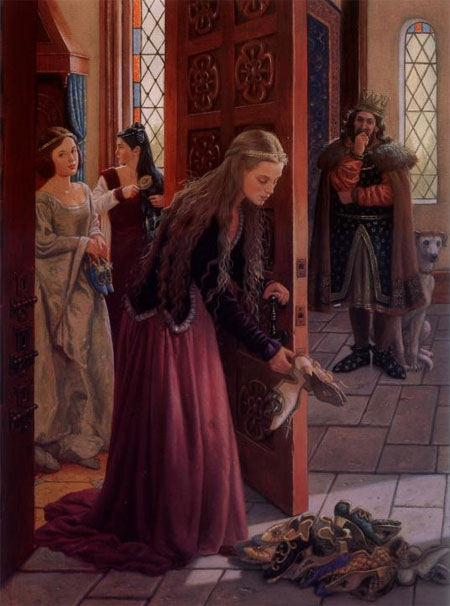
Here's the version I remember, from The Twelve Dancing Princesses by Ruth Sanderson

Here’s the version I remember, from The Twelve Dancing Princesses by Ruth Sanderson

There’s a lot to like about The Girls at the Kingfisher Club. In this mostly successful retelling, the fairy tale works well in its new setting. There’s a terrible logic to the father’s cruelty and tyranny, and the girls’ lives are uniformly dull and drab except for their nightly escapes. The dance halls are described in all their decadent 1920s glory — no wonder the sisters come to life on the dance floor, dancing the Charleston with enchanted admirers, always the belles of the ball, living fully in the moment. The era is a smart choice for this story, a time when women started emerging into something like independence, yet often chained to their fathers or husbands by complete financial dependence and a society that viewed strong women as depraved, or worse, mentally unstable.

Where the novel is less successful is in creating twelve distinct characters for the reader to care about. Jo is the point of view for the story, and we come to know her sisters through her eyes, but it’s difficult to differentiate one from another, particularly those we only see in passing. Certain sisters have more distinctive roles to play, but others seem to come and go with only a few lines or scenes, and it’s hard to remember who’s who or what’s special about each one.

The narrative style is somewhat choppy, so that while some passages and chapters keep the feeling of  a fairy tale in their descriptions — telling the story in broad strokes that seem like an outsider’s perspective on an enchanted world — other chapters bog down and feel sluggish. The book suffers a bit from a lack of intimacy. Perhaps because there are so many girls to keep track of, none seem very knowable, and I didn’t end up feeling connected emotionally to any of the characters, thus making the stakes of the story less compelling than they should have been.

Did I enjoy The Girls at the Kingfisher Club? Yes, quite a bit. Still, something was lacking, and the story always felt as thought it was unfolding at a distance. I wanted to know what happened, but I wasn’t invested in any one of the sisters enough — even main character Jo – to make the story feel the urgency it should have by the end.

Still, if you enjoy reading about the roaring 20s and relish the thought of a flapper-era fairy tale, check out The Girls at the Kingfisher Club. For those who always wanted to be one of the royal, glamorous sisters who dance the night away, this book offers a fresh spin on an old tale — and if nothing else, will make you want to dust off your copy of the Brothers Grimm.

_________________________________________

The details:

Title: The Girls at the Kingfisher Club
Author: Genevieve Valentine
Publisher: Atria Books
Publication date: June 3, 2014
Length: 288 pages
Genre: Adult fiction/historical fiction
Source: Review copy courtesy of Atria Books via NetGalley

Book Review: Cruel Beauty by Rosamund Hodge

Book Review: Cruel Beauty by Rosamund Hodge

Cruel BeautyWhat do you get when you put Beauty and the Beast, Bluebeard, and Greek mythology in a blender?

Probably something that looks a lot like Cruel Beauty!

In this new YA fantasy novel, 17-year-old Nyx is doomed to marry the demon who rules her land, as the price due for a bargain her father made before her birth. Nyx has spent her whole life dreading and preparing for her fate, filled with anger at her father for sacrificing her so easily and filled with dismay, knowing that she has no chance of surviving. Nyx’s purpose is not just to wed the ruler, but to bring about his destruction, in order to free her people and avenge her mother’s death.

Easier said than done. When Nyx finally arrives at the ruined castle, she meets her new husband — incredibly handsome, of course — as well as the shadow servant, Shade, who is forced to obey but seems to be on her side. Secrets abound, and Nyx realizes that her task will be even harder than she imagined… especially when her hatred for her husband and captor starts turning into something else.

In Cruel Beauty, there’s a whole mish-mosh of fairy tale and mythology stirred together. The land of Arcadia worships the Greek gods, and their stories and curses inform the actions of Nyx and the rest of the characters. The main tale of the girl promised to the hideous creature and then falling in love is straight out of Beauty and the Beast, although twisted and turned quite a bit along the way. There’s a magical system as well, as Hermetic works (related to the god Hermes) are what allow people to harness the elements of air, earth, fire, and water.

So does it all work? For the most part, I’d say yes. The plot gets overly complicated with so many different fantastical and mythological sources contributing to the mix. The Hermetic concepts take up space and seem to be very important early on — but don’t really matter much by the end of the story. There’s magic and dark spirits and curses and bargains… and the plot ends up practically tying itself into knots to make it all connect and work out in the end.

But, despite the convoluted story line, I enjoyed Cruel Beauty quite a bit. I think it helps that I read it straight through, all in one day. Yes, it’s that compelling — one of those books where you vow to stop after one more chapter… and suddenly an hour or two have slipped by. If I’d read it in smaller chunks or over the course of a week, maybe I would have taken more time to think about the plot developments and poke holes at certain pieces. But gobbling it up all at once, nothing bothered me too much…

Because wow. That’s some love story! Nyx and her captor do a slow burn, gradually moving from mistrust and outright dislike to grudging respect and amusement, and finally, kindness and affection — despite Nyx’s horrible sense that she betrays her family and her people by feeling anything for this strange and seemingly cruel man. Their passion is palpable, and feels like the kind of epic love that can make someone risk eternal suffering for the sake of the other.

Oh, and can we just take a minute to gaze at that cover? Gorgeous.

Overall, Cruel Beauty is probably over-plotted, but it’s a thrilling and oddly moving narrative none the less. If you enjoy fairy tale retellings, magical worlds, and dark secrets, this is one new release that you shouldn’t miss.

_________________________________________

The details:

Title: Cruel Beauty
Author: Rosamund Hodge
Publisher: Balzer + Bray
Publication date: January 28, 2014
Length: 352 pages
Genre: Young adult fantasy
Source: Review copy courtesy of Balzer + Bray via Edelweiss

Book Review: Fathomless by Jackson Pearce — **This review contains spoilers**

Book Review: Fathomless by Jackson Pearce

Fathomless (Fairytale Retellings, #3)I can’t write about Fathomless and express what I thought and felt reading this book without including SPOILERS — so consider this fair warning! This review will include plot spoilers, including the major twist that readers discover toward the end. If you don’t want to know, stop reading now! Seriously, final notice!

Are you still here?

Sure you don’t want to look away?

Really, really sure?

Okay….

Fathomless looks like a mermaid story, right? I mean, look at the cover. That’s a mermaid. Absolutely, without doubt.

Except the girls/creatures in Fathomless aren’t actually mermaids, or at least not the fairy tale and Disney versions of mermaids. For starters — no tails. Not at all. They have legs and feet, just like when they were human. And that’s a key point as well. You know how Ariel is the daughter of King Triton? No mermaid royalty here — these girls were once human, but have somehow been transformed into creatures who live in the ocean, happily swimming with their sisters all day long and bit by bit forgetting their previous lives.

Our main mermaid girl is Lo, who lives under the sea (not in a pineapple…) off the coast of Georgia. She still yearns vaguely for the lights of the human world, but grows more and more content with her underwater life with each passing day. She knows that she was once someone else and had a different name, but can’t remember those details any longer. She and her “sisters” share the belief that they were brought to live in the ocean by an angel, and that someday, when they’ve turned into one of the beautiful but vacant old ones, they’ll leave the ocean and become angels themselves.

There’s another path that the ocean girls believe in, even thought they’ve never seen it happen: Legend says that an ocean girl (sorry, I have a hard time calling them mermaids) can regain a human soul and a human life by getting a human boy to fall in love with her — and then drowning him. At that point, she takes his soul and can go back to living on land as a regular girl again. Okay, yeah, she’ll also have murdered someone to get there, but why quibble?

Celia is our main human point of view. She’s one of triplets — her sisters Jane and Anne are identical, and Celia is the odd girl out. All three have powers of sight: Through touch, Celia can read someone’s past, Jane reads the present, and Anne sees the future. The sisters live in a small Georgia beach town in their prep school dorm, supported by a distant uncle after their mother’s death and their elderly father’s descent into the fog of Alzheimer’s.

Celia and Lo collide one night when guitar-playing cute boy Jude falls off a pier into the ocean. Lo pulls him from the sea, Celia performs CPR, and Jude comes back to life. He falls for Celia, but he remembers hearing a song while he was being rescued — and Celia doesn’t sing. Celia and Jude form a relationship, but at the same time, Celia is drawn back to the beach to seek out the mysterious girl she saw disappear back into the ocean.

Lo is able to leave the water, but each step on land is torture for her, leaving her in agony and with bleeding feet. As Celia and Lo begin to know one another, Celia touches Lo and is able to see her past as a human. As Celia uncovers Lo’s history, Lo begins to remember her life as Naida, a normal human girl with a home and a family. Lo and Naida are presented as two separate personalities struggling for dominance; sometimes we see Lo’s perspective on life in the ocean, and sometimes we get Naida, who considers herself a prisoner and yearns to be free.

So far, so good. In fact, I liked Fathomless quite a bit for about the first 2/3 of the book. And then it took a twist that more or less ruined it for me.

To backtrack a bit, according to Goodreads, Fathomless is book #3 in author Jackson Pearce’s Fairytale Retellings series. I’ve read the previous two books, Sisters Red and Sweetly, although it’s been a few years since then and I’d forgotten a lot of the details. I remembered the vague plot outlines, and remembered that I’d found the books enjoyable, but didn’t remember much more than that.

So… I picked up Fathomless while under the impression that the author had written a series of separate novels, with a common theme of being inspired by different fairy tales. And then 2/3 of the way through Fathomless, I was smacked in the head by how wrong I was. All three of these novels are connected, and let me just say: Weird.

All of a sudden, in the middle of a book about quasi-mermaid-creatures, there are werewolves. Yup. Werewolves. Apparently, werewolves steal girls away and stick them in the ocean as some sort of incubator — and when the girls are done, they come back out of the ocean and join the werewolf pack. Or something. Sisters Red was about a Buffy-ish werewolf slayer fighting hordes of evil monsters. In Sweetly, as I’d completely forgotten until reading a synopsis last night, a Hansel and Gretel retelling ends up having werewolves behind the town’s evil secret as well. And now, here they are again, finding twins, killing one outright and biting the other, then putting her into the sea to cook or stew or whatever it is they’re doing down there. Supposedly, it has to be twins – something about sharing the soul, blah blah blah. To be honest, my eyes had started to glaze over at this point in the story so the twin rationale kind of escaped me. Or was just ridiculous to begin with. One of the two.

I liked the story of Celia and Jude well enough, although the two other triplets, Anne and Jane, seemed a bit amorphous to me. We learn about some of their habits, but their inner workings are a little vague and seem altogether too inconsistent for me to ever to get a true sense of who they are, what they want, and what role Celia plays in their lives. But their story, as interwoven with the story of Lo/Naida and the ocean girls, gets lost somewhere along the way, and the entire thing just falls apart by the end.

The werewolf twist comes out of nowhere and makes no sense. I was kind of enjoying the twist on the Little Mermaid fairy tale up to that point, and found some of the descriptions of the ocean world to be quite lovely. But the entire plot just falls apart when the werewolf element is introduced — at which point, I realized that the pieces that seemed to promise an interesting take on a traditional tale, such as the mermaids being formerly human girls, were all for nothing. If the author is trying to build an entire world in this series, then the connection needs to be stronger to make it work, rather than randomly introducing werewolves into a mermaid story. Better yet, in my opinion, would have been creating these stories as stand-alone fairy tale retellings that provide unique takes on traditional tales, without trying to force a big-picture framework onto them.

I see that book #4 in the Fairytale Retellings series will be published this fall. Called Cold Spell, it’s a retelling of The Snow Queen by Hans Christian Anderson. Which would be great… except I’m guessing there will be werewolves.

No thanks. I think I’m done with this series.

Book Review: Fables (volumes 1 – 3) by Bill Willingham

Fables (volumes 1 – 3) by Bill Willingham

I have quickly fallen in love with the Fables graphic novel series. By the end of volume 1, “Legends in Exile”, I was pretty sure it was just a crush. After reading volume 2, “Animal Farm,” I realized my feelings had deepened and that this just might be the start of a serious relationship. And now, three volumes in, after reading “Storybook Love”, I know it’s the real thing. I’m hooked.

Fables, written by Bill Willingham, is a DC Comics series that originally appeared in comic book format, now compiled in trade paperback volumes. So far, 17 volumes are available in print, with volume #18 due for publication in January of 2013.

Fables tell the story of fairy tale and other assorted mythical and magical characters, forced to flee their homelands after the invasion of the Adversary (about whom we know nothing so far, other than the fact that he’s unstoppable and ruthless. If you’ve read further in the series than I have — hush! I don’t want to know.) The survivors have taken refuge in our world — more specifically, Manhattan — where they live a secret life, concealing their magic from the mundys (that’s us, folks).

The mayor of the Manhattan Fable town is Old King Cole, but he’s merely a figurehead. The true authority lies with deputy mayor Snow White (our fearless heroine!), backed up by sheriff and overall enforcer Bigby Wolf (Big B. Wolf — get it?), whose gruff human exterior hides a predator with a core of integrity. Between the two of them, they ride herd on a mish-mash of misfits, including Little Boy Blue, Prince Charming (such a cad!), the Frog Prince (known as Flycatcher due to his unfortunate snacking habits), and Bluebeard (who reminds me of a really buff version of Walter White of Breaking Bad).

Their less human-looking counterparts reside on a hidden farm in upstate New York, concealed from the outside world, but also chafing under their enforced seclusion. A brilliant plot involving an uprising at the Farm is what truly got me involved in this series. Let’s just say that there’s a lot more to Goldilocks and the three bears than you might assume. And don’t get me started on nasty old Shere Khan either.

Fables is not for children. Mature themes abound, as well as plenty of gruesome deaths, sexy bedroom scenes, conspiracies, deceptions, murder and mayhem. The plotting is detailed and fast-paced, with masterful storytelling at every turn. It’s been a real pleasure for me to discover a tale well-told in a format that’s fresh and engaging. For someone who’s relatively new to the world of graphic novels, I’m really having a ball with this series, and I’m finding it seriously difficult to put Fables down in order to pick up a “real” novel.

Onward we go. So long as I have more volumes of Fables close at hand, it would appear that I’m not going to get anything else done.