Book Review: Children of Time (Children of Time, #1) by Adrian Tchaikovsky

Title: Children of Time
Series: Children of Time, #1
Author: Adrian Tchaikovsky
Publisher: Orbit
Publication date: June 4, 2015
Length: 600 pages
Genre: Science fiction
Source: Purchased
Rating:

Rating: 5 out of 5.

A race for survival among the stars… Humanity’s last survivors escaped earth’s ruins to find a new home. But when they find it, can their desperation overcome its dangers?

WHO WILL INHERIT THIS NEW EARTH?

The last remnants of the human race left a dying Earth, desperate to find a new home among the stars. Following in the footsteps of their ancestors, they discover the greatest treasure of the past age—a world terraformed and prepared for human life.

But all is not right in this new Eden. In the long years since the planet was abandoned, the work of its architects has borne disastrous fruit. The planet is not waiting for them, pristine and unoccupied. New masters have turned it from a refuge into mankind’s worst nightmare.

Now two civilizations are on a collision course, both testing the boundaries of what they will do to survive. As the fate of humanity hangs in the balance, who are the true heirs of this new Earth?

Children of Time is a big, detailed, complex work of science fiction. It requires focus and concentration… and is absolutely worth the effort.

In Children of Time, humanity’s time on Earth has come to an end. While expanding out beyond the solar system and exploring other worlds, factions at home and throughout Earth’s space colonies go from adversarial politics to all-out war. The few remnants of humans on Earth find ways to survive an ice age, only to discover, as the ice finally recedes, that the ice actually protected life from the toxins that now doom them all to extinction — unless they can recreate the ancient tech of their space-faring ancestors and journey to a new planet to start again.

Meanwhile, the earlier humans’ space exploration included an ambitious terraforming agenda, journeying to far-flung solar systems to seed likely planets with the potential for new homes for humanity. As we learn early on, though, even this undertaking comes to ruin due to the factionalism and wars that devastate life on Earth.

One scientist heading a terraforming project succeeds, however… in a way. The pioneer of a project known as exaltation, Dr. Avrana Kern’s mission is to seed a terraformed planet with monkeys and a nanovirus to speed their evolution — then have the humans remain in suspension for centuries until the monkeys have evolved enough to support human settlement on their planet. But thanks to the war between humans, something goes very, very wrong with her plans.

Without giving too much away, I’ll just say that the story of what happens on this planet is utterly fascinating. Essentially, an unintended species is infected by the nanovirus — and over the course of Children of Time, we see an intensely interesting version of human evolution as played out by another species entirely. Thanks to the relatively short life span of this species, many generations pass over the course of the decades and centuries that follow — and we see them evolved from basic hunting skills to complex reasoning, strategy, building, communication, religious ideology, and eventually, highly advanced biochemistry and technology.

Meanwhile, in alternating chapters, we see the final remnants of the human race aboard the ark ship Gilgamesh, following the star maps and recovered documents of the last space-exploring humans in a desperate search to locate the old terraformed planets. Because they mainly exist in suspension, millennia pass during the Gilgamesh’s journey. We see familiar characters as they come out of suspension, often after decades or centuries have passed, in order to deal with new threats or discoveries. The concepts of time and what constitutes a life span are investigated in strange and wonderful new ways.

I don’t want to go too far into specifics, as there’s a real joy in seeing just how inventively the author spins out this story. The chapters alternate between life on the Gilgamesh and life on the planet, and it’s done so well that by the time the inevitable conflict between the two arrives near the end of the book, it’s impossible for a reader to favor one side over the other.

I’m thrilled that I’ve finally read Children of Time. Despite the book’s length, it’s so engrossing that the pages just fly by. For science fiction fans, this book is a must!

There are two more volumes in the series currently available, with a fourth set for publication in early 2026. On the one hand, Children of Time does wrap up very well, so I’d say it’s perfectly fine and satisfying to approach it as a single-volume stand-alone. On the other hand, I enjoyed Children of Time so much that I’m eager to read more set in this sci-fi universe!

Purchase linksAmazon – Audible audiobook – Bookshop.org 
Disclaimer: When you make a purchase through one of these affiliate links, I may earn a small commission, at no additional cost to you.
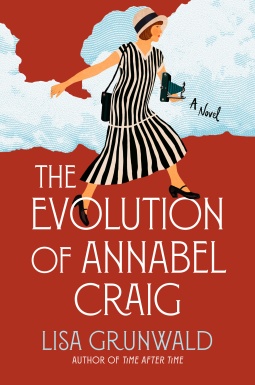
Book Review: The Evolution of Annabel Craig by Lisa Grunwald

Title: The Evolution of Annabel Craig
Author: Lisa Grunwald
Publisher: Random House
Publication date: April 16, 2024
Length: 320 pages
Genre: Historical fiction
Source: Review copy courtesy of the publisher via NetGalley
Rating:

Rating: 4.5 out of 5.

A young Southern woman sets out on a journey of self-discovery as the infamous 1925 Scopes Trial tests her faith and her marriage in this moving novel from the author of Time After Time and The Irresistible Henry House.

“Lisa Grunwald is a national treasure. . . . An essential American story from a master craftsman.”—Adriana Trigiani, New York Times bestselling author of The Good Left Undone

I had never questioned a miracle, witnessed a gunfight, or seen a dead body. . . . I had thought I knew exactly what I wanted and what I didn’t. Before the summer was over, all that and much more would change.

Annabel Hayes—born, baptized, and orphaned in the sleepy conservative town of Dayton, Tennessee—is thrilled to find herself falling quickly and deeply in love with George Craig, a sophisticated attorney newly arrived from Knoxville. But before the end of their first year of marriage, their lives are beset by losses. The strain on their relationship is only intensified when John T. Scopes is arrested for teaching Charles Darwin’s theory of evolution at the local high school.

Foreshadowing today’s culture wars, the trial against Scopes is a spectacle unlike any the country has seen. William Jennings Bryan—a revered Southern politician—joins the prosecution, pitting himself and his faith against the renowned defense attorney Clarence Darrow. Journalists descend in a frenzy, thrusting the town and its citizens into the national spotlight. And when George joins the team defending Scopes, Annabel begins to question both her beliefs and her vows.

As the ongoing trial divides neighbor against neighbor, it also divides the Craigs in unexpected ways. But in the midst of these conflicts—one waged in an open courtroom, the other behind closed doors—Annabel will discover that the path to her own evolution begins with the courage to think for herself.

Happy Book Birthday to this wonderful historical novel! The Evolution of Annabel Craig is the story of one woman’s personal awakening (and yes, there are references to The Awakening by Kate Chopin), set in the midst of one of the pivotal societal earthquakes of the early 20th century.

Prior to reading The Evolution of Annabel Craig, I’d had a vague familiarity with the “Scopes Monkey Trial” — I knew it centered around a battle between evolutionists and creationists. Beyond that, though, I didn’t actually know much of anything — not even where the event took place or what the name “Scopes” represented.

In this fascinating novel, Annabel Craig is the readers’ eye and ears in the town of Dayton, Tennessee as their quiet little community gets turned upside down. In 1925, the State of Tennessee passed the Butler Act, making it a criminal offense to teach evolution in public schools. The leading citizens of Dayton realize they had a potential goldmine on their hands — why not challenge the law in their own town, and reap the reward of the inevitable news coverage that would bring them tourism and an economic boom? The town leaders recruit John Scopes, a high school football coach who’d subbed for a science teacher earlier in the year. Since the standard biology textbook included a few pages on Darwin and evolution, Scopes must have taught evolution in the school. The fact that Scopes doesn’t actually remember covering evolution didn’t matter — he agrees to be the town’s test subject, and to be arrested for violating the Butler Act.

Beyond the details of the Scopes trial itself, The Evolution of Annabel Craig is truly Annabel’s story. The daughter of strawberry farmers who were very much in love, Annabel finds herself orphaned as a teen, with only her faith and the kindness of her community to sustain her. A steady churchgoer, Annabel never questions the Bible or her religion, and her belief in God is central to who she is as a person.

When Annabel marries the handsome young lawyer who sweeps her off her feet, she finds partnership and love, even though George isn’t as committed to church attendance as Annabel is, and has even been seen to doze off a time or two. Their perfect marriage begins to show strain after a disastrous court case leaves George distraught, and cracks between the couple start to grow larger.

The tensions are only exacerbated when George is offered a place on the Scopes defense team, where he’ll work alongside the illustrious Clarence Darrow, a well-known agnostic. Annabel can’t understand how George can stand against faith like this, but she also finds herself swept up in the town’s excitement, especially once a journalist — a woman! — is housed with Annabel and George, and once Annabel’s photography hobby shows promise of becoming a profession.

The trial itself is fascinating. I loved the chapters showing the developing split in Dayton, as the devout Christians and the followers of science square off and stake their claims. The arrival of expert witnesses adds another layer of interest, and I particularly enjoyed a brief scene showing Annabel in conversation with a visiting rabbi.

Beyond the historical context and the details of the trial, Annabel’s journey is wonderful, heartbreaking, and empowering. She’s devastated by the breakdown of her marriage, left at sea once she’s forced to question the absolutes she’s been raised to believe, crushed to have close friends turn on her for being on what they see as the wrong side. Through it all, Annabel starts to question her place in the world and to ponder what she truly wants, while also refusing to be cowed into abandoning the faith that’s sustained her.

Author Lisa Grunwald crafts a story that weaves together the personal and political, as we see the unfolding courtroom drama while getting to know a seemingly ordinary woman whose life is much richer and deeper than others might assume. Annabel is a wonderful character, sympathetic and strong, but also very much a flesh-and-blood, flawed person who tries to find the right way forward.

I highly recommend The Evolution of Annabel Craig. The historical details are fascinating, and so are the people — especially Annabel — at the heart of the story. Don’t miss it.

Note: Lisa Grunwald’s previous novel, Time After Time was one of my favorite books of 2020. If you haven’t read it, drop everything and grab a copy! Now I need to explore even more of her books…