Thursday Quotables: A Farewell To Arms

quotation-marks4

Welcome back to Thursday Quotables! This weekly feature is the place to highlight a great quote, line, or passage discovered during your reading each week.  Whether it’s something funny, startling, gut-wrenching, or just really beautifully written, Thursday Quotables is where my favorite lines of the week will be, and you’re invited to join in!

NEW! Thursday Quotables is now using a Linky tool! Be sure to add your link if you have a Thursday Quotables post to share.

Farewell to Arms 2

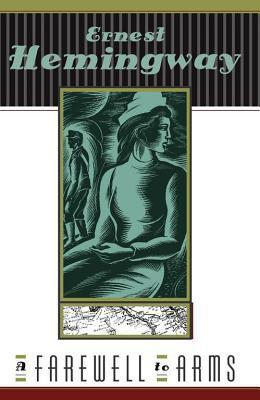
A Farewell To Arms by Ernest Hemingway
(published 1929)

I’m only on chapter two at this point — but I’ve never read Hemingway before, and I really enjoyed this paragraph from the very first page:

In the late summer of that year we lived in a house in a village that looked across the river and the plain to the mountains. In the bed of the river there were pebbles and boulders, dry and white in the sun, and the water was clear and swiftly moving and blue in the channels. Troops went by the house and down the road and the dust they raised powdered the leaves of the trees. The trunks of the trees too were dusty and the leaves fell early that year and we saw the troops marching along the road and the dust rising and leaves, stirred by the breeze, falling and the soldiers marching and afterward the road bare and white except for the leaves.

I have no idea what to expect, but I’m intrigued by the writing style and want to know more!

What lines made you laugh, cry, or gasp this week? Do tell!

If you’d like to participate in Thursday Quotables, it’s really simple:

  • Write a Thursday Quotables post on your blog. Try to pick something from whatever you’re reading now. And please be sure to include a link back to Bookshelf Fantasies in your post (http://www.bookshelffantasies.com), if you’d be so kind!
  • Click on the linky button (look for the cute froggie face) below to add your link.
  • After you link up, I’d love it if you’d leave a comment about my quote for this week.
  • Be sure to visit other linked blogs to view their Thursday Quotables, and have fun!

Save

Save

Save

Audiobook Review: The Call of the Wild by Jack London

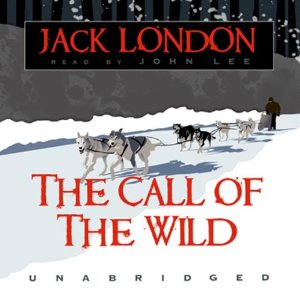
Call 2I’m so glad Audible featured The Call of the Wild as a daily deal recently; otherwise, I might have gone through life never having read this powerful, beautifully written book.

Shocking, I know, but I’d never read anything by Jack London, except for the short story “To Build A Fire” which I think pops up in pretty much everyone’s high school English anthology sooner or later.

The Call of the Wild is the story of Buck, a huge dog of Saint Bernard mixed descent. When we first meet Buck, he’s literally the top dog on a farm in Santa Clara, California. But a deceitful farm hand out for money steals Buck and sells him one night, and Buck ends up passed from hand to hand until he ends up in the snowy north. With his size and strength, Buck is sought after as a sled dog by the adventurous men heading off to the Yukon during the gold rush. Buck’s domesticity is left far behind, as he learns to heed his instincts and allow his inner fearless predator to take over.

The use of language in The Call of the Wild is outstanding. The descriptions of the rugged land, the struggles of men to survive without resources, and their foolhearty, often fatal journeys are intensely vivid. Best of all is Buck’s inner life. It’s not at all cutesy, and it’s not presented as though Buck himself is telling his story.

Instead, the omniscient narrator takes us through the evolving thought processes and emerging instincts that transform Buck over time from a tame farm animal into a true beast of the wild.

The narration of the audiobook is slow and steady, giving the words a stately, dignified feeling. There’s not much dialogue, and yet the narrator’s use of tone and inflection keeps the narrative from sagging or bogging down.

I found The Call of the Wild to be an engaging, enjoyable listen, and would like to either read or listen to some of London’s other adventure tales in the future.

A final word: Those who find animals-in-peril stories too painful to read should be warned that you may have a hard time with this book. Bad things do happen to Buck and many of the other dogs in the story, and it’s not pretty. I’m glad to have read it, but it won’t be for everyone.

_________________________________________

The details:

Title: The Call of the Wild
Author: Jack London
Narrator: John Lee
Publisher: Varied (many different editions in print)
Publication date: 1903
Audiobook length: 3 hours, 28 minutes
Printed book length: 208 pages
Genre: Fiction
Source: Audible

Thursday Quotables: The Call of the Wild

quotation-marks4

Welcome back to Thursday Quotables! This weekly feature is the place to highlight a great quote, line, or passage discovered during your reading each week.  Whether it’s something funny, startling, gut-wrenching, or just really beautifully written, Thursday Quotables is where my favorite lines of the week will be, and you’re invited to join in!

NEW! Thursday Quotables is now using a Linky tool! Be sure to add your link if you have a Thursday Quotables post to share.

Call of the Wild

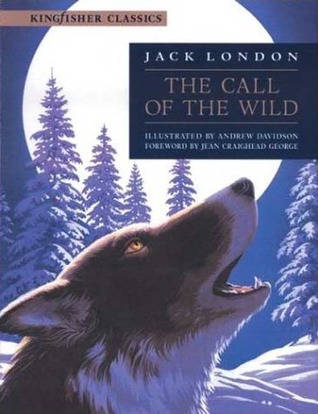
The Call of the Wild by Jack London
(originally published 1903)

I’m on a classics roll! I needed a new audiobook this week, and The Call of the Wild happened to be an Audible daily special. I can’t believe I’ve never read a Jack London book before. Simply listening to his story makes me feel all rugged and outdoorsy! It’s a quick listen, but I’m really enjoying the descriptions of life in the Yukon, as seen through the doggy eyes of Buck.

Buck’s feet sank into a white mushy something very like mud. He sprang back with a snort. More of this white stuff was falling through the air. He shook himself, but more of it fell upon him. He sniffed it curiously, then licked some up on his tongue. It bit like fire, and the next instant was gone. This puzzled him. He tried it again, with the same result. The onlookers laughed uproariously, and he felt ashamed, he knew not why, for it was his first snow.

What lines made you laugh, cry, or gasp this week? Do tell!

If you’d like to participate in Thursday Quotables, it’s really simple:

  • Write a Thursday Quotables post on your blog. Try to pick something from whatever you’re reading now. And please be sure to include a link back to Bookshelf Fantasies in your post (http://www.bookshelffantasies.com), if you’d be so kind!
  • Click on the linky button (look for the cute froggie face) below to add your link.
  • After you link up, I’d love it if you’d leave a comment about my quote for this week.
  • Be sure to visit other linked blogs to view their Thursday Quotables, and have fun!

BabyLit: Classics for Kids!

All together now: Awwwwwwww. Are these the cutest things or what?

image

Author Jennifer Adams and artist Alison Oliver have created the most adorable board books, sure to please every bookworm of a parent who’s just dying to share their love of literature with their little ones.

These two are the newest in their BabyLit series, and they’re totally precious. We have “Little Miss Austen” with Emma, teaching toddlers all about emotions with pages such as these:

Also featured are Emma being excited, Miss Taylor happy, and a very angry and red-faced Mr. Elton.

In the pirate world, we learn about shapes with “Little Master Louis Stevenson” and Treasure Island, with pictures of the Admiral Benbow inn, a treasure chest, Long John Silver, and a parrot, along with:

image

Have I used the words “adorable”, “cute”, and “precious” already? I’m running out of ways to say it. These board books are bright and colorful and are sure to catch the eyes of babies and toddlers… and meanwhile, bookloving adults can chuckle and appreciate that even if they’re too busy with diapers and bottles to sit and read, at least they can get a little flavor of the classics with the BabyLit books.

These are only two of the ADORABLE (yup, still using that word) books in the collection. Check out the BabyLit website for much, much more. Because all toddlers with taste need Moby Dick and Romeo and Juliet in board book form.

One more time: Awwwwwwww.

Book Review: The Scarlet Pimpernel by Baroness Emmuska Orczy

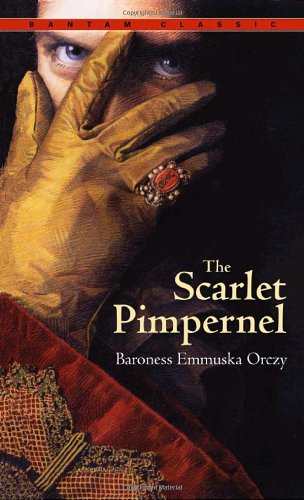
Scarlet Pimpernel2The Scarlet Pimpernel by Baroness Emmuska Orczy debuted as a stage play in 1903, and was subsequently rewritten as a novel. Reading The Scarlet Pimpernel, it’s hard to miss the dramatic flourishes and beats; the reader can practically see the moments when a character enters from the wings or hides behind some stage prop.

I had only ever heard of the book in passing and had never seen any of the many movie adaptations when my book group picked The Scarlet Pimpernel as our classic read. I really had no idea what to expect, other than a vague impression of dashing swordfights à la Errol Flynn.

The Scarlet Pimpernel is set during the Terror following the French Revolution, when members of the French aristocracy could be sent to the guillotine for crimes as innocuous as a remembered insult given to a passing stranger years earlier. The Scarlet Pimpernel is the nom de guerre of a heroic mystery man who, with a league of comrades, rescues the aristos from under the noses of the French citoyens who seek their deaths. Tales of the Scarlet Pimpernel’s daring escapades inspire hero worship back in England, and his true identity is the most sought-after secret among the French police who seek to capture and make a lesson of him.
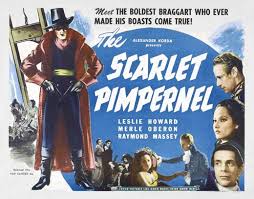
SP1The main focus of the book, however, is not the hero himself, but a young woman named Marguerite Blakeney, revered as the most beautiful and “cleverest” woman in all of Europe. She is married to Sir Percy Blakeney, described as a jovial but essentially stupid fop, who is lazy, impeccably dressed and groomed, very wealthy, and always the life of the party.

Marguerite becomes embroiled in intrigue when a French agent, Chauvelin, corners her and threatens her beloved brother, himself a former French republican now turned against the cruelties of the Revolution. If Marguerite wants to save Armand’s life, she must aid Chauvelin by tracking down the Scarlet Pimpernel, infiltrating his inner circle, and informing on him. Only upon the Pimpernel’s arrest will her brother be returned safely to her loving arms.

Much woe ensues, full of breast-beating, doubt, anguish, betrayal, protestations of love, feelings of terrible guilt, and a cliffside ambush and rescue full of a number of true cliff-hangers.

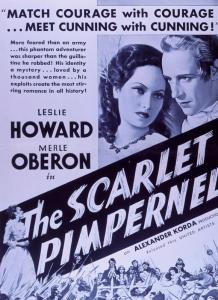
TScarlet-Pimpernel-Posterhe Scarlet Pimpernel is not a long book, but is chock-full of action. In The Scarlet Pimpernel, we can see the forerunner of many modern dramatic tropes: the damsel in distress, the hero with the hidden identity, laughing in the face of danger, the foolish police captain always one step behind, victory snatched from the jaws of defeat. As a period piece, it’s quite interesting. I was amused imaging how new and daring some of these set pieces must have seemed to the contemporary audiences at the time of publication.
Certain aspects seemed rather laughable to me as a modern reader. If I had to hear one more time about Marguerite’s beauty or her unmatched cleverness, I might have pulled my hair out. Really, she seemed like kind of a ninny a lot of the time. She dithers and moans, she ignores her husband or thinks badly of him, only later to realize that he’s truly the love of her life. Her inner monologue is given to melodramatic, self-centered fancies, imagining dying in her lover’s arms as the ultimate happiness. Um, wouldn’t it be better for you both to survive? Just a thought.

SP2My book group takes a chapter-a-week approach to our classic reads, and in this case, I think the pacing worked against my overall enjoyment of the book. The chapters are fairly short, and the plot moves forward only incrementally from chapter to chapter. By reading only one chapter each week, I think we basically had too much time to find and focus on the silliness and melodrama of the characters (particularly Marguerite), rather than enjoying it as a whole.

Do I recommend The Scarlet Pimpernel? Yes, I do. I think, had I read it all the way through in a day or two, I would have become caught up in the race to elude Chauvelin, the Pimpernel’s daring, and Marguerite’s attempts to save the day (even though I tend to think that she mostly mucks things up, rather than actually helping anybody). Although the attitudes and overall writing style are quite dated (and easy to poke fun at), the story itself is nicely entertaining. Overall, I was glad to have read it, although I won’t be tracking down any of the numerous sequels.

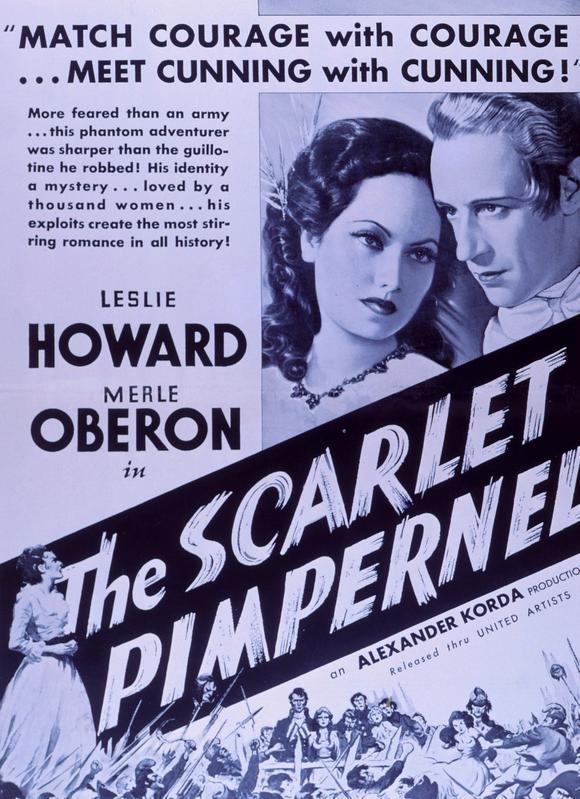
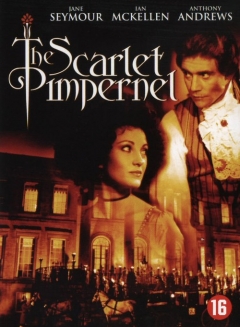
Meanwhile, I look forward to checking out a few of the many film adaptations, most notably the 1934 version starring Leslie Howard and the 1982 film starring Jane Seymour as Marguerite and Ian McKellen as Chauvelin.

_________________________________________

The details:

Title: The Scarlet Pimpernel
Author: Baroness Emmuska Orczy
Publisher: varied (available free for Kindle)
Publication date: 1903
Length: 264 pages
Genre: Classic/adventure
Source: Purchased
Take A Peek Book Review: Treasure Island by Robert Louis Stevenson

“Take a Peek” book reviews are short and (possibly) sweet, keeping the commentary brief and providing a little peek at what the book’s about and what I thought. This week’s “take a peek” book:

TI collage

Treasure Island by Robert Louis Stevenson
(originally published 1883)

Synopsis:

(via Goodreads)

Originally conceived as a story for boys, Stevenson’s novel is narrated by the teenage Jim Hawkins, who outwits a gang of murderous pirates led by that unforgettable avatar of immorality, Long John Silver. Admired by Mark Twain, Rudyard Kipling, and (reluctantly) Henry James, the story has the dreamlike quality of a fairy tale. It has worked its way into the collective imagination of more than five generations of readers, young and old alike, gaining the power of myth.

The most popular pirate story ever written in English, featuring one of literature’s most beloved “bad guys,” Treasure Island has been happily devoured by several generations of boys—and girls—and grownups. Its unforgettable characters include: young Jim Hawkins, who finds himself owner of a map to Treasure Island, where the fabled pirate booty is buried; honest Captain Smollett, heroic Dr. Livesey, and the good-hearted but obtuse Squire Trelawney, who help Jim on his quest for the treasure; the frightening Blind Pew, double-dealing Israel Hands, and seemingly mad Ben Gunn, buccaneers of varying shades of menace; and, of course, garrulous, affable, ambiguous Long John Silver, who is one moment a friendly, laughing, one-legged sea-cook . . .and the next a dangerous pirate leader!

The unexpected and complex relationship that develops between Silver and Jim helps transform what seems at first to be a simple, rip-roaring adventure story into a deeply moving study of a boy’s growth into manhood, as he learns hard lessons about friendship, loyalty, courage and honor—and the uncertain meaning of good and evil.


My Thoughts:

For a fairly slim book (my edition had 190 pages), it sure took me a while to finish this classic tale of pirates, treasure maps, and treachery. Treasure Island wasn’t a stay-up-all-night, can’t-put-it-down read for me — but it was definitely entertaining and well worth reading.

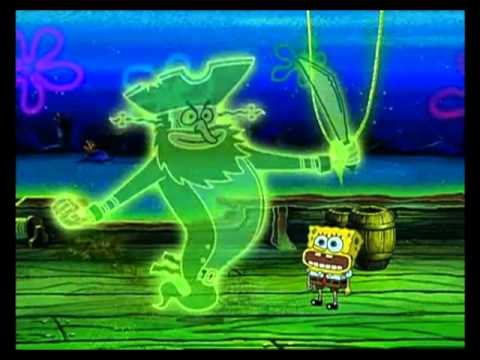
It’s kind of hilarious, in a way, to read this quintessential pirate story, in light of Pirates of the Caribbean, Black Sails, and even Spongebob Squarepants, and realize that Treasure Island was written at a time when pirate stories weren’t clichéd yet. In Treasure Island, the guy with a wooden leg exclaiming “Shiver me timbers!” while a parrot perches on his shoulder isn’t a joke; he’s honest-to-blazes scary. Doubloons, pieces of eight, cutlasses, buried treasure, the black spot, pointing skeletons used as road signs — here’s where to go to find where they entered popular culture.

It seems practically silly to review a classic like Treasure Island. It’s a classic for a reason! But, bottom line: I’m glad that I finally dug up a copy and took the time to read it. It’s a fun, fast-paced adventure, providing a glimpse into a by-gone era of storytelling — and next time International Talk Like a Pirate Day rolls around, I’ll have something to think about besides these guys:

hqdefault FILM Depp 2

or this:

ljs_old_store

or even my current pirate obsession:

Black Sails 2014

_________________________________________

The details:

Title: Treasure Island
Author: Robert Louis Stevenson
Publisher: Varied (available free for Kindle)
Publication date: 1883
Length: 190 pages
Genre: Classic adventure story
Source: Purchased

Thursday Quotables: Treasure Island

quotation-marks4

Welcome back to Thursday Quotables! This weekly feature is the place to highlight a great quote, line, or passage discovered during your reading each week.  Whether it’s something funny, startling, gut-wrenching, or just really beautifully written, Thursday Quotables is where my favorite lines of the week will be, and you’re invited to join in!
Treasure Island

Treasure Island by Robert Louis Stevenson
(originally published 1883)

I’m feeling very piratey this week. Watch out! I make burst out in a sea shanty before I’m done…

I brooded by the hour together over the map, all the details of which I well remembered. Sitting by the fire in the housekeeper’s room, I approached that island in my fancy, from every possible direction; I explored every acre of its surface; I climbed a thousand times to that tall hill they call the Spyglass, and from the top enjoyed the most wonderful and changing prospects. Sometimes the isle was thick with savages, with whom we fought; sometimes full of dangerous animals that hunted us; but in all my fancies nothing occurred to me so strange and tragic as our actual adventures.

And there’s this little gem, which I’ll have to remember next time I need an indignant comeback:

“Sir,” said Captain Smollett, “with no intention to take offence, I deny your right to put words into my mouth.”

What lines made you laugh, cry, or gasp this week? Do tell!

If you’d like to participate in Thursday Quotables, it’s really simple:

  • Write a Thursday Quotables post on your blog. Try to pick something from whatever you’re reading now. And please be sure to include a link back to Bookshelf Fantasies in your post (http://www.bookshelffantasies.com), if you’d be so kind!
  • Leave your link in the comments — or, if you have a quote to share but not a blog post, you can leave your quote in the comments too!
  • Visit other linked blogs to view their Thursday Quotables, and have fun!

Top Ten Tuesday: Top Ten Classic Books I Want to Read… or Re-read

fireworks2

Top Ten Tuesday is a meme hosted by The Broke and the Bookish, featuring a different top 10 theme each week. This week’s topic is Top Ten Classics — and I can see taking a few different approaches: Favorite classics already read? Classics that we want to read? Classics that everyone should read? And just what is a classic, anyway?

For me, I’m splitting my list between classics I really want to read (you know, someday) and classics that I read long ago and would really like to read again. And for purposes of this list, my definition of “classics” is pretty fluid: Older parts of the “canon”, to be sure, but also more modern works that have become cultural reference points.

Classics I want to read:

 1) Great Expectations by Charles Dickens

2) One  Hundred Years of Solitude by Gabriel Garcia Marquez

3) In Cold Blood by Truman Capote

4) Cannery Road by John Steinbeck

5) Treasure Island by Robert Louis Stevenson

6) The Time Machine by H. G. Wells

7) The Woman in White by Wilkie Collins

Classics I Want to Re-Read:

1) To Kill a Mockingbird by Harper Lee

2) Dracula by Bram Stoker

3) Frankenstein by Mary Shelley

And to round it all off: A few “classic” authors whose works I’ve never read. Must fix that ASAP! (And if you’ve have a favorite book by one of these authors, please leave me a comment with your recommendation!)

1) Agatha Christie

2) Jack London

3) Jules Verne

How do you define a classic? What classics are your favorites? And which classics are on your to-read list?

Share your link, and I’ll come check out your top 10!

If you enjoyed this post, please consider following Bookshelf Fantasies! And don’t forget to check out our regular weekly features, Thursday Quotables and Flashback Friday. Happy reading!

♥♥♥♥♥♥♥♥

Do you host a book blog meme? Do you participate in a meme that you really, really love? I’m building a Book Blog Meme Directory, and need your help! If you know of a great meme to include — or if you host one yourself — please drop me a note on my Contact page and I’ll be sure to add your info!


Flashback Friday: Les Miserables — the book!

Flashback Friday is my own little weekly tradition, in which I pick a book from my reading past to highlight — and you’re invited to join in!

Here are the Flashback Friday book selection guidelines:

  1. Has to be something you’ve read yourself
  2. Has to still be available, preferably still in print
  3. Must have been originally published 5 or more years ago

Other than that, the sky’s the limit! Join me, please, and let us all know: what are the books you’ve read that you always rave about? What books from your past do you wish EVERYONE would read? Pick something from five years ago, or go all the way back to the Canterbury Tales if you want. It’s Flashback Friday time!

My pick for this week’s Flashback Friday:

Les Misérables

Les Misérables by Victor Hugo

(first published 1862)

From Goodreads:

Introducing one of the most famous characters in literature, Jean Valjean – the noble peasant imprisoned for stealing a loaf of bread – Les Misérables (1862) ranks among the greatest novels of all time. In it Victor Hugo takes readers deep into the Parisian underworld, immerses them in a battle between good and evil, and carries them onto the barricades during the uprising of 1832 with a breathtaking realism that is unsurpassed in modern prose.

Within his dramatic story are themes that capture the intellect and the emotions: crime and punishment, the relentless persecution of Valjean by Inspector Javert, the desperation of the prostitute Fantine, the amorality of the rogue Thénardier and the universal desire to escape the prisons of our own minds. Les Misérables gave Victor Hugo a canvas upon which he portrayed his criticism of the French political and judicial systems, but the portrait which resulted is larger than life, epic in scope – an extravagant spectacle that dazzles the senses even as it touches the heart.

I’m just imagining how many people in the new few years will say, “Les Misérables? Great movie!”  — but how many would actually consider picking up the book?

Yes, it’s massive. (The Signet edition, listed above, has 1,463 pages). And guess what? I’ve actually read it. (Patting self on the back right now…)

Way back when in the dark ages (otherwise known as the late 1980s), during a brief visit to London, I had the opportunity to see the then-new musical Les Mis, from several balconies up and with no knowledge of the plot details ahead of time. I enjoyed the show tremendously, but boy, was I confused. Because I had time on my hands, I decided to read the book. Not the abridged version, thank you very much, but the whole huge doorstop of a book, all 1000+ pages.

And it was worth it. Granted, I probably learned a lot more than I ever wanted to know about the Parisian sewer systems and daily life in a convent, but I also gained the richness of Hugo’s detailed descriptions, so that I finished the book more or less understanding not just the events of the plot, but the feeling of the time and place.

There’s a reason (many reasons, to be more accurate) that Les Misérables is a classic. It’s a compelling portrait of a man’s life, as well as a study of human nature, the good and the bad, courage and weakness, and what it means to take a stand and do right. Beautifully written with unforgettable characters, Les Misérables shouldn’t be missed.

Note from your friendly Bookshelf Fantasies host: To join the Flashback Friday fun, write a blog post about a book you love (please mention Bookshelf Fantasies as the Flashback Friday host!) and share your link below. Don’t have a blog post to share? Then share your favorite oldie-but-goodie in the comments section. Jump in!

Armchair BEA: The Classics

Today’s focus for Armchair BEA discussions is “The Classics”:

Today, tell us all the reasons why you love classic literature. What are your favorite classics? If you could give a list of classics to someone who claims to hate them to make them change their mind, what would be on it? How would you convince them to give classics a try? And why do you keep coming back to those old favorites?

I suppose we could argue about the definition of a classic. Is it anything over a certain number of years old? Is it something that fits into a certain body of work? Do certain authors count more than others? I guess I go with the “I know it when I see it” standard: If it feels like a classic to me, then I consider it a classic!

My favorite classics are:

  1. A Tale of Two Cities by Charles Dickens
  2. Any/all stories by Edgar Allan Poe
  3. The works of William Shakespeare
  4. Jane Eyre by Charlotte Bronte
  5. Brave New World by Aldous Huxley
  6. Anything and everything by Jane Austen
  7. Little Women by Louisa May Alcott

If I were trying to convince someone that classics are not all dusty and boring, I think I’d give them a few of the above, especially:

  • A Tale of Two Cities: This book really has it all! Drama, intrigue, plots, suspense, legal drama, historical fiction, mistaken identities… all the elements of modern-day TV dramas, in one terrific book.
  • Pride and Prejudice: I think it would be hard to find someone who hasn’t been exposed to at least one TV or movie version of Pride and Prejudice or any of the dozens of modern fiction retellings, sequels, and monster mash-ups. I think the popularity of the story helps keep it fresh and accessible, and it tends to be a good jumping-off point as an introduction to the rest of Jane Austen’s works.
  • Little Women: This is one that really feels universal. Do girls still read this growing up? The four sisters, their ups and downs, games and romances, successes and disappointments, are truly timeless. And again, given the numerous movie versions and the pop-culture references (remember the Friends episode where Joey read Little Women??), this doesn’t seem like an old, forgotten book.
  • Brave New World: If you haven’t read this one in a while, I strongly suggest going back to it. It’s amazing, really, to see how much the author got right. So many of the science fiction elements of this book can be found in our world today — it’s downright eerie!

As for why I keep coming back — well, there’s always something new to discover! I just re-read Jane Eyre for the first time in about 10 years, and was amazed to discover how fresh and sharp the dialogue is. When I stumble across some random “classic” short story and realize how much it gives me to think about, it makes me want to pull my older books off the shelf and read them all over again. True classics still have something to say that relevant even in a different time and a different society, and those are the ones that really last.