The Monday agenda

Not a lofty, ambitious to-be-read list consisting of 100+ book titles. Just a simple plan for the upcoming week — what I’m reading now, what I plan to read next, and what I’m hoping to squeeze in among the nooks and crannies.

The head cold that had been bouncing around my house earlier this week finally caught up with me and did serious damage to my scheduled reading time. Mostly better now, so it’s time to dive back in. What’s on the agenda for this week?

From last week:

Tell The Wolves I’m Home by Carol Rifka Brunt: Such a lovely book. My review is here.

The Red House by Mark Haddon: I just couldn’t finish it, despite giving it my best college try. Find out why here.

A Trail of Fire by Diana Gabaldon: Joy! Bliss! A new Diana Gabaldon book! My reaction is here.

The kiddo and I finished Half Magic by Edward Eager, always a delight. Somehow I missed out on this one during my own childhood, but have now had the pleasure of enjoying it with two of my children.

Drums of Autumn by Diana Gabaldon (group re-read): Going strong, getting close to the end.

And this week’s new agenda:

I’m about half-way through with Seating Arrangements by Maggie Shipstead, which is quite a fun read.

Next up: I must make some serious headway on the stack of new YA novels I’ve borrowed from the library. I’m planning to start with a sequel: Because It Is My Blood by Gabrielle Zevin, book two in the Birthright series. I’ve enjoyed a few of her books previously, including the first Birthright book, All These Things I’ve Done. I’m looking forward to this one. If I have time for one more book, then I’ll start Dare Me by Megan Abbott, which was one of my recent Wishlist Wednesday picks.

I am absolutely committing myself to starting Doc by Mary Doria Russell by the end of Thanksgiving weekend, so I’ll have enough time to read, digest (the book, not my Thanksgiving meal — although perhaps that too), and come up with some thoughtful observations before my book group meets to discuss it in early December.

My son and I have just started Magic By The Lake by Edward Eager, a follow-up to Half Magic. So much fun!

Drums of Autumn by Diana Gabaldon: Chapters 66 and 67 this week, I think. I’d better check the group reading calendar — for all I know, we may be on hiatus for Thanksgiving.

Let’s give thanks for all the wonderful books out there just waiting to be read!

So many book, so little time…

That’s my agenda. What’s yours? Add your comments to share your bookish agenda for the week.

The Monday agenda

Not a lofty, ambitious to-be-read list consisting of 100+ book titles. Just a simple plan for the upcoming week — what I’m reading now, what I plan to read next, and what I’m hoping to squeeze in among the nooks and crannies.

So what’s on the agenda for this week?

From last week:

The Raven Boys by Maggie Stiefvater: I finished this one early in the week. Sadly, not all that impressed. (You can find out why here.)

Where’d You Go, Bernadette by Maria Semple: Done! Loved it. My review is here.

Drums of Autumn by Diana Gabaldon (group re-read): Two more engaging chapters. Almost done.

And this week’s new agenda:

I’m about 2/3 of the way through Tell The Wolves I’m Home by Carol Rifka Brunt. What a lovely, poignant story. I’ll finish and have a review up in the next few days.

Next, from my library pile, I plan to start either The Red House by Mark Haddon or Seating Arrangements by Maggie Shipstead.

Tiny aside: One of the benefits of having a school-aged child is learning all sorts of useful acronyms. At my son’s school (and probably lots of others), they have DEAR time — Drop Everything And Read — in which everyone stops all other work, picks a book, and reads without interruption for 15 – 20 minutes. When my older kids were that age, it was called Silent Sustained Reading (very cute to hear a 1st-grader say this, by the way).

How is this relevant to the Monday agenda? I expect to have a DEAR moment myself in the next day or two. In my case, this means that I’ll be dropping whatever else I’m reading or planning to read as soon as my copy of A Trail of Fire by Diana Gabaldon arrives. I’ll write more about this book, and why it’s a big deal, when my copy finally gets here… which should be tomorrow (fingers crossed).

My son and I are about half-way (!) through Half Magic by Edward Eager. I was pleasantly surprised when I offered him a stack of eight or nine books and he picked out this children’s classic. It’s been many years since I last read it, but it’s still thoroughly delightful.

Drums of Autumn by Diana Gabaldon: Chapters 64 and 65 this week. Emotional high points. The end is in sight.

So many book, so little time…

That’s my agenda. What’s yours? Add your comments to share your bookish agenda for the week.

Q&A with the kiddo: A kid’s-eye view of The Haunting of Granite Falls by Eva Ibbotson

Book Review: The Haunting of Granite Falls by Eva Ibbotson


From Amazon:

American millionaire Hiram C. Hopgood will stop at nothing to make his daughter, Helen, happy—even if it means buying her an ancient Scottish castle and shipping it back to Texas. Assembling the castle isn’t a problem for the oil tycoon . . . it’s the ghosts that worry him. Hopgood has made up his mind: the ghouls have got to go. But these spirits don’t spook so easily. Instead, they make their way to America, where they meet up with a magical severed hand and three fiendish, cross-dressing kidnappers for a Texas-sized adventure with a ghostly Scottish flair.

Proudly presenting Q&A with the kiddo, courtesy of my 10-year-old son, in which I ask my kiddo to describe a book he’s enjoyed recently and he gives his opinions, more or less unfiltered by mom.

Without further ado:

Q: What book do you want to talk about?

A: The Haunting of Granite Falls.

Q: What was it about?

A: [Note: The kiddo didn’t feel like giving a plot summary, so here’s the mom version: An American millionaire buys a Scottish castle for his sickly daughter, has the castle shipped to America to be rebuilt in the heart of Texas, and unintentionally gets a handful of castle ghosts to go with it. Scottish orphan Alex and the millionaire’s daughter Helen form a fast friendship, and need to call upon the ghosts for help when a dastardly kidnapping plot threatens their safety. Much mayhem ensues.]

Back to the kiddo:

Q: Who was your favorite character?

A: The Severed Hand [a ghostly disembodied hand who haunts the local cinema and the mineshafts underneath]. He’s really fun, he can cook, he’s an author, and he’s also a Hand of Glory.

Q: Who else did you like?

A: Flossie [the ghost of a 5-year-old girl, currently wreaking havoc as a poltergeist]. She’s really funny, and she messes up everything.

Q: What was your favorite part of the book?

A: When all the action was happening [towards the end] in the theater and in the mineshaft. [Note: A scary kidnapping in the mines, a daring rescue by the ghosts, much chasing about, shouting, scaring, and… heroic ghosts!]

Q: How would you describe the book overall?

A: Lots of cliffhangers. A tiny bit scary. Mostly funny, silly, weird, and mysterious.

Q: Who do you think would like the book?

A: My friends. If you have a sense of humor, you’ll like this book.

Q: Did you think this was a good reading level for you?

A: There were some words I didn’t understand [Note: that’s where moms come in handy], but otherwise it was fine. I probably could have read it on my own but it would have taken a lot longer.

Q: Would you want to read more books by this author?

A: It depends what they’re about.

Q: Would you want to read more ghost stories?

A: Maybe. It depends what kind. If they’re scary, then I wouldn’t want to read them before bed-time. That would give me nightmares.

Mom’s two cents: This was one book that we both could enjoy. It worked well as a read-aloud, but a kid who’s comfortable reading chapter books solo should be able to handle this one just fine. The kiddo and I found The Haunting of Granite Falls to have just the right combination of funny elements (a Viking ghost named Krok Fullbelly is good for all sorts of laughs) and dramatic action. 12-year-old Alex makes a fine hero as well, a nice mix of sensitivity and loyalty, with a dash of Scottish laird in him as well. I was a bit uncomfortable with the bad guys, who were more seriously threatening than I typically expect in a book aimed toward ages 8 – 12; in particular, the ringleader, a woman with many awful traits, among them a fondness for souvenirs of Hitler, was especially distasteful. Still, the book overall was a success. Author Eva Ibbotson has a delightful writing style, humorous and exciting, that really appeals to my son and keeps me entertained as well. We both give this one high marks.

So there you have it. We’ll be back with more book opinions from my kiddo, whenever I can get him to talk books again.

Book Review: Merits of Mischief by T. R. Burns

And now, for the mom’s perspective…

Book Review: Merits of Mischief: The Bad Apple by T. R. Burns

From Amazon:

The start of a mischievous new middle-grade series has trouble written all over it.Twelve-year-old Seamus Hinkle is a good kid with a perfect school record—until the day he accidentally kills his substitute teacher with an apple.

Seamus is immediately shipped off to a detention facility—only to discover that Kilter Academy is actually a school to mold future Troublemakers, where demerits are awarded as a prize for bad behavior and each student is tasked to pull various pranks on their teachers in order to excel. Initially determined to avoid any more mishaps, Seamus nonetheless inadvertently emerges as a uniquely skilled troublemaker. Together with new friends Lemon and Elinor, he rises to the top of his class while beginning to discover that Kilter Academy has some major secrets and surprises in store….

When reviewing kids’ books, I usually prefer to let my son do the talking. After all, what matters is whether he liked it, right? In the case of Merits of Mischief: The Bad Apple, I find that I have a thing or two to say myself. Consider this the point/counterpoint version of Q&A with the Kiddo, if you will. And now for my rebuttal:

SPOILER ALERT! While I usually make it my policy to avoid spoilers in my book reviews, I’m breaking my own rules for Merits of Mischief. I’m assuming that anyone reading this is an adult and won’t be bothered by learning how the book ends. If this isn’t true for you — look away now! You have been warned: I will be disclosing the ending of this book. END OF SPOILER ALERT.

I’ll be blunt. I did not like this book. I knew early on that I was going to have a problem with it, but my son was hooked and didn’t seem to be bothered by the moral issues that bothered me, so onward we went.

The main character, Seamus, is a well-behaved 12-year-old who attempts to break up a lunchroom fight by throwing an apple across the room. Unfortunately, the apple hits brand-new substitute teacher Ms. Parsippany in the head AND SHE DIES. Yup, chapter one ends with a dead teacher, killed by the book’s hero.

Seamus isn’t proud of himself:

I killed her.

Some people say it was an accident. They say I didn’t mean to do it, that I was just scared and tried to help. That may be true. But what’s also true is that Miss Parsippany, who’d been a substitute teacher for all of four hours and thirteen minutes, was alive in homeroom and dead by lunch.

Because of me.

A week later, Seamus’s parents are dropping him off at Kilter Academy, reputedly a severe scared-straight type of reform school for seriously troubled kids. The building is gray and imposing, ringed by barbed wire, and with a very menacing armed guard waiting to greet Seamus. But the second that his parents drive away, the guard reveals that her gun is a water pistol, sheds the ugly uniform to reveal stylish clothing, and shakes out her long, pretty hair. It’s Annika Kilter, sparkly director of the Kilter Academy, and nothing is as it seems.

Kilter, it turns out, is a school dedicated to encouraging promising young troublemakers to live up to their potential. The grey walls are merely a facade; behind the prison-like walls are high-tech dorms filled with endless sorts of entertainment, a cafeteria serving unlimited treats, beautiful gardens, and all sorts of trouble-making gadgets. The school store (the Kommissary) sells a variety of gear, including bows and arrows, a tar-and-feather kit, Hydra Bombs, and flame starters and extinguishers. Students earn Kommissary credits through a complicated system of points: misdeeds are rewarded with demerits, good deed earn you gold stars. The trick is, it’s the demerits that are desirable, and the bigger the difference between your number of demerits and gold stars, the more credits you get toward stocking up on the weaponry of your choice.

Seamus is naturally baffled at first, particularly when Annika greets him enthusiastically and proclaims herself delighted to welcome Kilter’s first murderer. Seamus is assigned to room with Lemon, an arsonist who starts fires in his sleep. Seamus and Lemon begin to bond after Seamus sticks by Lemon despite a series of middle-of-the-night dorm room fires, and eventually they form an alliance with other students as well. Despite making friends, Seamus feels that he must hide the reason for his entry into Kilter from all others, believing (rightly, as it turns out) that his friends would turn against him if they knew what he’d done.

Students are referred to as Troublemakers, and the goal is to advance in trouble-making skills. As part of their studies, students are expected to “get” each of their teachers by pranking them in a way that demonstrates knowledge of that teacher’s field of expertise. Pranks include sniper-like attacks with paint ball guns, stealing items without being caught, staging fake fires, and unfortunate incidents involving bodily functions. First year students are assigned trouble-making specialties based on their perceived talents in a ritual quite reminiscent of a sorting at Hogwarts — minus the magical talking hat, of course.

Seamus is assigned into the Sniper Squad, and is soon in training with his tutor Ike on the advanced usage of arrows, metallic boomerangs, rifles, and anything else that can be aimed and thrown or fired. Seamus is determined not to harm anyone else, but finds himself at the top of his class as his skills cause him to successfully “get” more teachers than any other students.

Exhausted yet? I am. Now is probably a good time to recount all the little things that bothered me so much about this book:

1) It makes no sense. Not that I’m a stickler for reality — I appreciate a zany approach to kids’ books as much as the next fun-loving reader. Take, for example, the Wayside School books — clearly, a set of rules apply that don’t exist in real life, wacky things happen, and it’s all for fun. Here, in Merits of Mischief, the story is presented as taking place in an ordinary boy’s life, but the pieces don’t hold together. So Seamus is sent off to reform school one week after killing a teacher? What happened to the legal system? Was there a trial? Weren’t there any witnesses? Doesn’t the accidental nature of the incident come into play? And what about this reform school that the parents send Seamus to — didn’t they check it out at all?

2) Hold on, Seamus is assigned to share a dorm room with a kid WHO STARTS FIRES IN HIS SLEEP! Lemon has had something like 12 different roommates assigned to him, none of whom last more than a day (and a fire) before moving out. Somehow, it’s supposed to be a sign of Seamus’s loyalty that he sticks by Lemon, despite the fact that he almost chokes to death one night from smoke inhalation. Um, no. I don’t care how zany a school this is supposed to be — leaving a kid to burn to death isn’t a good idea.

3) The kids are rewarded for their bad behavior — but the behavior isn’t about solving mysteries or figuring out physical conundrums, a la Mysterious Benedict Society. Nope, Lemon the arsonist is assigned a tutor to teach him even more fire-starting skills. Seamus, the alleged killer, is assigned to become an even better sniper. No ultimate purpose is ever defined, other then teaching the students to become better troublemakers. What will they do with these skills? Are they being trained to join some sort of secret agent force? We don’t know.

4) The teachers show a remarkable lack of awareness or concern. When a girl is injured at the end of the book during a major trouble-making assignment, the teaching staff continue celebrating the success of the trouble-making and refuse to assist the girl, leaving it up to her friends to get her medical treatment.

5) Finally… the book is about a kid who KILLED A TEACHER! Although as an adult reading this book, I was pretty sure it would turn out that she wasn’t really dead, my son had no idea and spent the entire book rooting for a kid who KILLED A TEACHER. Sure, Seamus feels bad about what happened and writes unsendable emails to Ms. Parsippany expressing his regret — but in point of fact this is a kid who caused someone’s death and who then gets to attend a super-fun high tech academy where he’s expected to make trouble. It makes no sense.

We do find out – on the very last page — that Ms. Parsippany is in fact alive and well. Seamus receives an email from her (which, as my son pointed out, shouldn’t have been able to happen, as the book very clearly states that the email system only works within the Academy itself). Her email simply says that she just returned from vacation and received his emails (huh?), that she appreciates how he feels, and that she’d be happy to keep corresponding with him. And that’s it. No explanation. The end.

The Bad Apple is the first book in a projected Merits of Mischief series, and I assume that someone who keeps reading will eventually find out more about why the Academy exists, how parents can send their children to a school with no knowledge of what happens there, and how Seamus ends up punished (if you’d call it punishment) for a crime that never happened. As is, The Bad Apple answers none of these questions… and it’s not mysterious, it just feels like poor planning.

I found Merits of Mischief: The Bad Apple to be a poorly executed but presumably well-intentioned book for kids. It seems to aim for fun and adventure, in the spirit of The Mysterious Benedict Society, mixed in with the excitement of a boarding school for specially gifted children, perhaps akin to a Muggle Hogwarts — but it misses its mark by a mile.

I like to let my children find their own way through book likes and dislikes, and so I didn’t drop this book in the middle. However, I found the moral fuzziness at the heart of Merits of Mischief quite disturbing, and would be perfectly happy to not read any further in the series. Fortunately, book 2 doesn’t come out until sometime in 2013, and I’m assuming my kid will have moved onto other things by then.

All in all, while my son enjoyed the story, I’d mark Merits of Mischief with a big red “not recommended” sign. On to bigger and better, I hope!

Q&A with the kiddo: A kid’s-eye view of Merits of Mischief by T. R. Burns

Book Review: Merits of Mischief: The Bad Apple by T. R. Burns


From Amazon:

The start of a mischievous new middle-grade series has trouble written all over it.Twelve-year-old Seamus Hinkle is a good kid with a perfect school record—until the day he accidentally kills his substitute teacher with an apple.

Seamus is immediately shipped off to a detention facility—only to discover that Kilter Academy is actually a school to mold future Troublemakers, where demerits are awarded as a prize for bad behavior and each student is tasked to pull various pranks on their teachers in order to excel. Initially determined to avoid any more mishaps, Seamus nonetheless inadvertently emerges as a uniquely skilled troublemaker. Together with new friends Lemon and Elinor, he rises to the top of his class while beginning to discover that Kilter Academy has some major secrets and surprises in store….

Proudly presenting Q&A with the kiddo, courtesy of my 10-year-old son, in which I ask my kiddo to describe a book he’s enjoyed recently and he gives his opinions, more or less unfiltered by mom.

NOTE: THIS Q&A CONTAINS SPOILERS! You have been warned.

Without further ado:

Q: What book do you want to talk about?

A: Merits of Mischief.

Q: What was it about?

A: It was about this boy, Seamus, who threw an apple at a teacher named Ms. Parsippany. He thought she died but she didn’t. He went to this reform school that was actually to teach the kids to be bad. Then he met lots of new friends and pranked all the teachers.

Q: What did you like about the book?

A: There were funny parts. I liked that the kids were supposed to get into trouble [at the school]. I like all the characters except Abe. My favorite character was Lemon, because he always makes fires. Also, because he stands up for people. My favorite teacher was Mystery, because he’s mysterious and really hard to prank.

Q: What didn’t you like about the book?

A: The Good Samaritans [mom’s note: the GS are the school’s police force], because they try to stop the kids from doing bad stuff.

Q: What did you think of the ending?

A: It was stupid. Seamus got an email from outside the school, but all along they said you couldn’t get emails from off-campus. Also, because you find out Ms. Parsipanny’s not really dead, and if she’s not, then Seamus shouldn’t have gotten sent to the school in the first place.

Q: Are you glad you read Merits of Mischief?

A: Yeah.

Q: How would you describe the book?

A: Funny, with lots of action.

Q: Who do you think would like the book?

A: I think most kids would like it. If they’re bad, they’ll love it!

Mom’s two cents: My kid and I are usually in sync about our read-aloud books. We tend to either both enjoy a book, or both be bored or unimpressed. Merits of Mischief was one of the rare books we’ve encountered where we had vastly different experiences reading it. I’ll be back with the mom point of view in a separate review. In terms of reading levels, this book is listed as ages 8 and up, although I think it would be a bit much for an 8-year-old.

So there you have it. We’ll be back with more book opinions from my kiddo, whenever I can get him to talk books again.

The final read-aloud, part deux

Last week, I published a blog post called “The Final Read-Aloud” about my experiences reading with my 10-year-old son and dreading the day that he decides he’s too old to be read to. My beautiful, talented, and apparently neglected-feeling daughter, age 22, pointed out that my experiences with her were quite different. In the interest of family peace, as well as presenting another view of the end of reading aloud, I thought I’d add an overview of my daughter’s evolution as a reader as well.

Let me start by saying that my husband makes fun of me whenever I bemoan the difficulty of parenting a rowdy, active boy — because he thinks that I expected this one to turn out to be another perfect little angel like his sister, and as it turns out, that wasn’t the case. Don’t get me wrong, I love ALL my children. But you know the children’s book I Love You The Purplest? That really sums up a parent’s life in a nutshell.

My daughter  was easy from day one. I could and did take her anywhere with me and she got along just fine, whether it was lunch with girlfriends, shopping expeditions, or museum outings. We hit the theaters and movies, did crafts, enjoyed dancing around the house, or just sitting and watching “The Little Mermaid” for the thousandth time. And, like me, my little angel was a reader from the get-go.

We read together every night before bed, sometimes piles of books, and she never got tired of it. When she started elementary school, she took to early phonics and reading exercises like a champ. By second grade, although we were still reading together every night, she discovered the joys of reading on her own. Her first chapter books were the junior versions of Ann M. Martin’s Babysitters Club series — The Babysitters’ Little Sister books. These were perfect for her — not too difficult, and centered around a 2nd-grade girl and her friends. After she got tired of that bunch, she graduated into the bigger kid stories in The Babysitters Club, and then on into the big, wide world of reading, no mom filters required.

BUT, we hung in there and continued reading together as well. Our read-alouds gave us the opportunity to explore books together, and gave her the chance to enjoy books that she probably would have found too difficult on her own at that point, such as The Golden Compass (those first chapters are so dense, they’re practically impenetrable). So why did we stop reading aloud together? I blame Harry Potter.

We read the first three Harry Potter books together. She’s of the lucky generation that grew up with Harry Potter, always about the same age as Harry as he grew up from book to book. On book 3, I pretty much lost my voice by the end, as we’d gotten to the really good parts and she simply would not allow me to stop reading. What could I do? I was as hooked as she was, so we pressed on.

In the year 2000, when Harry Potter and the Goblet of Fire was published, my lovely girl was 10 years old. We brought the book home, read a single chapter together, and boom! That’s when it happened. She decided that it was just too slow, all this reading aloud business, took the book off on her own, and plowed right through it. See ya, mom! Of course, she loved it, and I loved the book too. We just loved it separately, that’s all.

Goblet of Fire wasn’t necessarily a cold-turkey stop to reading aloud together, but it certainly marked the beginning of the end. That experience showed her, beyond a doubt, that she was a full-fledged independent reader who could handle longer, more complex stories on her own.

It didn’t feel like a sad ending of a chapter with her, probably because she has remained a devoted, avid reader all her life. Like me, she gets overly involved in her books, falls in love with the fictional worlds she visits, becomes highly invested in the characters, and likes to be surrounded by the books she loves wherever she goes. We’ve spent our whole lives together talking about books, trading books, and recommending books, and I don’t think we’ll ever stop.

Which brings me back to my son (sorry, daughter sweetie, I know this was supposed to be all about you…). I think the reason that I dread the end of our reading-aloud times is that I don’t feel confident that he’ll end up a reader. Left to his own devices so far, books are the things that he picks up when he’s forced to. I can count on one, maybe two hands, the times he’s voluntarily chosen to spend time reading. I’m afraid that once he no longer wants to be read to, he’ll fall into a book-less void.

I’m not giving up. I know I still have a job to do to get him to the point where reading is fun and exciting, and not just a chore. We’re not there yet. But we’ll get there, I hope. Onward!

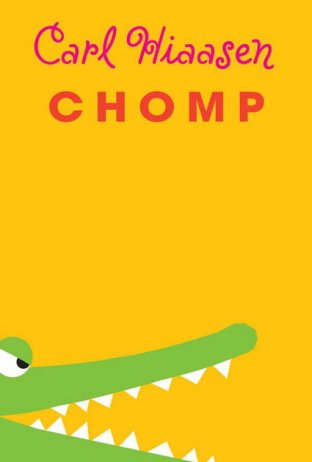
Book Review: Chomp by Carl Hiaasen

Book Review: Chomp by Carl Hiassen

Chomp is a total romp! And that concludes the rhyming portion of this book review.

Novelist, columnist, and all-around funny guy Carl Hiaasen has now written four books for kids, Chomp being the most recent. Hiaasen brings his sense of humor and his devotion to the preservation of natural habitats and native species to his writing for younger readers, and the result is pure fun.

Chomp tells the story of Wahoo Cray, an ordinary kid… who happens to live with gators, howler monkeys, and pythons, among other critters. Wahoo’s dad Mickey is an animal wrangler, expert at handling all sorts of wild creatures and making them look good on camera. Unfortunately, Mickey is a bit out of commission after sustaining a concussion thanks to a frozen iguana falling on his head (don’t ask). The family’s finances are in dire straits until they’re hired by reality TV star Derek Badger to wrangle animals for an upcoming Everglades episode of the hugely popular series, Expedition Survival! (That exclamation mark is part of the show’s name, not an expression of my enthusiasm.)

Problems? You bet. Derek is, to put it politely, a big fake. Overweight and sporting an artificial tan, Derek relies on stunt doubles and fancy camera angles, until he gets it into his head to make the Everglades episode “real”. Wahoo and Mickey find themselves deep in the Glades, dealing with snakes, bats, and other biting critters, while trying to earn their keep by making the star look good. Let’s just say that it doesn’t go according to plan. Out-of-control airboats, a runaway science-loving girl, her gun-toting crazy father, thunderstorms and grounded helicopters all come together for a riotous, dangerous, and ultimately hilarious dramatic high point.

Wahoo is a terrific lead character — devoted to his father and their animals, brave when he needs to be, willing to put himself on the line for family and friends, but with a low tolerance for fools — which may not be the best quality in someone trying to work with a conceited Hollywood star. Supporting characters, like his friend Tuna and Derek’s assistant Raven, are memorable, well-defined, and full of spunk and sparkle.

My 10-year-old and I picked this one out as our latest read-before-bed book, and it was a great choice. We were hooked and had a hard time stopping for the night after just one chapter, and the kiddo’s giggles and snorts (quoth he, “Derek is a jerk!” and “Derek is so stupid!) were entertaining interruptions throughout. (I did try to get the kiddo to do a Q&A with me for this one, but apparently watching TV with his dad is, at the moment, a lot more fun). He obviously enjoyed Chomp a great deal, and I really did too. There are times when I find my mind wandering while I read aloud, but not with this one — I think I had as much fun as my son did.

A final note: My son enjoyed Chomp as a read-aloud, but I don’t think he’d have managed it on his own. I would say that most elementary grade readers would find it a challenge, but would enjoy it with an adult reading partner. For independent reading, I’d recommend Chomp for middle school aged kids. Reading aloud or reading on their own, kids who enjoy adventure stories will definitely get a kick out of Chomp.

The final read-aloud

The day is coming, and it’s not that far off, when the moment I dread will finally arrive: The day when my youngest child turns to me at bed-time and says, “That’s okay, Mom. You don’t need to read to me any more.”

Our bed-time reading ritual has been a daily staple since he was a newborn, when I’d lie on the bed with him and watch him kick his feet in time to the rhythms of A. A. Milne’s fabulous poetry:

Whenever I walk in a London street,
I’m ever so careful to watch my feet;
And I keep in the squares,
And the masses of bears,
Who wait at the corners all ready to eat
The sillies who tread on the lines of the street
Go back to their lairs,
And I say to them, “Bears,
Just look how I’m walking in all the squares!”

(A. A. Milne, “Lines and Square”, When We Were Very Young)

As he grew, our choice of books varied, but always, always, we’d grab a few books off the shelves, cuddle up, and dig in. During the toddler and preschool years, favorites included:

For some reason, the “corn car” always cracked us up.

Board books galore, such as Richard Scarry’s Cars and Trucks From A To Z (try reading this to a toddler and have him/her repeat all the car names after you. Guaranteed hilarity!); any and all of the oh-so-silly Boynton books (The Going To Bed Book and Pajama Time are special favorites of ours); the Margaret Wise Brown books, of which Big Red Barn is far and away the best.

As he grew older, we moved into the world of Seuss and friends, first the shorter classics (One Fish, Two Fish and In A People House were among the most requested), then moving on to The Cat in the Hat and all of those crazy shenanigans. As he progressed through the early elementary years, my son became hooked on some of the longer, wackier Seuss works, such as The Sneetches, I Had Trouble In Getting To Solla Sollew, and a perennial favorite, Dr. Seuss’s Sleep Book.


A moose is asleep. He is dreaming of moose drinks.
A goose is asleep. He is dreaming of goose drinks.
That’s well and good when a moose dreams of moose juice.
And nothing goes wrong when a goose dreams of goose juice.
But it isn’t too good when a moose and a goose
Start dreaming they’re drinking the other one’s juice.
Moose juice, not goose juice, is juice for a moose.
And goose juice, not moose juice, is juice for a goose.
So, when goose gets a mouthful of juices of mooses
And moose gets a mouthful of juices of gooses
They always fall out of their beds screaming screams
So, I’m warning you, now! Never drink in your dreams.

(Dr. Seuss’s Sleep Book)

Now that he’s a an older elementary school student, practically on the verge of middle school, his tastes have changed, although his interest in bed-time reading sessions has not. Two years ago, the boy decided he wanted to know what all this Harry Potter fuss was about and asked to watch the first movie. “Aha!” I said (paraphrasing here…), “here’s my opportunity!” and I insisted that he read the book before seeing the movie. This negotiation quickly ended with the compromise that he’d listen to the book if I’d read it to him at bedtime. And so we did. I read, he listened, he became hooked, I got to re-read a favorite series all over again and see it fresh through a child’s eyes. Ten months later, we closed Harry Potter and the Deathly Hallows, with me having read OUT LOUD every book in the series. (I was quite proud of myself, really — I’m not a very dramatic reader, but I do think I managed a pretty good Snape voice).

Harry Potter set us on a course of venturing into longer books and books series. We’ve read The Mysterious Benedict Society series, The Incorrigible Children of Ashton Place, started (but didn’t enjoy) the Lemony Snicket books, read a few classics such as My Side of the Mountain by Jean Craighead George and a variety of Roald Dahl books. Our current book is Chomp by Carl Hiaasen, which the author probably did not envision as a bed-time story — full of adventure and danger in the Everglades, as well as some unique and very funny characters — but we’re fully enjoying it together.

The bottom line, for me, is that our bed-time reading ritual ensures that the kid and I have quality time together at the end of each day, that we have a shared book experience to discuss and enjoy, and equally importantly from my perspective, it gives my boy, a truly reluctant reader, a chance to experience the joy of reading. It’s a struggle to get him to pick up a book and read on his own, which he is capable of doing — he’s just usually not interested or so inclined. (“Mom, I can read. I just prefer not to.”) Our night-time reading sessions let him see the beauty and excitement of a good book and experience how great it feels to be so caught up in a story that you just have to know what happens next, that you dream about the characters, that you wake up in the morning with a theory about one of the book’s mysteries.

My son is ten. He’ll be in middle school next year. He’s growing up, I know — picks out his own clothes, checks his email, going boogie-boarding with his big brother, and mostly wants to assert his independence. I’m guessing that at some time in the coming year, he’ll decide that he’s too old for all this read-aloud business. But I’m hoping it’s a ways off yet. For now, he’s definitely enjoying it, and I plan to hang in there as long as possible to keep our reading time alive.

If you’re a parent of an older child, I’d love to know: Do you still read to your kids, even it they can read on their own? If not, when did your read-alouds stop? Share your thoughts in the comments, please!

Q&A with the kiddo: A kid’s-eye view of…

Book Review: The Secret of Platform 13 by Eva Ibbotson

From Goodreads:

A forgotten door on an abandoned railway platform is the entrance to a magical kingdom–an island where humans live happily with feys, mermaids, ogres, and other wonderful creatures. Carefully hidden from the world, the Island is only accessible when the door opens for nine days every nine years. A lot can go wrong in nine days. When the beastly Mrs. Trottle kidnaps the prince of the Island, it’s up to a strange band of rescuers to save him. But can an ogre, a hag, a wizard, and a fey really troop around London unnoticed?

Proudly presenting Q&A with the kiddo, courtesy of my 10-year-old son, in which I ask my kiddo to describe a book he’s enjoyed recently and he gives his opinions, more or less unfiltered by mom.

Without further ado:

Q: What book do you want to talk about?

A: The Secret of Platform 13.

Q: What was it about?

A: The king and queen of this island had a child. It was the happiest day on the island. The three babysitters took the baby through the gump into the real world (kind of like teleporting). One of the girls got knocked out by car exhaust and a woman took the baby. Now the people on the island are trying to get the baby back.

Q: What’s the gump?

A: The gump opens every nine years and stays open for only nine days. If you step through, you go to a cove and can take a ship to the island. It opens at platform 13 at King’s Cross Station in London. There are ghosts who watch over the opening. If you go through and you don’t get back in time, then you’re stuck for nine years.

Q: What’s special about the island?

A: There are different animals and there’s a king and queen. It’s a magical island. There are creatures called mistmakers that makes mist when you play music, so when ships and planes pass by, they can’t see the island.

Q: How do they try to get the baby back?

A: The king and queen send a giant, a wizard, a fairy, and a hag through the gump the next time it opens. They think they find the right kid but he’s really just a spoiled brat.

Q: Who is your favorite character?

A: My favorite character was Ben. Ben is an honest boy who knows how to do work and is really cool. He is very nice and tries to help people but he’s also kind of gullible.

Q: How would you describe the book?

A: 4-star book. It’s funny and exciting.

Q: Who do you think would like the book?

A: I think kids my age would like the book if they like adventure stories, exciting stories, and cliffhangers.

Q: Are you glad you read it?

A: Yes, I am.

Mom’s two cents: We read The Secret of Platform 13 as a bed-time read-aloud, and it was quite a success. My kiddo was very involved and got excited about the story to the point that he was jumping in with comments and conjectures each time another plot twist was introduced. In my opinion, this was a nice option for a middle grade reader. The magical elements were fun, there was tension, drama and a little bit of menace, but nothing too scary. I was a little put off at first by the similarities in the early chapters to elements of Harry Potter (note: this one came first!), but fortunately the overlap didn’t carry all the way through the book and thus wasn’t too distracting. I had a great time seeing my son get caught up in this book, and I enjoyed it myself as well. All in all, a good choice for a mom/kid reading adventure!

So there you have it. We’ll be back with more book opinions from my kiddo, whenever I can get him to talk books again.

Various & sundry stuff on an overcast Sunday morning (including a book review at no extra charge!)

The sky is gray, we received an overseas phone call at 6:45 am (really, people, learn about time zones!), and I’m a little too draggy to put on sweats and shoes and go for an invigorating walk by the sea, as is my wont most weekend mornings. So instead, I’m hiding away in my office nook/basement computer room, hoping that my family won’t complain too much if I ignore them temporarily while I write and muse about… whatever.

First up, I finished reading Stiff by Mary Roach! I stayed up until 12:30 last night (had I known about the upcoming 6:45 am wake-up call, I might more wisely have chosen to go to bed), and can proudly say that I know a lot more about cadavers than I did a few days ago. So herewith…

Book Review: Stiff by Mary Roach

Mary Roach is to science what Christopher Moore is to religious history. Both are knowledgeable writers with a deep understanding of their subject matter — yet they manage to make these subjects absolutely hilarious. (Granted, the comparison isn’t entirely apt, but any chance to make a Lamb reference works for me).

In Stiff, Roach investigates what happens to human bodies after death. She gives a comprehensive look at what happens to bodies donated to science, and devotes chapters to the use of cadavers in automotive testing, ballistics testing, and more. Further chapters cover the purported healing powers of mummy parts, the question of whether decapitated heads remain alive and aware for brief moments post-beheading, methods of preserving bodies (embalming and plastination), and covers the unsavory history of anatomists and body snatchers.

The author certainly does not shy away from disgusting details, and she’s there first-hand to tour a decomposition study as well as to witness the harvesting of organs for donation. Her research is thorough, and she clearly is not afraid to ask the questions ordinary people might wonder about but would feel undignified asking.

Mary Roach has a way with words that never fails to entertain, even while covering incredibly morbid  topics. And yet, it’s clear that she has the utmost respect for the scientists and researchers whose work she describes, as well as for the deceased and their families.

Her chapter on organ donation is especially lovely and inspiring, as was her description of the newer standards in medical school anatomy classes, in which students are encouraged and expected to show gratitude toward their cadavers and find ways to honor them, as in this passage describing a memorial service held by anatomy students at UCSF for their year’s cadavers:

One young woman’s tribute describes unwrapping her cadaver’s hands and being brought up short by the realization that the nails were painted pink. “The pictures in the anatomy atlas did not show nail polish,” she wrote. “Did you choose the color? Did you think that I would see it? I wanted to tell you about the inside of your hands. I want you to know you are always there when I see patients. When I palpate an abdomen, yours are the organs I imagine. When I listen to a heart, I recall holding your heart.”

I learned a lot from reading Stiff — on a subject that I never would have thought I’d want to explore. My only quibble is that perhaps it went on a bit too long. Sure, it was fascinating, and in Roach’s talented hands, quite entertaining as well. Still, by the end, I had definitely had enough and was ready to be done. I would recommend this book to anyone interested in a behind-the-scenes look at science, told from the perspective of someone just like us, someone who’s not a scientist but just wants to know what happens. Mary Roach has a way with words that’s funny, sarcastic, and hard to predict; read her work and you’ll find yourself laughing at things you just can’t believe you’d laugh at. I loved her more recent Packing for Mars, and I’m very glad to finally have gone back and read Stiff as well.

And furthermore:

My plans for today including continuing my incredibly satisfying project of building Ikea bookshelves and installing them in what is currently a spare room — I’m hoping the designation “library” will catch on. Let’s respect the books, people! I have high hopes for my new little reading nook, and even my kid is getting into the project. He’s quite handy with a hammer and screwdriver, and has been asking all morning if he can help put the shelves in. (My answer: Shelves, yes. Books, no. The placing of books on the shelves has taken on a practically religious significance for me, and I plan to meditate on careful placement for quite some time).

The Sunday book review section didn’t have all that much that grabbed me this week, although it did mention a new collection of stories in tribute to Ray Bradbury which sounds quite good. Margaret Atwood and Neil Gaiman have contributed stories, among other terrific writers, so methinks this will be a good one to pick up and read in small pieces.

Now that I’ve finished Stiff, and after reading Jaycee Dugard’s powerful memoir earlier this week, I’m ready to dive back into fiction! As usual, I have a stack of library books begging for some love and attention, and I can’t wait to dig in!

Finally, I’ll just add that my son and I are really enjoying Chomp by Carl Hiassen as a read-together bedtime story. I’d never read any of his kids books before, but based on our experiences with Chomp so far, we’ll be reading a lot more of his books in the future. Chomp is funny and exciting, with lots of elements to appeal to a 10-year-old boy (and his mom). I’ll be back with a review once we’re done.

Happy weekend! And for those who celebrate the Jewish new year, l’shanah tovah! May you have a sweet and healthy new year — filled with lots of great reading, I hope!