
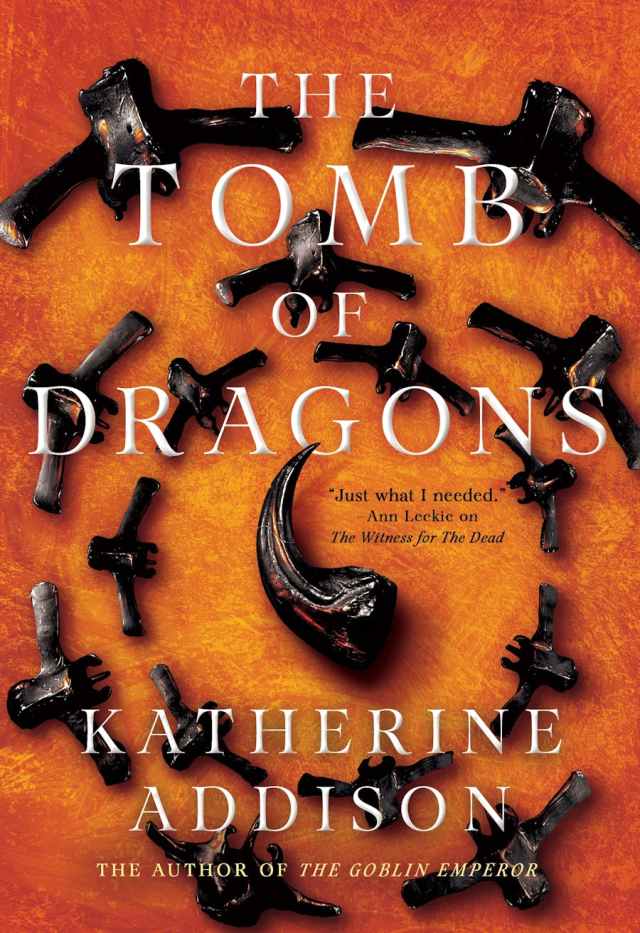
Title: The Tomb of Dragons
Author: Katherine Addison
Publisher: Tor Books
Publication date: March 11, 2025
Length: 352 pages
Genre: Fantasy
Source: Purchased (hardcover); ARC via NetGalley
Rating:
Thara Celehar has lost his ability to speak with the dead. When that title of Witness for the Dead is gone, what defines him?
While his title may be gone, his duties are not. Celehar contends with a municipal cemetery with fifty years of secrets, the damage of a revethavar he’s terrified to remember, and a group of miners who are more than willing to trade Celehar’s life for a chance at what they feel they’re owed.
Celehar does not have to face these impossible tasks alone. Joining him are his mentee Velhiro Tomasaran, still finding her footing with the investigative nature of their job; Iäna Pel-Thenhior, his beloved opera director friend and avid supporter; and the valiant guard captain Hanu Olgarezh.
Amidst the backdrop of a murder and a brewing political uprising, Celehar must seek justice for those who cannot find it themselves under a tense political system. The repercussions of his quest are never as simple they seem, and Celehar’s own life and happiness hang in the balance.
The Tomb of Dragons is the 3rd book in author Katherine Addison’s Cemeteries of Amalo series (or the 4th book in the Chronicles of Osreth series, depending on how you look at all these inter-related books). The start of it all is the superb book The Goblin Emperor — but the three Cemeteries of Amalo books are set in the same world, which is always a great place to visit.
We first met Thara Celehar in The Goblin Emperor, and have followed him as the main character in The Witness for the Dead and The Grief of Stones. Celehar serves the god Ulis and is a witness for the dead — someone gifted with the ability to speak with the deceased and gain final words, requests, or information from them. His charge then becomes acting on behalf of the deceased, whether to bring peace to their family, settle a dispute, or seek justice for the wrongs committed against them. Celehar is an honest man who’s devoted to his work: As he reminds those who thank him, he follows his calling.
But the end of The Grief of Stones showed Celehar suffering a terrible blow, by which he loses the ability to speak with the dead. Without his calling, he lacks purpose or official status. Still, he has the favor of the top cleric in the empire, who assigns him tasks to carry out on his behalf, and manages to do good for others even when not able to pursue his calling.
The plot becomes complicated when Celehar is kidnapped and forced into a dangerous situation, which soon embroils him in a pursuit of justice that threatens to shake the foundations of the empire. We follow him on his day-to-day tasks and errands, but also on the greater mission that he takes on. The book as a whole is a mix of the mundane with more tension-filled dramatic moments. After a somewhat slow start, the pace picks up quite a bit.
Let’s be clear: You absolutely cannot start with The Tomb of Dragons and hope to get anywhere at all. This series is dense and detailed. The world-building is pretty awe-inspiring, but even the very language is a barrier to getting situated within the books’ world. I don’t think a reader coming to these books without starting with The Goblin Emperor would have the slightest chance of making it past the first page or two.
Don’t believe me?
“We are Thara Celehar, a prelate of Ulis. We have come about the revethmerai of Ulnemenee.”
Got that?
How about…
But that was nonsense. There couldn’t be such a thing as a revethvezvaishor’avar. Could there?
I could go one. From forms of address to official titles to place and ethnicity names, not to mention names of building, families, locations, and religious sects, there is just an overwhelming amount to keep track of. Because it’s been three years since the last book in the series was released, I had a very difficult time readjusting to the language of this world. Fortunately, the addenda to The Goblin Emperor (an explanation of language plus a glossary/guide to people) and a wiki page all helped me through it.
After struggling a bit with the first third or so of The Tomb of Dragons, I found myself pulled back into Celehar’s life and pursuits, and ended up very absorbed by the story. It’s a worthy addition to the series, and for those who’ve read the earlier books, I think it’ll be a hit.
The Tomb of Dragons is apparently the final book in the Cemeteries of Amalo series, and it makes me a bit sad to think that Katherine Addison may be signing off for good from this incredible fantasy world that she’s created. I do hope we’ll see more in the future, perhaps focusing on another character or location within the empire.
Meanwhile, we’ll always have The Goblin Emperor… and although I’ve read it twice already, reading The Tomb of Dragons makes me want to go back to it (at least!) once again.
 Bookshelf Fantasies