
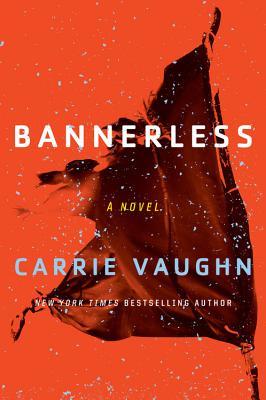
Book Review: Bannerless by Carrie Vaughn

A mysterious murder in a dystopian future leads a novice investigator to question what she’s learned about the foundation of her population-controlled society.

Decades after economic and environmental collapse destroys much of civilization in the United States, the Coast Road region isn’t just surviving but thriving by some accounts, building something new on the ruins of what came before. A culture of population control has developed in which people, organized into households, must earn the children they bear by proving they can take care of them and are awarded symbolic banners to demonstrate this privilege. In the meantime, birth control is mandatory.  Enid of Haven is an Investigator, called on to mediate disputes and examine transgressions against the community. She’s young for the job and hasn’t yet handled a serious case. Now, though, a suspicious death requires her attention. The victim was an outcast, but might someone have taken dislike a step further and murdered him?  In a world defined by the disasters that happened a century before, the past is always present. But this investigation may reveal the cracks in Enid’s world and make her question what she really stands for.

Bannerless is a unique and interesting approach to the dystopian genre. In fact, if you took away the references to “the Fall”, you might almost think you were reading a story of agrarian life in the Middle Ages. Let me explain…

In Bannerless, we follow main character Enid, a resident of the town of Haven whose occupation is investigator. Investigators are both detectives and enforcers, sent from settlement to settlement to look into complaints, solve problems, and if needed, impose sentences. Investigators tend to be feared — when these outsiders show up wearing their official brown tunics, it’s likely to end in repercussions either for individuals, households, or possibly the entire town.

Enid’s village lies among the geographic area known as the Coast Road, sets of smaller and larger settlements who interact for trading, messages, and resources. All follow the same general governing principles. The towns are primarily agrarian, and all members of a community have roles to play. Towns may only produce up to their quotas, so that resources are preserved for for the future. People form households to work together to show productivity, and if they prove that they can support more, they are awarded banners, which give them the right to have a child.

All in all, it sounds like a rather peaceful and healthy way to go about life. Community is all-important. People offer one another help when needed, and when help is provided, there’s a commitment made to repay expended resources when the recipient is able.

As I mentioned, if you didn’t know the setting, you might think this story takes place a few centuries ago. It has that old-fashioned, idyllic feel to it. But we do know that there was a Fall — and while the author doesn’t go into tremendous detail, it becomes clear that civilization fell over the course of years in which the world was devasted by epidemics, followed by substantial climate change that brought life-threatening changes in weather patterns. Enid’s adult life takes place about a century after the Fall, and she still remembers her Aunt Kath, who was the oldest member of Haven and the only one to remember the time before. From Kath, Enid learns about how life used to be, from silly details (like a yearning for plastic wrap) to issues around birth control and reproduction.

In terms of the plot of Bannerless, we follow two timelines in alternating chapters. We see Enid and her investigator partner Tomas, a member of her birth household, as they investigate a suspicious death in the nearby town of Pasadan. This in itself is shocking — while their investigations mainly focus on banner or quota violations, murder is pretty much unheard of. Meanwhile, in every other chapter, we follow the story of Enid from about 10 years earlier, when she followed her lover on his journeys from town to town, and along the way, learns much more about the communities, the ruins of cities, and her own calling.

What’s unusual about Bannerless, and what makes me hesitate to call it “dystopian”, is that the societal structure seems to work. There are no castes or debasing rules or the other types of harsh governance that seem to be the hallmark of the genre. Yes, the story takes place in a post-apocalyptic world, but the people seem to have worked out a system that makes sense for them. The rules about banners and birth control don’t strike me as autocratic or despotic; they go hand in hand with the focus on resources and quotas. The communities bear an awareness of the disasters that led to civilization’s downfall, and they’re determined to avoid the excesses that result in barren lands and starving children.

And while Enid and others occasionally yearn for the resources they’ve heard about through stories about life before the Fall (medical equipment and reliable lab tests, for example), they’ve found a way to manage and preserve what they have, to share and take communal responsibility for one another, and to sustain future generations by conserving current resources.

Yes, the breaking up of households who flout the rules may sound harsh, but there’s a lot of reasonableness too. Of all the various fictional scenarios of life post-disaster, the world of Bannerless sounds pretty okay to me.

The book itself is a quick, engaging read. Don’t expect explosions or intense battles or action scenes. The drama is all about the people, their interactions, and their motives — although this book does a great job of demonstrating how scary it can be to be caught out in the open when a storm is on the way.

According to the author’s page on Goodreads, she’s working on a sequel, and Bannerless is listed as the first in a series. I had no idea while I was reading the book that this would be an ongoing story, and Bannerless works perfectly well as a stand-alone. (I’m glad I didn’t know ahead of time; I tend to avoid starting new series, and I’d hate to think that I might have missed out on a good book because of my series-aversion!)

I’ve enjoyed other books and stories by Carrie Vaughn (although I haven’t read her Kitty Norville series, which seems to be her best-known work), and I will definitely read the 2nd book whenever it comes out.

Interested in this author? Check out my reviews of other books:
After the Golden Age
Martians Abroad
“Raisa Stepanova” (Dangerous Women anthology)

_________________________________________

The details:

Title: Bannerless
Author: Carrie Vaughn
Publisher: John Joseph Adams/Mariner
Publication date: July 11, 2017
Length: 352 pages
Genre: Science fiction
Source: Purchased
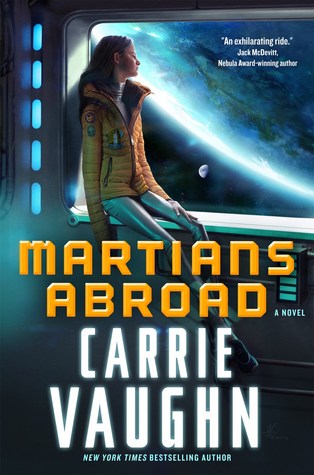
Book Review: Martians Abroad by Carrie Vaughn

martians-abroad

Polly Newton has one single-minded dream, to be a starship pilot and travel the galaxy. Her mother, the director of the Mars Colony, derails Polly’s plans when she sends Polly and her genius twin brother, Charles, to Galileo Academy on Earth—the one planet Polly has no desire to visit. Ever.

Homesick and cut off from her desired future, Polly cannot seem to fit into the constraints of life on Earth, unlike Charles, who deftly maneuvers around people and sees through their behavior to their true motives. Strange, unexplained, dangerous coincidences centered on their high-profile classmates begin piling up. Charles may be right—there’s more going on than would appear, and the stakes are high. With the help of Charles, Polly is determined to find the truth, no matter the cost.

Martians Abroad is a fun space romp, but somehow feels a bit unfinished — as if this is the introduction to a new series, not (as it’s described on Goodreads) a stand-alone.

There’s also the issue that while this book is billed as science fiction, it reads very much young adult to me. The main characters, Polly and Charles, are 17 years old. Although we don’t learn their exact age until the end of the book, the story focuses on their assignment to a new school, and it’s clear that they’re about college age at the start of the story.

In fact, if you took out the sci-fi trappings, much of the story is straight-up coming of age stuff — being an outsider, figuring out where you belong, dealing with cliques, exploring one’s own path, standing up to authority. The fact that it’s set in a brave new world gives it an extra zing, but the ingredients feel very familiar.

That said, I enjoyed Polly as a character very much. She’s independent, focused, and strong, with a rebellious streak and a core of integrity that sees her through the challenges that spring up in her path.

The best part of Martians Abroad, for me, was getting to see Earth through the eyes of someone experiencing it all for the first time. Polly was born and raised on Mars, and to her, Mars is home. She has no desire to leave it, except to fulfill her dream of becoming a pilot. The brown-red colors and the dust are what’s normal to her. Coming to Earth, Polly has shock after shock. Her body has to adjust to Earth’s gravity, so that she feels sluggish constantly and struggles for breath. Her Earth-born classmates are bulky and strong in comparison to the off-worlders’ elongated builds and their brittle bones. Polly has bouts of agoraphobia when stepping outside for the first time and dealing with the open sky. In Polly’s home world, she’d be dead without enclosures to keep the air in and scrubbed clean. Over and over again, we see Polly confront our world, and it’s fascinating (and entertaining) to see how alien it can all look.

A few small examples: Attending a banquet with fancy decorations, including floral centerpieces and arches:

They were cut — I checked, they didn’t have roots, just stems stuck in water. They’d all be dead in a few days. This room had more flowers than entire greenhouses on Mars, and they were all dying. It seemed a little sad.

Polly’s first encounter with Earth-style breakfast:

“Good. I was going to warn you not to eat the bacon, it will probably make you sick. We don’t have the stomach enzymes to digest it.”

[…]

“What’s bacon?” I said.

“Fried pig muscle.”

And on the universality of sweets:

There was a cake — happily, I wasn’t going to have to get anyone to explain cake to me. We had round, fluffy, mooshy sweet things on Mars, because humanity couldn’t exist without dessert.

As Polly acclimates to her school and the planet, she begins to suspect that something sinister is behind a string of accidents that befall her class, and she puts herself in danger time and again to keep others safe and uncover the truth. The accidents provide the key points of excitement in the novel, and there are moments of great adventure and thrill… but unfortunately, the pacing is uneven, so we get these spots of action in between longer segments on daily life at the academy and Polly’s attempts to find a place for herself.

Heck, there’s even dress shopping in the mix. A makeover! Doesn’t that just reinforce the YA-ness of it all?

I don’t really mean to sound overly negative. This is a fun book, but it was a bit too YA and not enough sci-fi for my taste, and I had the odd experience of never quite having a real feel for what kind of book it was that I was reading.

Overall though, I enjoyed Martians Abroad. I can’t help wondering whether there’s more to come. As I mentioned earlier, although it’s billed as a stand-alone, much of this book feels like a long introduction. We’ve met Polly, her classmates, her school — the question is, now what? While the book works on its own well enough, it seems natural that there should be further adventures.

_________________________________________

The details:

Title: Martians Abroad
Author: Carrie Vaughn
Publisher: Tor Books
Publication date: January 17, 2017
Length: 288 pages
Genre: Science fiction
Source: Review copy courtesy of the publisher via NetGalley

Save

Save

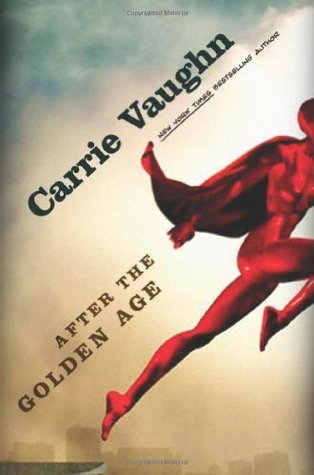
Take A Peek Book Review: After the Golden Age by Carrie Vaughn

“Take a Peek” book reviews are short and (possibly) sweet, keeping the commentary brief and providing a little peek at what the book’s about and what I thought.

After the Golden Age


Synopsis:

(via Goodreads)

Most people dream of having superheroes for parents, but not Celia West. The only daughter of Captain Olympus and Spark, the world’s greatest champions, she has no powers of her own, and the most exciting thing she’s ever done is win a silver medal in a high school swim meet. Meanwhile, she’s the favorite hostage of every crime boss and supervillain in Commerce City. She doesn’t have a code name, but if she did, it would probably be Bait Girl, the Captive Wonder.

Rejecting her famous family and its legacy, Celia has worked hard to create a life for herself beyond the shadow of their capes, becoming a skilled forensic accountant. But when her parents’ archenemy, the Destructor, faces justice in the “Trial of the Century,” Celia finds herself sucked back into the more-than-mortal world of Captain Olympus—and forced to confront a secret that she hoped would stay buried forever.

My Thoughts:

I have been meaning to read this book for over a year now, and I’m so glad that I finally did! How does an ordinary girl grow up when she has superheroes for parents? Not easily, that’s for sure. Now an adult, Celia West is finally reconciling with her parents and figuring out how she fits into their world of crime-fighting, where the city’s needs come first and Celia is always a distant second. Meanwhile, Celia’s secrets from her teen years have resurfaced in a most unpleasant way, and the consequences of this exposure are upsetting, to say the least.

After the Golden Age is much more heart-felt than I’d expected. Despite the urban fantasy setting, Celia deals with real emotions and crises, and her struggle to find her place in the world and figure out how she can possibly make peace with her parents has a universal feel to it. There’s romance, intrigue, and adventure, and despite the often desperate throes, also plenty of snarky humor. I knew I was in for a treat when, in the first chapter, Celia’s response to being kidnapped is:

Damn, not again.

I really enjoyed After the Golden Age. The fantasy elements work well as a framework, but it’s the main character and her friends and family that make the book come alive. I’m looking forward to reading the sequel!

_________________________________________

The details:

Title: After the Golden Age
Author: Carrie Vaughn
Publisher: Tor
Publication date: April 12, 2011
Length: 304 pages
Genre: Fantasy
Source: Purchased