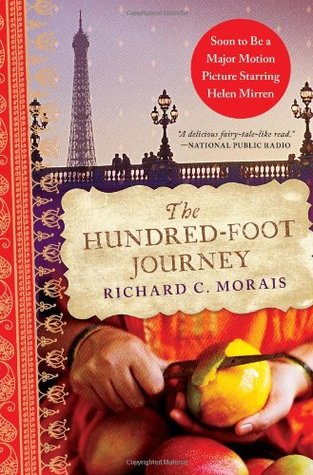
 The Hundred-Foot Journey is the story of Hassan Haji, who travels over the course of the story from his boyhood in Mumbai to the pinnacle of the French culinary world as a Parisian chef and restaurateur. When we first meet Hassan, he is just a boy, growing up in a loud, boisterous Muslim family, with the family’s kitchen and restaurant the center of his world. The tastes and smells of Indian curries and spices are with him from birth, and his large, gregarious father is the heart that keeps them all going at top speed.
But after Hassan’s mother is killed, the family sells the restaurant and spends months traveling through Europe, finally stopping in the small village of Lumiere in the French Alps, when Hassan’s father declares that it’s time to set down new roots. He buys a vacant property and decides to open a new restaurant, Maison Mumbai, and all seems well with the family once more…
Except. Maison Mumbai is located just across the road from La Saule Pleureur, an upscale French inn and restaurant run by the indomitable Madame Mallory, practically an institution in the world of French cuisine. Madame Mallory is outraged by the impertinent Indian family and its noisy, uncouth intrusion into her refined world, and she sets out to make them feel as unwelcome as possible, going so far as to blackmail all the local vegetable and fish purveyors into not selling to the Hajis.
Madame Mallory’s greatest pain, though, comes after eating at Maison Mumbai. Hassan, now a teen-aged boy, is the head cook, and Madame Mallory cannot believe what she’s tasting. To her shock and dismay, she realizes that Hassan has a natural gift, which she describes as the food equivalent of having perfect pitch in music. Finally, Madame Mallory’s jealousy drives her to an act that causes real harm to the Haji family, and in penance and remorse, she asks Hassan’s father to allow Hassan to cross the street — the hundred-foot journey — and become her apprentice. Her greatest desire is to train Hassan in the art of French classical cuisine, and as it turns out, it is Hassan’s greatest wish as well.
All this occurs in roughly the first half of the book. From here, we follow Hassan’s training in Madame Mallory’s kitchen, his eventual departure for Paris, and ultimately the opening of his own restaurant, Le Chien Mechant. Hassan rises through the ranks of the elite chefs of France, a remarkable achievement for someone seen as an outsider.
And… that’s about it.
The book is weirdly anticlimactic, and wasn’t at all what I expected. It has a charming and engaging start, focusing on the Haji family and its eccentricities, especially with the outsized personality of Hassan’s irrepressible father. The conflict in Lumiere between the proper, elegant French restaurant and the noisy Indian restaurant, with its plastic menus and statues of elephants, is a funny, relatable portrait of a culture clash.
But from the moment Hassan moves over to Madame Mallory’s kitchen, the story loses all its steam. The second half of the book feel like a recitation of events, rather than a story. Hassan tells us about where he’s been, what he’s done, what he’s cooked, but it’s all just reporting. It simply does not feel lived in. As Hassan grows older and pursues the success he’s dreamed of, we see him doing it all, but I could not feel it. Even in relating what seems to be the emotional turning point of the second half, Hassan’s friendship with a star chef who is driven to suicide by the impending collapse of his business empire, there’s a lack of emotional connection. I didn’t feel that we got to know Paul particularly well, and while Hassan talks about their friendship, it seems more like listening to someone tell you about an old friend that actually meeting that friend yourself.
The narrator of the audiobook, Neil Shah, does a nice job with Hassan’s first-person narrative, and I loved his depiction of Hassan’s father. The voice for the female characters was not as convincing, bordering on mimicry, especially when putting on a French accent for Madame Mallory.
 In terms of the writing style, I had a problem with the author’s descriptions of the female characters. Madame Mallory is a highly respected French chef in her mid-sixties when we meet her, yet the author persists in describing her as elderly and crone-like — and indeed, he’s not kind to any of the women in the novel. Do we need to know that a woman Hassan briefly dates is thick-thighed? I don’t think so, especially as he doesn’t bother to describe anything else about her. Madame Mallory acts awfully toward the Haji family but ultimately becomes important to Hassan, yet it’s hard to get past the incredibly negative descriptions of her looks that get so much emphasis.
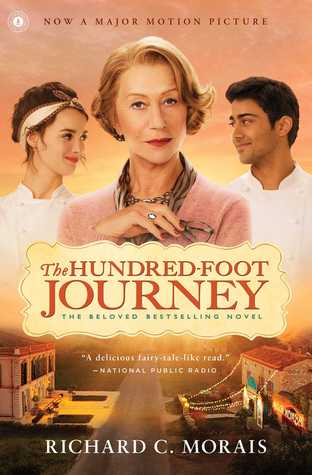
I know The Hundred-Foot Journey was made into a movie (starring Helen Mirren), and I’d still like to see it as a point of comparison, even though I didn’t much care for the book. My impression from what I’ve read about the movie is that it focuses on the first half of Hassan’s story. I only wish the book had had the same focus. Sadly, the second half of the book often seems like a boring slog through lectures on food preparation, the French economy, and the challenges of the restaurant business. Without any drama or personal investment, it’s hard to care much at all about Hassan’s ultimate triumph.
Note: I read/listened to this book after my book group selected it for our March group read. I haven’t yet checked in with the group to see what they thought. For me, this was not one of our more successful picks.
_________________________________________
The details:
Title: The Hundred-Foot Journey
Author: Richard C. Morais
Narrator: Neil Shah
Publisher: Scribner
Publication date: 2008
Audiobook length: 8 hours, 551 minutes
Printed book length: 272 pages
Genre: Fiction
Source: Library (Overdrive)










 Bookshelf Fantasies