Book Review: The Revised Fundamentals of Caregiving by Jonathan Evison

Book Review: The Revised Fundamentals of Caregiving by Jonathan Evison

Benjamin Benjamin Jr. is a certified caregiver, having completed a night-school course offered at a church and mastering essentials like setting professionals boundaries, avoiding burnout, and memorizing helpful mnemonics such as ALOHA (Ask – Listen – Observe – Help – Ask again).  How very much Ben defines himself by his ability to provide care is central to this sad yet funny book.

When we first meet Ben, he is heading out on a job interview for the first time in a very, very long time. On the brink of middle age, he is tapped out, having used up every penny of his savings and with no other option if he wants to make rent on the impersonal, grungy “compartment” in which he resides. As we soon discover, Ben’s life has not always been such a wreck. Until just a few short years earlier, he seemed to have a golden life, true happiness, and everything a man could want — until disaster ripped his life apart and left him empty and hopeless. At the end of his rope, Ben is hired to care for Trevor, a 19-year-old wheelchair-bound muscular dystrophy patient, for whom Trevor provides companionship as well as the day-to-day physical care necessitated by Trevor’s degenerating condition.

Ben is clearly a natural at caregiving. Bodily functions don’t faze him; he cleans Trevor, applies his deodorant, dresses him, and maneuvers him in and out of his chair. Despite his commitment to his so-called professional boundaries, Ben has to constantly remind himself not to push Trevor past his comfort zone, not to goad him to break out of routine and try something new. Eventually, the two head out on a somewhat ill-conceived road trip to visit Trevor’s estranged, accident-prone father in Utah. Along the road, the two are joined by a variety of waifs and strays, all lost in some way and in need of care. Ben becomes a de facto protector and shepherd for his odd assortment of travel companions, as they drive through the American West past landscapes and attractions such as the world’s largest pit and other weird roadside highlights.

As the book progresses, the details of the horrible loss in Ben’s past slowly emerge. It’s no wonder the man is a mess. His grief is unending, his self-blame immense. He believes himself responsible for the destruction that occurred, and cannot see himself as deserving of happiness. Through his caregiving role and his developing relationship with Trevor, a glimmer of light emerges. Ben will never forget the past or stop hurting over his incomprehensible losses, but he can begin to trust himself once more. By book’s end, we see that Ben is perhaps not a totally lost cause after all, and although it will be long, his road to recovery and redemption is within his view, if not yet quite within his grasp.

I hesitate to say any more about the plot, as I believe the emotional impact would be lessened by knowing too much in advance. I found The Revised Fundamentals of Caregiving an affecting story, sad yet with moments of lightness and humor. The writer’s deft skills give sharp focus to the speech, physical traits, and personality quirks of the various secondary characters whose lives intersect with Ben’s, and Ben’s cynicism and bruised soul make him an interesting lens through which we readers can peek into his world.

I did find some awkward phrasings (“And what was I thinking in that instant just before the world went icy black, as I strode toward the front door irritably beneath my mountain of groceries?”) and odd word choices (Trevor diverted — not averted — his gaze), and a weird interlude related to Facebook that just didn’t ring true to life. These are relatively minor quibbles, however. Overall, I found Ben’s voice convincing, and the plot was a touching portrayal of a man’s journey from tragedy towards the first tiny specks of the possibility of finding meaning in life again.

Book Review: The Dog Stars by Peter Heller

Book Review: The Dog Stars by Peter Heller

When is the last time you were so mesmerized by lovely writing that you had a hard time finishing the book, simply because you wanted the reading experience to last just a little longer? That’s how I felt as I neared the end of The Dog Stars. I almost wanted to put the book down for a while just to avoid having to say I was done… Of course, I didn’t do that, because I really, really wanted to see how it would all work out.

Where to begin? The Dog Stars is a vision of a post-apocalyptic world at once horrifying and beautiful. Nine years before the start of the events in the book, a virulent flu pandemic wiped out 99% of the human population of earth. Those who survived were further decimated by an HIV-like blood disease that doomed many to a slow, lingering, miserable death. And yet, the land remains, canyons, woods, creeks, and plains, mostly empty of people now, and nature is busily trying to reassert itself even in the face of climate change and species die-offs.

Hig is one who survived unscathed, at least physically, having lost his beloved wife to the flu. As the story opens, Hig lives in relative safety at an isolated airstrip in rural Colorado, with his dog Jasper and his gruff survivalist neighbor Bangley as his only companions. And Hig has the Beast — an older Cessna airplane that he lovingly maintains, and which gives Hig and Bangley the power to protect their home turf. Hig flies the perimeter, scouting for intruders and surveying the stark and empty land. Bangley is a weapons expert, ready to shoot anything that moves. Between the two of them, they protect their home from the bands of dangerous invaders who seem to find them every few months.

Hig lives, but he’s only partially alive. He experiences joy when he flies, with Jasper in his accustomed place in the copilot’s seat, or when he tends his garden and has a moment where he just is:

I could almost imagine that it was before, that Jasper and I were off somewhere on an extended sojourn and would come back one day soon, that all would come back to me, that we were not living in the wake of disaster. Had not lost everything but our lives. Same as yesterday standing in the garden. It caught me sometimes: that this was okay. Just this. That simple beauty was still bearable barely, and that if I lived moment to moment, garden to stove to the simple act of flying, I could have peace.

But Hig remembers, too, and suffers mightily over his losses: his wife, their future together, and the world that they inhabited. Although not entirely spelled out, it’s clear that some other global environmental catastrophes have crept up on the world. Early on, we hear a list of animals that no longer exist — elephants, apes, even trout. Throughout the book, we learn of changing weather patterns and shorter rainy seasons, with drought always threatening. It’s clear that global warming is upon us, and its effects are not kind. Hig is a man who loved to fish, who appreciates nature and its cycles, and the loss of the animals, trees, and rivers hit him as hard as some of his more human losses.

When Hig suffers one more devastating bereavement, it frees something in him to the point that he decides to venture out of the safe perimeter that he and Bangley have so carefully maintained and fly off in search of a phantom voice heard years earlier over his airplane radio. What happens to Hig from that point forward is better left to the reader to discover, and so I won’t go into any more detail about plot points.

The writing in The Dog Stars is spare and lovely, reminding me of the beautiful, airy language in Plainsong by Kent Haruf. In The Dog Stars, each paragraph stands alone, with gaps in between lines and phrases. There’s space there, and you can almost feel Hig thinking in between anything he decides to say. Sentences may be half-formed, phrases are uttered but not finished. It truly feels like we are living inside a man’s head, experiencing his viewpoint and his pain through his use of language.

I could pick almost any passage to illustrate the unique writing. One example that stands out:

You hear bullets make the sound they always do in Westerns and war stories and guess what? They do. They make a phhhht like someone opening a poisonous can of soda. The Soda of Death. Like a vacuum following itself at the speed of a diving duck. Followed almost simultaneously by a little hum, a musical exclamation point.

Peter Heller is a journalist and has written several non-fiction books. The Dog Stars is his first novel, and I hope there will be many more to come. You don’t often hear a post-apocalyptic book described as beautiful, but The Dog Stars truly is. I highly recommend this literary, lovely, moving book.

Book Review: Chomp by Carl Hiaasen

Book Review: Chomp by Carl Hiassen

Chomp is a total romp! And that concludes the rhyming portion of this book review.

Novelist, columnist, and all-around funny guy Carl Hiaasen has now written four books for kids, Chomp being the most recent. Hiaasen brings his sense of humor and his devotion to the preservation of natural habitats and native species to his writing for younger readers, and the result is pure fun.

Chomp tells the story of Wahoo Cray, an ordinary kid… who happens to live with gators, howler monkeys, and pythons, among other critters. Wahoo’s dad Mickey is an animal wrangler, expert at handling all sorts of wild creatures and making them look good on camera. Unfortunately, Mickey is a bit out of commission after sustaining a concussion thanks to a frozen iguana falling on his head (don’t ask). The family’s finances are in dire straits until they’re hired by reality TV star Derek Badger to wrangle animals for an upcoming Everglades episode of the hugely popular series, Expedition Survival! (That exclamation mark is part of the show’s name, not an expression of my enthusiasm.)

Problems? You bet. Derek is, to put it politely, a big fake. Overweight and sporting an artificial tan, Derek relies on stunt doubles and fancy camera angles, until he gets it into his head to make the Everglades episode “real”. Wahoo and Mickey find themselves deep in the Glades, dealing with snakes, bats, and other biting critters, while trying to earn their keep by making the star look good. Let’s just say that it doesn’t go according to plan. Out-of-control airboats, a runaway science-loving girl, her gun-toting crazy father, thunderstorms and grounded helicopters all come together for a riotous, dangerous, and ultimately hilarious dramatic high point.

Wahoo is a terrific lead character — devoted to his father and their animals, brave when he needs to be, willing to put himself on the line for family and friends, but with a low tolerance for fools — which may not be the best quality in someone trying to work with a conceited Hollywood star. Supporting characters, like his friend Tuna and Derek’s assistant Raven, are memorable, well-defined, and full of spunk and sparkle.

My 10-year-old and I picked this one out as our latest read-before-bed book, and it was a great choice. We were hooked and had a hard time stopping for the night after just one chapter, and the kiddo’s giggles and snorts (quoth he, “Derek is a jerk!” and “Derek is so stupid!) were entertaining interruptions throughout. (I did try to get the kiddo to do a Q&A with me for this one, but apparently watching TV with his dad is, at the moment, a lot more fun). He obviously enjoyed Chomp a great deal, and I really did too. There are times when I find my mind wandering while I read aloud, but not with this one — I think I had as much fun as my son did.

A final note: My son enjoyed Chomp as a read-aloud, but I don’t think he’d have managed it on his own. I would say that most elementary grade readers would find it a challenge, but would enjoy it with an adult reading partner. For independent reading, I’d recommend Chomp for middle school aged kids. Reading aloud or reading on their own, kids who enjoy adventure stories will definitely get a kick out of Chomp.

Book Review: The Casual Vacancy by J. K. Rowling

Book Review: The Casual Vacancy by J.  K. Rowling

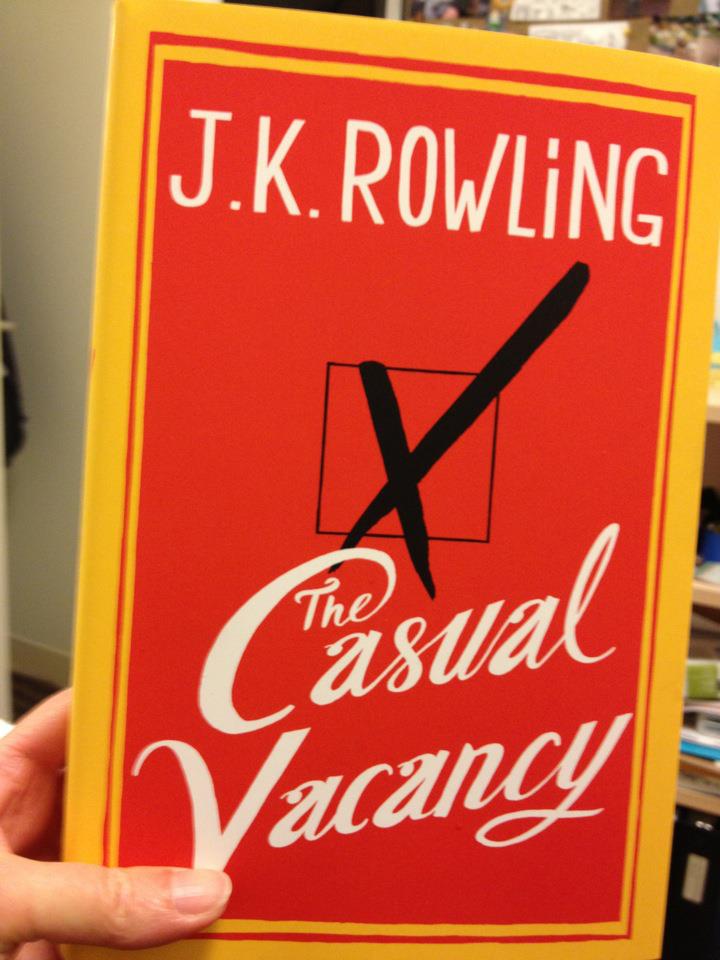
My very own copy of The Casual Vacancy. Yup, that’s my thumb.

When I first read Amazon’s description of The Casual Vacancy, I can’t say I was immediately bowled over:

When Barry Fairweather dies unexpectedly in his early forties, the little town of Pagford is left in shock. Pagford is, seemingly, an English idyll, with a cobbled market square and an ancient abbey, but what lies behind the pretty façade is a town at war. Rich at war with poor, teenagers at war with their parents, wives at war with their husbands, teachers at war with their pupils…. Pagford is not what it first seems. And the empty seat left by Barry on the town’s council soon becomes the catalyst for the biggest war the town has yet seen. Who will triumph in an election fraught with passion, duplicity and unexpected revelations?

But, of course, this is J. K. Rowling’s first post-Harry Potter publication, and her first adult novel, so does it really matter what it’s about? As of today, one week after its release, The Casual Vacancy is #3 in Amazon’s sales rankings. Let’s be honest: If a debut author was releasing a book with that very same description, would people be lining up to read it?

(By the way, Amazon has it wrong — the recently deceased character is named Barry Fairbrother, not Fairweather.)

Beyond the hype, how is the book itself? Does The Casual Vacancy work as a novel? Has J. K. Rowling successfully transitioned into the world of adult fiction?

Hard questions to answer. First, let’s start with the basics: The book blurb, above and on the dust jackets, does not really do justice to the richness of the world created by Rowling, nor does it convey the awfulness — not of the writing — but of the characters’ lives. This is not a happy book. You might expect — again, based on the blurb — a charming story of a quaint English town filled with interesting and eccentric characters squabbling over petty (but still quaint) politics. You would be quite mistaken.

Pagford may be a small, idyllic town, but its troubles are by no means picturesque. Old, respectable Pagford sits right next to the more urban Yarvil, which decades earlier expanded onto land sold by Pagford aristocrats and put up council housing there. This housing area, known as the Fields, is home to every imaginable form of low-life — petty thieves, drug dealers, addicts, prostitutes, all part of a generally hopeless and beaten-down populace. By the miracle of zoning, however, Fields children are able to attend the more desirable Pagford schools rather than the Yarvil institutes of education. A fight has been brewing for years between those in Pagford who want to retain the Fields within town limits and accept Fields denizens into their community versus the Pagford old-timers who want to maintain the quality of their little village by redrawing the boundaries and handing the Fields off to Yarvil.

Barry Fairbrother’s death triggers the events of the novel, as his vacancy on the parish council presents an opportunity for those on both sides of the Fields conflict to try to seize control and push through their own agenda. As the election to replace Barry nears, the Pagford citizens’ worst natures and deepest secrets are slowly revealed as the desperation of those involved intensifies.

Rowling’s cast of characters is simply huge, enough so that it might be helpful early on to take notes. Major characters include:

  • The sixteen-year-old daughter of a hopeless drug addict, struggling to keep her three-year-old brother out of foster care while maintaining her tough facade at school and on the streets
  • The self-deluded wife of the lead council member, who prides herself on being a medical professional due to her hospital volunteer work
  • The social worker who makes a difference in clients’ lives while cluelessly messing up her own in pursuit of a doomed-to-fail romance with a completely passive boyfriend
  • The abusive father, who doesn’t realize how his son works to undermine him
  • The bored housewife, more interested in fantasies of a boy band singer than in her stable but unexciting husband
  • The Sikh doctor who is passionately involved in town politics but can’t see the problems within her own household

A tangled web connects the various players, linking parents and children, social workers and clients, doctors and lawyers, politicians and thieves, restless housewives and rebellious teenagers. There is no one main character; the points of view shift constantly, and the domestic dramas move from household to household rapidly. It’s a lot to keep track of, but for the most part, it works.

What doesn’t work so well is the incessant head-hopping that Rowling engages in throughout the novel. Within a chapter, and often on the same page, we shift from one character’s mind to another’s with no warning. The transitions can be jarring, and while perhaps the ever-changing perspective is an intentional literary device, I found it distracting and occasionally hard to follow.

Other quibbles: As an American reader, I had to rely on Wikipedia and Google to provide explanations of parish councils, housing estates, and the British healthcare system. I certainly welcome the opportunity to learn about other cultures and societies, but The Casual Vacancy‘s settings and politics are presented without background or explanation, and were therefore a little difficult to navigate without doing some research.

Additionally — and this may be a fault of the marketing rather than necessarily a flaw of the book — the election is set up as the pivotal catalyst of the plot… yet it was strangely underplayed and anticlimactic when it finally took place. There really was no suspense about the election outcome, as only one candidate was presented as viable in any real way. So yes, the vacancy on the council is what sets events into motion, but the actual machinations and developments within the town political system were oddly unimportant in the end, and we never get more than a passing glimpse of the council in action.

It’s hard, if not impossible, to evaluate The Casual Vacancy on its own merits and disregard the fact that THIS IS J. K. ROWLING WRITING! Consequently, especially early on, it’s a bit disconcerting to read the oh-so-very adult language and content matter. In the second chapter, a particularly unsavory character exclaims, in regard to his teen-aged son smoking:

I’m not going to fund the little f*cker’s filthy habit! F*cking cheek of him, puffing away in my f*cking shed!

The asterisks are mine; the language — here and throughout — is rough and unvarnished. Early on, I had to pause for breath a few times, thinking to myself, “J. K. Rowling is using the f-word! J. K. Rowling is writing about sex!” And then, of course, remind myself that we are not at Hogwarts, there is no magic here, and this is not a book intended for children.

At 500 pages, The Casual Vacancy is not a quick read, nor is it easy. J. K. Rowling is not kind to her characters. This is, after all, the woman who (SPOILER ALERT) killed off Sirius Black and Albus Dumbledore. Very bad things happen to her characters. No one gets off easy, no one gets a free pass, and while future happiness may be foreseeable for some characters, most will not be so lucky.

Would I have read this book if it were not written by J. K. Rowling? Probably not. And yet, I’m glad that I did. The Casual Vacancy‘s complex plotting and tragic trajectories were quite compelling, and while it often felt a bit unfocused, the overall story held my attention start to finish. It will be interesting to see where the author goes from here… but whatever she writes next, I’m sure I’ll be one of the millions lining up to read it.

Book Review: The Brides of Rollrock Island by Margo Lanagan

Book Review: The Brides of Rollrock Island by Margo Lanagan

I’ve been a bit in awe of Margo Lanagan ever since reading her story collection Black Juice. Regular readers of my blog will know that I have an aversion to short stories; no matter how well written, I get antsy and never quite make it through an entire book of stories, at least not without a lot of hair-pulling. Not so with Black Juice; I was captivated, start to finish, by the author’s language and the mood she creates. The lead story in Black Juice, “Singing My Sister Down”, has to be one of the saddest and most matter-of-factly tragic stories I’ve ever encountered. There’s also a very odd story told from the perspective of elephants, but that’s okay… it was weird but it worked.

I’ve been eagerly awaiting the publication of The Brides of Rollrock Island for some months now, and was delighted to finally get my hands on a copy. The verdict? In short, well worth the wait.

The Brides of Rollrock Island is a novel — which often feels more like a collection of linked stories — about the odd lives of the people of windswept, sea-battered Rollrock Island. Generations gone by, legend has it, the men of the island would take sea-wives, women called forth from the sea, leaving behind their true forms as seals in order to live and love among men. Children grow up hearing whispers of these lovely women, but it’s so long ago as to be remembered only by the great-grandparents among the town.

Into this small, isolated island community is born a homely little girl named Misskaella, youngest daughter of the rather large Prout family. Misskaella is valued by no one, considered odd and ugly, and grows up realizing that the men and women of the island either scorn or pity her. Yet Misskaella has one thing that no one else does — the magic to call to the seals. Misskaella revives the island’s past by bringing forth a sea-wife for one young man of the town. The woman is ethereally beautiful — graceful, slender, with large dark eyes and silky black hair. By comparison, the other women of Rollrock appear frowzy and rough. The men are enchanted, and bit by bit, the island is emptied as the womenfolk, deserted in favor of the sea-wives, leave the island. The men of Rollrock shower Misskaella with treasures and provide her with a place of honor in the town, and in return, she makes sure that they have lovely sea-wives to marry and to provide them with sons.

The men and boys treat their women (the mams, as the boys call them) with veneration and tender care, never losing their fascination with the women’s gentle beauty and fragility. And the women love their husbands and sons, without doubt, yet they pine for the sea and the world that they lost.

Did Misskaella bless the men of Rollrock Island with true love? Or did she exact a torturous revenge upon all the island folks by gifting them with love that must inevitably lead to pain?

It’s hard to describe just how strange and beautiful is the language of The Brides of Rollrock Island. Margo Lanagan’s words twist and cut, caress and murmur. She evokes the crash of the sea, the pervasive smell of the ocean air, the natural wonders of the island and the sea:

And down the cliff we went. It was a poisonous day. Every now and again the wind would take a rest from pressing us to the wall, and try to pull us off it instead. We would grab together and sit then, making a bigger person’s weight that it could not remove. The sea was gray with white dabs of temper all over it; the sky hung full of ragged strips of cloud.

Ms. Lanagan use the first person plural throughout; the narrative is full of what “we” did and how “we” felt, creating with the very words a sense of tight-knit community and insularity. Her odd vernacular seems particularly suited to this island of outcasts and loners, and her writing creates its own spell throughout the book.

The Brides of Rollrock Island is not a typical romance or fantasy, not a supernatural love story or thriller. This is a book of magical power and grace, of tragedy and sorrow as well as love, filled with lyrical writing unlike most anything on bookstore shelves today. Don’t miss it.


Q&A with the kiddo: A kid’s-eye view of…

Book Review: The Secret of Platform 13 by Eva Ibbotson

From Goodreads:

A forgotten door on an abandoned railway platform is the entrance to a magical kingdom–an island where humans live happily with feys, mermaids, ogres, and other wonderful creatures. Carefully hidden from the world, the Island is only accessible when the door opens for nine days every nine years. A lot can go wrong in nine days. When the beastly Mrs. Trottle kidnaps the prince of the Island, it’s up to a strange band of rescuers to save him. But can an ogre, a hag, a wizard, and a fey really troop around London unnoticed?

Proudly presenting Q&A with the kiddo, courtesy of my 10-year-old son, in which I ask my kiddo to describe a book he’s enjoyed recently and he gives his opinions, more or less unfiltered by mom.

Without further ado:

Q: What book do you want to talk about?

A: The Secret of Platform 13.

Q: What was it about?

A: The king and queen of this island had a child. It was the happiest day on the island. The three babysitters took the baby through the gump into the real world (kind of like teleporting). One of the girls got knocked out by car exhaust and a woman took the baby. Now the people on the island are trying to get the baby back.

Q: What’s the gump?

A: The gump opens every nine years and stays open for only nine days. If you step through, you go to a cove and can take a ship to the island. It opens at platform 13 at King’s Cross Station in London. There are ghosts who watch over the opening. If you go through and you don’t get back in time, then you’re stuck for nine years.

Q: What’s special about the island?

A: There are different animals and there’s a king and queen. It’s a magical island. There are creatures called mistmakers that makes mist when you play music, so when ships and planes pass by, they can’t see the island.

Q: How do they try to get the baby back?

A: The king and queen send a giant, a wizard, a fairy, and a hag through the gump the next time it opens. They think they find the right kid but he’s really just a spoiled brat.

Q: Who is your favorite character?

A: My favorite character was Ben. Ben is an honest boy who knows how to do work and is really cool. He is very nice and tries to help people but he’s also kind of gullible.

Q: How would you describe the book?

A: 4-star book. It’s funny and exciting.

Q: Who do you think would like the book?

A: I think kids my age would like the book if they like adventure stories, exciting stories, and cliffhangers.

Q: Are you glad you read it?

A: Yes, I am.

Mom’s two cents: We read The Secret of Platform 13 as a bed-time read-aloud, and it was quite a success. My kiddo was very involved and got excited about the story to the point that he was jumping in with comments and conjectures each time another plot twist was introduced. In my opinion, this was a nice option for a middle grade reader. The magical elements were fun, there was tension, drama and a little bit of menace, but nothing too scary. I was a little put off at first by the similarities in the early chapters to elements of Harry Potter (note: this one came first!), but fortunately the overlap didn’t carry all the way through the book and thus wasn’t too distracting. I had a great time seeing my son get caught up in this book, and I enjoyed it myself as well. All in all, a good choice for a mom/kid reading adventure!

So there you have it. We’ll be back with more book opinions from my kiddo, whenever I can get him to talk books again.

Book Review: Beautiful Ruins by Jess Walter

Book Review: Beautiful Ruins by Jess Walter

If not for all the rave reviews out there, I might never have picked up Beautiful Ruins on my own. And that would have been a shame.

Based on the dustjacket flap, this didn’t really sound like a book for me. Hollywood producers. Scandal on the set of Cleopatra in the 1960s. Richard Burton and Elizabeth Taylor, for God’s sake. Do I care about any of this?

As it turns out, the answer is yes. Beautiful Ruins is a vast book, in terms of subject matter if not actual page length. (For the record, the book is 337 pages long). What sounded to me like a relatively simple story of worlds colliding is in actuality a tale that spans decades and continents, with a cast of characters so large that it shouldn’t work — but it does.

Beautiful Ruins starts in 1962 in a small Italian fishing village — so small that neighboring villages look down at it, so isolated that arrival by boat is the only access, a place so not of note that no one arrives here by accident, ever. Into this village comes Dee Moray, a young beautiful wannabe starlet, believing herself to be dying and awaiting a final assignation with her lover. Dee is sent to stay at the one hotel in the village, run by Pasquale, son of the recently deceased innkeeper, come home to fulfill his father’s unrealistic dream of turning the family inn into a tourist attraction.

Dee has been sent packing to Porto Vergogna from the set of the Burton/Taylor movie fiasco, Cleopatra. The reasons for her exile unfold throughout the story, and all is not as it seems. Pasquale is smitten and finds a new purpose in championing Dee’s tragic cause.

Meanwhile, in modern-day Hollywood, a young assistant on the verge of walking away from her job with a legendary producer and giving up on the business once and for all is roped back in by the sudden appearance of an old man seeking a woman once encountered, briefly but intensely, fifty years earlier.

Adding to all this, we see bits of screenplays and manuscripts, a stage play and a movie pitch, and meet people across the years, from 1960s to present, with stops in Seattle, Idaho, Edinburgh, Rome, and Florence. Bit players come and go; some have a huge impact on the unfolding drama, some appear only long enough to spin events off into a new direction.

Amazingly, it works. What I’d initially thought would be a story following two main plot threads evolved into a story with seemingly endless characters and lives, all taking different trajectories, separate but connected by coincidences and happenstance. The characters’ intersections are fascinating, and I couldn’t help wondering at the dexterity with which the author keeps all of the plot points moving forward and continuing to matter.

My quibbles, if any, are that there are a few minor characters whom I would have like to learn more about and seen fleshed out to a greater degree, such as the shiftless musician we encounter midway through the book, and others whose role is so minor that fewer pages devoted to them might have been better, such as the self-deluding young screenwriter who ends up functioning as translator throughout the book. Likewise, a subplot concerning the Donner party (of all things!) was a bit overplayed and seemed unnecessary.

Still, Beautiful Ruins was both absorbing and moving, and I found myself completely engrossed in the characters’ lives. Ultimately, for many of the characters, a choice (or several choices) had to be made. Pasquale reflects, late in the book, on a childhood memory concerning a decision he once had to make, and remembers his mother’s advice:

“Sometimes,” she said, “what we want to do and what we must do are not the same.” She put a hand on his shoulder. “Pasqo, the smaller the space between your desire and what is right, the happier you will be.”

For the characters in Beautiful Ruins, navigating this space is what forms the core of the choices they must make, and the decisions they make and the actions they take set the course for their chances of happiness. Seeing these choices play out is what makes this book so fascinating.


Various & sundry stuff on an overcast Sunday morning (including a book review at no extra charge!)

The sky is gray, we received an overseas phone call at 6:45 am (really, people, learn about time zones!), and I’m a little too draggy to put on sweats and shoes and go for an invigorating walk by the sea, as is my wont most weekend mornings. So instead, I’m hiding away in my office nook/basement computer room, hoping that my family won’t complain too much if I ignore them temporarily while I write and muse about… whatever.

First up, I finished reading Stiff by Mary Roach! I stayed up until 12:30 last night (had I known about the upcoming 6:45 am wake-up call, I might more wisely have chosen to go to bed), and can proudly say that I know a lot more about cadavers than I did a few days ago. So herewith…

Book Review: Stiff by Mary Roach

Mary Roach is to science what Christopher Moore is to religious history. Both are knowledgeable writers with a deep understanding of their subject matter — yet they manage to make these subjects absolutely hilarious. (Granted, the comparison isn’t entirely apt, but any chance to make a Lamb reference works for me).
In Stiff, Roach investigates what happens to human bodies after death. She gives a comprehensive look at what happens to bodies donated to science, and devotes chapters to the use of cadavers in automotive testing, ballistics testing, and more. Further chapters cover the purported healing powers of mummy parts, the question of whether decapitated heads remain alive and aware for brief moments post-beheading, methods of preserving bodies (embalming and plastination), and covers the unsavory history of anatomists and body snatchers.

The author certainly does not shy away from disgusting details, and she’s there first-hand to tour a decomposition study as well as to witness the harvesting of organs for donation. Her research is thorough, and she clearly is not afraid to ask the questions ordinary people might wonder about but would feel undignified asking.

Mary Roach has a way with words that never fails to entertain, even while covering incredibly morbid  topics. And yet, it’s clear that she has the utmost respect for the scientists and researchers whose work she describes, as well as for the deceased and their families.

Her chapter on organ donation is especially lovely and inspiring, as was her description of the newer standards in medical school anatomy classes, in which students are encouraged and expected to show gratitude toward their cadavers and find ways to honor them, as in this passage describing a memorial service held by anatomy students at UCSF for their year’s cadavers:

One young woman’s tribute describes unwrapping her cadaver’s hands and being brought up short by the realization that the nails were painted pink. “The pictures in the anatomy atlas did not show nail polish,” she wrote. “Did you choose the color? Did you think that I would see it? I wanted to tell you about the inside of your hands. I want you to know you are always there when I see patients. When I palpate an abdomen, yours are the organs I imagine. When I listen to a heart, I recall holding your heart.”

I learned a lot from reading Stiff — on a subject that I never would have thought I’d want to explore. My only quibble is that perhaps it went on a bit too long. Sure, it was fascinating, and in Roach’s talented hands, quite entertaining as well. Still, by the end, I had definitely had enough and was ready to be done. I would recommend this book to anyone interested in a behind-the-scenes look at science, told from the perspective of someone just like us, someone who’s not a scientist but just wants to know what happens. Mary Roach has a way with words that’s funny, sarcastic, and hard to predict; read her work and you’ll find yourself laughing at things you just can’t believe you’d laugh at. I loved her more recent Packing for Mars, and I’m very glad to finally have gone back and read Stiff as well.

And furthermore:

My plans for today including continuing my incredibly satisfying project of building Ikea bookshelves and installing them in what is currently a spare room — I’m hoping the designation “library” will catch on. Let’s respect the books, people! I have high hopes for my new little reading nook, and even my kid is getting into the project. He’s quite handy with a hammer and screwdriver, and has been asking all morning if he can help put the shelves in. (My answer: Shelves, yes. Books, no. The placing of books on the shelves has taken on a practically religious significance for me, and I plan to meditate on careful placement for quite some time).

The Sunday book review section didn’t have all that much that grabbed me this week, although it did mention a new collection of stories in tribute to Ray Bradbury which sounds quite good. Margaret Atwood and Neil Gaiman have contributed stories, among other terrific writers, so methinks this will be a good one to pick up and read in small pieces.

Now that I’ve finished Stiff, and after reading Jaycee Dugard’s powerful memoir earlier this week, I’m ready to dive back into fiction! As usual, I have a stack of library books begging for some love and attention, and I can’t wait to dig in!

Finally, I’ll just add that my son and I are really enjoying Chomp by Carl Hiassen as a read-together bedtime story. I’d never read any of his kids books before, but based on our experiences with Chomp so far, we’ll be reading a lot more of his books in the future. Chomp is funny and exciting, with lots of elements to appeal to a 10-year-old boy (and his mom). I’ll be back with a review once we’re done.

Happy weekend! And for those who celebrate the Jewish new year, l’shanah tovah! May you have a sweet and healthy new year — filled with lots of great reading, I hope!

Book Review: Earthling! by Mark Fearing

Book Review: Earthling! by Mark Fearing

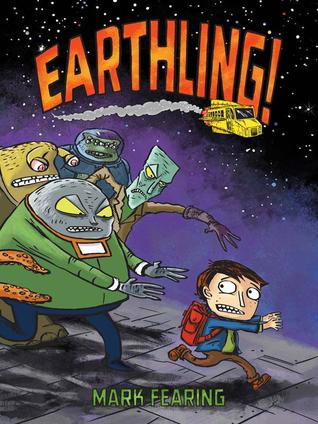
Earthling! was “awesome”, according to my 10-year-old, and I’d have to agree. This graphic novel tells the story of average kid Bud, who moves to New Mexico with his dad and, on his first day of school, gets on the wrong school bus. Not just any bus, though — Bud gets on a bus going to Cosmos Academy, an intergalactic school located on a huge space ship. Bud must keep his identity secret, as Earthlings are the most feared species in the universe. Posing as a Tenarian exchange student, he must fit in, make friends, and figure out how in the universe he’s going to get back home. Oh, and also lead his team to victory in ZeroBall — if he can figure out what that is before the championship.

Earthling! is clever and funny, and makes good points about friendship, being the new kid, and being judged based on stereotypes — all without being preachy or talking down. The artwork is bright, humorous, and includes enough weird and gross aliens to delight kids and entice them to read on.

This was a great choice for my middle grade reader, who usually has to be chained down and force-fed his reading material. This one, he read without a struggle… and liked it enough to insist that I read it too.

Guess what? I found myself giggling as well. Earthling! is a winner.

Book Review: The Unbecoming of Mara Dyer by Michelle Hodkin

Book Review: The Unbecoming of Mara Dyer by Michelle Hodkin

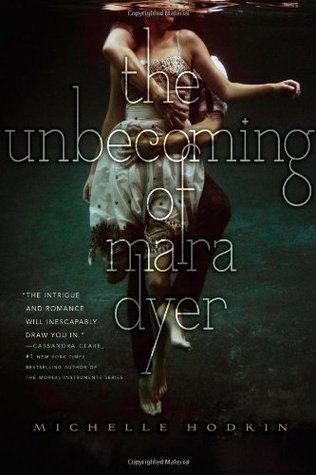
16-year-old Mara wakes up in a hospital to some truly horrifying news: She was injured when an abandoned building collapsed with her and three friends trapped inside. Even worse, Mara is the only survivor, yet she has no memory of what happened or why they were there.

Suffering from flashbacks and hallucinations and diagnosed with PTSD, Mara begs her parents to relocate some place new and let her start fresh — a new town and a new school where the daily reminders of her loss won’t confront her everywhere she turns. The family packs up and moves from Rhode Island to Florida, but the trauma for Mara isn’t over.

Mara continues to see things that aren’t there and to have occasional lapses in time that she can’t account for. On top of that, her new private school is not exactly welcoming, and Mara manages to alienate a typical mean girl on her very first day. On the bright side, stunningly attractive Noah seems drawn to Mara, and despite her misgivings, the two eventually develop a strange yet strong connection.

As Mara and Noah’s tension-filled chemistry grows, so too does the mystery. Why can’t Mara remembers some of her actions? Why does she see faces of her dead friends in mirrors? Why do people around her keep ending up dead?

This being the first book in a trilogy, of course there are no quick answers. Unbecoming ends with some insights and revelations, but no major mysteries solved. Clearly, Mara and Noah are involved with forces and powers they don’t understand, and clearly, there are dangers waiting for them in the next installment.

I found this young adult novel addictingly readable, and managed to gobble it all up in the space of 24 hours. The writing is adept and flowing, with snappy dialogue that seems true and authentic for its teen protagonists. Mara is an immensely sympathetic lead character; the reader feels her pain, her confusion, and her sorrow, as well as her more pedestrian worries about fitting into a new school, trying to make friends, and fretting about GPAs and college acceptance letters.

The Unbecoming of Mara Dyer sets out an intriguing set of mysteries, with dynamic characters and relationships, and leaves everything swirling around with enough suspense that I can’t wait to read the next book. Which, luckily for me, won’t be a terribly long wait: The Evolution of Mara Dyer will be released October 23, 2012.