
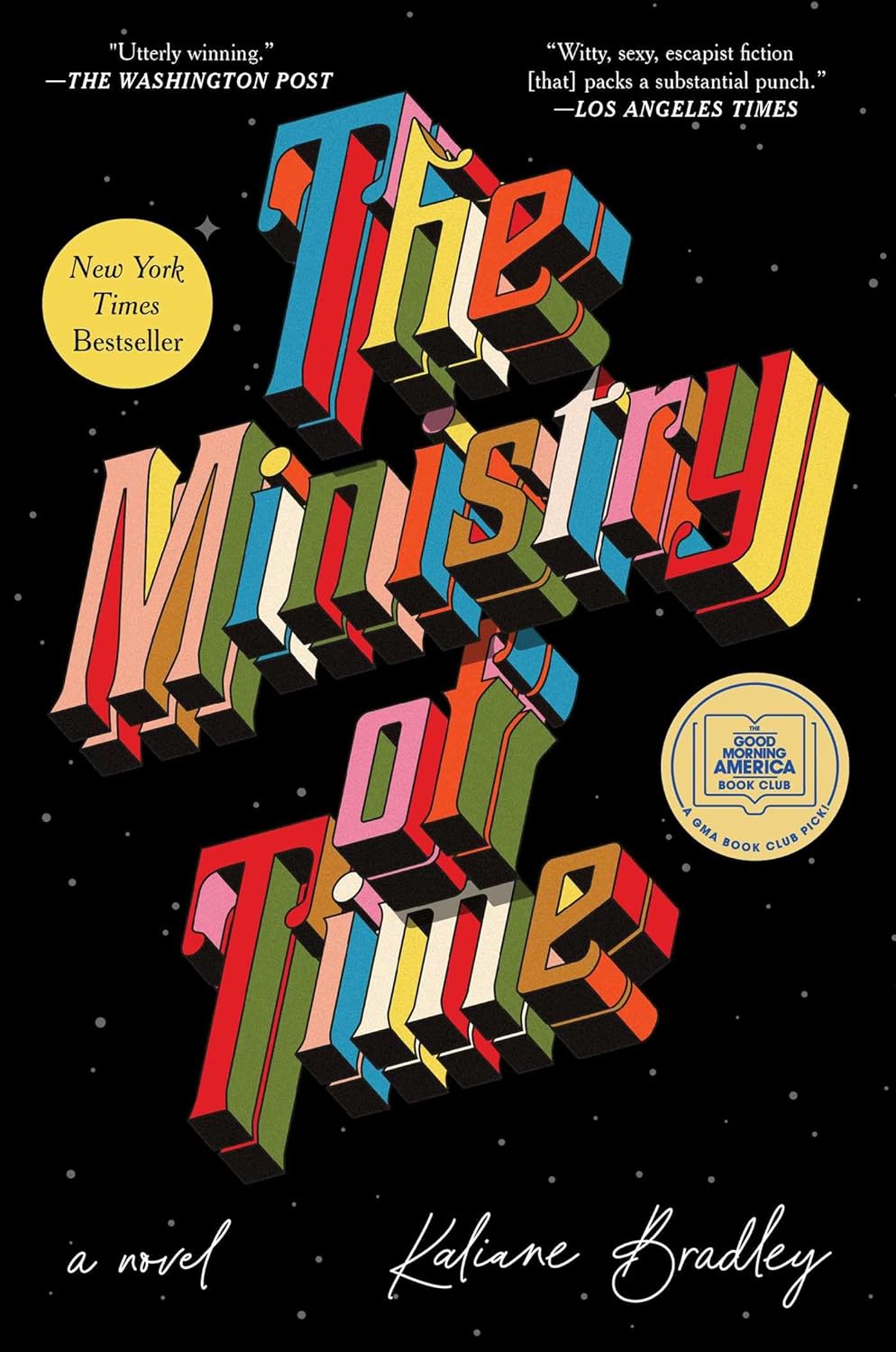
Title: The Ministry of Time
Author: Kaliane Bradley
Publisher: Simon & Schuster
Publication date: May 7, 2024
Length: 352 pages
Genre: Science fiction
Source: Purchased
Rating:
A time travel romance, a spy thriller, a workplace comedy, and an ingenious exploration of the nature of power and the potential for love to change it all:
In the near future, a civil servant is offered the salary of her dreams and is, shortly afterward, told what project she’ll be working on. A recently established government ministry is gathering “expats” from across history to establish whether time travel is feasible—for the body, but also for the fabric of space-time.
She is tasked with working as a “bridge”: living with, assisting, and monitoring the expat known as “1847” or Commander Graham Gore. As far as history is concerned, Commander Gore died on Sir John Franklin’s doomed 1845 expedition to the Arctic, so he’s a little disoriented to be living with an unmarried woman who regularly shows her calves, surrounded by outlandish concepts such as “washing machines,” “Spotify,” and “the collapse of the British Empire.” But with an appetite for discovery, a seven-a-day cigarette habit, and the support of a charming and chaotic cast of fellow expats, he soon adjusts.
Over the next year, what the bridge initially thought would be, at best, a horrifically uncomfortable roommate dynamic, evolves into something much deeper. By the time the true shape of the Ministry’s project comes to light, the bridge has fallen haphazardly, fervently in love, with consequences she never could have imagined. Forced to confront the choices that brought them together, the bridge must finally reckon with how—and whether she believes—what she does next can change the future.
In The Ministry of Time, five people are yanked out of their lives in past centuries and pulled into 21st century England, to live as “expats” — term the Ministry deems most acceptable for describing these people forced to live in a time not their own.
The 21st century world is similar to our present day, but perhaps a few more decades farther down the road, if the cataclysmic weather events and political strife are indicators. The expats — from the 15th, 18th, 19th, and 20th centuries — are each assigned “bridges”: Ministry agents who live with their assigned expat and help them assimilate into their new worlds.
There’s much at stake: Those who fail to adjust and somehow get a grip on “hereness” — belonging where they are — are likely to get rejected by the current time, almost like an infection being rejected by a body’s antibodies. For the unnamed main character, a woman who jumps at the job offer mainly because of the large salary that goes with it, the task is frustrating and daunting. Her assignment is Graham Gore, a member of the doomed Franklin expedition of the mid-1800s, who’s pulled from the Arctic through a time door, leaving behind the men under his command. Gore is disoriented and belligerent, but with the help of his bridge, begins to learn more about the maddening world he now inhabits.
The Ministry of Time covers interesting ground, with an approach I haven’t seen before in time travel fiction. The book isn’t particularly concerned with the technology of it all. There’s a time door and a device that enables the time travel, but don’t look for explanations — this isn’t that sort of book.
Despite the science fiction trappings, this is instead a work of literary fiction exploring the implications of moving through time, changing the past and the future, and the experiences of belonging, being a refugee, and looking for a home.
As someone who doesn’t normally gravitate toward literary fiction, I must admit that I often found the writing style annoyingly opaque.
Quentin treated me with an impatient familiarity, as if we were both sticky and were leaving streaks on each other.
Throughout the book, I’d come across phrases and passages that made me stop and wonder — is it me, or does this not make any sense? There are words put together in interesting ways, yet I could not find meaning in them.
He blushed with his face on mute.
While sections of the the book felt like a slog, at times I became more invested, particularly in the latter half of the book, when both danger and emotions are heightened and the overall stakes are much more intense. And yet, I couldn’t entirely grasp the implications of the ending, and large chunks of the plot felt a bit half-baked to me. Perhaps this is the non-sci-fi factor: As a fan of science fiction, I expect a certain level of detail — the sci-fi elements need to have enough grounding to feel possible or at least make sense in the context of the world being described. In The Ministry of Time, the time travel is just a fact, the central device that drives the story, and the lack of specificity annoyed me.
By and large, though, it comes back to the writing, which generally did not work for me:
She looked like her organs had been removed and placed in cold storage; worse, like it had happened when she was on her way to what she thought was a birthday party.
There are examples upon examples of descriptions that probably are meant to be clever, but which feel meaningless to me. I read the sentence above multiple times — I still have no idea what the person being described might actually look like in this instance.
The Ministry of Time was one of my more eagerly anticipated reads for winter. Now that I’ve read it, I can’t help feeling let down. I expected something very different than what I got. Overall, while I enjoyed certain elements of the story and was very interested in some of the characters, the storytelling style kept me from truly engaging.
I know this book generated a lot of buzz when it came out and has oodles of fans. I don’t regret reading it, but it won’t be on any of my “best of” lists for 2024.


 Bookshelf Fantasies