Book Review: Fangirl by Rainbow Rowell

Book Review: Fangirl by Rainbow Rowell

FangirlFangirl is so adorable, I didn’t know whether to read it or hug it.

This sweet, funny, charming novel tells the story of Cath Avery, a college freshman who just isn’t quite ready to leave her childhood comforts and touchstones behind. Cath is a twin, and she and sister Wren have been inseparable their entire lives… until Wren abruptly informs Cath that she wants them to live apart in college, try something new and meet new people. Cath is devastated. She has no interest in making friends and meeting new people; she and Wren have lived together for eighteen years — why stop now?

On top of that, their dad is not the most stable of guys, tending toward the manic end of the bipolar spectrum without someone around to make sure he’s eating, sleeping, and generally keeping it together. Ever since their mother left, just after 9/11 when the girls were eight years old, Cath and Wren have kept their dad on an even keel, and Cath is terrified that he’ll lose it without them around every day.

Now that she’s lost Wren as a roommate and built-in best friend, one of the unwelcome adjustments required in Cath’s new college life is her brash and irritable roommate Reagan, who seems to be constantly shadowed by her best friend Levi, a sunny older boy who is just always around… and who somehow manages to work his way into Cath’s reluctant heart.

The biggest change of all is the impact of college life on the twins’ obsession with Simon Snow. In the world of Fangirl, Simon Snow is the fictional main character of a series of books set in a magical world. Think Harry Potter, with a few twists. Simon Snow is simply the biggest thing ever, with a huge fanbase that’s getting crazier and crazier as the publication of the 8th and final book in the series approaches. Cath and Wren have always loved Simon Snow and are immersed in the world of fanfiction — or at least they were. Wren seems to have left it all behind in her quest to grow up and be a “normal” college girl, with all the drinking, partying, and boyfriends that entails, while Cath wants nothing more than to live in her Simon Snow “fic” world for as long as she can.

Cath isn’t just a regular old fan, though — she’s the incredibly popular author of Carry On, Simon, which has become the hottest fanfic in the Snow-verse. Each new installment by “Magicath” gets tens of thousands of hits, and Cath can think of nothing better than spending hours writing about Simon and the boy-on-boy romance she’s created for him with his archnemesis Baz.

Fangirl follows Cath through her first year of college, through the ups and downs of her relationship with Wren, her worries about her dad, her growing romance with Levi, and her struggles to define herself as a writer, both in the world of Simon  Snow and in the context of her advanced fiction writing course — presided over by a professor who just doesn’t “get” fanfiction and won’t allow it in her students’ writing.

This is the third book I’ve read by Rainbow Rowell, and once again I’m just incredibly impressed by her talent. In Fangirl, she’s created not one but two fictional worlds. The story of Cath and her growth and development at college is convincing and feels authentic, and at the same time, Rainbow Rowell has created a fiction-within-fiction world for the story of Simon Snow that makes it feel like a real, well-thought out book series. Actually, I suppose you could say that there are three worlds going on in Fangirl, because I don’t see how you couldn’t count Cath’s fanfiction creation as a story all its own. By the end of Fangirl, I wanted to know not only how Cath’s life would work out, but both versions of Simon Snow’s as well!

Cath’s inner life is well-described throughout. She’s scared and reclusive, yearning for connection but afraid of it too, wanting to write but not willing to leave her fanfic behind or relegate it to 2nd place. I loved Cath’s insecurities and fears, her love for her father, her anger toward Wren even while she misses her sister desperately. Perhaps most charming of all is Cath’s friendship with Levi. Levi is the boy everyone wishes they met in college. He’s sweet and smart, caring without being controlling, always there for Cath when she needs him, and funny and positive to boot. I loved that Cath and Levi could explore their feelings, not without complications or issues, but at least without the trite contrivance of an unnecessary love triangle. In fact, I thought early on that the plot was setting up a triangle, and when that didn’t turn out to be the case, I felt like raising a banner with a big “THANK YOU RAINBOW ROWELL” on it. What a relief!

Rowell’s writing is full of sparkling humor and zippy dialogue. Even when serious matters are arise, there are plenty of funny and quirky moments to lighten the mood. I love this moment, among many, which uses a pop-culture reference point as almost a throw-away quip, yet really sets a great tone (and made me snicker):

Reagan was sitting at Cath’s desk when Cath woke up.

“Are you awake?”

“Have you been watching me sleep?”

“Yes, Bella. Are you awake?”

Probably my only quibble with Fangirl has to do with names. Cath is short for Cather, and it took me the longest time to realize that yes, Cather is in fact her name and not a nickname. The explanation for Cath’s name (and Wren’s too) was just too cutesy by far for me to believe, and felt like a forced joke that didn’t work at all in the context of an otherwise totally believable (if not terribly functional) family dynamic. This is a small complaint, however, and certainly didn’t detract from my enjoyment of Fangirl for more than a moment or two.

Overall, I loved Fangirl. It doesn’t have the emotional punch of Rainbow Rowell’s Eleanor & Park, which took my breath away with the sorrow and hurt of its characters. In Fangirl, Cath goes through quite a lot, but it’s mostly a happy book about a young woman coming into her own, finding out who she is and what she wants, and learning how to be her own person. Cath’s experiences during her freshman year of college include unique elements, yet feel universal. For anyone who has suffered through meeting strange new roommates, figured out to maneuver through a dorm dining hall, or confronted a professor who just doesn’t get your work, reading Fangirl will be a nostalgic, emotional journey back to those days of excitement and confusion.

Filled with strong writing and original, well-developed characters, Fangirl is a joy to read — and it’s sure to especially delight readers who, no matter their age, still get a secret thrill from flipping back through their Harry Potter collection… again and again and again.

__________________________________________

The details:

Title: Fangirl
Author: Rainbow Rowell
Publisher: St. Martin’s Press
Publication date: 2013
Genre: Young adult/New adult
Source: Purchased
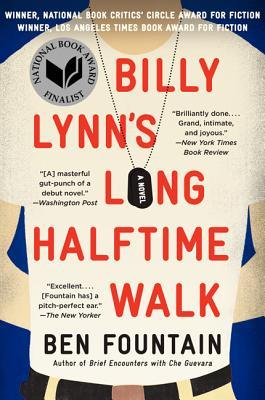
At A Glance: Billy Lynn’s Long Halftime Walk by Ben Fountain

Book Review: Billy Lynn’s Long Halftime Walk by Ben Fountain

Billy Lynn's Long Halftime Walk

Synopsis via Goodreads:

A finalist for the National Book Award!

Three minutes and forty-three seconds of intense warfare with Iraqi insurgents has transformed the eight surviving men of Bravo Squad into America’s most sought-after heroes. Now they’re on a media-intensive nationwide tour to reinvigorate support for the war. On this rainy Thanksgiving, the Bravos are guests of the Dallas Cowboys, slated to be part of the halftime show alongside Destiny’s Child.

Among the Bravos is Specialist Billy Lynn. Surrounded by patriots sporting flag pins on their lapels and Support Our Troops bumper stickers, he is thrust into the company of the Cowboys’ owner and his coterie of wealthy colleagues; a born-again Cowboys cheerleader; a veteran Hollywood producer; and supersized players eager for a vicarious taste of war. Over the course of this day, Billy will drink and brawl, yearn for home and mourn those missing, face a heart-wrenching decision, and discover pure love and a bitter wisdom far beyond his years.

My thoughts:

This is a hard book to sum up or describe. While Billy Lynn takes place over the course of one day, Billy’s reflections take us into his memories of his service in Iraq as well as to the previous two weeks spent touring the US. Billy is smart and surprisingly mature for age 19 — although perhaps not really so surprising, given what he’s been through. The Bravos have survived an intense battle but have suffered terrible loss as well — and thanks to embedded journalists and video footage fresh from the battlefield, they’ve become instant celebrities and poster boys for the American war effort. Everywhere they go, they’re mobbed by grateful citizens who want to shake their hands, praise their courage, and find out if America is really winning the war.

Meanwhile, Billy and his fellow soldiers are a bit shell-shocked by their losses, their battlefield experiences, and their insta-fame. Thrust back into the heart of the US for a two-week whirlwind “Victory Tour”, the guys are bombarded by the sheer absurdity of it all, as the publicity machine moves them forward and a Hollywood producer tries to spin their story into big fat paychecks. And when they’re all done being paraded around like trophies? It’s back to Iraq for another eleven months, and who knows whether any of them will make it home again?

The writing is intense, often aggressive, and high energy, and yet full of moments of beauty as well:

The transect of sky through the open dome is the color and texture of rumbled pewter, an ominous boil of bruised sepias and ditchwater grays that foretells all kinds of weather-related misery.

Or in a scene at a press conference:

He means to say more, but the room erupts in thunderous applause. Billy is stunned, then worried that they have missed the point, then he’s sure they’ve missed the point but is too unconfident of his communication skills to try to force a clarification down their throats. They’re happy, so he will leave it at that. The flash cameras are really going now, and like so much of his nineteen years’ experience of life it has become mainly something to get through, then the applause dies down and he’s asked if he’ll be thinking of his friend Seargeant Breem during the playing of the national anthem today, and he says yes just to to keep it upbeat and on track, Yes, I sure will, which sounds obscene to his ears, and he wonders by what process virtually any discussion about the war seems to profane these ultimate matters of life and death. As if to talk of such things properly we need a mode of speech near the equal of prayer, otherwise just shut, shut your yap and sit on it, silence being truer to the experience than the star-spangled spasm, the bittersweet sob, the redeeming hug, or whatever this fucking closure is that everybody’s always talking about. They want it to be easy and it’s just not going to be.

In various places throughout the book, words may be scattered across the page or repeated until they lose all meaning, and the chapter in which the men of Bravo are in the VIP clubhouse at the stadium during the singing of the national anthem is truly a work of art.

Billy Lynn’s Long Halftime Walk has been nominated for countless awards and has received all sorts of critical praise. Who am I to disagree? This is a moving, clever, and provocative look at what is truly sacrificed when a nation goes to war, and a piercing exploration of so-called American values. This is a book that requires the reader to think, and the thoughts it provokes are not pretty. Seeing these young men being sent overseas to die — and it’s made very clear that their deaths are the most likely outcome — demonstrates all over again that money pulls the strings, that media provides a glossy and inspirational story of heroism, but that the soldiers are thrust into situations in which they can not possibly succeed, and in which their own death or mutilation is a constant but too-real threat.

Sadly, in every war and in every generation, a new crop of books emerges to remind us all over again of the waste and horror of it all. Billy Lynn’s Long Halftime Walk belongs on the shelf right next to Catch-22 by Joseph Heller and The Things They Carried by Tim O’Brien, among others. Billy Lynn is a literary achievement with a powerful punch, and deserves every bit of the attention it has received.

__________________________________________

The details:

Title: Billy Lynn’s Long Halftime Walk
Author: Ben Fountain
Publisher: Ecco
Publication date: 2012
Genre: Contemporary fiction
Source: Purchased

Book Review: The Unlikely Pilgrimage of Harold Fry by Rachel Joyce

Book Review: The Unlikely Pilgrimage of Harold Fry by Rachel Joyce

The Unlikely Pilgrimage of Harold FryIn this sentimental novel, retired brewery salesman Harold Fry lives a quiet life of routine and avoidance in a strained but long-lasting marriage with his wife Maureen — until a letter arrives out of the blue and changes everything. The letter is from a woman named Queenie Hennessy, a former coworker whom Harold has not seen or heard from in twenty years. Queenie writes to inform Harold that she is dying of cancer, and Harold — moved to tears — decides to write back.

But something odd happens along the way to the mailbox. Harold starts to feel that his response is inadequate, and so continues walking to the next mailbox, and then the next, while he thinks about what to say. After a random encounter with a young women working at a gas station, Harold becomes convinced that if he only has faith, he can make Queenie survive. And what better way to demonstrate his faith than to walk to see Queenie — in a town five hundred miles away. Harold sets out in his trousers, shirt, tie, and yachting shoes, with no maps and no cell phone, and starts his unlikely pilgrimage.

Harold is singularly unprepared and unqualified for such an adventure, and yet he perseveres:

Harold’s heel stung and his back ached, and now the soles of his feet were beginning to burn. Even the smallest flint caused him pain; he had to keep stopping to remove a shoe and shake it empty. From time to time, he also found that his legs buckled for no apparent reason, as if they had been jellied, causing him to stumble. His fingers were throbbing but maybe that was because they were not used to being swung back and forth in a downward direction. And yet, despite all this, he felt intensely alive. A lawn mower started up in the distance and he laughed out loud.

As he walks, he contemplates his life. His marriage to Maureen started out full of love and excitement, but the two have by now withered into a pair of cross-tempered people living around each other, not with each other. Harold thinks about his unremarkable career and his failures as a father and husband. At the heart of his problems with Maureen, it seems, is the prickly, uncomfortable relationship between Harold and their only son, David. We receive only hints at first, but over the course of the novel, we piece together more and more bits of information about David’s troubled youth and his ultimate estrangement from his parents, for which Maureen bitterly blames Harold.

Meanwhile, Harold walks, encountering strangers on the road and in the many towns through which he passes. People show him kindness, and in turn, Harold offers what he can, which is mainly his attention and a sympathetic ear. Little by little, he starts to revise his opinion of himself and his interpretation of the key events in his life. Harold starts to realize that he can make a difference, both by giving and by receiving, and his spontaneous, poorly-planned trek to see Queenie becomes more of a spiritual quest, and eventually, a movement that captures the popular imagination of the entire country.

It’s not until the final chapters that we find out why Queenie matters so much and what exactly happened to destroy Harold and Maureen’s previously happy life together. Let me tell you, when the secret of their past is finally revealed, it’s a doozy. (Unfortunately for me, I read this book on a plane — and there may have been some surreptitious wiping of tears going on…)

I found Harold Fry to be a thoroughly readable novel, sweeping me along from chapter to chapter through the various landmarks and roadways of Harold’s journey. Harold and Maureen are both good people who have suffered loss and deprivation, and it’s hard not to root for them. Harold’s pilgrimage is quixotic and seemingly random — after all, what makes him think that his walk can make the slightest bit of difference in a woman’s fight against terminal cancer? Yet, Harold is committed to his sense that he’s made a pledge and that, in seeing it through, he’s keeping Queenie alive.

Here’s my slight quibble with the book: Harold’s walk really makes no sense. If it’s so important for him to see Queenie, why not hop in a car or a train? (In fact, quite a few people suggest this to him along the way.) It does become clear that Harold himself is gaining a tremendous amount from his pilgrim’s journey, finding an inner peace and certainty that he’d lacked all these years. He believes that Queenie will wait for him, but he sure doesn’t make it easy, making detours, getting lost, and refusing comforts that might speed him along his way. It’s almost as if he doesn’t really want to reach his goal — the journey becomes the point, not the arrival. But as the key motivating factor in the main character’s actions, the cause and effect — walking = Queenie lives — doesn’t hold up to much poking. Likewise, Harold’s entire decision to walk is based on one brief (and imperfectly understood) conversation, and his certainty about his quest occurs so quickly that we as readers don’t have the opportunity to fully buy into his mission or even truly understand his rationale for doing it.

Still, logical or not, it’s the pilgrimage itself that matters. It’s part meditation, part atonement for a life full of missed connections and poorly communicated desires and emotions, and a very blatant metaphor for a man embarking on the road to change. Harold is aware that people may not understand, may even mock or think him too old for what he’s trying to do, but what counts is how Harold experiences the journey. Harold Fry is a man who sets out to make a difference, and somehow manages to prove that you’re never too old to start fresh and make a change.

It must be said, too, that for those of a more classical/literary bent, The Unlikely Pilgrimage of Harold Fry can be read as a modern version of the hero’s journey. The plot kicks off with a call to adventure, Harold experiences challenges and temptations, meets helpers and mentors, and goes through stages of revelation, transformation, and atonement before he is able to return to his regular life. If you’re so inclined, it’s an interesting exercise to match up elements of Harold’s pilgrimage with the hero’s journey and see how well it fits.

I had some misgivings, as I’ve said, about the fundamental purpose and thought process behind Harold’s pilgrimage — but that doesn’t mean that I wasn’t moved by it. We see a man doing what should be impossible, and that’s a wonderful thing. The relationship between Harold and Maureen feels very real, and Harold’s encounters along the road are funny and poignant, each offering a snippet of another life touched and perhaps changed by this ordinary man’s choices and actions.

Harold Fry is well-written and quick-paced, so that it was easy to polish it off during one concentrated day of reading. There’s plenty of food for thought here, and I was intrigued especially by the novel’s portrait of a marriage’s deterioration, which seemed spot-on in its depiction of the small hurts, misunderstandings, and judgments that if left uncorrected, can cause permanent damage.

I was afraid that this book would be mawkish or trite, but despite veering dangerously close to Hallmark-card sentiments in a few spots, overall The Unlikely Pilgrimage of Harold Fry is a thought-provoking, sweet but sad look at a life and at second chances.

__________________________________________

The details:

Title: The Unlikely Pilgrimage of Harold Fry
Author: Rachel Joyce
Publisher: Random House
Publication date: 2012
Genre: Contemporary fiction
Source: Purchased

Book Review: Bring Up The Bodies by Hilary Mantel

Book Review: Bring Up The Bodies by Hilary Mantel

Bring Up the Bodies (Thomas Cromwell, #2)Bring Up The Bodies is the second book in Hilary Mantel’s trilogy focusing on Thomas Cromwell, self-made man, advisor to King Henry VIII, and arguably the most powerful man in England during a brief period of the Tudor reign. The first book, Wolf Hall,  covers Cromwell’s rise to power and his role in Henry’s divorce of Katherine of Aragon and marriage to Anne Boleyn. Bring Up The Bodies traces Queen Anne’s fall from favor and her ultimate destruction, as viewed through the lens of Cromwell’s own role in the dramatic and controversial events.

This is ground well-covered through a myriad of history books, historical novels, and dramatizations, yet author Hilary Mantel finds a fresh angle. By using Thomas Cromwell as the point-of-view perspective for the story, we get a peek into the mind of one of England’s most enigmatic historical figures and at the same time see the court machinations through the eyes of someone who wields great power and yet is constantly an outsider due to low birth. As a result, we view Henry and Anne from a distance, and can only marvel at the deceit, treachery, and political maneuvers that form the daily texture of life in the Tudor palace. Bring Up The Bodies captures the events of the time and presents the ups and downs, the legal and political details, and the impact on the kingdom and its people in a way that breathes new life into the drama of these events.

Hilary Mantel’s writing is spectacular, as it was in Wolf Hall, with its own quirky rhythms and phrasings, and a use of language that is unparalleled in most modern fiction. Simple lines like:

The susurration, tapesty-muffled, of polyglot conversation.

… simply take my breath away. Quiet descriptions are powerfully conveyed in language that demands to be noticed:

And now night falls on Austin Friars. Snap of bolts, click of key in lock, rattle of strong chain across wicket, and the great bar fallen across the main gate. The boy Dick Purser lets out the watchdogs. They pounce and race, they snap at the moonlight, they flop under the fruit trees, heads on paws and ears twitching. When the house is quiet — when all his houses are quiet — then dead people walk about on the stairs.

Once again, it took me a few chapters to adapt to the author’s use of pronouns. Throughout the book, the word “he” almost always refers to Cromwell, even if the preceding reference is to someone else. Occasionally, but not always, the author will make it a bit clearer, using phrasing such as “He, Thomas Cromwell, shrugs.”

I could open to any page in this magnificent book and find an example of outstanding writing… so I’ll indulge and quote one more that captures, for me, the author’s unique style:

All summer has been like this, a riot of dismemberment, fur and feather flying; the beating off and the whipping in of hounds, the coddling of tired horses, the nursing, by the gentlemen, of contusions, sprains and blisters. And for a few days at least, the sun has shone on Henry.

I can’t say enough good things about Bring Up The Bodies — which, like its predecessor Wolf Hall, won the Man Booker Prize and many other accolades and awards. I absolutely want to read the third book in the trilogy, which I believe is expected to be published in 2015. Bring Up The Bodies is proof that even familiar subject matter can be new and exciting in the hands of a talented writer with a compelling vision.

I read Bring Up The Bodies all in one day, while enduring about 12 hours of travel time through three airports and two flights. It was an intense reading experience, but I’m glad I had the opportunity to consume this book without interruption. Whether or not you have enough hours to devote to a straight read-through or prefer to enjoy Hilary Mantel’s writing in smaller bites, if you appreciate beautiful language and a compelling plot, I think you’ll find Wolf Hall and Bring Up The Bodies well worth your time.

__________________________________________

The details:

Title: Bring Up The Bodies
Author: Hilary Mantel
Publisher: Picador
Publication date: 2012
Genre: Historical fiction
Source: Purchased

Book Review: Tumble & Fall by Alexandra Coutts

Book Review: Tumble & Fall by Alexandra Coutts

Tumble & Fall

I was pleasantly surprised by this lovely young adult novel, given that the premise sounds like a sure recipe for a depressing, coming-of-the-apocalypse tale.

In Tumble & Fall, the world is heading toward disaster on a global scale. The mile-wide Persephone asteroid is on a collision course with planet Earth, and unless a last-ditch effort to blow it to smithereens is effective, Earth as we know it will be no more.

With a week to go until the asteroid hits, we witness events through the eyes of three teen narrators, all of whom spend what may be their final week on Earth on the island of Martha’s Vineyard. Sienna is newly released from a lengthy stay in mental-health home for teens after a desperate suicide attempt; Caden is edgy and sick of spending his life cleaning up after his alcoholic mother; Zan is mourning the loss of her boyfriend Leo in a tragic accident 10 months earlier. All three find themselves, in this final week, assessing their relationships, their families, and their own sense of purpose and self. As the clock winds down, they test themselves, test their limits, and figure out where they want to be — and by whose side — when the last moments come.

Here’s what the book is NOT about: Politics. Panic. Scientific intervention. Space missions. Global destruction. Building shelters. Selection of a chosen few to survive. In other words, this is not an apocalypse book along the lines of others we’ve seen before. While the basic premise immediately made me think of the two 1990s-era movies about death-by-asteroid, Deep Impact and Armageddon, there are no space cowboys and mad, so-crazy-it-just-might-work missions to (sound the trumpets, please!) SAVE PLANET EARTH!

Instead, Tumble & Fall is a strangely moving, introspective story about people and their connections. Some parts were funny, in a wry sort of way: All three of the characters, for different reasons, spend at least one night away from home without telling anyone, and while they worry about what their parents will think, there’s still a sense of “C’mon, the world is ending in a few days — drop the curfew!” Parents are forced to accept that they can’t protect their children; children are forced to acknowledge that parental love isn’t a one-way street. The characters on this island act out their love and commitment in so many ways — small acts of caring, coming home when they might feel like staying away, letting someone else be nurturing even when they themselves don’t need to be nurtured.

It’s hard to describe the sense of quiet doom lurking in the shadows. All of the characters know that there really isn’t any hope that the asteroid will miss. No one truly expects a miracle. As the clock winds down, the community gathers together, in sorrow and in love, because there really isn’t any other option. The end will come; it’s how they choose to spend the remaining time that matters.

Filled with lovely prose and vivid descriptions of the characters’ inner lives, this book moves at a fast pace and, once started, is really difficult to stop reading before the end. People who pick up Tumble & Fall expecting a big, flashy disaster book may be disappointed. But if you’re someone who appreciates reading about honest emotions, difficult choices, and people figuring out how to be when it really counts, then I strongly recommend Tumble & Fall.

Book Review: The Returned by Jason Mott

Book Review: The Returned by Jason Mott

The ReturnedThe Returned is a brand-new release by a first-time author — and fortunately for the author, it’s gotten a tremendous amount of advance buzz, perhaps in large part because it’s already been snatched up by Brad Pitt’s production company and is scheduled to debut in 2014 as a TV series (with the title Resurrection – see here for more information on the TV show).

Not a bad beginning! But is it worth the hype?

In The Returned, dead people start showing up all around the globe — not as zombies or creatures out of horror stories, but simply picking up where they left off at the time of their death. They come back, whole and healthy, and if they remember where they’ve been or know why they’re back, they’re not saying.

The Returned, as the formerly deceased are known, reappear suddenly and in random locations. In the central storyline, 8-year-old Jacob appears one day by a river in a small fishing village in China, and it is up to the Bureau — an international agency hastily funded to manage the Returned — to get Jacob back where he belongs. Where Jacob belongs is in the tiny, isolated Southern town of Arcadia with his parents Harold and Lucille, now in their 70s… who never really recovered from their son’s tragic death fifty years earlier.

What plays out in microcosm in Arcadia is happening everywhere. More and more Returned keep appearing, and what people first viewed as miraculous has now started making them nervous. Just how many are there? Will it ever stop? Where are we going to put them all? Eventually, the Bureau stops focusing on reunions and soon shifts its mission to one of containment. Before long, Returned are living in increasingly squalid camps behind wire fences and with soldiers on patrol — but as it quickly becomes apparent, no camps can ever be big enough for the never-ending flood of Returned.

In some ways, The Returned tells two very different stories. On the one hand, it’s an exploration of love, parenting, and family. We meet Harold and Lucille as two elderly, somewhat ornery but likeable folks, getting on with their lives, with their aches and pains, bickering and scolding as only a long-married couple can. As Jacob reenters their lives, they confront their losses over time, what it meant for them to lose their child, and how their lives might have been different if they’d had Jacob all along. They also must adjust to being parents of an eight-year-old at a time when they might more naturally be grandparents — and confront the inevitable question facing all families of Returned: Is this person really their son? Is he really a person? What does it mean to have him back? And is he back for good?

The chapters focusing on this fractured and then reunited family are touching in their small details — Lucille’s need to feed Jacob and check up on him whenever he’s out of arm’s reach, Harold’s resumption of the ordinary daily rituals that used to be a part of the father-son relationship, like swimming in the river and teaching him knock-knock jokes. By extension, we get to know more of the townspeople and see how the phenomenon of the Returned impacts all of them, for good or for bad, in some cases bringing up memories of horrible events, for others a longing for a lost loved one who hasn’t Returned.

On the other hand, as the book approaches its climax, the tone shifts into something a bit more action-oriented, focusing on the cramped quarters of the camp that has taken over the entire town and the enraged townsfolk who want to get rid of the Returned by any means possible. It’s a powder keg that is bound to explode, and the inevitable results are violent and sad. For me, these parts of the book reminded me in various ways of Under the Dome by Stephen King, Haters by David Moody, and The Leftovers by Tom Perrotta — and certainly , shades of Torchwood: Miracle Day (for those who appreciate the geeky side of TV). None are a perfect comparison, but bits and pieces and certain themes definitely brought these other books to mind.

Overall, I liked The Returned quite a bit, although the climax and resolution didn’t entirely work for me. The parts of the book that deal with the emotional impact of the return of lost loved ones were evocative and emotional, and I truly enjoyed the lovely little moments at play as tentative new bonds are explored between family members separated by death decades earlier. The dilemmas the characters face seem realistic for people facing impossible situations and choices, and it’s easy for the reader to sympathize with their struggles and feel invested in their lives. Yet once the narrative becomes centered on the violent outcomes of the treatment of the Returned, the book in some ways became more ordinary for me. As an action story, it isn’t much that we haven’t seen before, in one shape or another. It’s the more personal moments that set this book apart and make The Returned such an interesting read — and I only wish that the focus had remained more on the relationships rather than moving into (dare I say it?) practically a dystopian set-piece by the end.

__________________________________________

The details:

Title: The Returned
Author: Jason Mott
Publisher: Harlequin MIRA
Publication date: 2013
Genre: Fiction
Source: Review copy courtesy of Harlequin MIRA via NetGalley

Book Review: Letters From Skye by Jessica Brockmole

Book Review: Letters From Skye by Jessica Brockmole

Letters from SkyeIn this romantic look at wartime love, letters hold the key. Letters From Skye is told entirely via letters written during two different but very similar time periods. The main story follows the correspondence that blossoms between poet Elspeth Dunn, on her faraway, windswept Isle of Skye off the northern coast of Scotland, and David Graham, an impetuous American college student who has mustered the courage to write a fan letter to an author he admires. Their correspondence begins in 1912 and continues through the first World War. As Elspeth and David write letters, they come to know one another deeply and intimately, until — almost inevitably — they declare their love and seek each other in real life as well as on paper.

In parallel to this piece of the story is the correspondence of Margaret, Elspeth’s 20-ish daughter, taking place in 1940 and relating to her fiance Paul the strange circumstances of her mother’s disappearance during an air raid on Edinburgh and her discovery that her mother has kept a hidden cache of mysterious letters for over twenty years.

From Margaret’s side of the story, we learn that Elspeth has raised Margaret on her own and has never shared any information with Margaret about her father — so while we’re reading the love letters of Elspeth and David and seeing how their commitment and passion for one another grows, we’re also aware that something must have happened to separate them. The suspense in Letters From Skye comes from this contrast, knowing that these two were madly in love in the 1910s, yet knowing also that in 1940, David has not been a part of Elspeth’s life for as long as Margaret can remember.

In Letters From Skye, the romance is heightened by the urgency of war, and indeed Elspeth has warned Margaret not to rush into a wartime engagement, when sentiments are heightened and no one takes the time to think things through. Clearly, she’s speaking from experience, but are her assumptions about what took place in her own past correct?

There’s much to love in Letters From Skye. Jessica Brockmole succeeds exceedingly well at painting pictures of the various times and places in the novel through the characters’ letters. We get from Elspeth a great sense of what her isolated life on Skye is like, with her views of the sea and hills, the lonely winters and hard rains, the dependence on family and the judgments of the neighboring townsfolk. From David, we get a grand view of privileged American youth in its heyday, playing pranks on campus, itching to get to the glory of the battlefield without any true conception of what horrors really await in the trenches. From Margaret, we get the feeling of incredulity as German bombs fall on the homes and streets of Edinburgh and London, as well as the privations of a country living on rations and sending their children off to the relative safety of the countryside.

While Letters From Skye is primarily a love story, it also does a very effective job of conveying the experience of life in wartime, both from the perspective of the women on the homefront and through the eyes of men on the front lines. Our culture often romanticizes these wars, but Letters From Skye makes abundantly clear that while love may flourish in the pressure-cooker of war, there’s nothing romantic about war itself.

The many threads of the storyline come together nicely by the end, and we learn that there is much more to understand about the past than any of the characters had realized. Misunderstandings and the tragedies of war conspire to separate lovers, and it takes the diligent digging of Elspeth’s daughter until all the various players understand what happened and why. While some of the answers ultimately may seem a bit familiar or predictable, it works nonetheless.

Telling the story through the medium of letters is very effective here, as we readers aren’t simply reading about two people and their growing connection — we’re a part of it. As we read their letters, it’s like a peek into David and Elspeth’s inner lives, and we are privy to their most intimate thoughts and feelings. We absolutely want them together, and it’s heartbreaking for the reader to see the obstacles that separate them, seemingly forever. I felt very invested in David and Elspeth by the end of the book, and while I’ve described the events of the ending as a bit predictable, that in no way detracts from impact that the resolution had on me. I simply couldn’t rest (it was just about midnight when I finished this book) until I found out what happened and why — and what the characters could expect next in their lives.

It was worth staying up for, believe me. I enjoyed Letters From Skye, felt a great connection to the characters, and truly cared about their fates. I’d say that qualifies as a success! Letters From Skye is author Jessica Brockmole’s first novel. I hope we’ll hear much more from her in years to come.

_________________________________________

The details:

Title: Letters from Skye
Author: Jessica Brockmole
Publisher: Ballantine Books
Publication date: 2013
Genre: Historical fiction/romance
Source: Library book


Book Review: The Humans by Matt Haig

Book Review: The Humans by Matt Haig

The HumansThe Humans is full of such wonderful writing that I almost turned into one of THOSE people. You know the ones I mean. The super-annoying ones who interrupt you every five minutes to read you yet another quote from the book they claim is totally fabulous. Awful, right? Yet in this case, I would have been perfectly justified. The Humans is, in fact, fabulous — and absolutely loaded with quote-worthy lines and passages that practically beg to be read out loud to whatever audience is available.

What’s it about? In a nutshell, The Humans is the story of an alien from a world far, far away… and light-years ahead of Earth in terms of understanding technology. When an Earthling mathematician named Andrew Martin makes a startling breakthrough that could, unbeknownst to him, completely change life for humans in ways detrimental to the rest of sentient life in the universe, the Vonnadorians decide he must be stopped.

An alien impersonator is sent to assume the life of Andrew Martin, figure out how much damage has been done, and then wipe out all evidence of his progress — which means eliminating not just computer files and notes, but also his wife, son, best friend, and anyone else who may have learned of Martin’s leap forward.

Faux-Andrew (he doesn’t actually have a name) shows up in Cambridge naked as a jaybird and has but minutes to adapt to life on Earth. Almost inevitably, he ends up in a psychiatric ward diagnosed with a mental breakdown, then is sent home to recover. And it is here that complications arise. The real Andrew Martin was kind of a jerk: completely absorbed in his work, completely neglectful of his vulnerable teen-aged son Gulliver and his lovely but ignored wife Isobel. But faux-Andrew, in his quest to complete his mission, actually pays attention to the people around him as he tries to ferret out what they know and what real-Andrew has told them… and the results are interesting, touching, and not at all what the alien visitor expects.

The Humans shows us what we Earthlings look like from an outsider’s perspective, and it’s not terribly flattering, especially at first. To be frank, humans are kind of disgusting:

I was repulsed, terrified. I had never seen anything like this man. The face seemed so alien, full of unfathomable openings and protrusions. The nose, in particular, bothered me. It seemed to my innocent eyes as if there was something else inside him, pushing through.

More than appearances, it’s the humans’ behavior that confounds the alien. The emotions, the beliefs in consumerism, religion, the micro-focus on their own small worlds and concerns while ignoring the greater events of the universe — all of this is completely bewildering and leads the alien to consider humans to be devoid of any sense of values:

The news was prioritized in a way I could not understand. For instance, there was nothing on new mathematical observations or still-undiscovered polygons, but quite a bit about politics, which on this planet was essentially all about war and money. Indeed, war and money seemed to be so popular on the news, it should more accurately have been titled The War and Money Show.

However, as he spends time among humans, things start to change. Faux-Andrew starts to feel, and has to reconsider whether a world such as his own — without pain, without change, without death, and without flaw — is really the best life has to offer. When faux-Andrew starts to feel pain, he also starts to feel love, and to realize that pleasant and easy are not substitutes for the things in life that have to be fought for — like relationships with people who matter, who hurt and who can cause hurt, and for whom he’d be willing to sacrifice his own well-being if that’s what it takes to protect them.

Ultimately, as faux-Andrew learns more and more about the people of this planet, The Humans become a meditation on what it means to be human. It’s quite lovely, actually. As voiced by a true alien, the homilies and lessons learned come across as real discoveries, not just a recitation of truisms or wisdom for the ages à la Everything I Need To Know I Learned in Kindergarten. Even in a chapter that consists of a numbered list of faux-Andrew’s pointers to Gulliver, entitled “Advice for a Human”, the words of wisdom avoid being treacly. Instead, the advice is concise, real, bittersweet, and often funny, and sum up a view of humans that we lack the distance and perspective to see for ourselves.  Some of my favorites:

6. Be curious. Question everything. A present fact is just a future fiction.

25. There is only one genre in fiction. The genre is called “book”.

33. You are not the most intelligent creature in the universe. You are not even the most intelligent creature on your planet. The tonal language in the song of the humpback whale displays more complexity than the entire works of Shakespeare. It is not a competition. Well, it is. But don’t worry about it.

37. Don’t always try to be cool. The whole universe is cool. It’s the warm bits that matter.

47. A cow is a cow even if you call it beef.

75. Politeness is often fear. Kindness is always courage. But caring is what makes you human. Care more, become more human.

I could go on and on… see what I mean about how quote-worthy this book is? I honestly can’t stop marking pages and lines that I think are just wonderful.

So maybe that’s where I should leave this review: by saying that The Humans is a wonderful book. The writing is an amazing balance of clever, funny, and a straight-to-the-heart emotional punch. The plot is smart and creative, and our first-person narrator, the unnamed alien, is more human than most actual humans by the end of the story.

The Humans is the third book I’ve read by Matt Haig, having previously read the vampires-in-suburbia novel The Radleys and the Hamlet retelling The Dead Fathers Club (my review is here). I’ve loved all three; at this point, I can safely say that I’ll be reading more by Matt Haig — much more, I hope.

_________________________________________

The details:

Title: The Humans
Author: Matt Haig
Publisher: Simon & Schuster
Publication date: 2013
Genre: Book 🙂
Source: Library book

Book Review: The Cuckoo’s Calling by Robert Galbraith

Book Review: The Cuckoo’s Calling by Robert Galbraith

The Cuckoo's Calling (Cormoran Strike, #1)OK, we all know the drama around The Cuckoo’s Calling, right? Initially released in April of this year by an  unknown author, Robert Galbraith — purportedly a veteran of the Royal Military Police — the book was later revealed to be the work of J. K. Rowling, writing under a pseudonym. I know this has raised the hackles of all sorts of folks professing outrage — but really, why the fuss? I’m just glad to have a new J. K. Rowling book to read, and I think it’s rather marvelous for her that she was able to  have fun writing something new and different without all the intense media scrutiny that accompanies her “event” books.

With that out of the way… how was the book?

Let me start by saying that I am not in general a reader of mysteries, at least not on a regular basis. Therefore, I can’t really judge how this book fits within the norms of the genre. What I can do is assess how it works as fiction — and in my opinion, it works just fine.

The Cuckoo’s Calling is a murder mystery, but actually the most interesting part for me was the introduction of a fascinating main character, private investigator Cormoran Strike. Strike is an army veteran, a skilled and respected member of the Special Investigative Branch of the British military, who has rejoined civilian life after losing a leg in Afghanistan. Strike is excellent at what he does and seems to be very well connected, yet when we meet him, he has just ended a tumultuous, dysfunctional relationship, is at the end of his rope financially, and has set up a camp bed in his office rather than admitting to his friends and relatives that he has no place to live.

Fortunately for Strike, he is approached by the brother of an old school chum and asked to take on the investigation of his sister’s death. The deceased is supermodel Lula Landry, and the police inquest proved that she committed suicide by jumping from her apartment balcony. Her brother, however, is convinced that there’s more to the story, and convinces  Strike to take the case. Despite misgivings about the validity of the brother’s claims, Strike agrees to investigate — after all, the promised fees are quite high, and he needs the cash.

As Strike digs deeper, we enter the world of fashion and super-celebrity, gossip and fame, and all sorts of tawdry secrets begin to emerge. The more Strike pokes around, the more he realizes that Lula may not have ended her own life, and he becomes committed to finding the truth about what he now is sure is a case of murder.

Unraveling the events of the day and night of Lula’s death gets quite complicated, and Strike finds sources in the unlikeliest places, from the security guard on duty to the fashion designer who saw Lula as his angel, from the limo driver to the drug-addicted boyfriend to the homeless woman Lula met in rehab. All have secrets to hide as well as information to impart, and all to seem to have something at stake. For Cormoran Strike, this case may prove to be a fresh start at a revitalized PI business — but he has to survive it first.

I found The Cuckoo’s Calling fascinating, and raced through it as quickly as I could. At 450+ pages, it did take quite a bit of time — and boy, did I resent having to put it down for little things like sleep and work. It’s compelling stuff. The plot moves quickly, with so many twists and turns that it became a bit tough to keep all the details and minor players straight. No matter — piece by piece, as Strike assembles shreds of evidence, it all comes together, and the end result is startling and yet completely thought out. The details come together nicely, and J. K. Rowling has left no loose threads or contradictions to undermine the resolution of the mystery.

As always, the author excels at creating sharply defined, memorable characters. Aside from Strike, I very much enjoyed the character of Robin, a young woman assigned as a temp to Strike’s office, who finds herself drawn into his investigation and becomes devoted to assisting Strike, personally and professionally. Many of the minor characters are quite good as well, from Lula’s Valium-addled, terminally ill adoptive mother to Strike’s entirely absent celebrity rocker of a father (whom Strike has met only twice in his life, Strike being the illegitimate offspring of a renowned super-groupie).

Perhaps my main quibble with The Cuckoo’s Calling lies with J. K. Rowling’s tendency to portray morally repugnant people as physically repulsive as well. In Harry Potter, we could not read about Severus Snape without hearing about his greasy hair, sallow skin, and hooked nose. In The Cuckoo’s Calling, there are three characters who come to mind who are just awful people — nasty, out for themselves, money-grubbing — and their descriptions make clear that we should find them disgusting:

She was wearing a pink Lycra vest top under a zip-up gray hoodie, and leggings that ended inches above her bare gray-white ankles. There were grubby flip-flops on her feet and many gold rings on her fingers; her yellow hair, with its inches of graying brown root, was pulled back into a dirty toweling scrunchie.

Within the next few paragraphs that follow, we read about her “straw-like strands of hair”, “pouchy eyes” and even the fact that when she inhales on her cigarette, the lines around her mouth resemble “a cat’s anus”. Another character is “as ugly as his pictures, bull-necked and pockmarked”, “his eyes tiny between pouches of flesh, black moles sprinkled over the swarthy skin.” In a third instance, Strike observes that an obstructionist police officer “leaned back in his chair, placing his hands behind his head, revealing dried patches of sweat on the underarms of his shirt. The sharp, sour, oniony smell of BO wafted across the desk.”

Aside from this annoyance, I found the characters, major and minor, to be well-defined and developed, and much more fleshed out as real people than the characters in The Casual Vacancy, most of whom I considered rather one-dimensional types rather than fully realized personalities. I was especially intrigued by Cormoran Strike himself. His personal story leaves a lot of room for future “investigation” — his military history, his mother’s own mysterious death, his superstar father, the crazy ex-fiancee — and I’m sure we’ll be hearing much more about all of these in future books.

And that’s the best news of all: J. K. Rowling has indicated that The Cuckoo’s Calling is likely to be the first in a series of books written under the Galbraith pseudonym and centering on Cormoran Strike. He’s a terrific character, and I would be happy to read much, much more about him.

Bottom line? I enjoyed this book tremendously. The plot is completely engrossing, Rowling is in fine command of the details, and the writing zips along. As I’ve said, I’m not much of a mystery reader and can’t compare The Cuckoo’s Calling to other books in the mystery genre. But taken on its own merit, as a novel with a well-drawn world, a great central problem to resolve, and strong characters, it’s a winner. Do I recommend it? Absolutely.

_________________________________________

The details:

Title: The Cuckoo’s Calling
Author: Robert  Galbraith (aka J. K. Rowling)
Publisher: Mulholland Books/Little, Brown and Company
Publication date: 2013
Genre: Contemporary fiction/Mystery
Source: Library book

At a Glance: Trash Can Days by Teddy Steinkellner

Trash Can Days: A Middle School Saga

Synopsis (from Goodreads):

Jake Schwartz is not looking forward to middle school. Puberty feels light-years away; he’s not keen on the cool clothes or lingo; and he has the added pressure of preparing for his bar mitzvah. The only saving grace is that Danny Uribe, his lifelong best friend, will be by his side…

Or will he? Since Danny’s summer growth spurt, there’s been a growing distance between him and Jake. Danny is excited to explore all that junior high has to offer…especially the girls (and most notably Hannah, Jake’s older sister). But gang life has its allure, too, and he soon finds himself in over his head.

Meanwhile, Hannah is dealing with her own problems–being queen bee is not easy. The other girls are out for blood, and boys are so…exhausting. Danny surprises her with his maturity, but can Hannah’s reputation survive if she’s linked to a sevvy? And what would Jake think about her hooking up with his best friend?

Dorothy Wu could not care less about junior-high drama. She is content to stay in her bedroom and write epic stories of her adventures as a warrior mermaid maiden. But that changes when she discovers the school’s writing club. There, she meets a young lad with heroic potential and decides that life outside her fantasy world just might have some appeal.

In the course of one year at San Paulo Junior High, these four lives will intersect in unique and hilarious ways. Friendships will grow and change. Reputations will be transformed. And maybe someone will become a man.

My thoughts:

Unfortunately, I did not enjoy Trash Can Days, for two main reasons:

1) The ages just seemed… off. This is a book about 7th and 8th graders, but the tone was really off for a middle school story. Between the Hollywood producer’s kids’ privileged lives, the gang turf wars, the online cattiness, and the “slut shaming” that happens far too frequently in a relatively short period of time, I felt that the content was not believable or realistic, given the ages of the characters. Perhaps if the setting had been a high school, it might have worked better. As is, I just didn’t buy it.

2) The main events and characterizations also felt strange and off-target. Oddball character Dorothy Wu comes across as a caricature and is not credible for a second as an actual 7th grader. Her weirdness — and then sudden triumphant change to a leadership role in the school — just doesn’t work at all. And this problem is consistent throughout the book — all of the various point-of-view characters and their storylines come across as an adult’s idea of what “kids today” are like. I didn’t buy any of it — not the Hollywood princess and her boy trouble, not the uncool younger boy, and definitely not the boy lured into gang life and violence. The pieces don’t mesh together, and none of it was believable. Additionally, the book can’t seem to settle on a tone — at times it feels almost satirical; other times, it’s deadly earnest about the pressures of middle school life. The jumps between flip and serious are jarring and don’t help the story at all. The synopsis uses the word “hilarious” — and this book definitely is not.

I struggled to finish Trash Can Days, and I can’t say that I enjoyed it. I wouldn’t recommend it for middle school-age kids, as the subject matter seems much older — yet I think it’s a bit too jokey and light-weight for the young adult market. I’m not sure where this book really belongs, and that’s one of the problems.

I’d looked forward to reading Trash Can Days. Sadly, I can’t recommend it.

__________________________________________

The details:

Title: Trash Can Days
Author: Teddy Steinkellner
Publisher: Disney-Hyperion
Publication date: 2013
Genre: Middle Grade (per Amazon, ages 10 and up)
Source: Review copy courtesy of Disney-Hyperion via NetGalley