
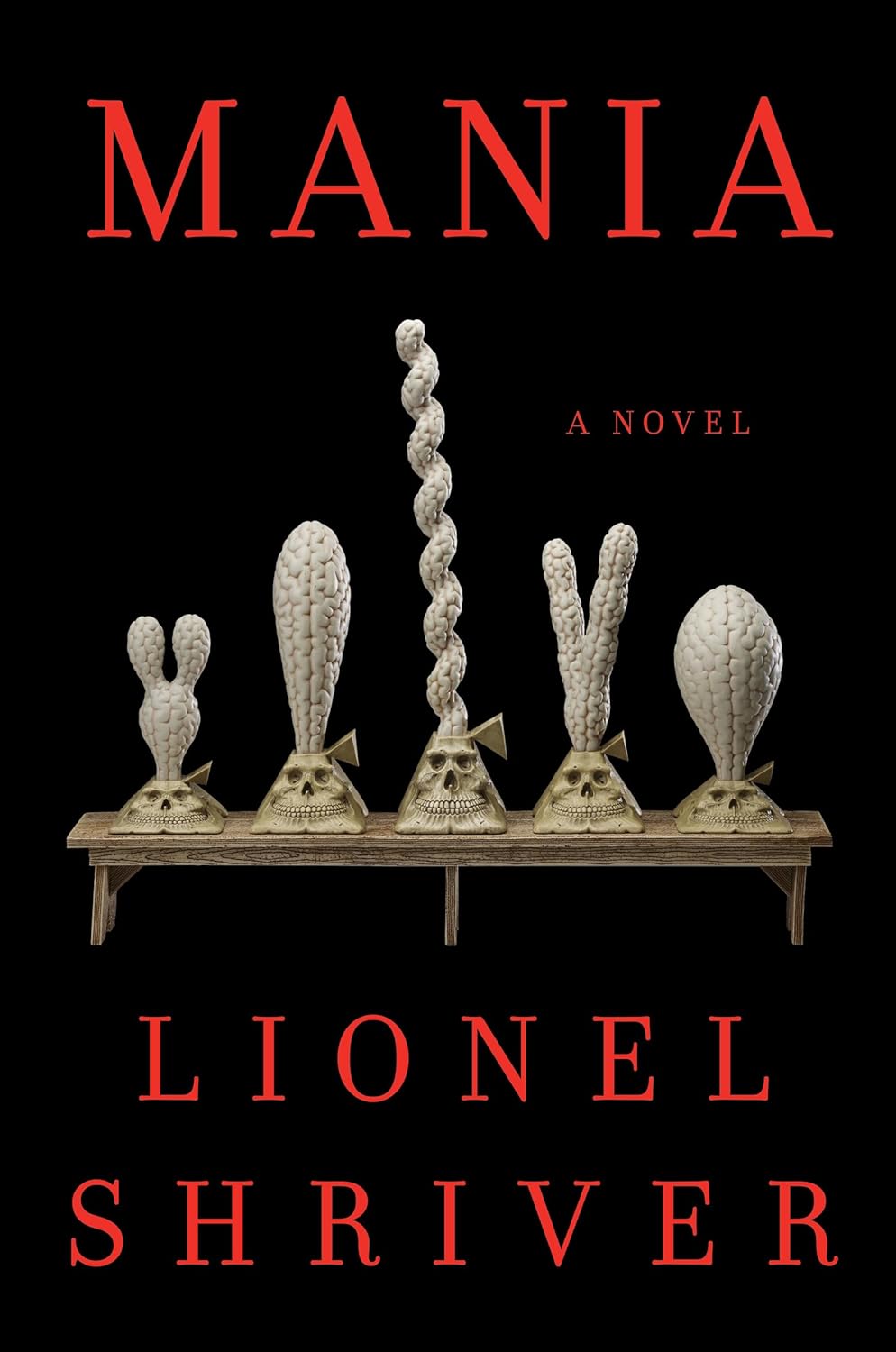
Title: Mania
Author: Lionel Shriver
Publisher: Harper Collins
Publication date: April 9, 2024
Length: 388 pages
Genre: Dystopian / alternative reality
Source: Library
Rating:
What if calling someone stupid was illegal? In a reality not too distant from our own, where the so-called Mental Parity Movement has taken hold, the worst thing you can call someone is ‘stupid’.
Everyone is equally clever, and discrimination based on intelligence is ‘the last great civil rights fight’.
Exams and grades are all discarded, and smart phones are rebranded. Children are expelled for saying the S-word and encouraged to report parents for using it. You don’t need a qualification to be a doctor.
Best friends since adolescence, Pearson and Emory find themselves on opposing sides of this new culture war. Radio personality Emory – who has built her career riding the tide of popular thought – makes increasingly hard-line statements while, for her part, Pearson believes the whole thing is ludicrous.
As their friendship fractures, Pearson’s determination to cling onto the ‘old, bigoted way of thinking’ begins to endanger her job, her safety and even her family.
Lionel Shriver turns her piercing gaze on the policing of opinion and intellect, and imagines a world in which intellectual meritocracy is heresy. Hilarious, deadpan, scathing and at times frighteningly plausible, MANIA will delight the many fans of her fiction and journalism alike.
Mania has got to be one of the strangest books I’ve ever read. This depiction of an alternate reality where Mental Parity is the new normal imagines a society where variation in intelligence is considered a myth. All are equally capable. All are equally intelligent. Some people may just process differently.
As narrated by main character Pearson Converse, what starts as a ridiculous idea — the idea that mental parity is the “last great civil rights fight” — takes over the country and much of the world. From a fringe cultural phenomenon, mental parity (MP) becomes a strident, powerful force for overturning everything from school (grades are eliminated, because all children are equally intelligent) to university admissions (strictly lottery based, because all are equally qualified) to employment opportunities, parenting, and all manner of social discourse.
Pearson, an English instructor at what was once considered a high-prestige liberal arts college, finds her hands increasingly tied as her surly students practically dare her to step out of line so they can report her to an MPC (Mental Parity Champion).
Even language becomes strictly policed. Words used to denote levels of intelligence are grossly offensive — stupid and dumb being prime examples — but over time, even words used in other contexts are stricken because they could possibly denote judgment that defies the concepts of mental parity. Can’t talk about the deep end of a swimming pool, because “deep” has a nasty association with the myth that some people are “deeper” than others — so let’s just refer to the end of the pool with more water. Also ruled out are words like dull or sharp, even in the context of kitchen knives, or brilliant as in the stars in the sky, or profound… as in deep… as in… oops, never mind.
As time passes and adherence to MP becomes absolute, Pearson finds herself increasingly on the outs with her former best friend Emory, someone with whom she was once aligned on just about everything. Now, Emory seems to have traded in her personal belief system in order to bolster her broadcast career, becoming a star commentator on CNN by offering high profile opinion pieces on the evils of those who oppose MP. Meanwhile, Pearson’s family life is increasingly at risk, as stepping a toe out of line brings down the wrath of Child Protective Services and puts her job (and financial survival) in danger.
Mania is clearly satirical, but what exactly is the author satirizing? At times, the MP world seems to be aligned with MAGA viewpoints denigrating academics and intellectuals as out-of-touch elitists, and the total undermining of scientific rigor mirrors some views of the MAHA movement. And yet, the hyperfocus on policing word choice and sanding away the edges of anything that ever might possibly offend anyone can also speak to what some see as the excesses of “wokeness”. The point, I think, is to show the damage of any sort of extremism taking over rational society — and as we see in Mania, bouncing from one extreme to another as the pendulum of societal norms swings to correct itself poses fresh set of dangers too.
I puzzled over the language in Mania. Pearson’s narration of her life is full of overstuffed sentences and pretentious, convoluted wording. I often had to stop to parse out what a particular sentence might mean. Not having read anything by this author previously, I was left to wonder: Is this delivery typical of this author, or is this meant to show how Pearson holds herself apart and embraces her intellectual superiority even while trying to survive in a world where the use of big words is derided as “brain-vain” or “smartist”? Yet Pearson repeats throughout the book that even while she’s adamantly opposed to MP and its concepts, she herself isn’t all that smart. And so, I remain a bit baffled by the character’s delivery of her life story.
A few examples:
To my embarrassment, here I am relating picayune points of philological fascism—the death of the “dumbbell”—while, out in the rest of the world, events of more considerable moment were afoot.
Emory’s ducking-below-the-parapet strategy had much to recommend it. We could keep our heads down, shuffling the world in camouflage like soldiers wearing dun in the desert, duly observing every new linguistic prohibition and suppressing perceptions of our species once prevailing, now retrograde, the better not to stand out.
Needless to say, heroin users were no longer “dope fiends,” although if you were an opioid addict, surely having your perspicacity traduced was the least of your problems.
The author weaves our own world into the story, warping people and events to suit this strange alternate reality. Obama is president… but only for one term. His brand of intellectualism is a huge turn-off — prime example of being brain-vain! — but his VP, Biden — with his lost trains of thought and awkward public speeches — is a perfect MP president. He’s just as intelligent as everyone else! Because everyone is just as intelligent as everyone else!
Even later, political standards become yet more entrenched in MP:
It’s now taken as a given that for any candidate to be seriously considered for either major party’s presidential nomination next year, he or she will necessarily be badly educated, uninformed, poorly spoken, crass, oblivious to the rest of the world, unattractive and preferably fat, unsolicitous of advice from the more experienced, suspicious of expertise, inclined to violate constitutional due process if only from perfect ignorance of the Constitution, self-regarding without justification, and boastful about what once would have been perceived as his or her shortcomings. We blithely assume that whoever is elected president will surround him- or herself with mediocrities or worse and purposefully appoint a cabinet whose leading credentials are having no credentials.
Hmm. Does that ring any bells?
My ratings graphic only allows full and half stars; otherwise, I would have rated Mania at 3.25. It’s better than a 3-star read, which to me is a “meh”, but I can’t bring myself to go all the way to 3.5, which would imply that it succeeds much more than I feel is accurate. Despite the weirdness of so much of the story, Mania still pulled me in. Once I started, I didn’t want to put it down. I just can’t say that I loved it.
I recommend Mania as a thought experiment and as a very different sort of reading experience. There’s a lot to chew on, despite being so totally outside the scope of believability. Mania is commentary on all sorts of societal woes, dressed up as the story of a woman’s struggle to hold onto the truth even if it costs her everything.
Mania was my book group’s pick for March, and I’m looking forward to hearing what everyone else thought of it. Despite its strangeness, this book is probably a great one for kicking off a lively discussion!

Interested in learning more? Here’s a round-up of reviews:
New York Times
The Guardian
NPR
Kirkus
The Times (UK)
Purchase links: Amazon – Audible audiobook – Bookshop.org – Libro.fm
Disclaimer: When you make a purchase through one of these affiliate links, I may earn a small commission, at no additional cost to you.
 Bookshelf Fantasies
This sounds very different! Not sure I’d pick it up, but I’ll bet your book group will have a lot to talk about😁
Haha, yes, I’m sure we will! Different is a good word for it — can’t say I’ve ever come across a premise like this one before!
This is probably the perfect book to promote lots of discussion. It’s been a long time since I read this author and tbh this one doesn’t appeal to me. I’m not always onboard with Dystopian ideas – they usually prompt more questions from me than I receive answers for.
Lynn 😀
This book is definitely a good discussion prompt! It helps to think of it as satire — taken literally, it makes almost no sense… but the ideas are thought-provoking for sure.