
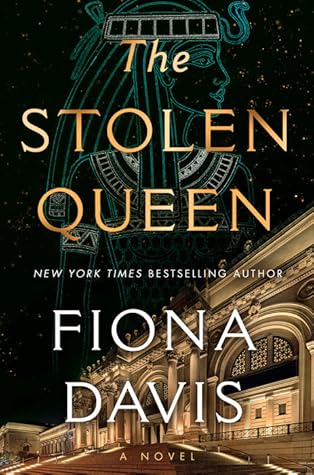
Title: The Stolen Queen
Author: Fiona Davis
Publisher: Dutton
Publication date: January 7, 2025
Length: 352 pages
Genre: Historical fiction
Source: Library
Rating:
From New York Times bestselling author Fiona Davis, an utterly addictive new novel that will transport you from New York City’s most glamorous party to the labyrinth streets of Cairo and back.
Egypt, 1936: When anthropology student Charlotte Cross is offered a coveted spot on an archaeological dig in Egypt’s Valley of the Kings, she leaps at the opportunity. But after an unbearable tragedy strikes, Charlotte knows her future will never be the same.
New York City, 1978: Eighteen-year-old Annie Jenkins is thrilled when she lands an opportunity to work for iconic former Vogue fashion editor Diana Vreeland, who’s in the midst of organizing the famous Met Gala, hosted at the museum and known across the city as the “party of the year.” Though Annie soon realizes she’ll have her work cut out for her, scrambling to meet Diana’s capricious demands and exacting standards.
Meanwhile, Charlotte, now leading a quiet life as the associate curator of the Met’s celebrated Department of Egyptian Art, wants little to do with the upcoming gala. She’s consumed with her research on Hathorkare—a rare female pharaoh dismissed by most other Egyptologists as unimportant.
That is, until the night of the gala. When one of the Egyptian art collection’s most valuable artifacts goes missing . . . and there are signs Hathorkare’s legendary curse might be reawakening.
As Annie and Charlotte team up to search for the missing antiquity, a desperate hunch leads the unlikely duo to one place Charlotte swore she’d never return: Egypt. But if they’re to have any hope of finding the artifact, Charlotte will need to confront the demons of her past—which may mean leading them both directly into danger.
I seem to say this a lot: Thanks to my book group, I’ve read yet another book that I might not otherwise have picked up… and I’m so glad I did!
In The Stolen Queen, author Fiona Davis presents a dual-timeline story, alternating between events in Egypt in 1937 and in New York in 1978. The connection is Charlotte Cross, a curator at the Metropolitan Museum of Art specializing in Egyptian artifacts. In 1937, as a young student, she worked on an archaeological team in the Valley of the Kings, where she helped discover a previously unknown tomb. But tragedy struck, and she vowed never to return to Egypt.
Now, in 1978, she has a steady career at the Met, and pursues her passion project — an investigation into the woman pharaoh Hathorkare, whom most historians ignore or consider unimportant. Charlotte has uncovered evidence that disputes the generally held beliefs about Hathorkare, and just needs approval to move ahead with publication.
The other main character is Annie, a 19-year-old who works hard at menial jobs to support herself and her immature, selfish mother while dreaming of a future in fashion. When a chance encounter puts her into the orbit of Diana Vreeland, her dreams appear to be within reach — until a disaster at the Met Gala seems to entirely ruin her hopes.
When a priceless Egyptian artifact is stolen and Charlotte and Annie end up in the path of the thief, they join forces to track down the missing item. Charlotte is finally forced to confront her past as the search leads them to Egypt. Together, they not only trace clues to the theft, but uncover deeper secrets that have a huge impact on Charlotte’s life and change everything she thought she knew about her own past.
I picked up this book with some trepidation. I wasn’t entirely sure that I was in the mood for historical fiction, and was afraid (for whatever reason) that the story would be dry. I’m happy to report that my fears were unfounded! Once I started reading, I was hooked.
Both timelines are handled very well. The 1937 storyline gives us a strong foundation for who Charlotte is as a person, and is crucial for understanding the woman we meet in the later timeline. We get a very good sense of the status of women in the field of archaeology, as well as a vivid picture of the challenges and triumphs of life on a dig. The descriptions of working in Egypt — the heat, the sights and sounds and smells — bring the period and the setting to vibrant life.
In the 1978 timeline, we initially encounter a very different Charlotte, but as the book progresses, we can make the connection between who she once was and who she is now, as a 60-year-old woman with respected status in her field and a personal life that seems to teeter back and forth between being satisfying or just a holding pattern. The tragedy from Charlotte’s past is never forgotten, but also never spoken of — and as we learn, there are unresolved pieces that even Charlotte doesn’t fully understand.
I did question the inclusion of the Diana Vreeland storyline. I suppose if you’re writing a novel set at the Met, including the Met Gala adds glamour and excitement — but of all the various story threads, this is the one that interested me the least and seemed least successful. This is Annie’s entry into Charlotte’s life, but other than that, much of the Met Gala plot felt unnecessary to me.
My other quibble with the book is Charlotte’s focus on the curse associated with Hathorkare. As a scholar and an archaeologist, Charlotte’s belief in the curse and her suspicion that it was responsible for some of the tragedies in her life just isn’t credible. I couldn’t prevent a bit of eye-rolling whenever the subject of the curse cropped up.
On the other hand, I enjoyed the scenes in Egypt and the investigation that occurs there, as well as the development of the research into Hathorkare’s tomb and her history. Some events feel a bit too convenient or coincidental, but ultimately, I was able to overlook these as the overarching story kept me engaged throughout.
Themes of lost and found family tie the various elements of the plot together, as does the examination of women’s professional opportunities and how those have changed (or not) over the decades.
Through the characters’ discussions, we also gain insights into the ongoing debate about where antiquities belong. Does preservation or the ability to share with a greater public override the claims of the country of origin, even if that country doesn’t have the means to adequately preserve, protect, or display the antiquities? There aren’t any easy answers, but I appreciate the thoughtful way the issues are discussed in this book.
The Stolen Queen is the first book I’ve read by Fiona Davis, although I have a few others on my TBR list. If you have recommendations, please let me know!
Overall, I’m very glad to have read The Stolen Queen. It had me hooked right from the start. I loved the characters, the historical elements, and the several mysteries that are central to the plot. Definitely recommended for fans of historical fiction — and needless to say, recommended for book groups!

Purchase links: Amazon – Audible audiobook – Bookshop.org – Libro.fm
Disclaimer: When you make a purchase through one of these affiliate links, I may earn a small commission, at no additional cost to you.
 Bookshelf Fantasies
Bookmarked!
Yay!
I would like this one! Thanks.
I hope you check it out!
I was going to say, adding a plot about Diana Vreeland sounds so out of place with the rest of the story! But it looks like it worked somewhat, based on your rating. 😁
The book as a whole really works! And some readers may enjoy DV’s role in the story, I suppose — but it just felt so beside the point to me, in contrast to the main storyline related to Egypt and Charlotte’s past.
Not my favorite of hers, but certainly a very good read.
Which do you consider your favorites? I have a copy of The Spectacular, and I’ve heard good things about others too.
The Spectacular is probably my favorite. But I haven’t read them all. My least favorite is The Address, but it still got 4/5 stars from me.
For a least favorite, 4 out of 5 is still great!
All the rest got 4.5, which was before I stared doing 4.25 and 4.75 star ratings. I’m SO particular and stingy with my 5 stars.
I love that this book takes place in 1936 Egypt – what drew you to this time period and setting in The Stolen Queen? 📚