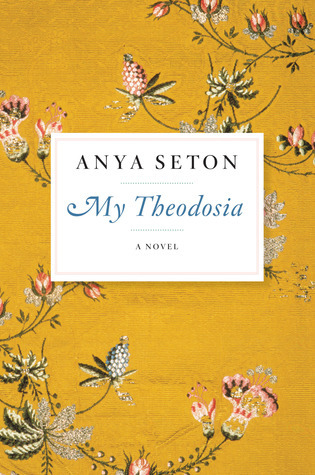
Title: My Theodosia
Author: Anya Seton
Publication date: 1941
Length: 418 pages
Genre: Historical fiction
Source: Purchased
Rating:
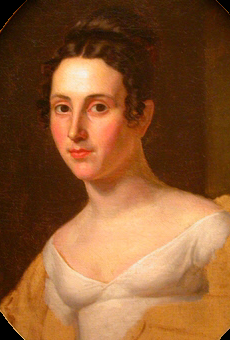
Anya Seton’s bestselling first novel, originally published in 1941, captures all the drama of the short life of Theodosia Burr (1783-1813).
Theodosia’s father is Aaron Burr–Thomas Jefferson’s vice president, most famous for his great duel with Alexander Hamilton. With charm and tenderness, he holds sway over young Theodosia’s heart, but his arrogance forces her to choose between the man he insists she marry and her love for a young soldier who will turn out to play a decisive role in her father’s fate. Persuaded by Aaron that she will soon be crowned princess of the Kingdom of Mexico as a result of his treasonable plans, she is received like royalty on Blennerhassett Island, only to end up trying to exonerate him as he awaits trial in a Richmond jail, repudiated by his fickle son-in-law and friends.
Theodosia remains a haunting figure in American history, still lovely, still imperious, never vanquished.
To be honest, the name Theodosia would have meant nothing to me before the Hamilton era… and of course, once my book group selected this historical novel about Aaron Burr’s daughter, this was all I could think of:
My Theodosia opens with Theodosia Burr’s 17th birthday. She’s the pretty, vivacious daughter of Aaron Burr, a man with unlimited ambitions and the highest of standards for his beloved daughter. He oversees every aspect of her upbringing, demanding excellence in her studies, perfect beauty, and social graces to help move all his own machinations forward.
She was flesh of his flesh, an infinitely dear projection of himself.
As Theo will soon learn, while he loves her immensely, he’s also keenly focused on making sure that her future marriage will be advantageous for him, including providing a source of wealth to keep his expensive lifestyle afloat and help propel him into the Presidency.
Theo, meanwhile, adores and idolizes her father, while also basking in the attention and admiration that surrounds her. While she may not want the marriage Aaron decides upon, she obeys her father’s wishes in this as in all things. By age 18, Theo is married to Joseph Alston, a wealthy plantation owner from South Carolina who has the funds and the political clout to further Aaron’s political ambitions.
My Theodosia follows Theo through the ten years between her marriage and her untimely death, with Aaron’s life and scandals as the backdrop to all of Theo’s own feelings, desires, and plans. No matter what else occurs in her life, her father always is her priority, to the detriment of her marriage and her security. Key events, such as the Hamilton duel, happen mainly off the page, and we experience these through Theo’s eyes, as she worries for Aaron, rushes to his defense whenever she can, and makes his well-being and reputation her primary objectives.

Reading this book over 80 years after its original publication, I found it difficult to enjoy. Theo and Aaron’s relationship is problematic and dysfunctional in so many ways. Theo’s overriding dedication to Aaron feels unhealthy, and his focus and molding of her is disturbing.
He did not quite admit it to himself, but he would have opposed any match with a man whom she passionately desired. He had no intention of transferring her devotion from himself to another. Her worship was the sweetest thing in life.
Most difficult for me as a modern reader is the casual racism that permeates the book. We might expect a slave-owner such as Joseph (and the rest of his family) to hold abhorrent views, but even Aaron and Theo, supposedly more enlightened New Yorkers, use the n-word freely and invoke all sorts of degrading and disparaging language in reference to the slaves and servants of color in their lives. I suppose some might argue that the author was attempting to evoke the prevailing attitudes of the time she was portraying, and perhaps that was more acceptable at the time of publication, but reading the book today, it’s awful — no two ways about it.
While the storytelling style is immersive, I often found myself wondering about sources and historical accuracy. There’s a brief author’s note, but it doesn’t shed much light on how much of the story is substantiated through historical documentation and how much is embroidered or speculative. (For example, the idea that the passionate yet unfulfilled love of Theodosia’s life was Meriweather Lewis is, as far as I can tell, an invention of the author’s and is not supported by historical evidence.)
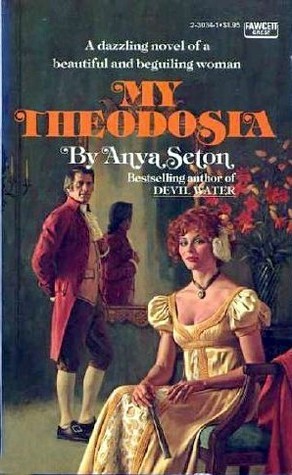
My Theodosia was Anya Seton’s first novel. I understand that many of her subsequent books are quite beloved. However, based on my experiences with My Theodosia, I don’t feel particularly compelled to explore her works any further.
As for My Theodosia itself, I can’t say I particularly recommend it. On the one hand, it’s an informative look at the life of a woman I knew nothing about, and through her, a look into the character and life of Aaron Burr beyond his Hamilton-related infamy. On the other hand, the racism, sexism, and uncomfortable father-daughter relationship make this an unpleasant reading experience overall. If not for my upcoming book group discussion, I most likely would have put the book aside and not finished it.
I’d be curious to hear from anyone who’s read other books by Anya Seton. Are there any you recommend? And if you’ve read My Theodosia, I’d love to hear your perspective as well.

Purchase links: Amazon – Audible – Bookshop.org – Libro.fm
Disclaimer: When you make a purchase through one of these affiliate links, I may earn a small commission, at no additional cost to you.
 Bookshelf Fantasies
I think that you will have some lively discussions at the book club meeting about this book.
Today we have so many books at our fingertips that are written for the modern reader that picking up a book written so long ago can be shocking. I have just finished reading Mr. Standfast by John Buchan which he wrote about 100 years ago and the language, attitudes and themes were a little jarring too. Last year I read the Wizard Of OZ collection and that too reflected the times it was written in.
How we sit as judge and jury for these books can be tricky.
It makes me wonder what readers in another 100 years might have to say about the books written for our times.
I agree completely — and yet, there are plenty of books I’ve read from the early 1900s and even earlier that, while not aligned with today’s language and values, aren’t actively offensive. I am looking forward to my book group discussion — my group is full of smart, opinionated people, and it’s sure to be interesting!
The only book by Anya Seton that I’ve ever read is Katherine which is one of my all time favourite historical novels. It’s a gorgeous love story about Katherine Swynford, the third wife of John of Gaunt in the 14th century.
I definitely get the uncomfortable feeling with the racist attitudes and it occurs in authors like Agatha Christie too I assume that their characters were just reflecting the attitudes and language of the time but it does feel wrong when you read the books now
Thanks! Katherine is one that I see recommended a lot when I look into Anya Seton’s books, so I’ll consider that one a maybe! And I get it about reflecting the attitudes of the time, but it just felt so pervasive in this book — I’d understand it more if the worst of it came mainly from the slave-owners, but Theodosia herself thinks and speaks in such awful terms that it definitely affected my opinion of her and the book in general.
Katherine is a brilliant novel epic if you’re interested in the the wars of the roses
This would be a big no for me! The overbearing relationship between the two is enough to turn me off, and the racism, although probably quite normal for the time period, is not something I’d enjoy.
I hit a few points in the book where I was ready to walk away, but I stuck with it for the sake of being able to talk about it with my book group. It’s a shame — as a Hamilton fan, I thought this would be a really interesting look at the story of the Burrs, but the presentation and approach were just so off-putting.
Good on you for completing it. I think I’d have given up. I don’t think I could make through that father-daughter relationship.
It was tough to stick with for sure. And in retrospect, I think one of the things that irritates me the most about this book is the lack of references and sources. Maybe it’s because it’s an older book, but an explanation of sources seems pretty standard these days in historical fiction. It really bothered me that I finished the book with no clear idea of which elements were based in documented history and how much was embroidered by the author for the sake of the story.