
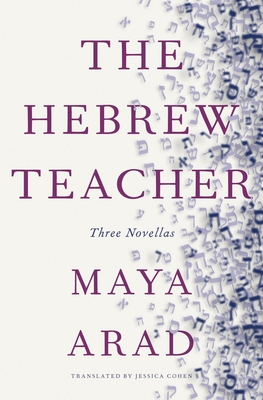
Title: The Hebrew Teacher
Author: Maya Arad
Translated by: Jessica Cohen
Publisher: New Vessel Press
Publication date: March 19, 2024
Length: 320 pages
Genre: Contemporary fiction
Source: Library
Rating:
Three Israeli women, their lives altered by immigration to the United States, seek to overcome crises. Ilana is a veteran Hebrew instructor at a Midwestern college who has built her life around her career. When a young Hebrew literature professor joins the faculty, she finds his post-Zionist politics pose a threat to her life’s work. Miriam, whose son left Israel to make his fortune in Silicon Valley, pays an unwanted visit to meet her new grandson and discovers cracks in the family’s perfect façade. Efrat, another Israeli in California, is determined to help her daughter navigate the challenges of middle school, and crosses forbidden lines when she follows her into the minefield of social media. In these three stirring novellas—comedies of manners with an ambitious blend of irony and sensitivity—celebrated Israeli author Maya Arad probes the demise of idealism and the generation gap that her heroines must confront.
The Hebrew Teacher is a collection of three novellas that, taken as a whole, provide insight into experiences of alienation, assimilation, and family generational estrangement. Originally published in Hebrew, this collection’s smooth English translation provides powerful, moving stories with universal themes.
While not normally a fan of short fiction, I was immediately pulled into the characters’ lives in each of these three novellas. Their stories are so relatable that they actually disturbed me quite a bit, as they highlight the ordinary heartbreak that daily life can present.
The first story, The Hebrew Teacher, focuses on Ilana, a woman approaching retirement who has spent her entire career teaching Hebrew at a midwestern university. She reminisces on the early days:
When she’d arrived in ’71, it had been a good time for Hebrew. When she told people she was from Israel, they used to give her admiring looks. […] But now was not a good time for Hebrew.
Ilana faces an alarming drop in her enrollment rates for the new semester, while also dealing with a new professor of Hebrew and Jewish literature — someone with authority over her classes — whose political views put him and Ilana on opposite sides of an academic cold war.
The Hebrew Teacher has a sad energy; we feel for Ilana as an older woman reflecting on the days when both she and her life’s work were once appreciated, forced to realize that she’s been left behind by changing times.
The second story, A Visit (Scenes) is also achingly sad. Miriam arrives in Silicon Valley to visit her son, daughter-in-law, and their toddler. She’s never met her grandson before, and her son and his wife seem distinctly uninterested in welcoming her into their home and lives. Told through vignettes (scenes) over the course of Miriam’s three-week visit, through Miriam’s POV as well as the other two adults’, the story unfolds in short glimpses that convey the utter estrangement Miriam feels as well as the tension within the household. Miriam’s visits with another grandmother and her daughter-in-law add poignancy, as they show the happiness and closeness that have eluded Miriam. For some reason, this story just broke my heart, especially Miriam’s reflections on the closeness of parents and children during the childhood years, and how adult children exclude their parents from their lives.
Make New Friends, the third and final piece in this collection, feels rather difference in focus, but is still disturbing in tone and content. Once again featuring a family of Israeli ex-pats in Silicon Valley, Make New Friends is told through the viewpoint of Efrat, a mother who worries constantly about her 13-year-old daughter’s lack of friends. As Efrat stews over Libby’s social standing, she crosses some major lines on social media, all the while coming to terms with her own long-simmering anxieties about friendship and belonging. The story is well told, and made me very uncomfortable — and then ends pretty abruptly. I expected a more dramatic conclusion; it seems to just stop.
Overall, I enjoyed reading this book, even though I don’t do particularly well with short fiction and am always left feeling a bit unsatisfied. The stories in The Hebrew Teacher present ordinary people dealing with life’s frustrations and disappointments, with characters who feel well-defined and specific. I appreciated the depiction of the cultural struggles of characters who end up livinge far from their original homes and families, and what this means for their children as well.
The Hebrew Teacher won the 2025 National Jewish Book Award for Hebrew Fiction in Translation. Maya Arad’s newest novel, Happy New Years, was released in the US this month, and I look forward to reading it.

Purchase links: Amazon – Bookshop.org – Libro.fm
Disclaimer: When you make a purchase through one of these affiliate links, I may earn a small commission, at no additional cost to you.
 Bookshelf Fantasies
These novellas sound good. I don’t read tons of short fiction, but every once in awhile it’s just what I’m looking for. I’ll have to keep this author in mind for the next time I need something short and easy to fall into.
The stories go very quickly, and they really kept my interest!
I don’t read much short fiction these days either. I do like the sound of these stories, though!
I normally don’t pick up short stories, but I’m glad I gave this collection a try!
I read these two backwards – First Happy New Years and then this. My review will go up on Sunday. And… nicely done describing the titular story, which isn’t easy.
Thank — I was trying not to go too deeply into specifics…