
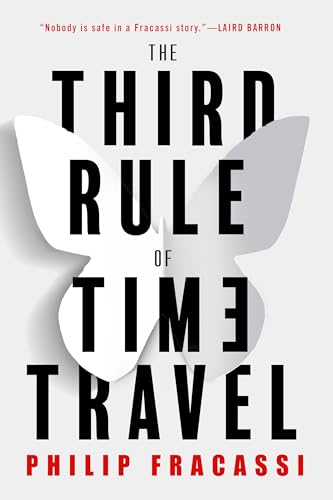
Title: The Third Rule of Time Travel
Author: Philip Fracassi
Publisher: Orbit
Publication date: March 18, 2025
Length: 325 pages
Genre: Science fiction
Source: Review copy courtesy of the publisher via NetGalley
Rating:
Rule One: Travel can only occur to a point within your lifetime.
Rule Two: You can only travel for ninety seconds.
Rule Three: You can only observe.
The rules cannot be broken.In this riveting science fiction novel from acclaimed author Philip Fracassi, a scientist has unlocked the mysteries of time travel. This is not the story you think you know. And the rules are only the beginning.
Scientist Beth Darlow has discovered the unimaginable. She’s built a machine that allows human consciousness to travel through time—to any point in the traveler’s lifetime—and relive moments of their life. An impossible breakthrough, but it’s not perfect: the traveler has no way to interact with the past. They can only observe.
After Beth’s husband, Colson, the co-creator of the machine, dies in a tragic car accident, Beth is left to raise Isabella—their only daughter—and continue the work they started. Mired in grief and threatened by her ruthless CEO, Beth pushes herself to the limit to prove the value of her technology.
Then the impossible happens. Simply viewing personal history should not alter the present, but with each new observation she makes, her own timeline begins to warp.
As her reality constantly shifts, Beth must solve the puzzles of her past, even if it means forsaking her future.
The Third Rule of Time Travel is a fast-paced, compelling story about (obviously) time travel, altered realities, consequences, and corporate greed. You won’t want to stop once you start… but when you do take the inevitable pause, there’s room enough for some doubts and quibbles to slide in.
Beth Darlow and her late husband Colson have done the seemingly impossible. They’ve created a time travel machine, but it’s not like something out of H. G. Wells or Doctor Who. The “traveler” doesn’t actually — physically — go anywhere at all. Instead, using negative energy, the traveler’s consciousness is sent through a wormhole into their own past. The destination can’t be set in advance; the machine targets a random point in the traveler’s life, where they relive the event they’ve already experienced. It’s like they become a visitor to themselves — they see what’s going on from behind their own eyes, but they’re a second consciousness present in the moment.
The traveling has absolute rules — the traveler is powerless to actually change anything or interact with the moment they’re visiting, and they can only visit for 90 seconds, which is all the machine can sustain. What would happen if they’re not pulled back within 90 seconds? Beth’s not really sure… but the guess is, it would be disastrous for the traveler, and could result in their consciousness never returning to their body.
Years earlier, Beth and Colson sold their machine to the Langan Corporation in order to get the funding investment needed to continue their work. Jim Langan, the CEO, treats them like his prize pet scientists and keeps the money flowing — but something seems to be going wrong at Langan. Fewer and fewer cars are in the employee parking lot, security is even tighter than ever, and long-time colleagues seem to be disappearing as projects are cancelled and departments close. When Jim starts pressuring Beth to move faster and to show the machine to a hand-picked reporter, Beth balks at the idea, but she really has no choice. Forced to travel more often than is safe, Beth’s experiences leave her emotionally battered… and worse, seem to have had consequences that no one expected.
The action in The Third Rule of Time Travel is nonstop, making for a propulsive reading experience. The story is fascinating, and the author does a great job of weaving together Beth’s professional and personal lives. She’s a hard-charging, brilliant scientist, but she’s also devoted to her young daughter and is a loving mother, although getting home from the lab in time for dinner and bedtime with Isabella is a challenge.
As the continued traveling starts to unravel Beth’s life, causing her emotional distress, physical exhaustion, and questions about pieces that seem to have gone missing, the stakes get higher and higher. Traveling via the machine is supposed to be purely observational… but after each round of travel, Beth feels as though something isn’t right. Could the machine have done something unimaginable — could visiting the past have changed Beth’s present?
I mostly enjoyed this book, and really couldn’t stand having to put it down and take breaks for, you know, life and stuff. Still, I had some quibbles, especially later in the book, that make me drop my star rating a bit:
- The purpose of the machine doesn’t really make sense. Maybe as a first step toward achieving actual time travel, but I fail to see the point of witnessing random past moments for 90 seconds. Call me a skeptic — I didn’t buy how the machine is treated as the most significant scientific achievement of all time.
- When I read books like this, at some point the science-y bits go over my head and I just have to accept that things like negative energy and quantum entanglement and wormholes make sense as depicted. Even so, the book’s approach to altered realities, with a hint of higher powers and cosmic woo-woo, rang a bit false. Some elements just don’t quite fit together.
- Certain characters play a role and are never mentioned again; some scenes aren’t quite explained.
- The CEO, the clear villain of the piece, is so mustache-twirlingly evil by the end that it’s a bit comical. He even gets to do some villain monologuing, and it feels quite over the top.
- I didn’t buy the ending. Can’t say why, without getting into spoilers, but it all felt a bit neat and convenient..
Okay, that’s a whole bunch of quibbles; hence my 3.5 stars. I enjoyed myself while reading The Third Rule of Time Travel, but my doubts about some of the plot elements kept me at a distance, and the final third or so of the book felt less credible the further along it went.
Still, as someone who’s read a lot of variations on the time travel theme, I was interested in this different approach, and felt invested in the characters’ lives and dilemmas — and couldn’t peel my eyes away once the unintended consequences started to pile up. Readers who enjoy speculative sci-fi — and the brain twistiness of thinking about alternate realities — will likely find plenty to puzzle over and savor with The Third Rule of Time Travel.

Purchase links: Amazon – Bookshop.org
This post contains affiliate links. If you click and buy, we may earn a small commission at no extra cost to you.
 Bookshelf Fantasies

You hit a lot of the quibbles I had too (and I had different ones as well). It’s was a hard to put down the book, but once you start analyzing it, it does start to fall apart a little.
Exactly! I was very caught up in it while reading, but then the doubts creep in. I just went back and looked at your review again (I didn’t read it in depth when first posted since I hadn’t read the book yet!), and I agree with your points. We only know Beth is brilliant because everyone says so… but it doesn’t come across through her actions or what we actually see. And also re the lab being empty and only her and Tariq doing the work. Just feels weird that this supposedly incredibly important, breakthrough project only has two people working on it. And as a side note, it seems really risky to push the only person who understands the science to also being the one traveling — if her brain breaks because of it, what happens to the project?
I’m a little confused by why going back to observe some past moment in your life from your own mind is considered ‘time travel’ instead of some kind of memory reoccurence thing, but the fact that things seem to start changing in her life because of it is interesting.
Really good question! They talk about it as “traveling” throughout, but it’s only the consciousness that goes to other times. The memory recurrence concept makes me think of a really disturbing book by Dan Simmons (Flashback) where there’s a drug that enables people to relive parts of their past as if they’re there. Anyway… yeah, there are definitely plot elements in this book that don’t entirely work, but it still kept me hooked!
I found the character Beth annoying.
The ending was abrupt. An ordinary read. Written, hopefully for a film deaI I imagine.
It’s a ho-hum from me.
I can see your point. There were definitely elements that didn’t quick click for me. Interesting — I could see there being a TV or film version!