
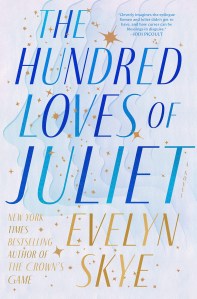
Title: The Hundred Loves of Juliet
Authors: Evelyn Skye
Publisher: Del Rey
Publication date: August 1, 2023
Length: 337 pages
Genre: Contemporary fiction / fantasy
Source: Review copy courtesy of the publisher via NetGalley
A woman discovers that she is part of a legendary love story that spans lives, years, and continents in this modern-day reimagining of Romeo and Juliet.
I may go by Sebastien now, but my name was originally Romeo. And hers was Juliet.
It’s a frosty fairytale of an evening in small-town Alaska when Helene and Sebastien meet for the first time. Except it isn’t the first time. You already know that story, though it didn’t happen quite as Shakespeare told it.
To Helene, Sebastien is the flesh-and-blood hero of the love stories she’s spent her life writing. But Sebastien knows better—Helene is his Juliet, and their story has always been the same. He is doomed to find brief happiness with her over and over, before she dies, and he is left to mourn.
Albrecht and Brigitta. Matteo and Amélie. Jack and Rachel. Marius and Cosmina. By any name, no matter where and when in time, the two of them are drawn together, and it always ends in tragedy.
This time, Helene is determined that things will be different. But can these star-cross’d lovers forge a new ending to the greatest love story of all time?
The Hundred Loves of Juliet takes the classic tragedy of Romeo and Juliet as inspiration for a modern-day love story that spans centuries.
After leaving her awful — manipulative, cheating, gaslighting — husband, Helene Janssen decides to create a new life for herself, and relocates to a small town in Alaska to recover her equilibrium and work on her novel. A professional journalist, Helene is eager to see if she can turn the snippets of stories she’s written all her life into an actual book.
Since middle school, Helene has had a vividly detailed imaginary hero at the center of her stories and daydreams. Whether as a nobleman at Versailles, a Swiss clockmaker, or trekking across the Sahara, the same man repeatedly appears in all her scenarios, and she knows everything about him — his appearance, his voice, even his quirky habits and gestures.
Imagine Helene’s shock when, on her first night in Alaska, the man from her stories shows up in the restaurant where she’s having dinner. He’s not just similar to her character — every detail matches up exactly. But when Helene approaches Sebastien, who’s clearly much beloved by the town and seems like kindness itself — he rudely rebuffs her and makes it clear that he doesn’t want to know her.
We soon learn more from Sebastien’s point-of-view, and what a story he has to tell! Sebastien is only his latest identity. Originally, he was Romeo Montague. Yes, that Romeo. And he lets us know just what Shakespeare got wrong. Juliet did die, shockingly and tragically, just a few short days after their secret marriage — but Romeo survived. Since then, he’s been cursed with immortality, and doomed to meet, fall in love with, and then lose reincarnations of Juliet, over and over again across the long centuries.
Each time he meets a new version of Juliet, he hopes things will be different, but each time, she dies — sometimes within days, sometimes after they begin a life together, but no Juliet has lasted more than two years after they meet. This time, he’s determined to save Helene — whom he immediately recognizes as Juliet — by staying out of her life. If he needs to run away from his life in Alaska in order to avoid her, he will… but when Helene is stranded near his home during a blizzard, he has no choice but to offer her shelter, and his carefully constructed walls can’t last once they begin to spend time together.
In many ways, The Hundred Lives of Juliet is highly enjoyable. Thanks to the alternating POV sections, we see the past vignettes as well as the current storyline unfold from both Helene’s and Sebastien’s perspectives, which helps us understand why they behave as they do. The rules of their curse aren’t clear-cut or consistent, and even Romeo/Sebastien isn’t entirely sure why things happen the way they do. Were they cursed by Mercutio’s dying words:
A plague o’ both your houses
Or is there some other reasons why Sebastien seems to live forever, while Juliet lives through sequential lives, always destined to die tragically at a young age?
There’s an undeniable tension that builds as the story progresses. Once Helene and Sebastien give in to the inevitability of their love, we can feel the clock ticking on their happiness. We know that all Juliets die, so there’s a sense of held breath — what will go wrong? This tension pulled me in and kept me reading, to the point where I just couldn’t stop until I reached the end.
At the same time, not everything here works well. We read Helene’s story vignettes scattered throughout the book, and there isn’t a particularly kind way to say that they feel pretty clichéd and stale. Not to mention, yes, Romeo has lived for about 700 years, but it still feels unlikely that his adventures would take him to quite that many new lives around the world.
On top of this, Helene’s novel-writing project is centered on turning her vignettes into a cohesive whole — but since it turns out that all of these stories are actually depictions of past lives she’s lived with Sebastien, how is that actually creative writing, and isn’t this all supposed to be a secret? (Also, I was amused that one of Helene’s first errands in Alaska is a trip to the local bookstore to buy a book about how to write a novel — is that really all it takes? A good how-to book?)
There’s a suspense element toward the end of the book involving a looming threat to Sebastien and Helene, as his secret is on the verge of being revealed (and they fear that if the truth gets out, he’ll be locked away in a government research facility forever — again, this feels very clichéd to me). However, the danger is dealt with pretty quickly in a way that is almost a deus ex machina solution, and I didn’t love anything about this part of the story.
Not to be overly nitpicky, but one scene in the first half of the book made me consider walking away from it all. Sebastien warns Helene not to go wandering around his house at night, she compares the warning to Belle being barred from the west wing in Beauty & the Beast, and he responds by calling her “childlike”. Okay, agreed, that’s rude… but she responds to the “childlike” comment by slapping him. SLAPPING him!?! Who does that? To a stranger who’s giving you shelter from a dangerous storm, and who may not be as polite as we’d like, but who has a right to set limits on where a guest goes in his home? Wow, I did not like this scene at all, and it made me think less of Helene as a person.
I’ve gone into greater details on what I didn’t like about the book, but the fact remains that I read the whole thing in about 24 hours, so clearly there was plenty that I did like! Helene and Sebastien’s struggles to make sense of their connection and to understand the past were very compelling, and the key concepts of the story are unique. I had a hard time suspending my disbelief, but ultimately decided to just go with it (immortality! reincarnation!) and not worry about whether every last bit made sense.
Overall, The Hundred Loves of Juliet is a compelling read despite its flaws, and I appreciated the momentum that builds over the course of the novel. It’s definitely more than a bit melodramatic, but considering this is a retelling/reimagining of Romeo and Juliet, I suppose melodrama is allowed!
 Bookshelf Fantasies
It is a pretty interesting and unique premise playing out Romeo and Juliet’s story like that. If you’d given it a higher rating I’d be putting it on my TBR list for sure, but as it is I’m a bit torn. Because what bugged you about this one would annoy me, too. And my TBR is already so long.
I enjoyed it, but wouldn’t say anyone should drop everything else and read it. If you ever get a chance, it’s worth checking out, but not a must.
It seems like this idea had so much potential, but it sounds like the execution needed work. I’m giggling at the “how to write a novel” book😁
Ha, yes, that made me laugh. 🙂 You’re comment is spot-on — there was potential for a much better books!
I really hate it when a book seems to have so much potential, with a good premise, but then totally fails on the execution! I think those books are my biggest disappointments!
I agree!