
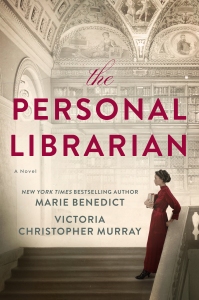
Title: The Personal Librarian
Authors: Marie Benedict and Victoria Christopher Murray
Publisher: Berkley
Publication date: June 29, 2021
Length: 347 pages
Genre: Historical fiction
Source: Purchased
The remarkable, little-known story of Belle da Costa Greene, J. P. Morgan’s personal librarian—who became one of the most powerful women in New York despite the dangerous secret she kept in order to make her dreams come true, from New York Times bestselling author Marie Benedict and acclaimed author Victoria Christopher Murray.
In her twenties, Belle da Costa Greene is hired by J. P. Morgan to curate a collection of rare manuscripts, books, and artwork for his newly built Pierpont Morgan Library. Belle becomes a fixture on the New York society scene and one of the most powerful people in the art and book world, known for her impeccable taste and shrewd negotiating for critical works as she helps build a world-class collection.
But Belle has a secret, one she must protect at all costs. She was born not Belle da Costa Greene but Belle Marion Greener. She is the daughter of Richard Greener, the first Black graduate of Harvard and a well-known advocate for equality. Belle’s complexion isn’t dark because of her alleged Portuguese heritage that lets her pass as white—her complexion is dark because she is African American.
The Personal Librarian tells the story of an extraordinary woman, famous for her intellect, style, and wit, and shares the lengths to which she must go—for the protection of her family and her legacy—to preserve her carefully crafted white identity in the racist world in which she lives.
The Personal Librarian is a fictionalized depiction of the life of historical figure Belle da Costa Greene, a powerful figure in the New York art and rare book world of the early 20th century. A novel about Belle should have been powerful, but instead, it left me cold (and very tempted to DNF).
The set-up is intriguing: Belle’s family is Black, and her father is a renowned, outspoken figure in the fight for racial equality, justice, and civil rights. Yet (according to the novel), her mother realizes that her light-skinned children will have a better shot at successful lives, free from the rampant racism, violence, and segregation of their time, if they pass as white.
From her teens onward, Belle presents herself socially and professionally as white, and uses an invented Portuguese ancestor (and the invented name “da Costa”) as a way to explain her darker complexion. She makes connections while working at the Princeton library that lead her to J. P. Morgan, whose driving ambition is to create an unrivaled personal library full of rare and valuable treasures. When he hires Belle as his personal librarian, her ascent to influence, social acceptance, and power in the world of collectors and dealers gets its start.
Belle’s story should have been fascinating, but I have a feeling I would have been better off reading a biography rather than reading this novel. Too much is invented or assumed. Belle’s internal musings on race and identity provide the background for her decisions and actions throughout the book, but given that the real-life Belle destroyed all her papers and letters before her death, we can’t actually know what she was thinking or feeling.
There’s a romance (of sorts) with a married man that lasts for years of Belle’s life, and this is documented in real life through her letters to him (which he kept, while she destroyed any letters that she’d received) — but the fictionalized version of this story makes assumptions and adds incidents that apparently are not established by more than speculation.
Beyond the question of fact versus fiction, I simply did not enjoy the writing. I felt at arm’s length from Belle throughout, and frankly, I was often bored. The writing is surface-level, jumps ahead by months at a time, and didn’t let me feel connected to Belle as a person. Her emotions are understandable only because we’re told what she’s feeling, not because they’re tangible in any way.
Reading this book made me ponder a bit too about what I appreciate in historical fiction — and what I don’t. In general, I think I appreciate historical fiction more when it focuses on ordinary/unknown people in historical settings, even up to and including brushes with or relationships with real people, rather than taking a historical figure and inventing thoughts and feelings for them that may be nothing more than speculation. I’m sure this factors into why I didn’t especially care for The Personal Librarian.
As I’ve mentioned, Belle herself seems like a fascinating historical figure. You can read more about her via the Morgan Library & Museum’s website, here. I’ve given The Personal Librarian three stars — I’m glad that this book introduced me to Belle’s life, even if it didn’t particularly work for me as a reading experience.
 Bookshelf Fantasies
It’s a fascinating story! I thought a bit dry. It must be difficult to write a story without a lot of primary source information. I appreciate that she cowrote this with an own voices author. They also wrote The First Ladies which you may find more engaging!
Thanks for the recommendation. I have read a couple of Marie Benedict’s book before and enjoyed them, but I don’t know how excited I’d be to read another just yet.
I think her writing partner livens up her writing a bit! I think you’d love First Ladies!
I do like the sound of Belle’s story, but it’s too bad the book just wasn’t engaging enough to really like.
Yes… she herself is fascinating, and I’ve been finding all sorts of interesting articles about her online!
That’s too bad. Belle’s story is so interesting I was hoping this book would be better. I struggle with historical fiction when it’s centered around a real person rather than an interesting event or time period, maybe because I’d rather just read a really good biography rather than a fictionalized story about them.
I think we have the same preferences. I’m glad to have been introduced to Belle, but didn’t feel like I could actually rely on this book to give me a real picture of who she was and what her impact was.
Oh well… not every book is for everyone. I really enjoyed it.
I’m glad you did! 🙂 I appreciated learning about Belle, but something about the approach just did not work for me.
Well, it wasn’t Benedict’s best book, but I wonder if collaborating might have been part of the problem.