Take A Peek Book Review: Paper Towns by John Green

“Take a Peek” book reviews are short and (possibly) sweet, keeping the commentary brief and providing a little peek at what the book’s about and what I thought.

6442769

Synopsis:

(via Goodreads)

Who is the real Margo?

Quentin Jacobsen has spent a lifetime loving the magnificently adventurous Margo Roth Spiegelman from afar. So when she cracks open a window and climbs into his life—dressed like a ninja and summoning him for an ingenious campaign of revenge—he follows. After their all-nighter ends, and a new day breaks, Q arrives at school to discover that Margo, always an enigma, has now become a mystery. But Q soon learns that there are clues—and they’re for him. Urged down a disconnected path, the closer he gets, the less Q sees the girl he thought he knew…


My Thoughts:

Oh, where to start? This was most decidedly a middle-of-the-road, “meh” sort of read for me. On the plus side, John Green is an indisputed talent when it comes to getting inside teen brains and portraying the shifting loyalties and tensions of teen friendships. On the negative side, I have very little tolerance for this type of tale, starring an every-boy main character — decent guy, not too remarkable, not part of the in-crowd — who is drawn to the oh-so-special wild girl, the one who can’t be pinned down, who acts out in crazy ways that are supposed to be a sign of just how special her specialness is.

I enjoyed the scenes of Quentin embarking on a crazy road trip with his best friends — a wild 24-hour drive up the coast on the trail of Margo’s confusing clues, with all sorts of escapades, close calls, and silly/manic rest stop shopping sprees. But… all this is in search of the elusive Margo, who, quite frankly, doesn’t seem to want to be found. And if she did want to be found, she made it next to impossible. I found it pretty hard to believe that the gang managed to decipher the obscure patterns that form a sort of roadmap to her — and further, I had a hard time seeing her all-night adventure with Quentin as something that he’d actually enjoy or go along with.

I loved The Fault in Our Stars and Will Grayson, Will Grayson — but Paper Towns had about the same effect on me as Looking For Alaska. Clearly, books about boy-next-door types falling under the spell of the elusive, magical, tormented, magnetic (etc, etc) wonder girl just don’t work for me.

Note: I picked up the e-book of Paper Towns a couple of years ago, and finally read it this month in preparation for a book group discussion. Who knows? Perhaps the amazing folks in my group will convince me that I missed something!

_________________________________________

The details:

Title: Paper Towns
Author: John Green
Publisher: Speak
Publication date: 2009
Length: 305 pages
Genre: Young adult
Source: Purchased

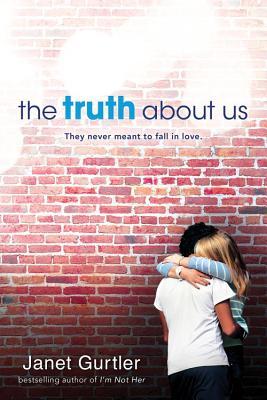
Book Review: The Truth About Us by Janet Gurtler

Truth About Us17-year-old Jess has what might seem to be an ideal life: She lives in a huge house in an upscale neighborhood, drives an Audi, and is sent out shopping for whatever she likes, parents’ credit card in hand. She goes to the best parties, where she and her bestie Nance get over-the-top drunk and flirt (and then some) with the best boys. Jess’s party-girl persona is a cover, though — a way for Jess to escape the worries and sorrows that have plagued her ever since a family tragedy two years earlier.

That doesn’t stop her from going too far, and when Jess is busted for daytime drinking, topless sunbathing, and a ridiculously expensive impulse buy on EBay, she’s sentenced to a horrible fate: Jess’s dad forces her to commit to daily “volunteer” work at the local soup kitchen. But Daaaaaad… you can practically hear her whining. So unfair.

Little by little, Jess comes to see the value in what she’s doing. Sure, the shelter is in a seedy part of town, serving lunch to all sorts of homeless riff-raff. And yes, the rest of the shelter volunteer crew and staff look at her as a spoiled little rich girl who’ll never fit in, unable to even walk to the corner bus stop without an escort. But when Jess meets the gorgeous Flynn and his adorable little brother, who come regularly for lunch and then stay to lend a hand, Jess’s heart begins to melt. Not only is she falling for Flynn hard, but she’s also made friends with an old man named Wilf, a widower and the shelter’s benefactor whose grumpy exterior hides the soul of a true romantic… and Wilf can’t resist imparting his own words of wisdom to Jess, including the lesson that love is worth fighting for.

There’s a lot that gets in the way of Jess and Flynn’s exploding feelings. Jess’s dad may want her to learn a lesson by working at the shelter, but he certainly doesn’t want her socializing with a poor boy from a bad neighborhood. Jess’s friends don’t understand why she doesn’t want to drink, flirt, and hook up the way she used to. Flynn’s mother isn’t a fan of Jess, either; to her, Jess is slumming and will only hurt Flynn. But as the summer progresses, Jess and Flynn grow closer, and Jess finally starts to open up about the sadness that threatens to rip her own family apart.

The Truth About Us tackles the subjects of privilege and economic challenges in a thoughtful and sensitive manner. Jess does really seem to have it all — but as the book shows us, even a perfect exterior can hide fractures and difficulty. Granted, Jess never has to worry about the roof over her head or where her next meal is coming from, so I wouldn’t say that her struggles and Flynn’s are equivalent. Still, the story forces readers to acknowledge that pain comes in many forms, and people don’t just get handed happiness alongside their gold credit cards and expensive electronics.

There are moments when the subject becomes a bit clunky:

I use the computer in Dad’s office to go online, and most of the time end up googling things like poverty. My eyes are open to a lot of things I didn’t know about being poor. I always knew my family had money, but it always seemed like everyone else did too.

Googling poverty? It’s really that foreign a concept to her? It’s hard to keep rooting for Jess in certain moments, even though ultimately we know that her heart is in the right place.

The romance in The Truth About Us is perhaps meant to be more of a “forbidden love” than it really seems. Jess’s friends are horrified that she’d get involved with a poor boy. Both Jess’s dad and Flynn’s mother are opposed to the relationship, but they come around eventually. Flynn’s own sense of responsibility toward his mother and brother keep him away from Jess for a time, but we know that these two feel instantly connected and that they’re fated to be together. The obstacles never appear to be truly insurmountable, and it’s not really a surprise when they manage to work things out.

This review perhaps sounds less positive than I actually feel about the book. The writing is witty and sensitive, and I liked the cast of characters very much. The secondary characters, especially Wilf and Jess’s former best friend Penny, are good people with a lot of heart. The story of the disintegration of Jess’s family and their slow steps toward healing is terribly sad, and it’s easy to see how Jess’s life became such a mess. She’s clearly a decent person who means well, cares for others, and wants to make a difference — and once she fights her way out from under her rich girl persona, she starts to grow into the person she wants to be.

I did feel that the realities of homelessness and poverty were a little sugar-coated, and that Jess didn’t see the truth of just how bad things could really be. However, The Truth About Us does show that it’s possible for people from such drastically different worlds to connect in a meaningful way, once they get past their preconceptions and prejudices. I haven’t seen many YA books confronting these issues, and the author should be commended for tackling the topic of economic disadvantage and differences in a way that will hopefully open readers’ eyes.

For more by this author, check out my review of her terrific previous novel, 16 Things I Thought Were True.

_________________________________________

The details:

Title: The Truth About Us
Author: Janet Gurtler
Publisher: Sourcebooks Fire
Publication date: April 7, 2015
Length: 304 pages
Genre: Young adult fiction
Source: Review copy courtesy of Sourcebooks Fire via NetGalley

Book Review: Better Off Friends by Elizabeth Eulberg

Book Review: Better Off Friends by Elizabeth Eulberg

Better off Friends

A little like When Harry Met Sally for teens, Better Off Friends asks the question, “Is it really possible for a boy and a girl to be just friends?”

Macallan (yes, she’s named for the whiskey) and Levi just click from the very start, when Levi moves from California to Wisconsin right at the start of 7th grade. He’s the new kid worried about fitting in and making friends. Macallan has troubles of her own, still recovering from her mother’s shocking death in a car accident the previous year. Yet somehow, these two get each other, moving quickly from the discovery of a shared loved for a (fictitious) BBC comedy to best friend status, finishing each others’ sentences, being relatively unsufferable to those trying to get a word in edgewise, fitting into each others’ families, and really connecting in the way only true friends can.

Their friendship continues, with its share of ups and downs, into high school. They manage to survive the awful fall-out from Levi dating Macallan’s best girl friend, as well as a variety of other awkward moments that might break up a less solid friendship. But Levi and Macallan are totally strong and inseparable — until things start to fall apart. As Levi finally gets what he always thought he wanted — guy friends, success in sports, a crowd to hang out with — he has less time and attention for Macallan. Meanwhile, she’s realizing that friendship with Levi isn’t quite as easy or comfortable as it was in their younger days.

For years, people have always assumed that these two were “together” — and they really can be quite frightful when they’re on a roll with their in-jokes, ignoring everyone else around them, completely oblivious to their other friends, or even their current boyfriend or girlfriend. An attempt at a double-date is never repeated, after it ends disastrously (and also somewhat hilariously).

But when Levi finally starts to wonder what it is that he feels for Macallan, their friendship enters rocky territory, to the point where it looks doubtful that they can survive it at all. Plagued by doubts and worries and serious miscommunication, Levi and Macallan each have to decide whether it’s worth pursuing something more… or whether they really are better off friends.

How many times have you seen a character in a book or movie use the excuse “I don’t want to ruin our friendship” as a reason for not going out with someone? Totally lame, right? Well, in Better Off Friends, not ruining the friendship is the crux of the problem, and it’s not at all lame. I loved seeing how much Levi and Macallan care about each other and how vital their friendship is for both of them. Neither of them can stand the idea of ruining it… but their inability to be honest and take a risk may destroy the friendship anyway.

Told in alternating voices, we get to hear in first-person perspective from both Macallan and Levi the history of their friendship and to see how it grows and changes over the years. Each chapter ends with a bit of banter between the two. It comes across like a recounting of their history, so that after Macallan tells the story of the first time she met Levi, we hear a few choice comments from Levi –usually snarky and funny — telling what he thinks of Macallan’s version of events. It’s a nice touch, and it lets the reader know that they’re in this together and enjoying the tales from their past. It does also remove a little element of suspense: Since the story is told as the two of them looking back on their shared history, there’s really no fear that they won’t end up at least as friends, if not more.

Insta-love seems to be all too common in YA fiction these days. They meet, they exchange five words, they looks into each others’ eyes — and BAM! It’s true, deep, soul-scorching love. (It definitely helps if one is from the wrong side of the tracks, or has a troubled past, or is hiding a deep, dark secret). Better Off Friends is like the antidote to insta-love: When romance finally becomes a possibility, it’s after years of friendship and a true, deep connection. We feel like the characters have earned it; love feels organic for these two, and not something forced on a pair of characters in order to fit a formula.

In fact, Better Off Friends is so far from formulaic that reading it feels like a breath of fresh air. Other than the fact that a main character has lost a parent at a young age, nothing in this book feels like a retread of what’s trendy in teen fiction at the moment. I enjoyed the originality of the characters and the care and detail devoted to letting us get to know them. Their struggles to pursue their own interests and passions, balance these with school and home demands, and figure out how to still be a good friend felt realistic and appropriate for their ages, and it was interesting to see how the two grow over the years from nervous middle school kids to confident high school juniors.

Last year, I read Revenge of the Girl With the Great Personality by Elizabeth Eulberg, and loved the honest way in which the author approached the problems and challenges of a terrific main character. (You can check out my review here.) After reading Better Off Friends, I’m adding Elizabeth Eulberg to my list of incredibly talented YA writers whose work I’ll always want to check out.

If you enjoy contemporary young adult fiction with main characters you can care about, definitely give Better Off Friends a try!

_________________________________________

The details:

Title: Better Off Friends
Author: Elizabeth Eulberg
Publisher: Scholastic
Publication date: February 25, 2014
Length: 288 pages
Genre: Young adult contemporary
Source: Review copy courtesy of Scholastic via NetGalley