
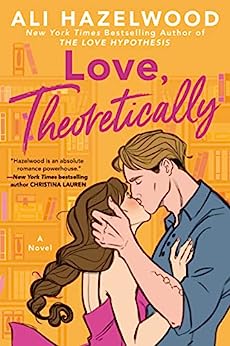
Book Review: Love, Theoretically by Ali Hazelwood

Title: Love, Theoretically
Author: Ali Hazelwood
Publisher: Berkley
Publication date: June 13, 2023
Length: 389 pages
Genre: Contemporary romance
Source: Library
Rating:

Rating: 3 out of 5.

The many lives of theoretical physicist Elsie Hannaway have finally caught up with her. By day, she’s an adjunct professor, toiling away at grading labs and teaching thermodynamics in the hopes of landing tenure. By other day, Elsie makes up for her non-existent paycheck by offering her services as a fake girlfriend, tapping into her expertly honed people pleasing skills to embody whichever version of herself the client needs.

Honestly, it’s a pretty sweet gig—until her carefully constructed Elsie-verse comes crashing down. Because Jack Smith, the annoyingly attractive and broody older brother of her favorite client, turns out to be the cold-hearted experimental physicist who ruined her mentor’s career and undermined the reputation of theorists everywhere. And that same Jack who now sits on the hiring committee at MIT, right between Elsie and her dream job.

Elsie is prepared for an all-out war of scholarly sabotage but…those long, penetrating looks? Not having to be anything other than her true self when she’s with him? Will falling into an experimentalist’s orbit finally tempt her to put her most guarded theories on love into practice?

Love, Theoretically is author Ali Hazelwood’s third novel… and I think I’ve reached the point of diminishing returns. This book on its own may be fine — but after reading the previous two, I can’t help but feel that Love, Theoretically is just more of the same.

Main character Elsie Hannaway is desperate for a good job in academia — one that allows her to focus on research, earn a steady paycheck, and have the health benefits she so desperately needs she she can afford her insulin supply. Her job as an adjunct professor keeps her finances unstable and her nerves fried, not to mention her reserve of patience absolutely tapped out dealing with the neverending flimsy excuses of slacker undergrads.

Being one of two finalists for a prestigious post at MIT is a dream come true, except one of the members of the selection committee is Jack Smith, the brother of a man she’s been fake-dating as well as someone who’s been ruthless in his criticism of her branch of physics. It seems likely that he’ll torpedo her candidacy, but despite his clear mistrust, he ends up showing her unexpected kindness.

Inevitably, these two supposed enemies are forced to acknowledge their mutual attraction and actual feelings, although there are plenty of barriers to break through before they get there. Elsie has spent her life trying to please everyone, pushing her own needs to the back of the priority line in order to give others what they want from her. She’s never her authentic self (doesn’t even admit to her best friend that she actually hates the art films they watch together), until Jack calls her on her lack of honesty and forces her to be true to herself while she’s around him.

Elsie and Jack have immediate chemistry… and, well, it’s clear from the start where this is going. As in the author’s previous books, the love story is well-established-professional-who’s-maybe-evil vs rising-star-needing-a-break-and-to-break-free-of-internalized-obstacles. (OK, from what I’ve read online, Ali Hazelwood started out writing ReyLo fanfic, and it shows… although I have only the barest of familiarities with that particular ship).

Perhaps I might have appreciated this book more if I hadn’t read the others, but I struggled with a been-there, done-that feeling throughout this particular reading experience. Yes, the particulars of the plot are different, but the overall dynamics are very much aligned.

It didn’t help for me that Jack, while ostensibly empowering Elsie to recognize and express her own desires rather than fit herself to everyone else’s, comes off as domineering and controlling. Further mucking things up for me is that Elsie’s character never actual seemed to make sense — I understood what I was told about her people-pleasing nature, but just didn’t buy it.

Love, Theoretically isn’t a bad read. It goes by quickly and kept my interest. It just didn’t seem to offer much new — so yes, it was fine, but perhaps I’ve just read enough by this author at this point. I don’t think I’ll need to read more of her books, unless she does something completely different and moves away from the love-amongst-scientists theme.
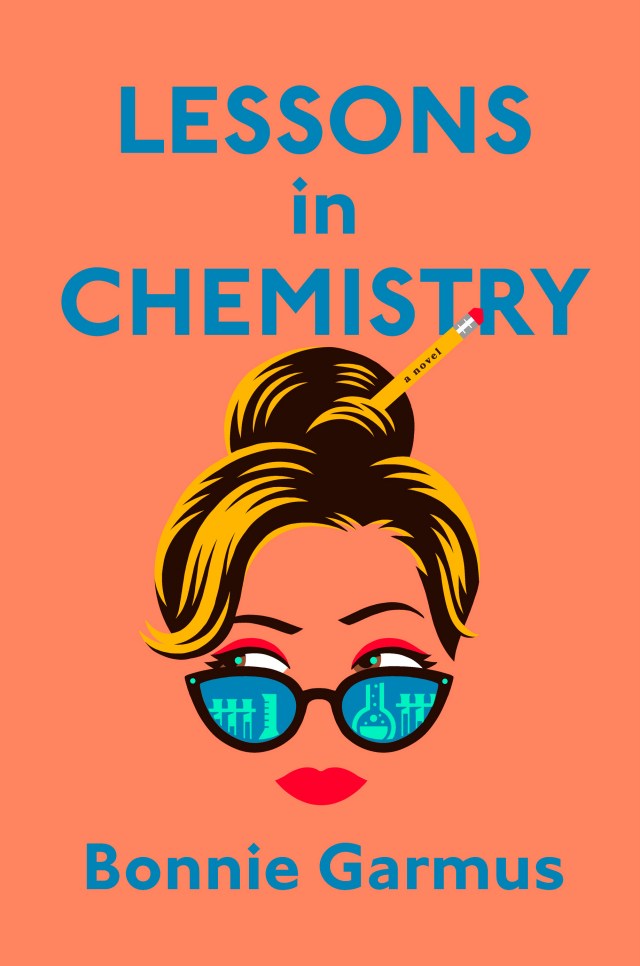
Book Review: Lessons in Chemistry by Bonnie Garmus

Title: Lessons in Chemistry
Author: Bonnie Garmus
Publisher: Doubleday
Publication date: March 31, 2022
Length: 400 pages
Genre: Historical fiction
Source: Purchased
Rating:

Rating: 3.5 out of 5.

Chemist Elizabeth Zott is not your average woman. In fact, Elizabeth Zott would be the first to point out that there is no such thing as an average woman. But it’s the early 1960s and her all-male team at Hastings Research Institute takes a very unscientific view of equality. Except for one: Calvin Evans; the lonely, brilliant, Nobel–prize nominated grudge-holder who falls in love with—of all things—her mind. True chemistry results.

But like science, life is unpredictable. Which is why a few years later Elizabeth Zott finds herself not only a single mother, but the reluctant star of America’s most beloved cooking show Supper at Six. Elizabeth’s unusual approach to cooking (“combine one tablespoon acetic acid with a pinch of sodium chloride”) proves revolutionary. But as her following grows, not everyone is happy. Because as it turns out, Elizabeth Zott isn’t just teaching women to cook. She’s daring them to change the status quo.

Laugh-out-loud funny, shrewdly observant, and studded with a dazzling cast of supporting characters, Lessons in Chemistry is as original and vibrant as its protagonist.

I’ve finally given in to the hype surrounding Lessons in Chemistry. After seeing this book’s weekly appearance on bestseller lists, the Goodreads Choice award buzz, and its selection as Barnes & Noble’s book of the year for 2022, I decided to give it a try — and while I’m glad that I did, I also have a few issues with the book.

I intentionally avoided reading reviews ahead of time, since I wanted to go in without preconceptions. In this case, there’s one plot point that I wish I’d known in advance.

The synopsis describes the book as “laugh-out-loud funny”, and yes, there are funny moments. However (and this is a big HOWEVER):

Content warning: There is a rape scene right near the start of the book.

I repeat, a book described as “laugh-out-loud funny” has a vividly described rape scene at the very beginning, and then never deals with the aftereffects in terms of trauma and survival, only focusing on the very practical impact on Elizabeth’s science career. How many people who picked up this book expecting something upbeat and silly found themselves triggered by this unexpected scene? After finishing the book, I started googling reviews, and see that there are more than a few people who walked away from the book based on that scene. Someone — the publisher? the marketing team? the author? — should have thought about this a little more.

If you can get past that opening, the rest of the book is fast-paced and entertaining, although I still don’t think I laughed out loud. Lessons in Chemistry uses quirky dialogue and interior thoughts to show the struggles of a brilliant woman trying to claim her place as a scientist in an era that wanted her to keep silent and follow the wife-and-mother path.

Elizabeth’s education and career are derailed early on, yet she does not give up and refuses to give in. She has a spectacular romance with fellow chemist Calvin, which we know from the early pages must end somehow, because she’s a single mother at the start of the novel. How we get from the romance to single motherhood is not something I’ll disclose here, but I will say that there are lovely moments as well as tragic ones. Through it all, Elizabeth battles the idiotic sexist norms that belittle her abilities, steal her work, deny her resources, and then force her out when she fails to follow misogynistic expectations.

There are plenty of ups and downs, and somehow, Elizabeth finds herself subverting a local TV station’s afternoon cooking show by making it into kitchen chemistry lessons that also encourage women to seek empowerment, enrichment, and standing up for themselves.

All this is admirable, yet somehow I found it all a bit unlikely. Yes, it’s fiction, and I’m all for strong women breaking barriers and refusing to back down — yet could a woman like Elizabeth in 1960 have this kind of impact? The success of her show, and the ripple effect amongst her viewers, seems highly implausible in terms of the actual time period.

There are other elements that clearly place this book outside the lines of a realistic depiction of… well… anything. Sections are told from the point of view of her dog, Six-Thirty, who can recognize hundreds of English words thanks to Elizabeth’s tutelage. I’m sure many readers will be charmed by Six-Thirty’s narratives, but for me, the approach got old pretty quickly.

Then there’s the matter of Elizabeth’s daughter Mad, who is so precocious that she’s reading Dickens at age 5. It’s lovely that Elizabeth has nurtured Mad to be intellectually curious and able to explore anything and everything that interests her, but even with outstanding reading abilities, I find it impossible to believe that a five-year-old could actually comprehend the content of a Dickens novel.

Those are some pretty major quibbles… and yet, I did race through the book, and once I acknowledged and then shelved the things that were bugging me, I found it an enjoyable read. The writing is pretty zingy, with lots of passages that caught my attention:

In the 1950s, abortion was out of the question. Coincidentally, so was having a baby out of wedlock.

“What’s wrong?” Elizabeth begged for the millionth time. “Just TELL me!” But the baby, who’d been crying nonstop for weeks, refused to be specific.

The biggest benefit in being the child of a scientist? Low safety bar. As soon as Mad could walk, Elizabeth encouraged her to touch, taste, toss, bounce, burn, rip, spill, shake, mix, splatter, sniff, and lick nearly everything she encountered.

There are also, though, some weird word usages, such as “she muffled into his shoulder”. I don’t think “muffled” as a verb works that way, sorry.

**Save

The book’s ending is satisfying, if improbable. Lots of coincidences come together to create a great outcome for Elizabeth and Mad, while also providing payback to someone who definitely deserves it.

(I was still annoyed that Elizabeth never got to finish her Ph.D., but who knows? Maybe that still lies in her future.)

Lessons in Chemistry was a fast read that held my attention, but the rape scene was a big stumbling block for me. Add to that the many smaller details that struck me as unlikely or oddly portrayed, and I’m left with very mixed feelings. Overall, I’m glad I gave the book a chance, but can’t say that I loved it.Save

Save

Save

Save

Save

Save

Book Review: Love on the Brain by Ali Hazelwood

Title: Love on the Brain
Author: Ali Hazelwood
Publisher: Berkley
Publication date: August 23, 2022
Length: 368 pages
Genre: Contemporary romance
Source: Review copy courtesy of the publisher via NetGalley
Rating:

Rating: 3.5 out of 5.

From the New York Times bestselling author of The Love Hypothesis comes a new STEMinist rom-com in which a scientist is forced to work on a project with her nemesis—with explosive results.

Bee Königswasser lives by a simple code: What would Marie Curie do? If NASA offered her the lead on a neuroengineering project – a literal dream come true – Marie would accept without hesitation. Duh. But the mother of modern physics never had to co-lead with Levi Ward.

Sure, Levi is attractive in a tall, dark, and piercing-eyes kind of way. But Levi made his feelings toward Bee very clear in grad school – archenemies work best employed in their own galaxies far, far away.

But when her equipment starts to go missing and the staff ignore her, Bee could swear she sees Levi softening into an ally, backing her plays, seconding her ideas… devouring her with those eyes. The possibilities have all her neurons firing.

But when it comes time to actually make a move and put her heart on the line, there’s only one question that matters: What will Bee Königswasser do?

Bee is a brilliant neuroscientist and Marie Curie’s #1 fangirl… but she’s also stuck in a job at NIH under a non-supportive boss and limited prospects, until she’s offered a spot co-leading an exciting project at NASA. This could be her big breakthrough! But Bee’s excitement dims when she learns that she’ll be partnering with Levi Ward, an engineer who was her nemesis back in grad school — the man despised her!

Still, it’s too good an opportunity to let slip by, so Bee heads off to Houston, determined to establish a good professional collaboration with her sworn enemy. Her first attempts at collegiality fail — he doesn’t even answer her emails, and he reprimands her about dress code (he apparently doesn’t care for her purple hair and septum piercing) on her very first day.

As they work together, Bee starts to notice Levi being less… awful, and even coming to her rescue when she (weirdly) gets trapped in a cemetery overnight. Their working relationship is blossoming, and their project is going amazingly well, but how can she allow herself to think that Levi is warming to her when she knows how deeply he hated her?

Love on the Brain, Ali Hazelwood’s follow-up to her debut novel, The Love Hypothesis, once again succeeds in combining romance with a portrait of women in science. I love that she shows brilliant women actually doing their jobs, using their education and intelligence to make a difference in their fields — and also battling the deeply embedded sexism and patriarchal structures that seem to doom women to unnecessary struggle just to get a seat at the table.

Bee’s humor shines through, even while describing the absolutely infuriating experience of being second-guessed or undervalued simply because she’s the woman in the room:

With Levi present, his team tends to agree to my suggestions more quickly — a phenomenon known as Sausage Referencing… In Cockcluster or WurstFest situations, having a man vouch for you will help you be taken seriously — the better-regarded the man, the higher his Sausage Referencing power.

Or another example:

I marvel that I was given credit for my idea. Goes to show how low the bar is for cis dudes in STEM, doesn’t it? Thank you, Oh Penised Overlords, for the recognition I deserve.

Bee is a fascinating character, obviously brilliant (I know I keep saying that, but it’s true!), but also burdened by a childhood in which she and her twin sister, after being orphaned, were shuttled from relative to relative and place to place, never establishing roots or a stable home. Bee has learned not to expect anything to last, especially after her scumbag ex-fiance cheated on her shortly before her wedding. So when she and Levi have the expected romantic breakthrough, she doesn’t allow herself to think of it as anything but colleagues-with-benefits — love just doesn’t last, so why set herself up for failure?

The book is very engaging and a quick, entertaining read. The plot balances the romantic elements with the challenges Bee faces at work, as someone tries to sabotage both her project and her professional reputation. Through Bee, we also get insight into other women’s struggles in STEM, both via her secret Twitter account (@WhatWouldMarieDo) and through her involvement in a new movement to promote fairness in grad school admissions by eliminating the GRE as a measure of worthiness. It’s not that we don’t know that women face unfair barriers, but seeing these brought to life through Bee’s experiences is really eye-opening in a dramatic way.

I do have a few quibbles, naturally. Bee is quirky and unusual, to say the least, but some of her affects, like her breaking down in sobs whenever she sees roadkill, feel a little over the top. Her EQ is also rather low for such a smart woman — I mean, she misses so many blatant cues about Levi’s true feelings that her obliviousness just seems unrealistic.

Not that this point takes away from my enjoyment, but Love on the Brain is the 3rd book I’ve read this summer where an anonymous correspondence turns out to be between the two main characters — it’s just not a big reveal if it’s completely expected! I think the secret-penpal trope may need to be retired…

Overall, I really enjoyed Love on the Brain — in fact, for some unknown reason, I went into it not expecting to really be in the mood, but then was happily proven wrong! This book was just what I needed, funny but with depth, with amazing smart women in the spotlight, and a writing style that keeps the story zipping along. The sparkly, funny dialogue (and Bee’s internal asides) make this such an engaging read, and I look forward to reading more by this author!