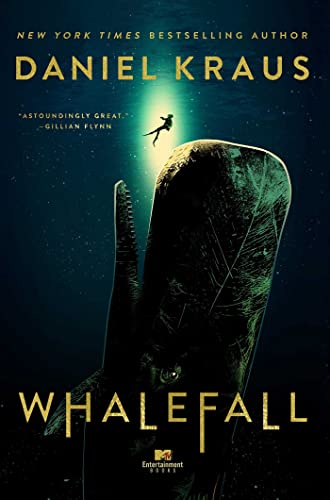
Book Review: Whalefall by Daniel Kraus

Title: Whalefall
Author: Daniel Kraus
Publisher: MTV Books
Publication date: August 8, 2023
Length: 336 pages
Genre: Contemporary fiction
Source: Purchased
Rating:

Rating: 4.5 out of 5.

Whalefall is a scientifically accurate thriller about a scuba diver who’s been swallowed by an eighty-foot, sixty-ton sperm whale and has only one hour to escape before his oxygen runs out.

Jay Gardiner has given himself a fool’s errand—to find the remains of his deceased father in the Pacific Ocean off the coast of Monastery Beach. He knows it’s a long shot, but Jay feels it’s the only way for him to lift the weight of guilt he has carried since his dad’s death by suicide the previous year.

The dive begins well enough, but the sudden appearance of a giant squid puts Jay in very real jeopardy, made infinitely worse by the arrival of a sperm whale looking to feed. Suddenly, Jay is caught in the squid’s tentacles and drawn into the whale’s mouth where he is pulled into the first of its four stomachs. He quickly realizes he has only one hour before his oxygen tanks run out—one hour to defeat his demons and escape the belly of a whale.

I can promise you that you’ve never read a book like Whalefall before! I’ve seen some comparisons to The Martian, and that’s pretty fair… more on that below!

In Whalefall, our protagonist is 17-year-old Jay, a teen wracked by guilt over his fractured relationship with his deceased father. Mitt Gardiner was revered in the Monterey dive community, but as a father, he inspired fear in his son. Mitt’s focus was 100% on the ocean and its mysteries, but his fury at the encroachment of humans and his dissatisfaction with daily life made him a man whose anger and bitterness cost him job after job.

While Jay’s older sisters were mostly immune to Mitt’s moods, Jay spent all his life as the focus of Mitt’s obsessions, forced out on dives from a young age, forced to parrot back Mitt’s teachings and support his ill-thought-out pipe dreams and get-rich-quick schemes. After a terrible confrontation, Jay left home and spent the last years of his father’s life, as Mitt deteriorated due to mesothelioma, living with friends and refusing to see his father.

We learn about Jay’s history and the torturous relationship with Mitt through flashback chapters, interwoven with the “now” of Jay’s story. As the book opens, Jay is heading for Monastery Beach, a dangerous area on Monterey Bay, to search for his father’s remains. Preferring to die at sea than in a hospital bed, Mitt committed suicide there by throwing himself off a boat while loaded down with dive weights. Jay has convinced himself that if he can retrieve Mitt’s bones from the Bay’s floor, he’ll find some sort of peace or redemption.

He definitely doesn’t believe in closure. People aren’t doors. They’re whole floor plans, entire labyrinths, and the harder you try to escape, the more lost inside them you become.

Using shoddy, second-hand gear, Jay heads into the water, at first allowing himself to marvel at the undersea world and its beauty, his father’s words echoing in his mind. Disaster strikes soon enough: Jay ventures across the edge of an undersea canyon that leads to true depths, is awed by the sight of a giant squid, and realizes too late that the squid is being hunted by a sperm whale. Caught up in the squid’s tentacles, Jay is pulled into the whale’s mouth, and then swallowed.

As the chapter headings show us, Jay’s oxygen tank will sustain him for no more than an hour. As each chapter passes, we see the tank’s readings decrease. He’s in a seemingly hopeless situation — how could a small human possibly manage to escape from a whale’s belly? And yet, Jay looks around and determines not to give up… at least, not until he has to.

As the situation deteriorates, and possibly due to the dangerous levels of nitrogen and methane, Jay begins to hear his father’s voice. Is it real? Is it in his mind? Is the whale channeling Mitt? Doesn’t matter — this voice reminds him again and again of incidents from his past, and through these memories, Jay is given hints of knowledge that he can use.

Depending only on what he has with him, as well as the weird flotsam floating in the whale’s stomach, Jay begins to fight a seemingly unwinnable battle to save himself. And little by little, as his father’s voice guides him, Jay begins to find an inner peace with his past as well.

The descriptions in Whalefall are brutal and terrifying. Jay’s body goes through unimaginable degrees of punishment, from acid burns to bone-breaking compression due to the whale’s stomach’s peristalsis, to the painful pressure damage caused by the whale’s sudden dive for the depths. Readers with weak stomachs and/or an inclination toward claustrophobia might want to think twice before starting this book!

So how is the story of a teen inside a whale similar to The Martian, the story of an astronaut stranded on Mars? In both cases, a person in an apparently hopeless, fatal situation finds a way to survive through science, knowledge, and a McGyver-ish ability to take what he has and use it to his advantage. For Jay, that means using neoprene, a squid’s beak, Brillo pads, batteries, and more to create tools, first aid supplies, and other devices necessary to last just a little bit longer and try to find a way out before his air is gone.

While a harrowing tale of danger and escape, Whalefall is also a deeper story of love, regret, and the complicated power of parent-child expectations and disappointments. Mitt is not a nice guy by any means, yet it’s his presence that enables Jay to survive, and as we learn through Jay’s memories, there are kernels of value buried deep in Jay’s subconscious that let him see that life with Mitt wasn’t only the nightmare he remembers.

I first heard about Whalefall thanks to Tammy at Books, Bones & Buffy, who featured it months ago as a Future Fiction pick. Thank you, Tammy! Don’t miss her review, here.

Whalefall is a tense, addictive read that’s impossible to put down once started. I did wish to know more about what happens next at the end, even though I recognize that that’s not the point of the story. (Can’t help that I’m super practical and curious…)

I’m so glad that I decided to read Whalefall. I loved the Monterey setting, the references to Steinbeck, the glimpses of lives devoted to the sea, and the depiction of the power and mystery of whales and other deep-dwelling creature. More than anything, this story of survival and desperation is a look inside a young man’s pain, longing, and regret, and these elements — the personal and the thriller — come together to make a compelling whole. Highly recommended.

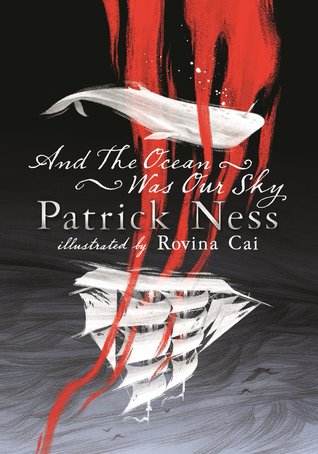
Shelf Control #277: And the Ocean Was Our Sky by Patrick Ness

Shelves final

Welcome to Shelf Control — an original feature created and hosted by Bookshelf Fantasies.

Shelf Control is a weekly celebration of the unread books on our shelves. Pick a book you own but haven’t read, write a post about it (suggestions: include what it’s about, why you want to read it, and when you got it), and link up! For more info on what Shelf Control is all about, check out my introductory post, here.

Want to join in? Shelf Control posts go up every Wednesday. See the guidelines at the bottom of the post, and jump on board!

Title: And the Ocean Was Our Sky
Author: Patrick Ness
Published: 2018
Length: 160 pages

What it’s about (synopsis via Goodreads):

From the #1 New York Times bestselling author of A Monster Calls comes a richly illustrated and lyrical tale, one that asks harrowing questions about power, loyalty, obsession, and the monsters we make of others.

With harpoons strapped to their backs, the proud whales of Bathsheba’s pod live for the hunt, fighting in the ongoing war against the world of men. When they attack a ship bobbing on the surface of the Abyss, they expect to find easy prey. Instead, they find the trail of a myth, a monster, perhaps the devil himself…

As their relentless Captain leads the chase, they embark on a final, vengeful hunt, one that will forever change the worlds of both whales and men.

With the lush, atmospheric art of Rovina Cai woven in throughout, this remarkable work by Patrick Ness turns the familiar tale of Moby Dick upside down and tells a story all its own with epic triumph and devastating fate.

How and when I got it:

I treated myself to the hardcover edition when it was released in 2018.

Why I want to read it:

I’ve read several Patrick Ness books by now, but not nearly enough! I think I have at least two more of his books sitting on my shelf, still to be read (maybe future Shelf Control books?). I was drawn to this book for a few reasons:

  1. I’ve never not liked Patrick Ness’s writing, even if the book’s main topic isn’t of huge interest to me. Can’t say I’ve ever been let down.
  2. It’s illustrated by Rovina Cai! She also does the illustrations for Seanan McGuire’s Wayward Children books, and I love her artwork.
  3. I’ve seen this book described as telling the story of Moby Dick from the whale’s perspective, and what’s not to love about that?? I actually read Moby Dick a few years ago (yes, really), and I think experiencing an “upside down” version of the story would be fascinating.

I really do intend to read this book soon… or as soon as I can remember which shelf I left it on, last time I came across it.

PS – The opening line of this book is:

Call me Bathsheba.

How awesome is that?

What do you think? Would you read this book?

Please share your thoughts!


__________________________________

Want to participate in Shelf Control? Here’s how:

  • Write a blog post about a book that you own that you haven’t read yet.
  • Add your link in the comments or link back from your own post, so I can add you to the participant list.
  • Check out other posts, and…

Have fun!

Through affiliate programs, I may earn commissions from purchases made when you click through these links, at no cost to you.

Buy now: Amazon – Book Depository – Bookshop.org

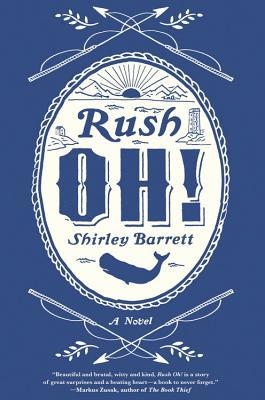
Take A Peek Book Review: Rush Oh! by Shirley Barrett

“Take a Peek” book reviews are short and (possibly) sweet, keeping the commentary brief and providing a little peek at what the book’s about and what I thought.

Rush Oh

Synopsis:

(via Goodreads)

An impassioned, charming, and hilarious debut novel about a young woman’s coming-of-age, during one of the harshest whaling seasons in the history of New South Wales.

1908: It’s the year that proves to be life-changing for our teenage narrator, Mary Davidson, tasked with providing support to her father’s boisterous whaling crews while caring for five brothers and sisters in the wake of their mother’s death. But when the handsome John Beck — a former Methodist preacher turned novice whaler with a mysterious past — arrives at the Davidson’s door pleading to join her father’s crews, suddenly Mary’s world is upended.

As her family struggles to survive the scarcity of whales and the vagaries of weather, and as she navigates sibling rivalries and an all-consuming first love for the newcomer John, nineteen-year-old Mary will soon discover a darker side to these men who hunt the seas, and the truth of her place among them.

Swinging from Mary’s own hopes and disappointments to the challenges that have beset her family’s whaling operation, RUSH OH! is an enchanting blend of fact and fiction that’s as much the story of its gutsy narrator’s coming-of-age as it is the celebration of an extraordinary episode in history.


My Thoughts:

If you’d asked me a few weeks ago whether I’d be interested in reading a book about whaling in Australia in the early 1900s, well… let’s just say the odds wouldn’t be in favor of a yes.

So I’m completely delighted to report that Rush Oh! is an awesome, funny, moving, and highly enjoyable read!

The historical elements are amazing, even more so after reading the author’s notes and discovering that the Davidsons were a real family, and that the snippets of breathless newspaper coverage about the whaling crews and their captain are all taken from the actual newspaper accounts of the time.

At times, Rush Oh! has an almost Austen-esque feel to it. Narrator Mary has a somewhat distorted view of her own talents and attractions, so her telling of the story is full of her own little oddities and self-flatteries. At the same time, she bears witness to her father’s fearless leadership and nobility — which comes through even in the most brutal moments of a whale hunt.

The whale hunts themselves are sometimes harrowing and sometimes humorous. The whaling crews of Twofold Bay are assisted by a pod of Killers (orcas), who corral the humpbacks and other whales that wander into the bay, acting with viciousness as well as playfulness, almost like water-dwelling sheepdogs. The Killers are looked on fondly by the townsfolk, each known by name and personality, and seem to have almost celebrity status. What’s really amazing is that these Killers really were a part of the history of Eden in New South Wales, just as described and with the names used in the novel — Tom, the leader, and his cohorts including Hooky, Humpy, and more.

Sounds weird, doesn’t it? But trust me — Rush Oh! is a pure delight to read. Mary’s narration is so funny and quirky, the story of the whaling crew is completely engaging, and the local customs and gossip really are straight out of a comedy of manners. I gobbled up this book in one day, but I think I’ll need to come back to it and savor it again more slowly.

_________________________________________

The details:

Title: Rush Oh!
Author: Shirley Barrett
Publisher: Little, Brown and Company
Publication date: March 22, 2016
Length: 368 pages
Genre: Fantasy/contemporary/adult
Source: Review copy courtesy of the publisher via NetGalley