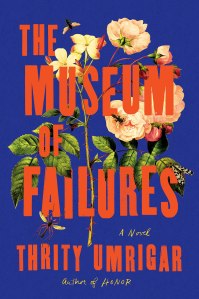
Title: The Museum of Failures
Author: Thrity Umrigar
Publisher: Algonquin Books
Publication date: September 26, 2023
Length: 358 pages
Genre: Contemporary fiction
Source: Purchased
Rating:
An immersive story about family secrets and the power of forgiveness from the bestselling author of Reese’s Book Club pick, Honor
When Remy Wadia left India for the United States, he carried his resentment of his cold and inscrutable mother with him and has kept his distance from her. Years later, he returns to Bombay, planning to adopt a baby from a young pregnant girl—and to see his elderly mother again before it is too late. She is in the hospital, has stopped talking, and seems to have given up on life.
Struck with guilt for not realizing just how ill she had become, Remy devotes himself to helping her recover and return home. But one day in her apartment he comes upon an old photograph that demands explanation. As shocking family secrets surface, Remy finds himself reevaluating his entire childhood and his relationship to his parents, just as he is on the cusp of becoming a parent himself. Can Remy learn to forgive others for their human frailties, or is he too wedded to his sorrow and anger over his parents’ long-ago decisions?
Surprising, devastating, and ultimately a story of redemption and healing still possible between a mother and son, The Museum of Failures is a tour de force from one of our most elegant storytellers about the mixed bag of love and regret. It is also, above all, a much-needed reminder that forgiveness comes from empathy for others.
The Museum of Failures is an emotional story of family secrets and redemption, with a painful mother-son relationship as its driving force.
Remy was raised in affluence in Bombay by a loving father and cold, unpredictable, cruel mother. After attending college in the US, he stayed, married a lovely woman, and built a life for himself. As the story opens, Remy returns to India for the first time since his father’s death three years earlier. His closest friends have arranged for him and his wife to adopt their unwed niece’s baby. Despite his mixed feelings and negative associations with Bombay, he and Kathy are eager to finally start a family of their own after years of fertility struggles.
Remy is initially repelled by the noise and crowds and intensity of Bombay. His trip appears to be headed for failure when the adoption seems doubtful. To make things worse, Remy’s obligatory visit to see his mother leads to a shocking discovery: She’s been neglected by the caretakers he hired, her living conditions are in disrepair, and she’s in the hospital in serious condition, no longer eating or speaking. Although he’s tried for years to keep as much distance as possible between himself and his mother, his sense of filial duty requires him to care for her during this health crisis and try to help her get better.
As Remy spends time with his mother, she seems to slowly find a new will to live. He discovers cracks in his memories — occasionally snippets of happy moments with a woman he remembers as consistently harsh and unloving. Ultimately, Remy stumbles upon a secret that upends his belief about his upbringing and parents — he discovers that what he remembers and what was actually true are two quite different stories. The family secret is explosive, and changes everything Remy once believed.
The Museum of Failures is a moving story of the damage done within families, the sacrifices parents make, and the lifelong impact of secrets. It’s also a portrait of Remy’s community within Indian society. For a reader previously unfamiliar with the Parsi community, it was a fascinating look at the culture and traditions of this small, tightly-knit segment of the Indian population. Additionally, The Museum of Failures presents a visceral portrait of life in Bombay, from the luxurious dwellings of the wealthy to the neglected and disreputable areas inhabited by the poor and lower castes.
The Museum of Failures is a much more personal story than the author’s previous book, Honor, which takes on oppressive societal structures and cultural differences and the horrible conditions of women’s lives in patriarchal villages. The focus here is on Remy and his family, who in many ways live a very privileged, comfortable life — and yet it’s clear that the pressures of the greater society in which they live have a strong influence on the trauma that pervades their experience.
Ultimately, The Museum of Failures conveys grace and forgiveness through Remy’s journey. The unraveling of secrets allows him to come to terms with his childhood and forge new connections as an adult. The reconciliation with his mother is only possible once the secrets between them are exposed and processed. It’s quite beautiful to see the emotional journey of mother and son, and while many parts of their story are painful, we end on a note of hope.
The Museum of Failures is an emotionally rich story that centers family dynamics within a great societal context. The storytelling feels personal, yet includes beautifully evocative descriptions of the sights, sounds, smells, and flavors of its setting. With well-drawn characters and a skillfully developed plot, this book conveys an intimate story that’s also a page-turner. Highly recommended.


 Bookshelf Fantasies